TIP3P vs TIP4P, NVT vs NPT, Gaussian vs ORCA
Three simulation choices that look like labels and change the numbers

Matic Broz, PhD13 min
What each of these choices decides
TIP3P and TIP4P are water models with three and four interaction sites, NVT and NPT are the constant-volume and constant-pressure ensembles, and Gaussian and ORCA are two quantum chemistry programs. Only the first and last pairs are real alternatives; NVT and NPT are two stages of one run. In each case the label hides a detail that moves the numbers more than the label does.
Take water. At 298 K and 1 bar, TIP3P gives a density of 0.980 g/cm³ against 0.997 measured, and it lets water diffuse at 5.5 × 10⁻⁹ m²/s against a measured 2.3, about 2.4 times too fast.[1] Pack a box at the measured density and hold its volume, and that density gap alone puts TIP3P water at about 300 bar.
Take B3LYP. Gaussian and ORCA both offer it, yet we computed a difference of 41.6 kcal/mol in the total energy of methanol between the two definitions of the functional, while the energy of the reaction methanol → formaldehyde + H₂ moved by only 0.17.
The water model is part of the force field, the ensemble is a sequence, and the program is a bundle of defaults. The first two are tied together through the density of the box; the third shares only the lesson that a label is not a setting.
 OpenMMPick the water model and barostat for AMBER or CHARMM36 systems and compare the results.Open tool
Why TIP3P and TIP4P are not interchangeable
TIP3P, from Jorgensen and colleagues in 1983, puts a partial charge on the oxygen and on each of the two hydrogens, three sites in all.[2] The TIP4P family moves the oxygen's negative charge to a fourth, massless site on the bisector of the H-O-H angle, 0.125 Å from the oxygen in TIP4P-Ew.[3] Both keep the gas-phase geometry of a water molecule, an O-H length of 0.9572 Å and an H-O-H angle of 104.52°.[2]
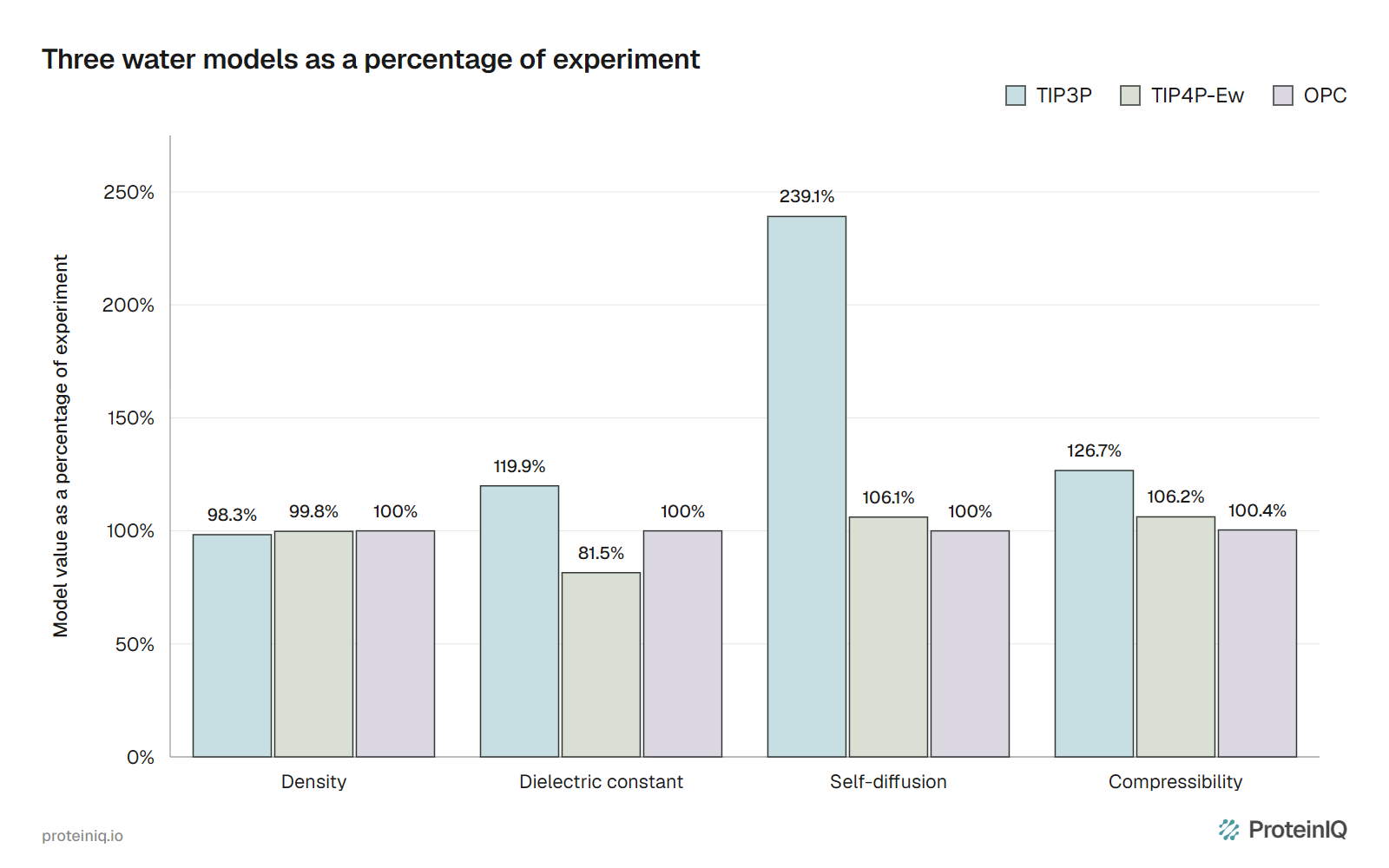
Izadi and colleagues tabulated how far each model's bulk properties sit from experiment at 298.16 K and 1 bar.[1] TIP3P misses on all four properties in Figure 1, and on more: its dielectric constant is 94 against 78.4, its isothermal compressibility is 57.4 against 45.3 × 10⁻⁶ bar⁻¹, and its temperature of maximum density is 182 K against 277 K, 95 K too low.
TIP4P-Ew gets the density and the density maximum right, 0.995 g/cm³ and 276 K, but its dielectric constant is 63.9, 18.5% low.[1][3] The four-site TIP4P/2005 also puts the density maximum at 278 K.[4] OPC, the four-site model Izadi and colleagues introduced, is within half a percent of experiment on all four.[1]
A model that matches experiment better is not automatically the better choice for a protein, because a protein force field is parameterized against one water. The AMBER and CHARMM families were fitted with TIP3P or a variant of it, so swapping the water in a TIP3P-era force field changes the balance of protein-water and protein-protein interactions that was tuned together.
The pairing can run the other way. The authors of ff19SB, a newer AMBER protein force field, recommend using it with the four-site OPC water.[6] Piana and colleagues found that common water models underestimate London dispersion and make disordered protein states too compact; TIP4P-D, a four-site model with stronger dispersion, gave more expanded states that agree better with experiment.[5]
Four sites also cost compute. On ProteinIQ's GROMACS tool, TIP4P and TIP4P-Ew run about half as fast as TIP3P, which halves the nanoseconds a budget buys.
Use the water model your force field was built for, or the one its authors name, as with ff19SB and OPC, and treat any other choice as a change of force field that needs its own validation. The test for a switch is not whether the water looks better in Figure 1 but whether a protein property you care about, such as the compactness of a disordered region, moves closer to experiment.
NVT and NPT run in sequence
NVT holds the number of atoms, the volume and the temperature fixed. NPT holds the pressure instead of the volume, so the box breathes. A standard setup in any of the common molecular dynamics engines runs them in order: NVT with a fixed box to bring the temperature to its target, then NPT to let the box find its density, then production in whichever ensemble suits the question.
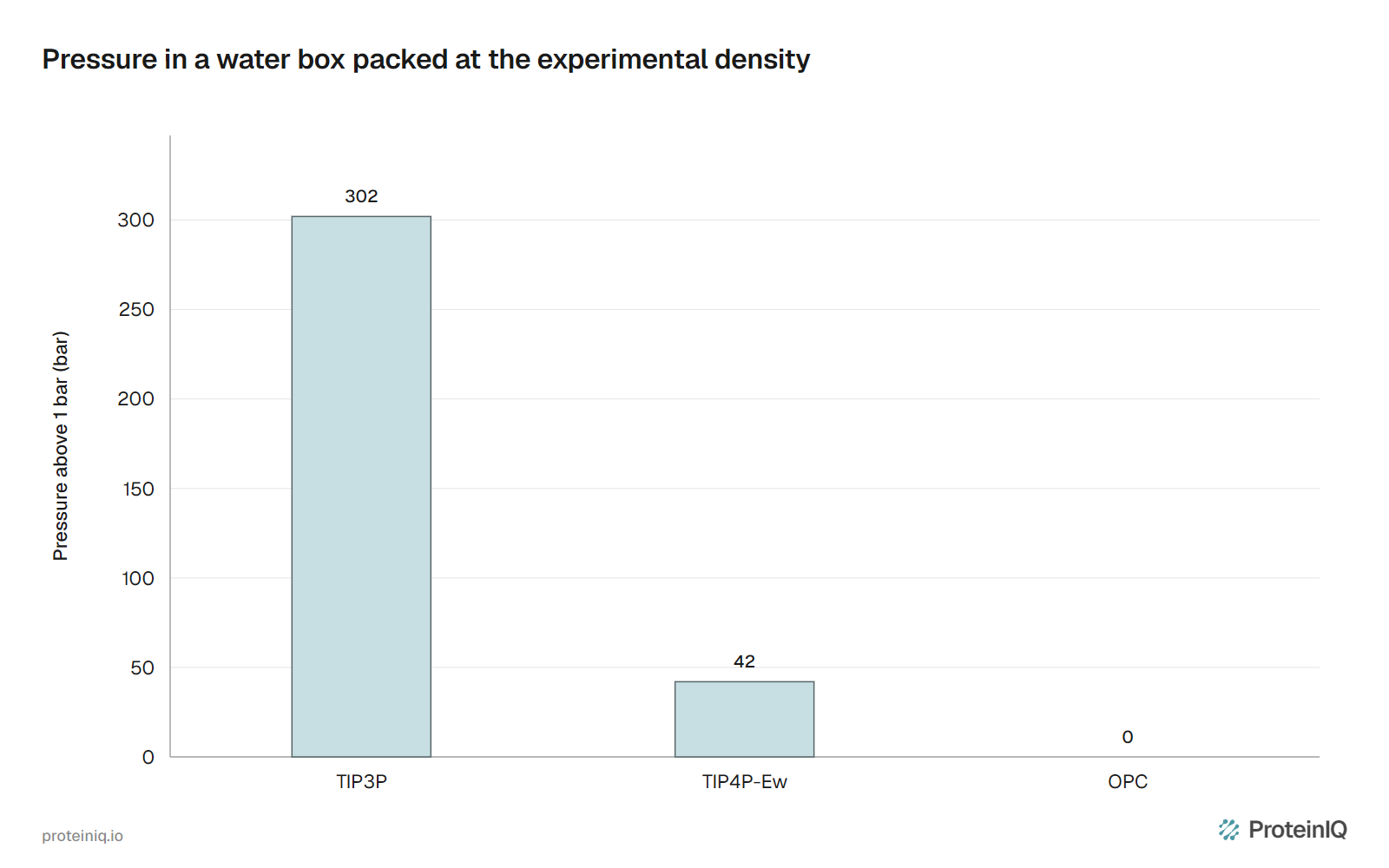
The real question is which ensemble production runs in, and that depends on whether the box already has the volume the water model wants. A freshly built box usually does not. Suppose one is packed at the experimental density of 0.997 g/cm³ and held there. The pressure it reports is set by how far that density sits from the model's own, through the compressibility :
For TIP3P, with = 0.980 g/cm³ and = 57.4 × 10⁻⁶ bar⁻¹, that is about 300 bar. TIP4P-Ew comes out near 40 bar and OPC near zero (Figure 2).
A fixed-volume run in the TIP3P box does not sample 1 bar. It samples whatever pressure its volume implies, and every pressure-dependent property inherits the error. An NPT stage removes the mismatch, because the box relaxes until its density is the model's own.
Pressure coupling itself barely touches the energy. A box of 100,000 ų, roughly 3,300 waters, fluctuates in volume with a relative standard deviation of , which is 0.49% for TIP3P at 298 K, or about 490 ų.
At 1 bar that swing is worth = 0.007 kcal/mol, one eighty-fifth of (0.59 kcal/mol); we calculated both from the standard fluctuation formula and TIP3P's compressibility.[1] NPT changes which volumes the system may visit, not the energy bookkeeping.
What matters more is the barostat that does the coupling. Bernetti and Bussi showed that the Berendsen barostat gives incorrect volume fluctuations, while their stochastic cell rescaling samples the correct ones and can be used in both equilibration and production.[7]
GROMACS says the same in its own words: Berendsen "does not yield a correct thermodynamic ensemble" and the authors strongly recommend against it for new simulations, C-rescale can be used for equilibration and production, and Parrinello-Rahman can oscillate badly if it starts far from the target pressure.[8]
A common recipe, and the one ProteinIQ's GROMACS tool follows, is C-rescale during equilibration and Parrinello-Rahman in production. The Monte Carlo barostat in OpenMM takes a different route: it scales the box vectors and each molecule's center and tunes its step size toward about 50% acceptance.[9]
Production in NVT is a sound choice when the box has already relaxed in NPT and the method needs a fixed cell. It is not a way around the relaxation. The check is cheap: plot the density through the NPT stage and start production only after it levels off near the water model's own value, which is about 0.98 g/cm³ for TIP3P.
Gaussian and ORCA define B3LYP differently
Both programs run density functional theory, and both write B3LYP in the input. Gaussian is a commercial product with separate academic and commercial price lists.[15] ORCA is free for academic use under its license agreement, which excludes commercial use.[14] Price is the visible difference. The differences that change a result sit in the defaults.
The best-known case is B3LYP itself. The ORCA manual calls the different implementation of B3LYP in ORCA and Gaussian "a prominent example": Gaussian's B3LYP uses the VWN III form of the local correlation functional, while ORCA's !B3LYP uses VWN V, consistent with TURBOMOLE.[10][12] Adding /G to the keyword, !B3LYP/G, gives ORCA the Gaussian definition.[10]
We measured what that costs. Using PySCF 2.15.0,[16] which carries both definitions, we ran B3LYP/6-31G* on fixed geometries of water, methanol, formaldehyde, hydrogen and the water dimer, once with VWN III and once with VWN V.
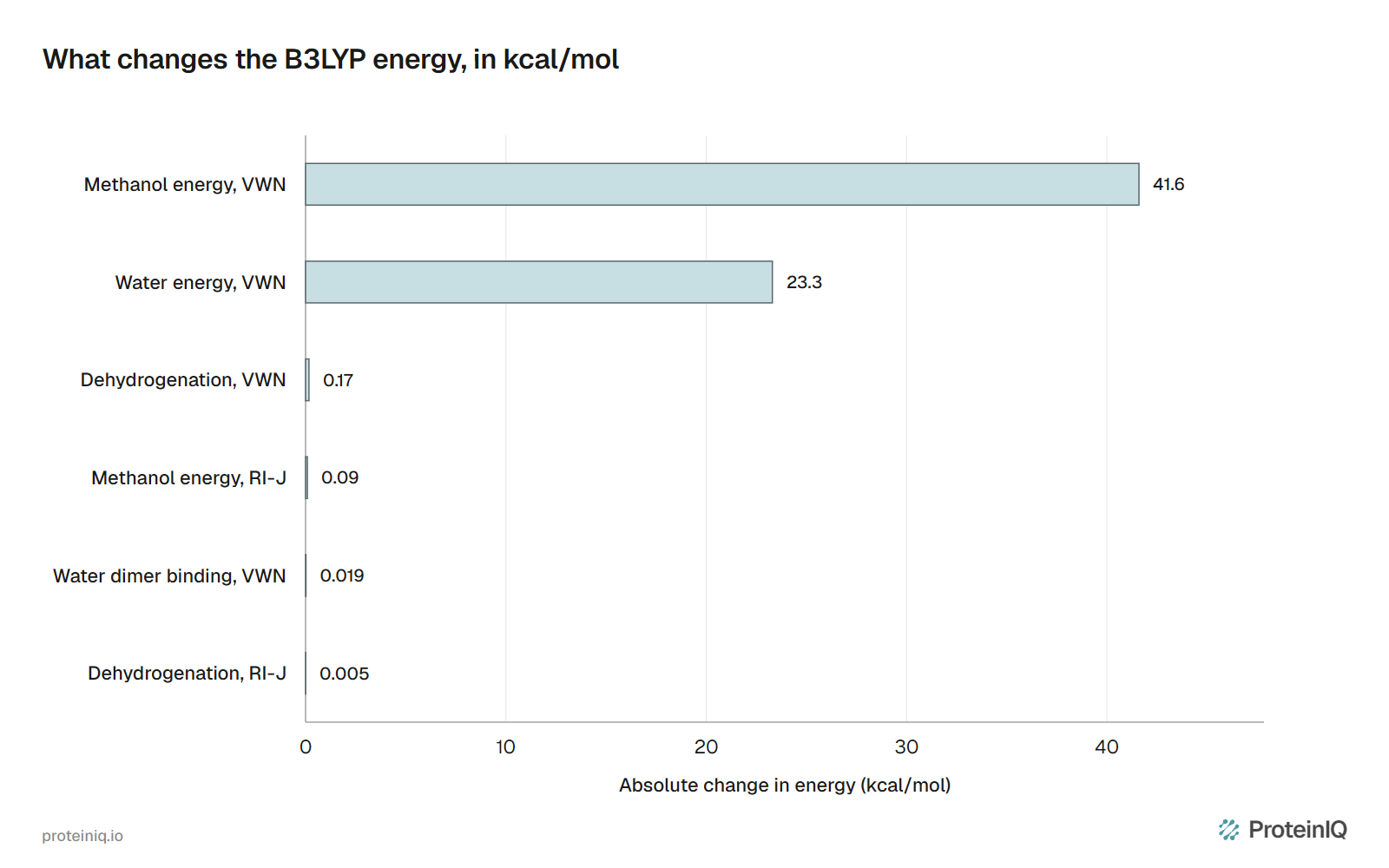
The total energy of methanol differs by 41.6 kcal/mol, and that of water by 23.3. Differences between molecules mostly cancel: methanol losing H₂ to give formaldehyde changes by 0.17 kcal/mol, and the binding energy of the water dimer by 0.019.
We ran the two definitions in one program, so these numbers isolate the functional, not the two programs' other defaults, and those differ too. Gaussian's default integration grid is UltraFine, a pruned grid of 99 radial and 590 angular points per atom,[13] while ORCA 6.1 uses its DefGrid2 setting, in which the SCF exchange-correlation grid takes its angular points from Lebedev 302.[11]
ORCA's simple input also switches on resolution-of-the-identity approximations for the Coulomb term (RI, and RIJCOSX for hybrid functionals) once a functional is named.[10] Density fitting of the Coulomb term is small next to the VWN question (Figure 3): in our calculation it moved the total energy of methanol by 0.09 kcal/mol and the dehydrogenation energy by 0.005.
An absolute energy from one program cannot be put next to the same-named energy from the other, even with matching basis sets. Energy differences between similar molecules mostly transfer, but the 0.17 kcal/mol in our reaction is not zero, and a small difference that decides a ranking can sit inside it.
Neither program is wrong; they answer slightly different questions under one name. Write down the functional with its correlation form, the basis set, grid, dispersion correction, integral approximations and program version, so that a reader can tell which calculation you ran.
What to check before you compare
Each of the three labels has a quick test that turns it from a name into a measurement, and Table 1 lists them.
| Comparison | What the label hides | Sign of trouble | Cheap check |
|---|---|---|---|
| TIP3P vs TIP4P | The water was tuned together with the protein force field | A mixed pairing, or a disordered region that is too compact | Use the force field's own water, or its authors' stated partner, and compare one observable with experiment |
| NVT vs NPT | The box volume came from the builder, not the model | Pressure far from 1 bar in an NVT run (about 300 bar for TIP3P at 0.997 g/cm³) | Run NPT first, check that density levels off, use C-rescale or Parrinello-Rahman rather than Berendsen |
| Gaussian vs ORCA | Functional definition, grid and integral approximations | Total energies from two programs that differ by tens of kcal/mol | Compare energy differences from one setup, or use !B3LYP/G and matching grids when you must cross programs |
When a result looks off by a suspicious amount, look first at the water model's own density, the pressure your box volume implies and the exact form of the functional. Each is set by a choice made before the run, and none shows up in the label.
Molecular dynamics and quantum chemistry tools on ProteinIQ
ProteinIQ runs molecular dynamics with two engines, from preparation through equilibration to production. A quantum calculation sits outside that chain, and ProteinIQ does not host Gaussian or ORCA.
- OpenMM: molecular dynamics for AMBER and CHARMM36 systems, with a selectable water model (TIP3P-FB by default for AMBER, OPC and TIP4P-Ew among the options) and a selectable barostat
- GROMACS: NVT then NPT equilibration, with C-rescale, followed by production with Parrinello-Rahman and TIP3P by default
- AIMNet2: neural-network energies and forces for small molecules, when a full quantum calculation would be too slow for the question

Frequently asked questions
Is TIP4P better than TIP3P?
It matches real water more closely. At 298 K and 1 bar, TIP3P's self-diffusion is about 2.4 times the measured value and its density maximum sits 95 K too low, while TIP4P-Ew gets the density and the density maximum right.[1] Better water does not guarantee better protein results, because force fields are parameterized with a particular water. Use the model your force field was built for.[6]
Which water model goes with which force field?
AMBER force fields were developed with TIP3P and variants of it, and CHARMM uses a modified TIP3P. The authors of the newer ff19SB recommend OPC instead.[6] ProteinIQ's OpenMM tool picks TIP3P-FB for AMBER and CHARMM-modified TIP3P for CHARMM36 automatically, and lets you choose another.
Do I need NVT before NPT?
Most protocols run NVT first and NPT second. The NVT stage brings the temperature to its target in a box that cannot change, and the NPT stage lets the box relax to the water model's density. A fixed box that does not match that density reports a pressure that can be hundreds of bar off, about 300 bar for TIP3P at the experimental density.[1]
Which barostat should I use?
Avoid Berendsen: it gives incorrect volume fluctuations.[7] GROMACS recommends C-rescale for equilibration or production and Parrinello-Rahman for production, and warns that Parrinello-Rahman can oscillate if the pressure starts far from the target.[8] OpenMM uses a Monte Carlo barostat.[9]
Do Gaussian and ORCA give the same B3LYP energy?
Not by default. Gaussian's B3LYP uses VWN III and ORCA's uses VWN V, and ORCA's !B3LYP/G reproduces the Gaussian definition.[10][12] At B3LYP/6-31G* we calculated a 41.6 kcal/mol gap in the total energy of methanol, but only 0.17 kcal/mol in the methanol dehydrogenation energy.
Is ORCA free, and is Gaussian paid?
ORCA is free for academic use, and its license agreement excludes commercial use.[14] Gaussian is sold commercially, with separate academic and commercial pricing.[15]