The best free molecular dynamics software in 2026
Which simulation engine to use, and when paying for one still makes sense

Matic Broz, PhD14 min
Molecular dynamics is a field where the free software is the standard. GROMACS, the engine behind a large share of published protein simulations, is open source and free for companies too. AMBER, NAMD and OpenMM are free for academic work, and most of them run faster on a gaming GPU than the clusters of ten years ago did. Schrödinger's Desmond is the main commercial engine, and plenty of pharmaceutical groups still never touch it.
The choice that matters is less about speed than about everything around it. Each engine comes with its own force fields, file formats, setup tools and community, and switching halfway through a project means rebuilding the system. A ligand that takes ten minutes to parameterize in one ecosystem can take a day in another.
ProteinIQ runs GROMACS and OpenMM in the browser, so read our enthusiasm for those two with that in mind. All five engines below are free to download whichever way you run them.
The best free molecular dynamics software
- GROMACS for everyday protein simulations on any GPU
- AMBER for the Amber force fields and ligand parameterization in one package
- OpenMM for scripting custom simulations and machine-learning potentials
- NAMD for very large systems and CHARMM-based workflows
- LAMMPS for materials, polymers and coarse-grained models
And Desmond, for the groups where paying still makes sense.
What makes good molecular dynamics software?
An MD engine integrates Newton's equations for every atom, a few femtoseconds at a time, using a force field to compute the forces. Speed decides how much sampling you get, so we compared nanoseconds per day on the same standard systems where the developers publish them: dihydrofolate reductase in water (DHFR, 23,558 atoms) and satellite tobacco mosaic virus (STMV, about 1.07 million atoms).
Speed is only half of it. We also judged each engine on its force fields, how hard it is to build a system with a ligand or membrane, which GPUs it supports, and its license, because several of these are free only for non-commercial use. Versions, licenses and prices were checked on each project's site on November 3, 2026.
We left out engines without a release in recent years, programs that are free only as a trial, and tools that solve a neighbouring problem. Quantum chemistry codes that run ab initio MD and generative models such as BioEmu-2, which sample conformations without simulating time, are covered under other options at the end.
The best molecular dynamics software at a glance
| Engine | Best for | GPU support | Biggest gap | License |
|---|---|---|---|---|
| Desmond | Industrial workflows inside Maestro | NVIDIA only | Price; Linux only | Commercial, quote only; free for academics on request |
| GROMACS | Everyday protein simulations | NVIDIA, AMD, Intel | Ligand parameters come from other tools | LGPL 2.1, free for everyone |
| AMBER | Amber force fields and ligand setup | NVIDIA; AMD optional | $25,000 per site for companies | Free for non-commercial use; AmberTools free for all |
| OpenMM | Custom methods and ML potentials | NVIDIA, AMD, Apple via OpenCL | No interface beyond Python | MIT and LGPL, free for everyone |
| NAMD | Very large systems | NVIDIA, AMD | Non-commercial license; setup through VMD | Free for academic and internal use |
| LAMMPS | Materials and coarse-grained models | NVIDIA, AMD, Intel | Awkward for proteins and ligands | GPL 2.0, free for everyone |
The commercial standard for molecular dynamics
Desmond (Linux)
Desmond pros:
- Built into Maestro, so system setup, OPLS parameters, FEP+ and analysis share one interface
- Among the fastest single-GPU engines on the DHFR benchmark
Desmond cons:
- Linux and NVIDIA GPUs only, with no published commercial price
Desmond was written at D. E. Shaw Research and is sold commercially by Schrödinger.[16] Its appeal in industry is the workflow rather than the integrator: the same Maestro session prepares the protein, assigns OPLS parameters to a ligand and hands the system to free energy perturbation, which is where most companies spend their Desmond time.
It is also fast. In D. E. Shaw Research's own 2021 report, Desmond ran DHFR at 2,028 ns/day on an A100 with a 4 fs timestep, though with its own electrostatics method and cutoffs, so the figure only roughly compares with the others below.[18] Academic and non-profit researchers can still get the D. E. Shaw Research build at no cost; the download page now asks you to request it by email.[17]
Desmond price: Quote only, from Schrödinger. Free for academic and non-profit use from D. E. Shaw Research.
Best free molecular dynamics software for protein simulations
Most MD projects simulate a protein, sometimes with a ligand or a membrane, in water for nanoseconds to microseconds. GROMACS and AMBER are the two engines most of that work runs on. GROMACS is free for everyone and runs on any vendor's GPU; AMBER bundles the force fields and the ligand tools that many GROMACS users borrow anyway.
GROMACS (Windows, macOS, Linux, web)
GROMACS pros:
- Free for every use, including commercial, and runs on NVIDIA, AMD and Intel GPUs
- Ships most standard analyses (RMSD, RMSF, hydrogen bonds, free energy) as built-in commands
GROMACS cons:
- Small-molecule parameters have to come from other tools such as ACPYPE or CGenFF
GROMACS started at the University of Groningen and is now developed mainly at KTH and Uppsala University in Sweden.[1] It is the most widely used engine for biomolecular simulation, partly because it is free without conditions and partly because it runs well on almost any hardware: CUDA on NVIDIA, SYCL on Intel and AMD, and a HIP backend for AMD that became fully supported in the 2026 release. The current version is 2026.4, from October 2026.[2]
On hardware, an independent benchmark by the Erlangen computing centre measured GROMACS 2024.1 at 472 ns/day for an 80,289-atom membrane protein on an L40S and 400 ns/day on an H100.[3] Those figures don't line up with the 4 fs numbers developers publish for AMBER and OpenMM, because the timestep isn't stated and a 4 fs timestep with heavier hydrogens roughly doubles nanoseconds per day.
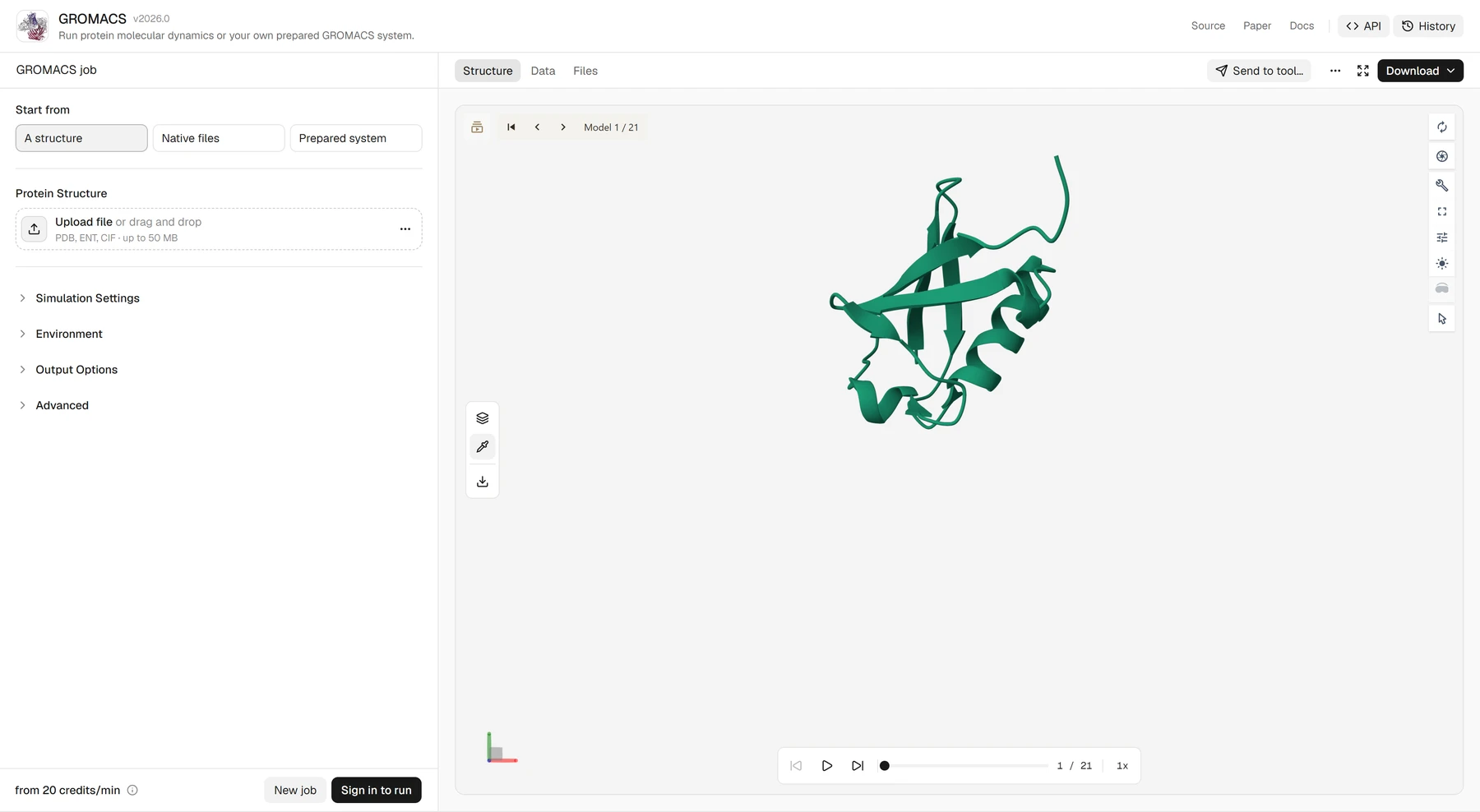
Locally, a run is a chain of command-line steps: pdb2gmx for the topology, solvate and genion for water and ions, then minimization, NVT and NPT equilibration and production. On ProteinIQ, GROMACS 2026.0 does those steps from a PDB file or an RCSB ID. The ubiquitin run above (PDB 1UBQ) finished 1 ns in just over three minutes, with RMSD, RMSF, radius of gyration and secondary structure computed for every frame. Parameterized ligands go in as native GROMACS files built elsewhere.
GROMACS price: Free and open source under LGPL 2.1. On ProteinIQ, runs are billed per second at 20 credits a minute on an A10G GPU, or 45 on the L40S that large systems use; the run above cost 63 credits. A free account starts with 200 credits and gets 100 a month.
AMBER (Linux, macOS)
AMBER pros:
- Home of the ff19SB and GAFF2 force fields, with antechamber to parameterize ligands
- pmemd.cuda is one of the fastest single-GPU engines for explicit-solvent proteins
AMBER cons:
- Companies pay $25,000 per site for pmemd, and one simulation runs on one GPU
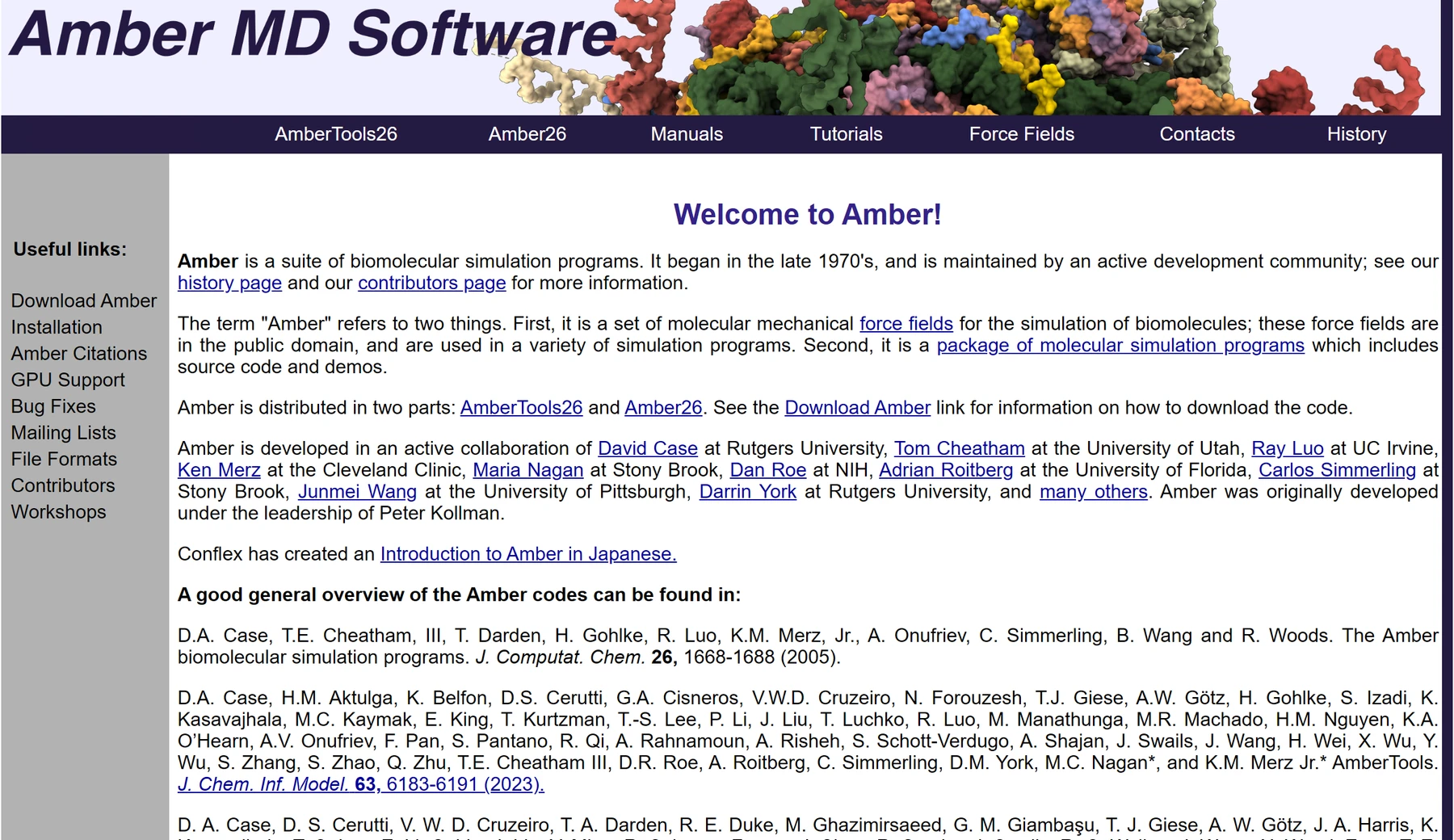
AMBER is two things: a family of force fields used far beyond AMBER itself, and a simulation package developed across Rutgers, Utah, UC Irvine, Pittsburgh and other groups. It is split in two. AmberTools26 holds the setup and analysis programs (tleap, antechamber, cpptraj, MMPBSA.py) and the slower sander engine, and is free for everyone; it has been on conda-forge since July 2026.[7][4]
Amber26 adds pmemd and its GPU version, pmemd.cuda. There is no fee for academic, non-profit or government use, while for-profit users pay $25,000 per site for a new license.[4] On the developers' benchmark page, pmemd.cuda runs DHFR at 1,425 ns/day on an H100 and the 1.07-million-atom STMV system at 70 ns/day, both with a 4 fs timestep.[5][6]
The case for AMBER is ligand work. Antechamber assigns GAFF2 parameters and AM1-BCC charges to a small molecule in one command, and that output is what many GROMACS and OpenMM users convert and import. The same parameters feed binding free energy estimates such as MM/PBSA and MM/GBSA, which ProteinIQ runs through gmx_MMPBSA on GROMACS trajectories.
AMBER price: AmberTools is free and open source. Amber26 is free for non-commercial use; commercial licenses cost $25,000 per site.
Best free molecular dynamics software for custom methods and ML potentials
OpenMM (Windows, macOS, Linux, web)
OpenMM pros:
- Every part of a simulation is a Python object, so new forces and integrators need no recompiling
- Runs machine-learning potentials such as ANI and MACE alongside a classical force field
OpenMM cons:
- No command-line workflow or interface of its own; setup and analysis are code you write
OpenMM began at Stanford and is now maintained by Peter Eastman with contributors from John Chodera's lab and others. It is a library rather than a program: you build the system, choose the integrator and write the loop in Python. That makes it the usual choice for methods work, from custom restraints to alchemical free energy packages such as OpenFE that are built on it.
OpenMM 8 added an interface for machine-learning potentials, so part of a system, a ligand for example, can be modelled by a neural network trained on quantum chemistry while the rest uses a classical force field.[8]
On the developers' benchmarks, OpenMM 8.6 runs DHFR at 1,734 ns/day on an H100 and STMV at 70.5 ns/day, also with a 4 fs timestep.[9] It supports CUDA, HIP for AMD, and OpenCL, which is also how it runs on Apple silicon. The current release is 8.6.1, from September 2026.[10]
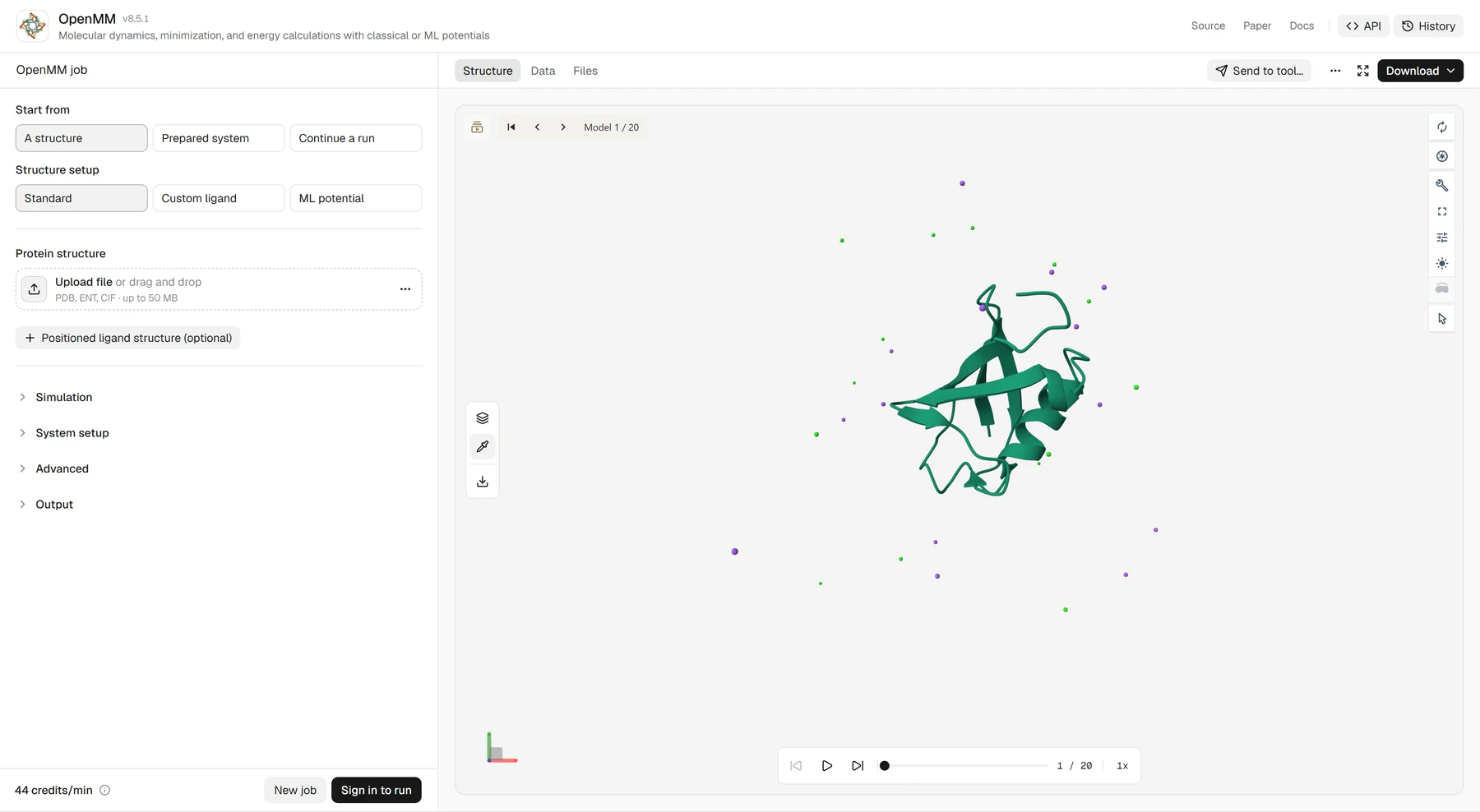
On ProteinIQ, OpenMM 8.5.1 runs without any code: a standard protein run, a positioned ligand parameterized with OpenFF, an ML potential, or a run continued from a checkpoint. It also adds well-tempered metadynamics and simulated tempering for enhanced sampling. The ubiquitin run above took a little over three minutes.
OpenMM price: Free and open source under the MIT and LGPL licenses. On ProteinIQ, runs are billed per second at 44 credits a minute on an L40S GPU; the run above cost 143 credits.
Best free molecular dynamics software for very large systems
NAMD (Windows, macOS, Linux)
NAMD pros:
- Scales from one GPU to hundreds of thousands of CPU cores for systems of hundreds of millions of atoms
- Built around VMD and the CHARMM force fields, with the Colvars module for biased simulations
NAMD cons:
- Its license covers academic and internal use only, and system setup runs through VMD and psfgen
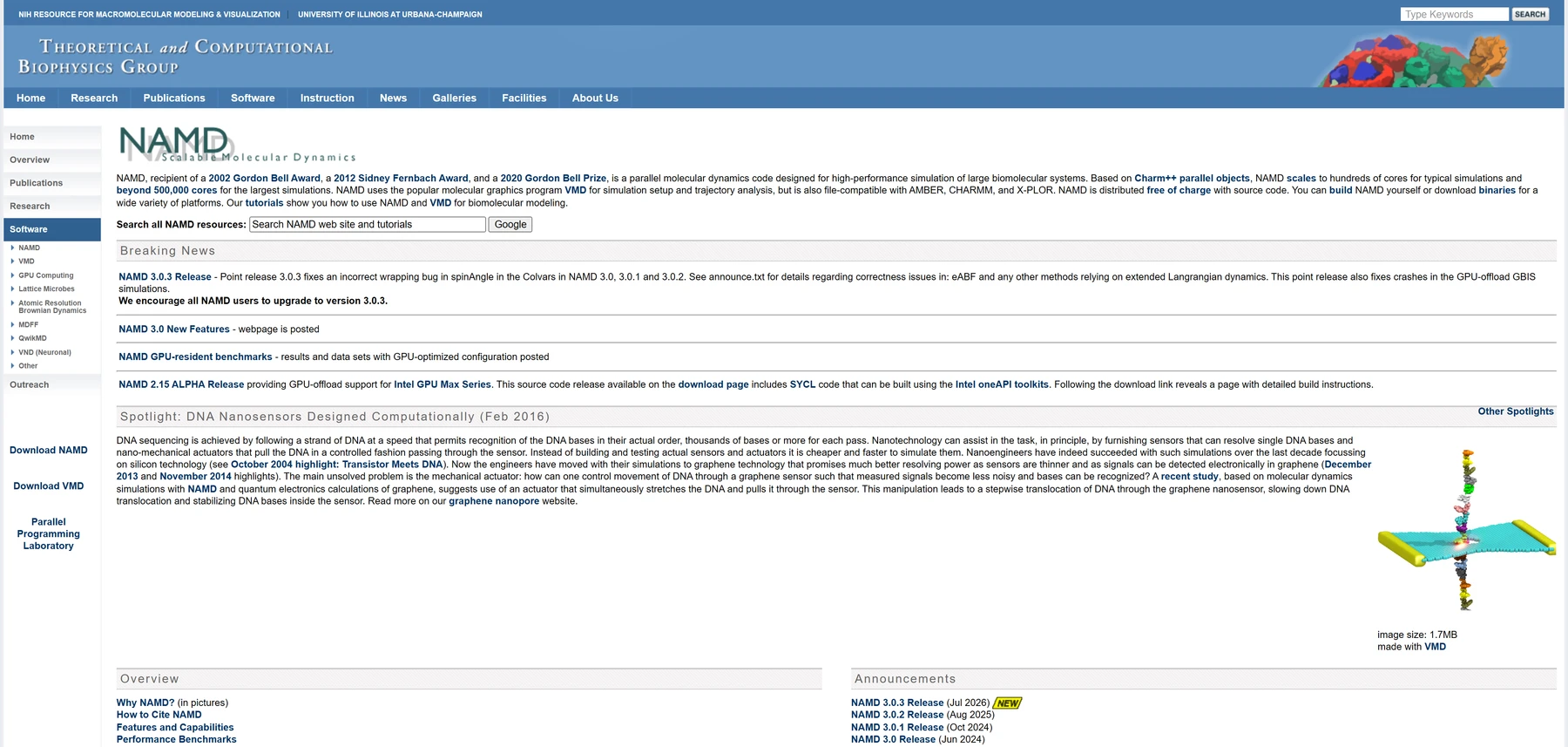
NAMD comes from the Theoretical and Computational Biophysics Group at the University of Illinois, the same group that makes VMD.[11] It was designed for the largest biomolecular systems, such as viral capsids and whole membrane patches, and its developers report runs beyond 500,000 cores. NAMD 3 added a GPU-resident mode that keeps the whole simulation on the GPU and runs more than twice as fast as the older GPU-offload mode.
The current release is 3.0.3, from July 2026, with binaries for Linux (CUDA and HIP), Windows (CUDA) and macOS (CPU only).[13] NAMD is free for academic, research and internal business use after registering; building it into a commercial product needs a negotiated license.[12] Choose it for a multi-million-atom system or a CHARMM-GUI membrane setup; for a single solvated protein, GROMACS or AMBER will do the same job with less ceremony.
NAMD price: Free under a non-commercial license from the University of Illinois. Commercial licenses are negotiated.
Best free molecular dynamics software for materials and coarse-grained models
LAMMPS (Windows, macOS, Linux)
LAMMPS pros:
- The widest range of potentials of any engine, from metals and reactive force fields to coarse-grained beads
- Easy to extend with new potentials, including machine-learning ones
LAMMPS cons:
- Building a protein-ligand system with CHARMM or Amber force fields is clumsy next to biomolecular engines
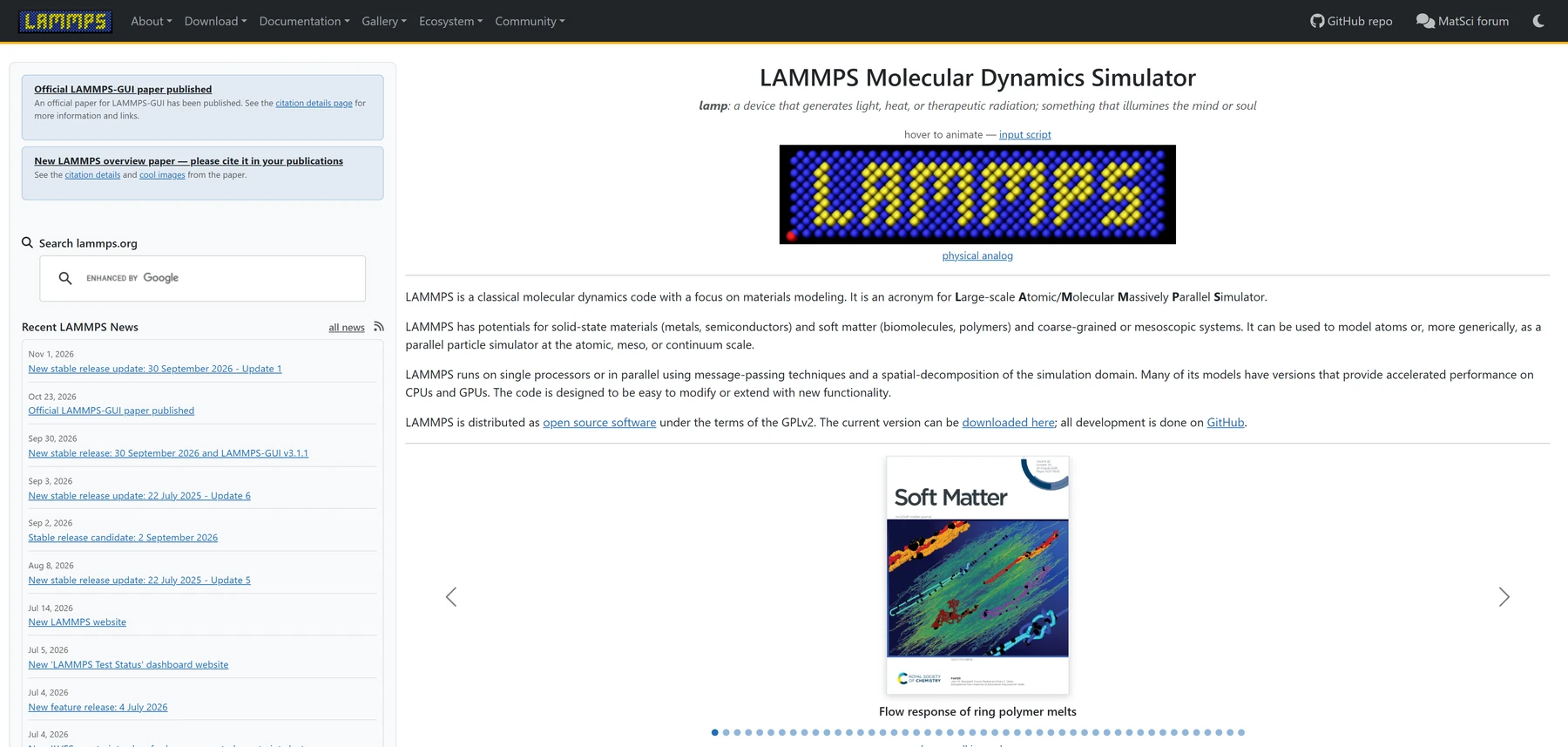
LAMMPS is developed at Sandia National Laboratories and Temple University and released under GPL 2.0.[14] Its users are mostly materials scientists, and its potentials reflect that: embedded-atom models for metals, ReaxFF for chemical reactions, granular and coarse-grained models, and a growing set of machine-learning potentials. GPU acceleration comes through two packages that cover CUDA, HIP and SYCL.
For a biologist, LAMMPS earns its place when the system isn't only biological: a peptide on a surface, a polymer coating, a lipid model at coarse-grained resolution. The current stable release is the 30 September 2026 version, updated on November 1.[15] For proteins in water, the engines above are faster to set up.
LAMMPS price: Free and open source under GPL 2.0.
Other free molecular dynamics software to consider
CHARMM, from Harvard and a long list of collaborating groups, is the origin of the CHARMM force fields and has been free with full functionality for academic, government and non-profit users since 2022.[19] Its scripting language is steep, and most people who use CHARMM force fields now run them in GROMACS, NAMD or OpenMM.
Tinker-HP runs the AMOEBA polarizable force field on NVIDIA GPUs and is free for academic institutions.[20] ACEMD, from Acellera, is free for non-commercial use and needs a paid license otherwise.[21] HOOMD-blue, under the BSD license, is built for coarse-grained and soft-matter particle simulations rather than all-atom proteins.[22] CP2K covers quantum mechanical and QM/MM molecular dynamics, a different problem from classical MD.
If what you need is a set of plausible conformations rather than a trajectory, generative models are much cheaper. BioEmu-2 and AlphaFlow sample protein ensembles in minutes, though without time ordering or kinetics. For analyzing a trajectory you already have, MD Trajectory Analysis computes RMSD, RMSF and radius of gyration from standard trajectory files.
Which molecular dynamics software should you choose?
For a protein in water, with or without a ligand, start with GROMACS. It is free for any use, runs on whatever GPU you have, and is what reviewers and collaborators expect. If your group lives in the Amber force fields or does a lot of ligand parameterization, use AMBER instead, or borrow AmberTools for the ligand and run the rest in GROMACS. Check the RMSD of a short run before committing to a long one, and clean the input with PDBFixer first.
Use OpenMM when the method is the point: a custom force, a machine-learning potential or a sampling scheme you want to control from Python. NAMD is for very large systems and CHARMM-centric labs, and LAMMPS for anything that isn't mostly biomolecule. Pay for Desmond when your organization already works in Maestro and runs FEP+, since that workflow, not the integrator, is what the license buys.