Binding free energy calculation
Score a GROMACS protein-ligand trajectory with gmx_MMPBSA, check the run for stability, and read MM/GBSA or MM/PBSA totals with per-residue contributions before deciding which analogues deserve FEP or an assay.
Find a starting pose
An end-point calculation is only as good as the complex it starts from. Dock with Vina or GNINA, or cofold with Boltz-2, then screen the poses for clashes and broken geometry before simulating.

AutoDock Vina
Docks ligands to produce the starting poses for simulation.

GNINA
Docks and rescores poses with CNN scoring as a second opinion before MD.

Boltz-2
Predicts a complex and an affinity value without simulation, for fast triage.

PoseBusters
Checks docked poses for chemical and geometric errors before they are simulated.
Set protonation states
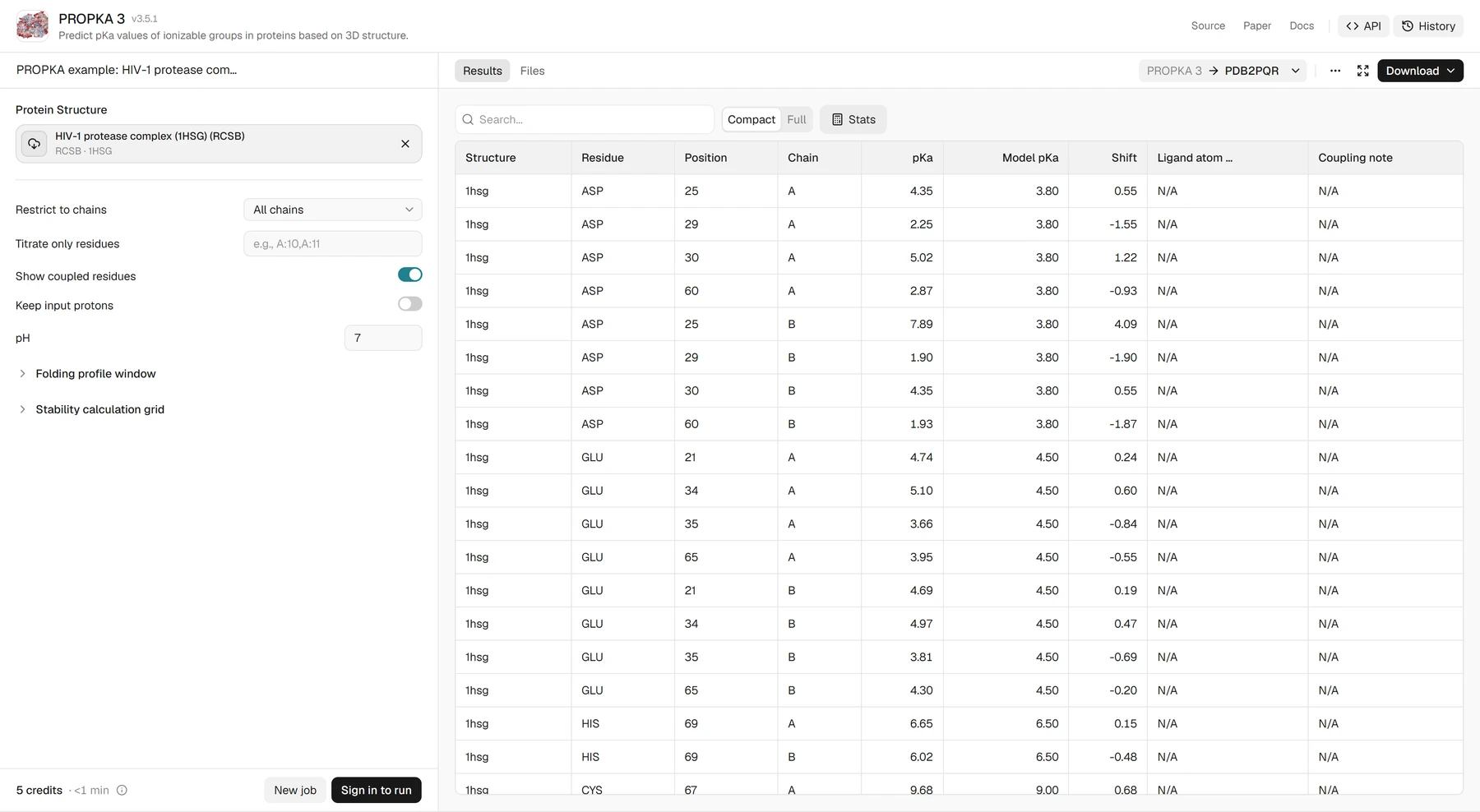
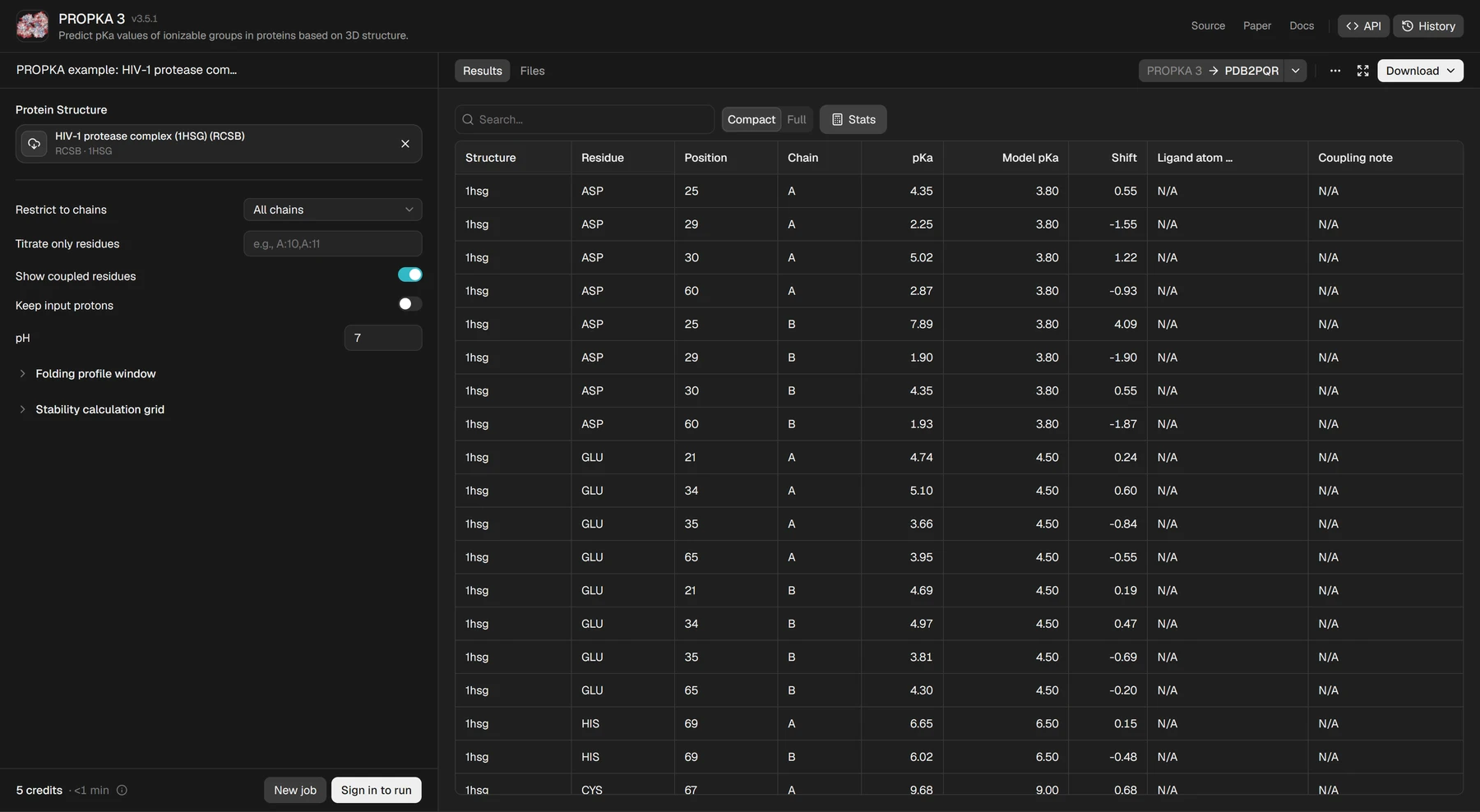
Charge states change the electrostatics in every later step. Dimorphite-DL enumerates ligand states at your pH, and PROPKA estimates pKa values for protein residues. In the HIV-1 protease example, Asp25 comes out at 4.35 in chain A and 7.89 in chain B.
Simulate and check the trajectory
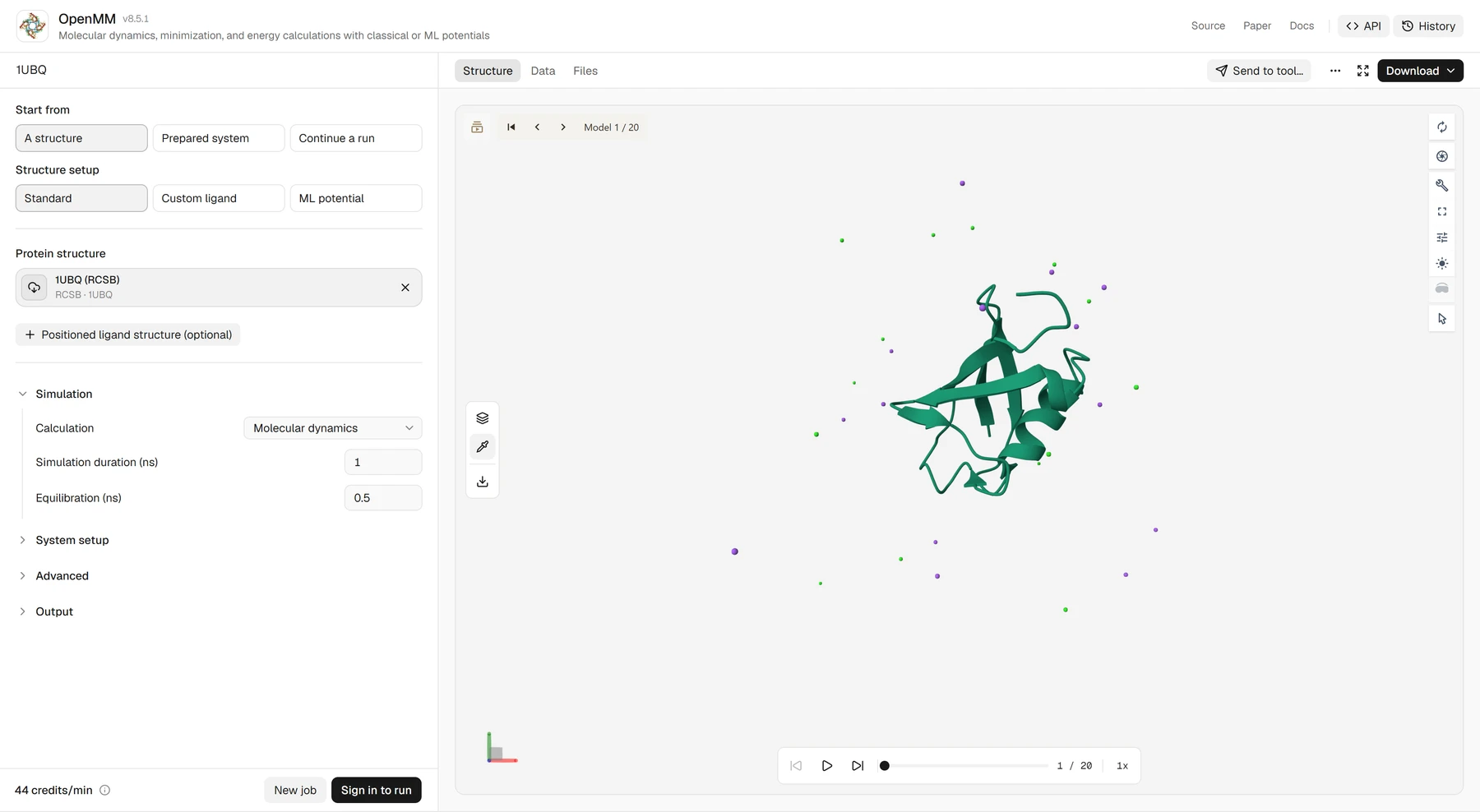
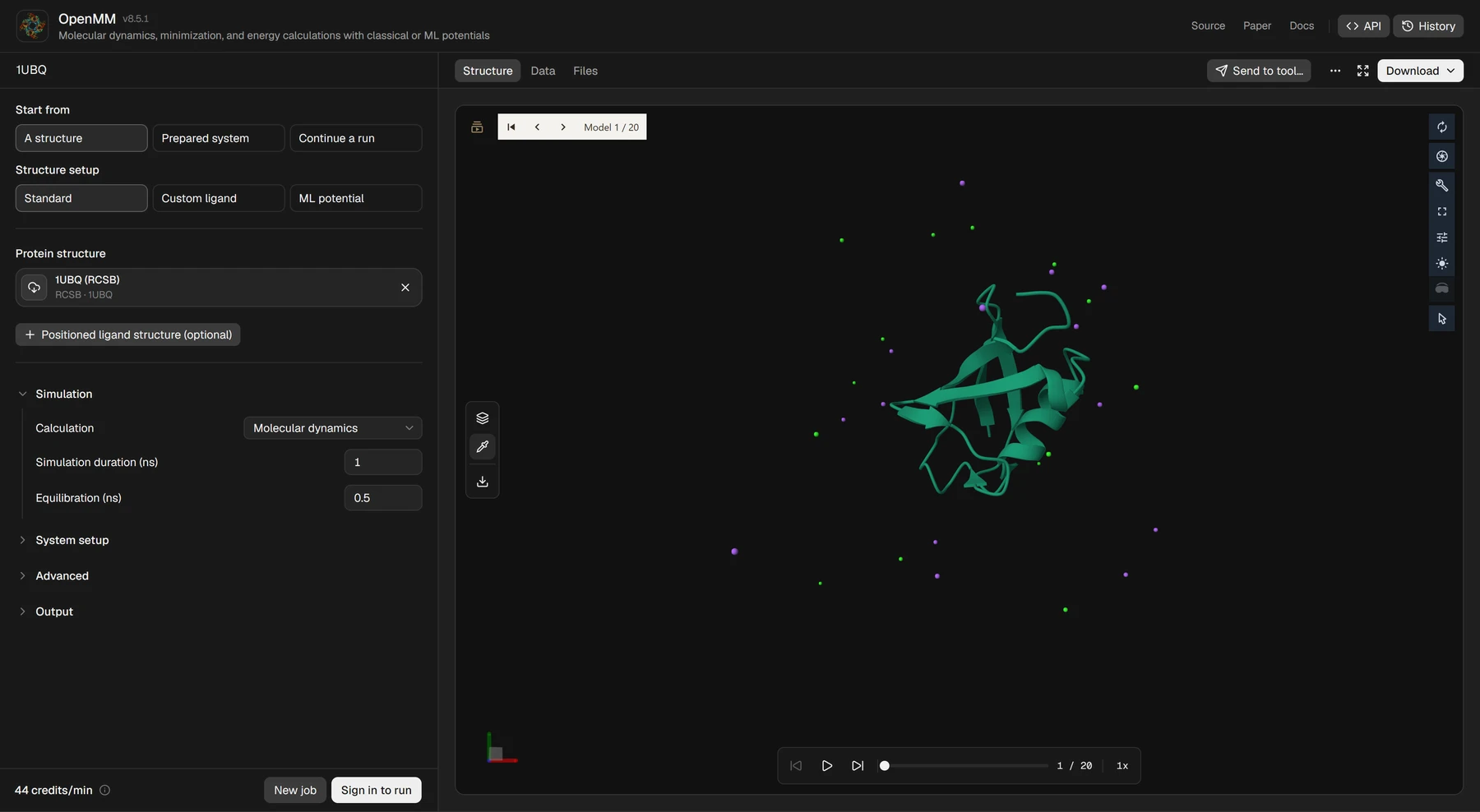
Run the prepared complex in GROMACS or OpenMM, then read RMSD and RMSF before scoring any frames. A ligand that leaves the pocket makes the later numbers meaningless. The OpenMM example is a 1 ns run of ubiquitin from PDB 1UBQ.

GROMACS
Runs a prepared protein-ligand system from a native TPR or file ZIP and returns the trajectory gmx_MMPBSA reads.

OpenMM
Simulates a protein with a positioned SDF or MOL2 ligand using OpenFF Sage parameters.

MD Trajectory Analysis
Checks a trajectory with RMSD, RMSF and distance metrics before frames are scored.
Score the frames
gmx_MMPBSA reads the GROMACS trajectory and returns MM/GBSA or MM/PBSA totals with per-residue contributions. These are end-point estimates for ranking analogues, not measured affinities. ProLIF lists which residues a pose contacts.
Run a hydration free energy
OpenFE returns the absolute hydration free energy of one neutral ligand. It is not a binding free energy, and relative or absolute binding free energy calculations are not hosted tools on ProteinIQ.




More small-molecule discovery workflows
What is binding free energy calculation?
Binding free energy calculation is a family of physics-based methods that estimate how strongly a ligand binds its target, as the free energy change when the two associate in solution. A more negative value means tighter binding, and at 298 K each 1.36 kcal/mol corresponds to a tenfold change in the dissociation constant.
Two families answer the question. Alchemical methods such as free energy perturbation transform one ligand into another through nonphysical intermediates, and rank a congeneric series most accurately. End-point methods score snapshots of the bound complex instead, for far less compute per ligand. ProteinIQ hosts the end-point route and one hydration-only alchemical protocol, not relative or absolute binding calculations.
Neither family gives a trustworthy absolute affinity by default. End-point totals are usually much larger in magnitude than measured values and should only rank ligands inside one protocol, which the MM/PBSA and MM/GBSA comparison sets out. Every result inherits the starting pose, so a wrong binding mode returns a precise answer to the wrong question.
Which binding free energy tool to use
| What you want to do | Tool | What you get back |
|---|---|---|
| Score a simulated complex with MM/GBSA or MM/PBSA | gmx_MMPBSA | DELTA TOTAL in kcal/mol with energy components and per-residue decomposition |
| Produce the trajectory the scoring reads | GROMACS | Trajectory, energies, topology and the final structure |
| Check the complex held together before scoring | MD Trajectory Analysis | RMSD, RMSF and distance traces per frame |
| Test the force field and charges for a ligand in water | OpenFE | Hydration free energy in kcal/mol with its uncertainty and MBAR overlap |
| Get a starting pose for the simulation | AutoDock Vina | Ranked poses with a Vina score in kcal/mol |
| Triage a complex without simulating it | Boltz-2 | A predicted complex with a binding probability and a predicted log10(IC50) |
Each tool runs online from structures or a prepared system and quotes its credit cost before it starts. AutoDock Vina jobs start at 15 credits, GROMACS at 100, and an OpenFE production run with three repeats is quoted at 8,400 credits.
What goes in and what comes out
You provide
Complex run files
TPR, XTC, TRR, PDB
The GROMACS run input of the bound complex and one to four trajectories of it, concatenated in order. A TPR is recommended over a PDB.
Index groups
NDX
A GROMACS index file whose receptor and ligand group numbers you enter in the settings.
Ligand parameters
MOL2, TOP
An Antechamber MOL2 for a small-molecule ligand, unless a complex topology already supplies its parameters.
You get back
Binding free energy table
CSV
DELTA TOTAL in kcal/mol with its van der Waals, electrostatic, polar and nonpolar solvation components for each requested method.
Per-frame and per-residue energies
CSV
Energies for every analyzed frame, and residue contributions when decomposition is on.
Native result files
MMXSA, IN, LOG
The gmx_MMPBSA report, the effective input file, run log and COMPACT_MMXSA_RESULTS.mmxsa for the gmx_MMPBSA analyzer.
Trajectory checks
CSV
RMSD, RMSF and distance traces from MD Trajectory Analysis for choosing which frames to score.
Know what each method can tell you
Background guides on the methods, scores, and numbers behind these workflows.
Docking · 17 min
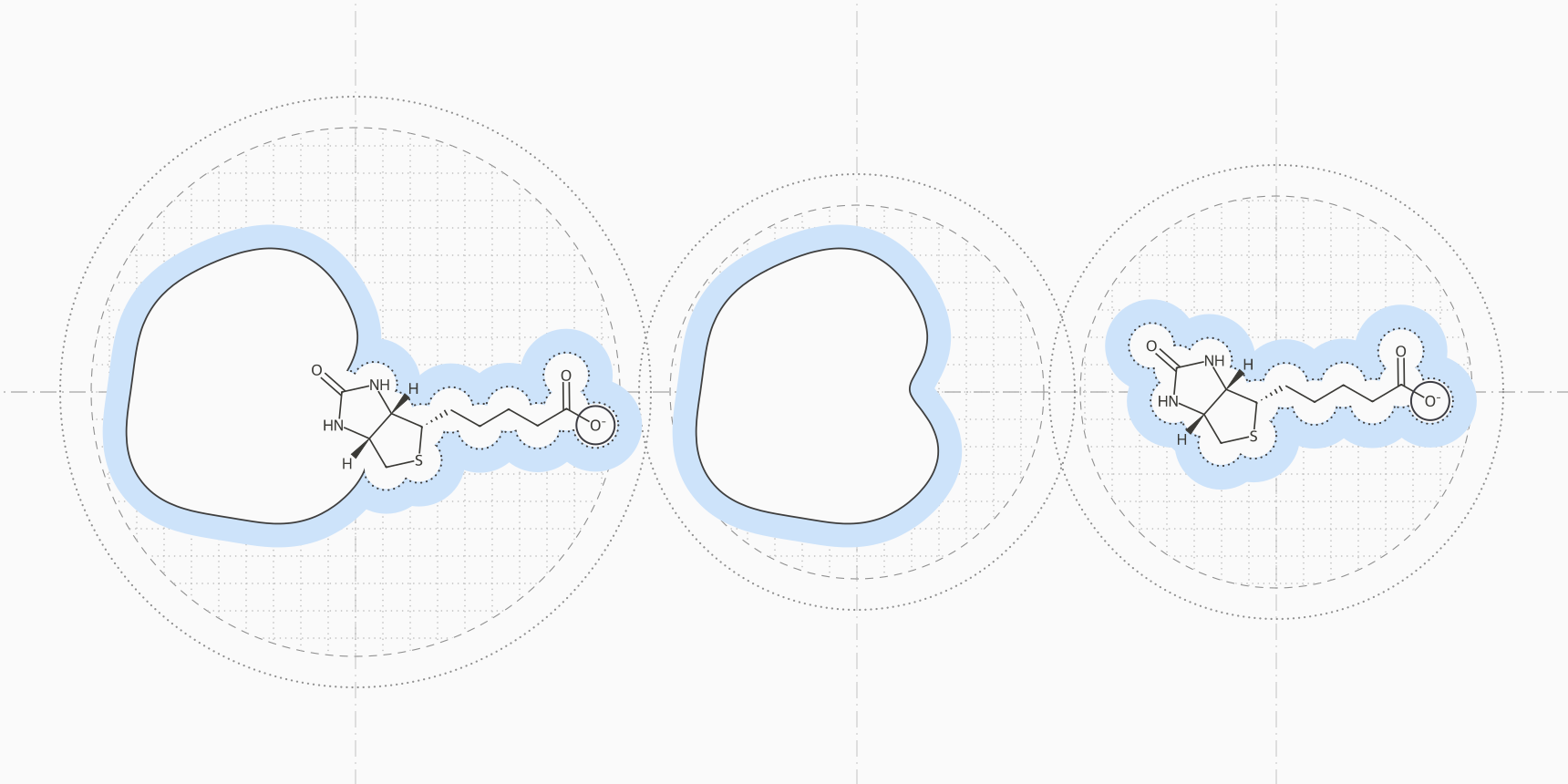
MM/PBSA vs MM/GBSA: how end-point binding free energies work
MM/PBSA and MM/GBSA estimate protein-ligand binding free energy from molecular dynamics snapshots. Learn the energy terms, how Poisson-Boltzmann and generalized Born solvation differ, single- versus three-trajectory protocols, the entropy term, and what benchmark studies say about accuracy.
Drugs · 18 min
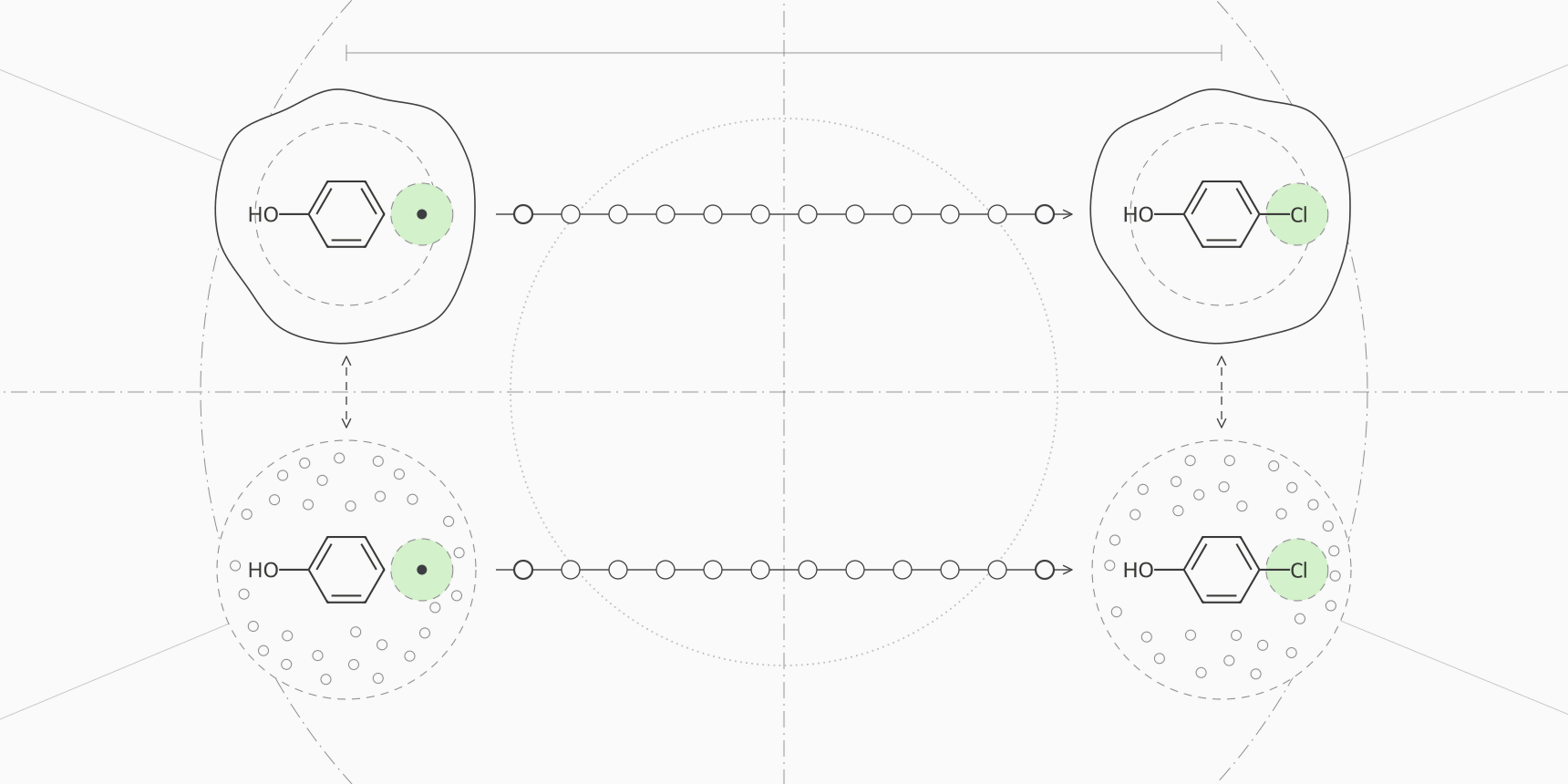
What is free energy perturbation (FEP) & how it works
Free energy perturbation (FEP) predicts how a chemical change alters binding affinity by simulating an alchemical transformation through lambda windows. Learn the thermodynamic cycle, relative vs absolute binding free energy, benchmark accuracy, GPU cost per edge, where FEP fails, and how it compares with docking and MM/GBSA.
Structures · 14 min
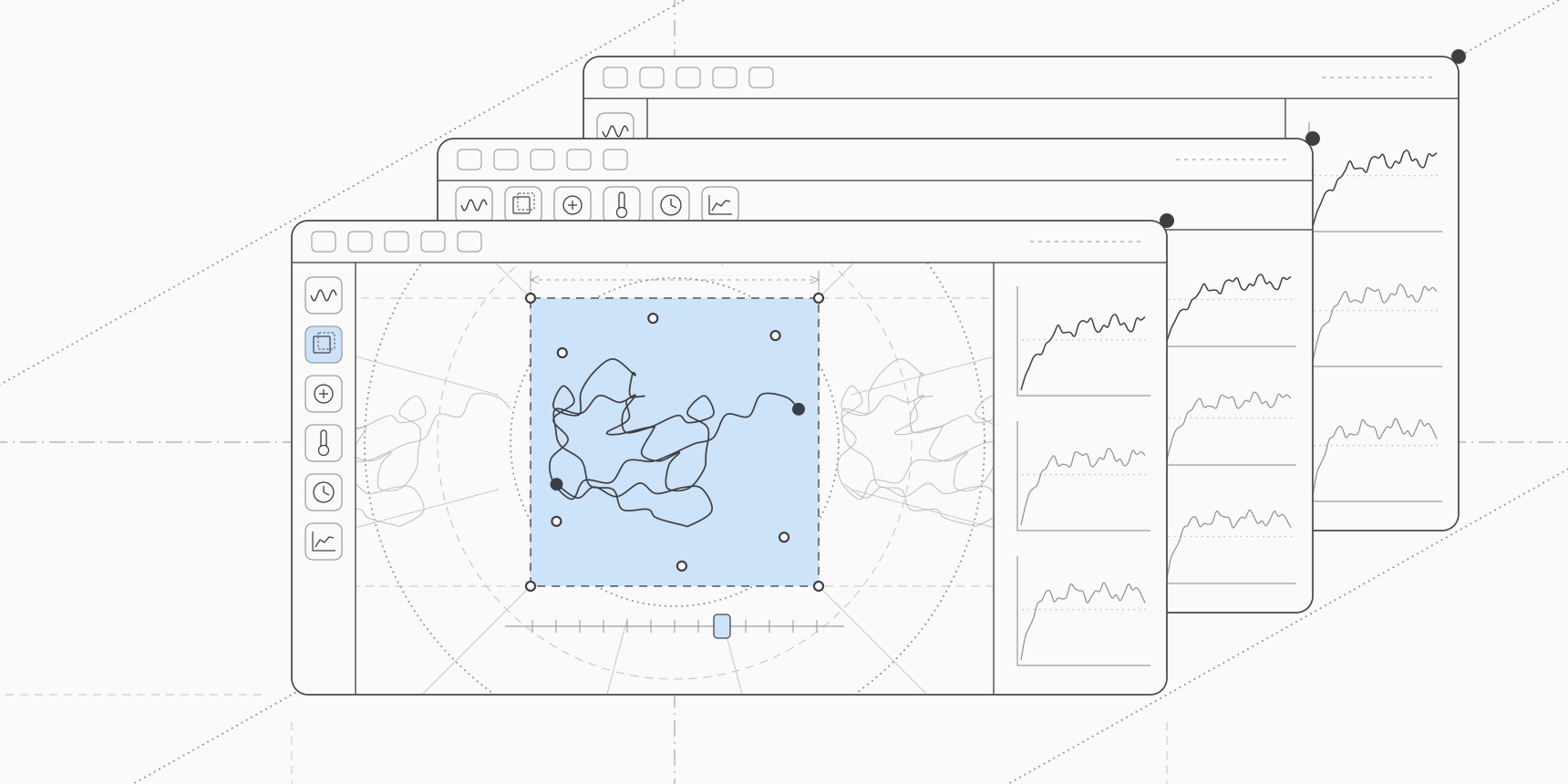
The best free molecular dynamics software in 2026
The best molecular dynamics engines are free: GROMACS, AMBER, OpenMM, NAMD and LAMMPS run most published simulations. We compare them on what each is best at, GPU speed on standard benchmarks, licenses and what a run needs from you, and say where Schrödinger's Desmond still earns its price.
Frequently asked questions
Outsourced binding free energy work is quote-based. Cresset Discovery offers to run or fully manage FEP projects and CD ComputaBio sells MM/GBSA and FEP analyses, but neither publishes a price, because the scope depends on the number of ligands, how much setup the system needs and whether results come with interpretation.
The largest cost drivers are protein and ligand preparation, the number of perturbations or trajectories, repeats needed for a usable error bar, and charged or ring-changing ligands that need longer sampling. Experimental measurement of the top compounds is a separate cost.
On ProteinIQ, a gmx_MMPBSA job costs 5,000 credits for one complex, quoted before submission, on top of the GROMACS credits for the simulation. Plans start at $29 per month for Plus and $99 per month for Pro, which includes 8,000 monthly credits and workflows. Relative FEP series and other done-for-you projects are scoped separately.
Not as a hosted tool. ProteinIQ runs OpenFE for absolute hydration free energies of single neutral molecules, not protein-ligand relative or absolute binding free energies. Use gmx_MMPBSA for end-point estimates on your own trajectories, and ask about a done-for-you project for an FEP series.
Yes. gmx_MMPBSA scores frames of an existing complex trajectory, so it needs the run input, trajectory and index file from a GROMACS simulation. ProteinIQ’s GROMACS tool runs protein-ligand systems from a native TPR or file ZIP that already contains ligand parameters; it does not generate ligand topologies.
One complex per gmx_MMPBSA job, with up to four trajectories of that complex concatenated. Compare a series by running one job per ligand with the same settings, and keep the method, GB model, dielectric and frame selection fixed across the series.
End-point totals are usually larger in magnitude than measured binding free energies, especially without an entropy term. Read them as a ranking within one series calculated the same way, not as a Kd.
Start with MM/GBSA, which is faster and in published benchmarks ranks related ligands at least as well as MM/PBSA for most proteins. Run both when you want to see how much the solvation model moves the answer for your system.
AI answers from our docs. No sign-in needed.
Run your first analysis today
Start with 200 free credits and no installs. Upgrade when your project needs more compute.