Dimorphite-DL
Generate ligand protonation states over a pH range with Dimorphite-DL.
How to use Dimorphite-DL for ligand protonation?
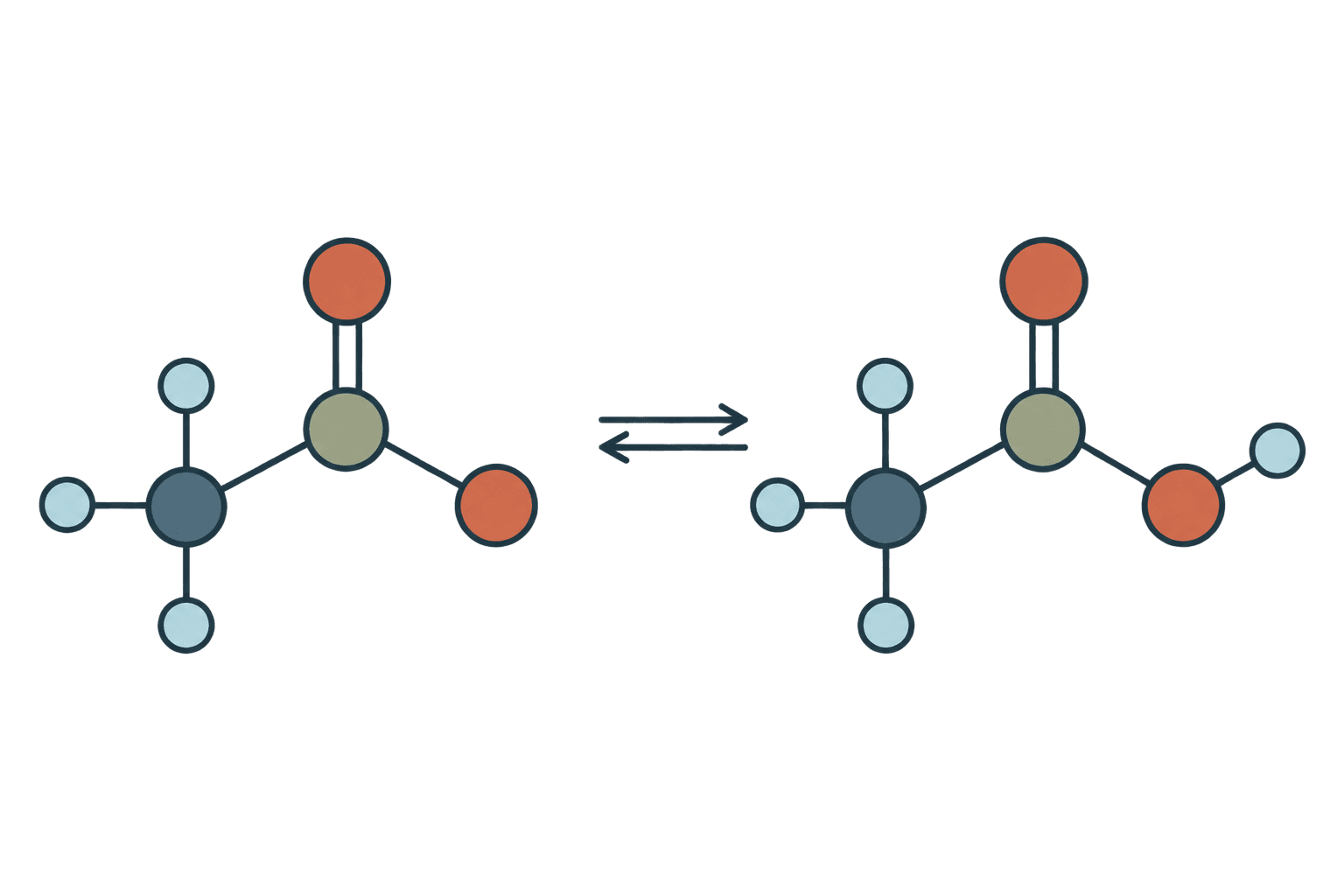
Enter ligand SMILES and choose a pH interval. Dimorphite-DL enumerates small-molecule ionization states using ionizable functional groups and empirical pKa ranges. Download the protonation states as SMILES or SDF. These chemical states can then be prepared with 3D coordinates for docking or other analysis.
- Paste ligand SMILES, one compound per line.
- Set
Minimum pHandMaximum pHto the experimental conditions. - Run Dimorphite-DL and review the generated states.
- Download
results.smiorresults.sdf.
Worked example
Input SMILES:
CC(=O)O acetic_acidAt the default pH interval of 6.4 to 8.4, the generated state is acetate. The results.smi file is:
CC(=O)[O-] acetic_acid_state_1Input
| Input | Accepted format | Requirements |
|---|---|---|
| Molecules | Pasted SMILES or .smiles, .smi, .txt upload | One SMILES followed by an optional name per line. Maximum file size: 50 MiB. |
Put the SMILES first, for example CCO ethanol, rather than a header row or name-first column. Blank lines are ignored. Unnamed molecules receive generated identifiers. Invalid SMILES fail the job instead of being silently dropped.
Settings
| Setting | Default | What it does |
|---|---|---|
Minimum pH | 6.4 | Lower end of the pH interval used to enumerate ionization states. Set both pH values to the same number to target one pH. |
Maximum pH | 8.4 | Upper end of the pH interval. Must be at least the minimum pH. A wider interval can return more states. |
pKa precision | 1.0 | Number of standard deviations around each functional group's mean pKa. Increasing this factor broadens uncertainty and can return more states; it is not decimal precision. |
Maximum variants | 128 | Maximum protonation variants generated per input compound. This is a cap, not a request to generate that many states. |
Results
| Output | Contents |
|---|---|
| Results table | Name, Parent, SMILES, State. |
results.smi | Returned molecules or states as SMILES and identifiers. |
results.sdf | Returned chemical structures with row properties; 3D coordinates are not guaranteed. |
results.tsv | Tab-separated table with the same rows and values. |
report.json | Result rows, resolved settings and warnings. |
run.log | Tool, settings, result count and warnings; failures include their error. |
Downloads are available from Files. The exported records retain returned row order.
What does Dimorphite-DL do?
Dimorphite-DL identifies ionizable groups with chemical patterns and uses empirical pKa information to enumerate states compatible with a pH interval. It is a specific ionization-state method, rather than a general ligand preparation pipeline. A returned state is not an experimentally measured pKa or a population fraction.
The pKa precision factor scales the uncertainty around a functional group's mean pKa. Increasing it can include more states. It does not specify decimal places or a confidence percentage. Multiple ionizable sites can yield several state combinations, limited by Maximum variants.
Choosing pH for ligand protonation
Use the conditions relevant to the experiment. Set both pH values to 7.4 to target one pH, or use an interval to represent several conditions. The default interval, 6.4 to 8.4, is not proof that these conditions fit every assay.
Inspect formal charges in the returned SMILES. Bracket expressions such as [O-] and [NH3+] encode charged atoms. The State column is an output index, not a probability or an abundance ranking.
Preparing protonation states for docking
The exported SMILES and supplementary SDF describe chemical states. The SDF is not guaranteed to have 3D coordinates. Generate coordinates with SMILES to SDF, then use SDF to PDBQT. SMILES to PDBQT can combine coordinate generation and docking preparation for selected state SMILES.
FAQ
Does Dimorphite-DL return the most likely state?
It enumerates states over the selected pH and pKa uncertainty intervals. It does not return population fractions or rank by abundance.
Does ligand protonation also enumerate tautomers?
This page runs Dimorphite-DL ionization-state enumeration. It has no separate tautomer enumeration setting.
Why does a molecule produce only one state?
It may have no recognized group that changes ionization in the interval, or only one compatible combination under those conditions.
Related tools

Stereoisomer generator
Enumerate stereoisomers from SMILES while preserving assigned stereochemistry by default.

Codon optimization
Optimize coding DNA for a target organism with DNA Chisel while preserving its translation.

DNA mutation generator
Mutate DNA online by exact count or mutation rate, with reproducible controls and FASTA export.

DNA Shuffle
Shuffle DNA sequences while preserving nucleotide, dinucleotide, or k-mer composition.

Overlapping peptide generator
Design overlapping peptide libraries with adjustable length, overlap and terminal restrictions. Runs in your browser.

DNAGenIQ (Random DNA sequence generator)
Generate random DNA sequences with controlled length, GC content, and restriction sites.

ProtGenIQ (Random protein sequence generator)
Generate random protein sequences with controlled length, amino acid composition, and motifs.

RNAGenIQ (Random RNA sequence generator)
Generate random RNA test sequences with adjustable GC content and optional RNA-like templates and sequence motifs.

Butina clustering
Group molecules by fingerprint distance using RDKit Butina clustering.

Chemical substructure search
Find compounds matching a SMARTS query with optional stereochemistry matching.