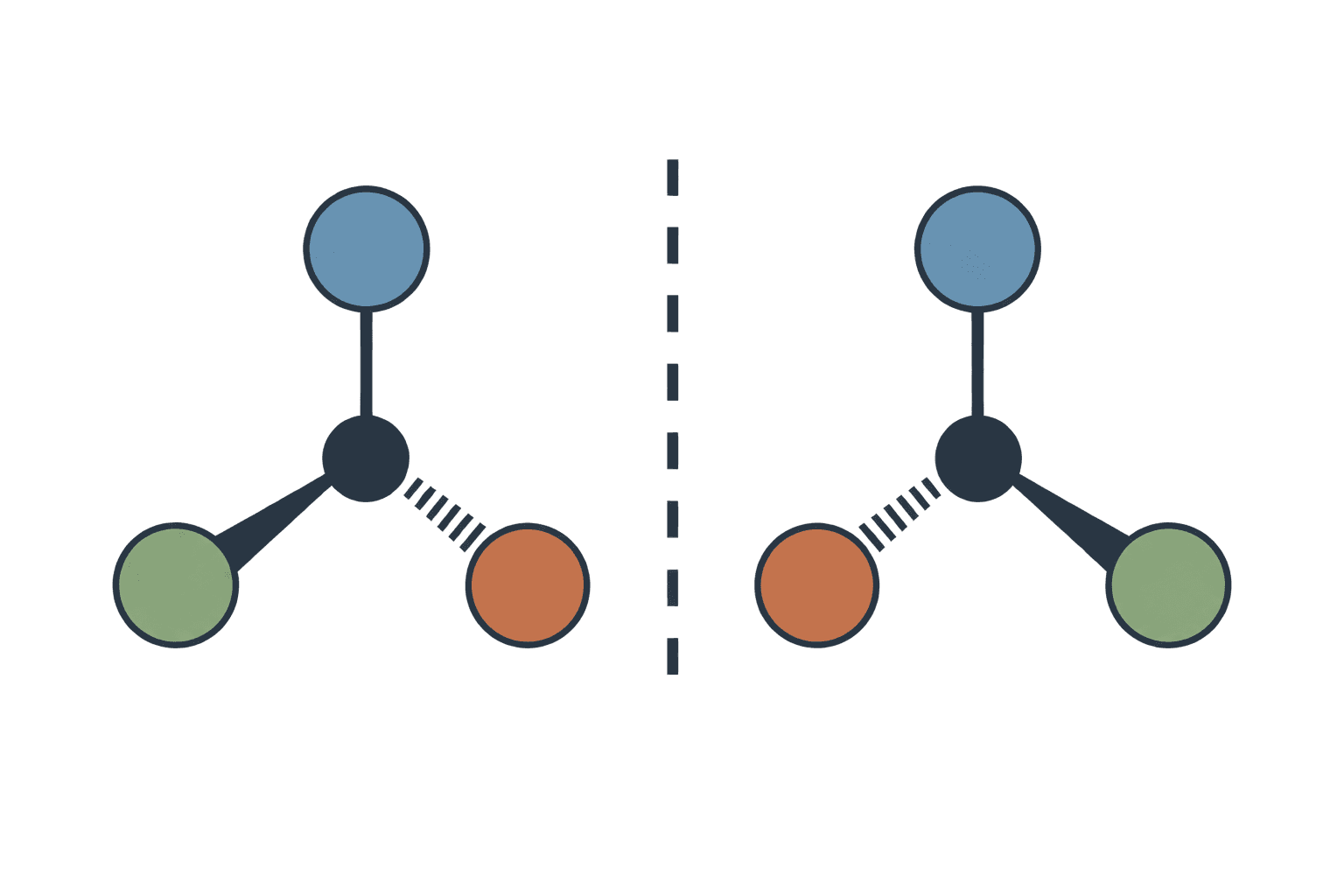
Stereoisomer generator
Enumerate stereoisomers from SMILES while preserving assigned stereochemistry by default.
How to generate stereoisomers from SMILES?
Paste a molecule with unspecified stereochemistry into the stereoisomer generator. RDKit enumerates possible stereoisomers, keeping already assigned stereochemistry by default. The results include isomeric SMILES, parent identifiers and structure downloads, so each generated variant can be reviewed or passed to a preparation workflow.
- Paste SMILES for the parent molecules.
- Leave
Only unassigned stereocenterson to preserve known stereochemistry. - Set an isomer cap and run the tool.
- Review the isomeric SMILES before further preparation.
Worked example
Input SMILES:
CC(F)Cl exampleThe unspecified stereocenter gives these two records in results.smi:
C[C@H](F)Cl	example_isomer_1
C[C@@H](F)Cl	example_isomer_2
Input
| Input | Accepted format | Requirements |
|---|---|---|
| Molecules | Pasted SMILES or .smiles, .smi, .txt upload | One SMILES followed by an optional name per line. Maximum file size: 50 MiB. |
Put the SMILES first, for example CCO ethanol, rather than a header row or name-first column. Blank lines are ignored. Unnamed molecules receive generated identifiers. Invalid SMILES fail the job instead of being silently dropped.
Settings
| Setting | Default | What it does |
|---|---|---|
Only unassigned stereocenters | On | Enumerate unspecified stereochemistry while keeping assigned stereocenters. Turn off to also enumerate already assigned stereochemistry. |
Unique stereoisomers | On | Return each distinct isomeric SMILES once, removing duplicate stereoisomers caused by symmetry. |
Maximum isomers | 1024 | Maximum stereoisomers to return per molecule, from 1 to 1,024. This is a cap, not a requested count. Unlimited enumeration is not available. |
Check 3D embedding | Off | Attempt 3D embedding to filter stereoisomers that RDKit cannot embed. This is a feasibility check; the exported SDF is not a set of 3D conformers. |
Only stereo groups | Off | Restrict enumeration to enhanced stereo groups encoded in the input. Ordinary unassigned stereocenters outside these groups are not enumerated. |
Results
| Output | Contents |
|---|---|
| Results table | Name, Parent, SMILES, Isomer. |
results.smi | Returned molecules or states as SMILES and identifiers. |
results.sdf | Returned chemical structures with row properties; 3D coordinates are not guaranteed. |
results.tsv | Tab-separated table with the same rows and values. |
report.json | Result rows, resolved settings and warnings. |
run.log | Tool, settings, result count and warnings; failures include their error. |
Downloads are available from Files. The exported records retain returned row order.
What does stereoisomer enumeration change?
Stereoisomers share connectivity but differ in stereochemistry. RDKit enumerates supported atom and bond stereo, including eligible tetrahedral centers and double bonds. The @ and @@ symbols in isomeric SMILES encode local stereo order; they are not universal R and S labels by themselves.
With Only unassigned stereocenters on, specified stereo is preserved. Turning it off also considers alternatives at already assigned sites. Symmetry can reduce the unique count below a simple power-of-two estimate.
A finite Maximum isomers caps the returned set. If there are more candidates than the cap, the output is not exhaustive. The maximum supported cap is 1,024 per molecule. Unlimited enumeration is not available.
Check 3D embedding filters candidates that RDKit cannot embed. It does not make the exported SDF a conformer ensemble. Use SMILES to SDF for prepared 3D coordinates.
Stereoisomers, protonation states and conformers
| Task | What changes | Tool |
|---|---|---|
| Enumerate stereo assignments | Atom and bond stereochemistry. | Stereoisomer generator. |
| Enumerate pH-dependent states | Protonation and charge. | Dimorphite-DL. |
| Prepare a docking ligand | Coordinates, charges and torsion information. | SMILES to PDBQT. |
FAQ
Does the generator predict the active stereoisomer?
No. It enumerates structures without ranking potency, stability or biological activity.
Can known stereocenters stay fixed?
Yes. Specify them in the input and leave Only unassigned stereocenters on.
Why does CCO return only one isomer?
CCO is ethanol. It has no eligible stereocenter or double-bond stereochemistry, so the output is the original molecule. Setting Maximum isomers to 1, 5 or 100 still returns one record. The setting limits the number returned; it does not ask the generator to invent that many structures.
Try CC(F)Cl, which has one unspecified stereocenter. A cap of 1 returns one stereoisomer; a cap of 5 or 100 allows both stereoisomers, as shown in the worked example above.
Why are fewer isomers returned than expected?
Symmetry, existing stereo assignments, the isomer cap and embedding checks can reduce the returned set.
Related tools

Dimorphite-DL
Generate ligand protonation states over a pH range with Dimorphite-DL.

Codon optimization
Optimize coding DNA for a target organism with DNA Chisel while preserving its translation.

DNA mutation generator
Mutate DNA online by exact count or mutation rate, with reproducible controls and FASTA export.

DNA Shuffle
Shuffle DNA sequences while preserving nucleotide, dinucleotide, or k-mer composition.

Overlapping peptide generator
Design overlapping peptide libraries with adjustable length, overlap and terminal restrictions. Runs in your browser.

DNAGenIQ (Random DNA sequence generator)
Generate random DNA sequences with controlled length, GC content, and restriction sites.

ProtGenIQ (Random protein sequence generator)
Generate random protein sequences with controlled length, amino acid composition, and motifs.

RNAGenIQ (Random RNA sequence generator)
Generate random RNA test sequences with adjustable GC content and optional RNA-like templates and sequence motifs.

Butina clustering
Group molecules by fingerprint distance using RDKit Butina clustering.

Chemical substructure search
Find compounds matching a SMARTS query with optional stereochemistry matching.