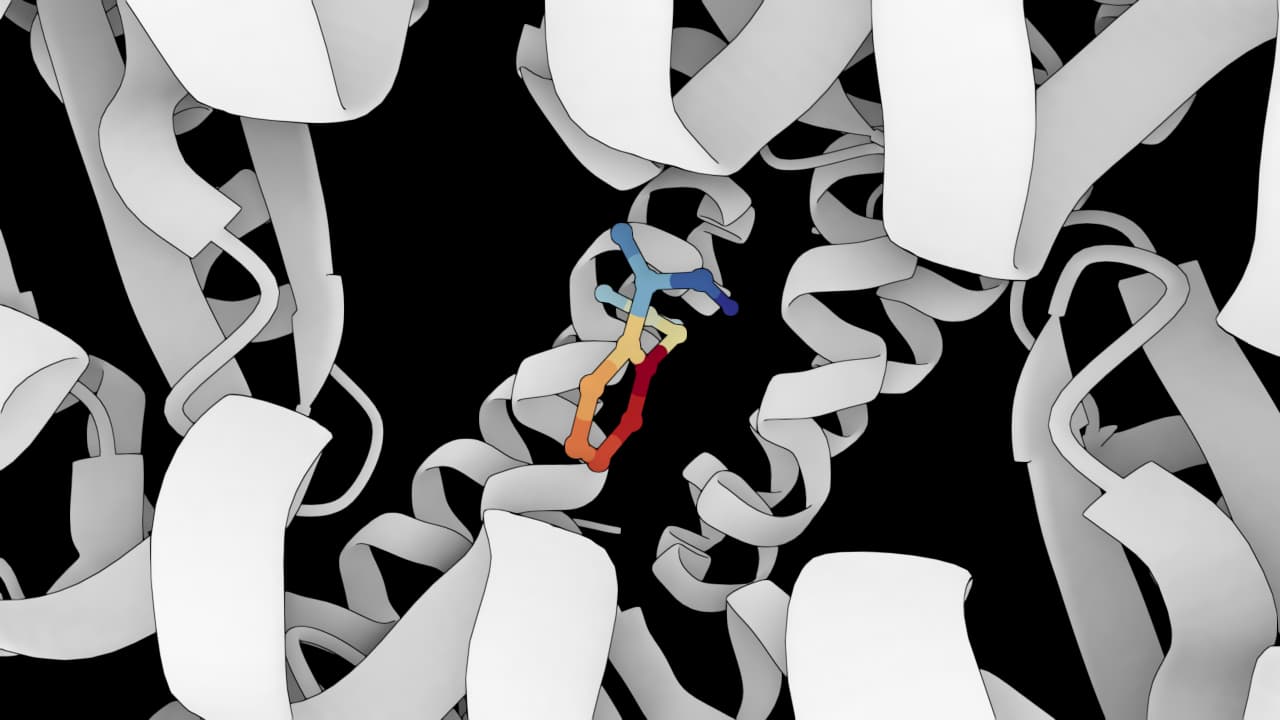
Absolute hydration free energy calculations for neutral small molecules
Input
What is OpenFE?
OpenFE (Open Free Energy) is an open-source Python framework for alchemical free energy calculations, a physics-based computational method used in drug discovery to predict how strongly molecules interact with their environment or a protein target. Rather than scoring a single static pose like molecular docking, alchemical methods simulate the thermodynamics of molecular transformations, yielding quantitative binding affinity estimates in kcal/mol with statistical uncertainty.
This OpenFE run calculates Absolute Hydration Free Energy (AHFE): the free energy change when a neutral small molecule is transferred from vacuum into water. AHFE quantifies how much a compound prefers aqueous solution over the gas phase, a property linked to solubility and membrane permeability.
OpenFE is developed by a consortium of pharmaceutical companies and academic groups, with GPU-accelerated simulations powered by OpenMM.
How alchemical free energy calculations work
In classical thermodynamics, measuring a binding free energy directly would require simulating the full association and dissociation of a ligand, an event that happens on timescales far beyond what molecular dynamics can reach. Alchemical methods sidestep this by exploiting the fact that free energy is a state function: the path between two states does not matter, only the endpoints.
Instead of physically pulling a ligand out of a binding pocket, the calculation gradually "switches off" the ligand's interactions with its surroundings through a series of unphysical intermediate states. A coupling parameter controls this transformation, varying from 0 (full interactions) to 1 (fully decoupled). At each value, a short molecular dynamics simulation samples the local thermodynamics.
Lambda windows
The number of intermediates is called the lambda window count. More windows provide smoother overlap between adjacent states and more reliable free energy estimates, at the cost of additional simulation time.
AHFE thermodynamic cycle
For hydration free energies, the ligand is decoupled in two environments independently:
- In solvent: electrostatic interactions are annihilated, then van der Waals interactions are decoupled
- In vacuum: the same decoupling is performed without solvent
OpenFE reports the hydration free energy from its two decoupling legs as .
Analysis
Free energies are extracted from the simulation data using MBAR (Multistate Bennett Acceptance Ratio), which simultaneously analyzes energy differences across all windows for statistically optimal estimates.
How to use OpenFE online
ProteinIQ provides cloud-hosted OpenFE calculations on GPU infrastructure, handling all environment setup, force field parameterization, and simulation orchestration automatically.
Inputs
| Input | Description |
|---|---|
Ligand | SMILES string or SDF file describing one neutral small molecule. |
Charged ligands are not supported by OpenFE’s absolute-solvation protocol. Metal-containing and coordination-complex ligands are also unsupported by the default AM1-BCC charge assignment and Sage small-molecule force field. An SDF submission keeps its supplied coordinates and explicit hydrogens. A SMILES submission follows OpenFE’s own SMILES-loading convention before parameterization.
Calculation settings
| Setting | Description |
|---|---|
Simulation Length | Production sampling per lambda window. Production uses OpenFE’s default 10 ns solvent and 2 ns vacuum sampling; setup and equilibration stages run in addition to these values. Shorter profiles are exploratory. |
Number of Repeats | Independent repeat calculations. 3 is the OpenFE default and supports a repeat-based uncertainty estimate. |
Advanced settings
| Setting | Description |
|---|---|
Water model | TIP3P or TIP4P-Ew. Each selection uses its matching OpenMM water force-field files in both thermodynamic legs. Changing the water model can change the calculated free energy. |
Results
Results include the hydration free energy estimate, repeat-based uncertainty, per-leg and per-repeat estimates, minimum MBAR overlap, and whether forward/reverse analysis completed for every repeat. The complete convergence record includes forward/reverse estimates, overlap matrices, replica-transition statistics, replica-state histories, and equilibration and production indices.
The Files view retains the complete OpenFE protocol, resolved settings, protocol DAG and result serializations, environment provenance, trajectories, checkpoints, structures, and logs. Large native files are uploaded directly instead of being discarded from an otherwise successful result.
Interpreting results
AHFE values
Negative hydration free energies indicate that transfer from vacuum into water is thermodynamically favorable; positive values indicate unfavorable transfer. The magnitude and experimental accuracy depend on the molecule, force field, water model, sampling, and convergence.
Uncertainty and convergence
The reported uncertainty measures variation among repeat estimates; it is not an experimental-error estimate. Interpret it together with MBAR overlap and forward/reverse convergence. Poor overlap, incomplete forward/reverse analysis, or unstable estimates indicate that more sampling or investigation may be needed even when repeat uncertainty is small.
Limitations
- Neutral molecules only: The OpenFE absolute-solvation protocol does not support charged alchemical molecules.
- No metal-containing ligands: The default AM1-BCC and Sage parameterization supports drug-like organic molecules, not metal-containing or coordination-complex ligands.
- Force field dependence: Results are only as accurate as the underlying force field. Molecules with unusual functional groups may be poorly parameterized.
- Convergence is not guaranteed: Short simulations with few lambda windows can produce results with small reported uncertainties that are nonetheless systematically wrong. When accuracy matters, use longer simulations with 3 repeats.
Related tools
OpenMM
Molecular dynamics, minimization, and energy calculations with classical or ML potentials
gmx_MMPBSA
Calculate binding free energies with MM/PBSA and MM/GBSA
PandaDock
Physics-based molecular docking with CPU-optimized hierarchical algorithms
SMINA
Enhanced molecular docking with custom scoring functions and fast minimization
Boltz-2
Predict biomolecular complex structures and binding affinities for proteins, ligands, DNA, and RNA.
Boltz-2.1
Structure and binding prediction for proteins, DNA, RNA and ligands.
LMI4Boltz
Low-memory Boltz inference for biomolecular structure and affinity prediction
AIMNet2
Predict quantum-informed molecular properties from 3D structures.
GROMACS
Run protein molecular dynamics or your own prepared GROMACS system.
PPAP
Deep learning-powered protein-protein binding affinity prediction