ProLIF
Calculate protein-ligand interaction fingerprints from 3D structures.
Input
What is ProLIF?
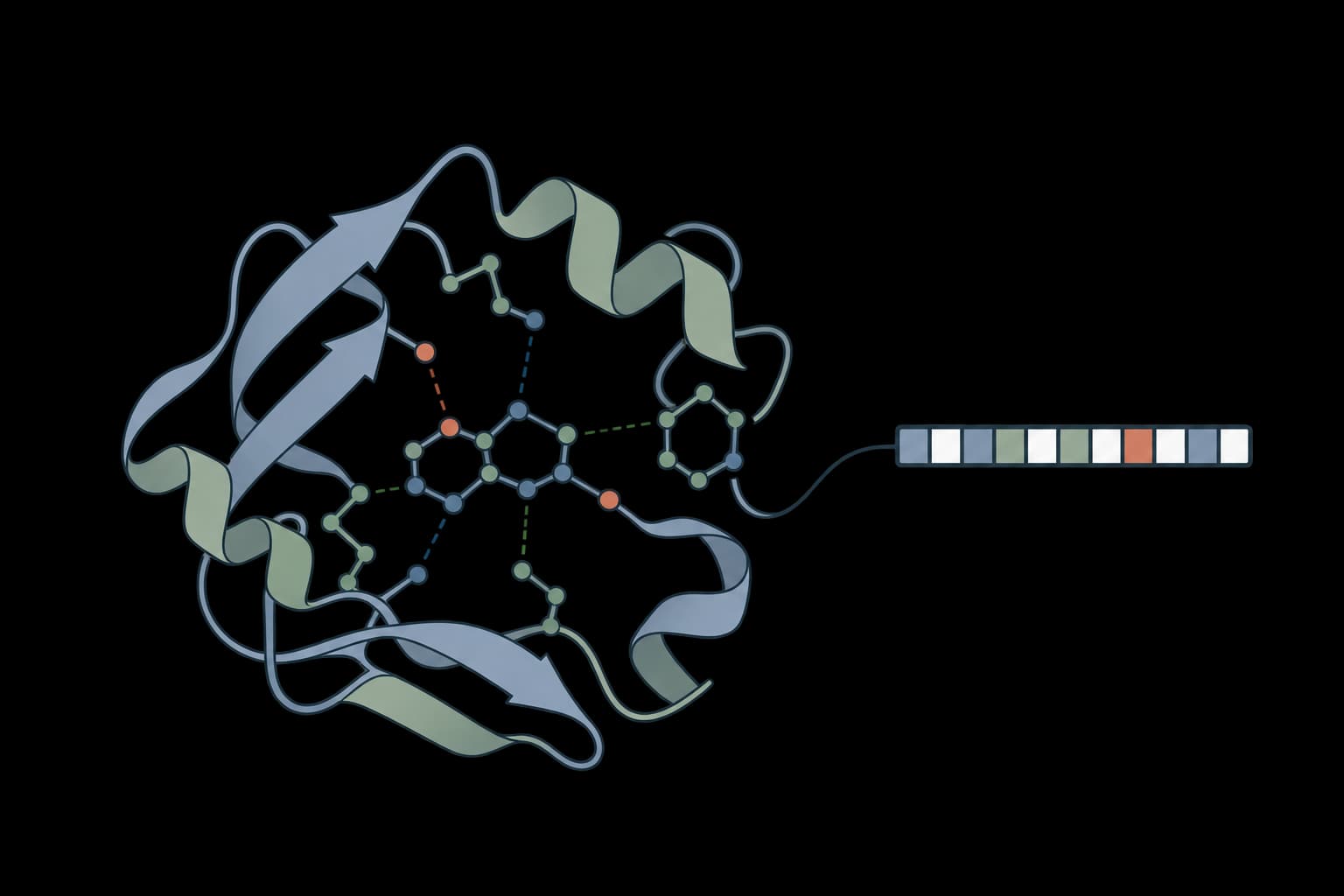
ProLIF encodes three-dimensional molecular contacts as protein-ligand interaction fingerprints. Each fingerprint records whether a ligand pose makes a defined interaction with a specific protein residue, producing a structured representation that can be compared across docking poses or conformers.
The fingerprint is a geometric description, not an affinity prediction. It is especially useful for finding conserved binding modes, clustering pose ensembles, and checking whether ranked ligands retain interactions with key residues.
How to use ProLIF online
Calculate a ProLIF fingerprint online by uploading a receptor PDB and a ligand pose file in SDF, MOL2, or PDB format. SDF files may contain multiple poses. ProteinIQ returns residue-level interaction rows, a fingerprint matrix, detailed interaction metadata, and the native ProLIF pickle for reuse in Python.
Inputs
| Input | Accepted formats | Description |
|---|---|---|
Protein receptor | PDB or RCSB PDB ID | Receptor structure used for every pose. Standard protein structures may omit hydrogens because automatic mode can use ProLIF's implicit-hydrogen workflow. |
Ligand poses | SDF, MOL2, PDB | One ligand or a pose ensemble. SDF is preferred for multiple records because each molecule becomes a separate frame. Ligand PDB files must contain explicit hydrogens; use SDF or MOL2 when they do not. |
The receptor and ligand coordinates must already share the same coordinate frame. ProLIF analyzes the submitted poses and does not perform docking or structural alignment.
Settings
| Setting | Description |
|---|---|
Interactions | Default ProLIF interactions calculates nine common classes. All supported interactions enables every compatible non-bridged interaction class in the installed ProLIF version. |
Hydrogen handling | Auto uses implicit-hydrogen interactions when the receptor or any ligand record has no explicit hydrogen atoms, and preserves explicit analysis when all molecules contain them. The explicit and implicit overrides are intended for prepared or partially protonated structures. |
Count all occurrences | Off produces the standard binary behavior, keeping the first matching atom combination for each residue pair and interaction type. On records all matching atom combinations and is slower. |
Vicinity cutoff (Å) | Restricts automatic residue selection to protein residues near the ligand. Default 6 Å. Increasing it is useful only when interaction definitions use longer distance limits. |
Residue chain labels | Selects automatic behavior, PDB chain IDs, or segment IDs for residue naming. |
The default fingerprint includes:
- Hydrophobic
- HBDonor
- HBAcceptor
- PiStacking
- Anionic
- Cationic
- CationPi
- PiCation
- VdWContact
In implicit mode, ProLIF replaces HBDonor and HBAcceptor with the source-supported ImplicitHBDonor and ImplicitHBAcceptor definitions. Protein residues are standardized with ProLIF's built-in amino-acid templates before analysis. Nonstandard protein residues without a source template may still require prior structure preparation.
Results
The spreadsheet is a long-form version of the fingerprint matrix.
| Column | Meaning |
|---|---|
Frame | Ligand record or pose index. |
Ligand | Ligand residue identifier. |
Protein residue | Interacting protein residue, including its residue number and chain or segment label. |
Interaction | ProLIF interaction class, including ImplicitHBDonor or ImplicitHBAcceptor when implicit mode is resolved. |
Value | 1 or 0 for a binary fingerprint; occurrence count when counting is enabled. |
Rows with 0 are useful because they preserve the complete matrix layout, while nonzero rows identify contacts present in a pose.
The downloadable files serve different downstream uses:
| File | Contents |
|---|---|
prolif-interactions.csv | Long-form table shown in ProteinIQ. |
prolif-fingerprint-matrix.csv | Native wide matrix from Fingerprint.to_dataframe(). |
prolif-interaction-metadata.json | Flattened atom-level occurrence metadata from Fingerprint.ifp. |
prolif-fingerprint.pkl | Native serialized fingerprint for loading with ProLIF. Pickle files should only be opened from trusted jobs. |
How ProLIF fingerprints work
ProLIF represents the receptor and ligands as RDKit molecules with three-dimensional coordinates. For each pose, it selects nearby residues and evaluates geometry rules for the requested interaction classes. The result is indexed by ligand residue, protein residue, and interaction type.
Binary fingerprints reduce every feature to present or absent. Count fingerprints preserve multiple atom combinations that satisfy the same feature. Binary form is usually better for pose similarity and clustering because a large functional group cannot dominate merely by making several equivalent contacts. Count form is more useful when the number of contacts within a residue pair matters.
Interpreting and comparing fingerprints
Fingerprint similarity summarizes shared contacts, not coordinate similarity. Two poses can have a modest heavy-atom RMSD while preserving the same key donor, acceptor, and hydrophobic interactions. Conversely, visually similar poses can differ at one interaction-critical heteroatom.
Useful questions include:
- Which contacts occur in most high-ranked poses?
- Does a candidate preserve an interaction with a catalytic or selectivity residue?
- Are pose clusters driven by meaningful polar contacts or only broad hydrophobic features?
- Does a ligand series switch binding modes across chemical substitutions?
The chosen interaction set, hydrogen mode, protonation state, residue labels, and vicinity cutoff must remain consistent when comparing fingerprints. Auto mode detects whether each molecule contains any explicit hydrogen atoms; it cannot determine whether a partially protonated structure is chemically complete, so select an explicit override for those inputs.
Use PLIP when a detailed report with water bridges, halogen bonds, metals, and interaction-specific geometry is the main goal. Use ProLIF when many poses need a consistent matrix for comparison, clustering, or machine learning. PoseBusters should be applied separately because a pose can produce a coherent fingerprint while still containing strained ligand geometry or receptor clashes.
Related tools

PLIP
Profile protein-ligand interactions from a PDB complex structure.

PoseBusters
Validate generated and docked ligand poses with structure, chemistry, and reference-pose checks.

ScanNet
Predict protein binding sites using geometric deep learning on 3D structures.

DockQ
Assess docking quality between model and native structures

AllMetal3D
Predict metal and water binding sites in proteins with 3D CNN models.

DeepRank-GNN-esm
Score every protein interface with ESM-2 and a graph neural network

DSSP
Assign helices, sheets, turns, bends, and PPII structure from atomic coordinates.

IPSAE
Score interprotein interactions in AlphaFold and Boltz predictions

LocScale
Physics-informed local sharpening for cryo-EM density maps.

Molecular descriptors
Calculate RDKit physicochemical descriptors, drug-likeness scores, rule violations, and structural fingerprints from SMILES.