AllMetal3D
Predict metal and water binding sites in proteins with 3D CNN models.
What is AllMetal3D?
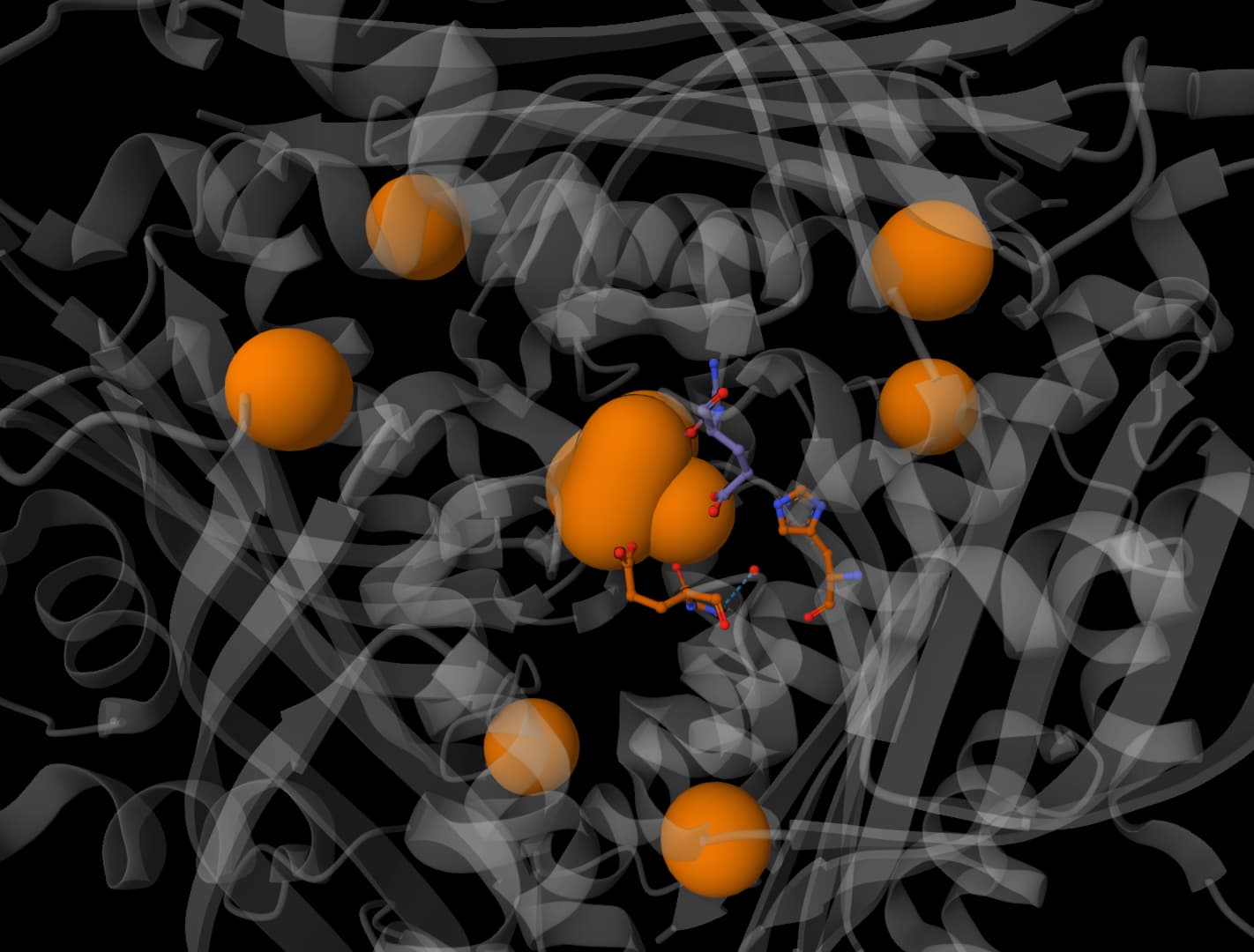
AllMetal3D predicts metal binding sites in protein structures, including where a site is likely to occur, the most likely native identity class, and the coordination geometry. Its identity classifier reports the same classes available in the original project: Alkali, MG, CA, ZN, NonZNTM, and NoMetal. A companion model, Water3D, predicts likely water binding positions in the same framework.
Developed by Simon Duerr and Ursula Roethlisberger at EPFL's Laboratory of Computational Chemistry and Biochemistry, AllMetal3D addresses a persistent blind spot in structure prediction: deposited PDB structures frequently have missing or misassigned metal ions, and apo structures lack metals entirely. AllMetal3D benchmarks favorably against MetalSiteHunter, AlphaFold3, MIC, MIB2, and MetalHawk.
How to use AllMetal3D online
ProteinIQ runs AllMetal3D and Water3D on cloud GPU infrastructure—no software installation, no Python environment.
Input
| Input | Details |
|---|---|
Protein Structure | PDB, ENT, CIF, or mmCIF file, or an RCSB PDB ID. The structure must contain protein atoms. Maximum file size 50 MB. |
Settings
| Setting | Description |
|---|---|
Models | AllMetal3D + Water3D (default) runs both models. Selecting one model reduces runtime. |
Prediction mode | Fast (default) subsamples residues for speed. All residues scans every residue and is more thorough. Site-focused restricts analysis to a sphere around specified residues. |
Central residue | Required for site mode only. One or more residue numbers separated by spaces (e.g., 101 203). |
Site radius | Radius in Ångströms around the central residues in site mode. Range 4–50 Å, default 8 Å. |
Clustering threshold | Agglomerative clustering cutoff in Ångströms. Lower values split nearby predictions into separate sites; higher values merge them. Range 0.1–10 Å, default 7 Å. |
Probability threshold | Minimum confidence for a site to appear in results. Raise to see only high-confidence predictions. Range 0.05–1.0, default 0.25. |
Output
Metal predictions are tabulated by site:
| Column | Description |
|---|---|
Structure | Source structure identifier |
Site | Sequential site index |
X, Y, Z | Predicted metal coordinates in Ångströms |
Location confidence | Model confidence in the predicted position (%) |
Predicted identity | Most likely native identity class (Alkali, MG, CA, ZN, NonZNTM, or NoMetal) |
Identity confidence | Confidence in the metal identity classification (%) |
Predicted geometry | Coordination geometry (e.g., tetrahedral, octahedral) |
Geometry confidence | Confidence in the geometry classification (%) |
The detailed table also includes raw per-class probability columns for both identity and geometry, so you can inspect the full native distribution instead of only the top-ranked class.
Water3D predictions appear in a separate table with coordinates and the site probability stored by the source in the PDB occupancy field.
Downloadable outputs include source-generated probe-only PDB files for predicted metal or water positions, CUBE files containing the corresponding prediction-probability density, and a JSON provenance record with the package version, source revision, settings, and verified model-checkpoint hashes. The predicted PDB files do not include the submitted protein structure.
How AllMetal3D works
AllMetal3D uses a fully convolutional 3D CNN trained on metal-containing structures from the PDB. The network processes a volumetric representation of the local protein environment centered on candidate positions. The architecture consists of five convolutional layers with 8, 60, 100, 80, and 30 channels, with leaky ReLU activation (slope 0.2) and max-pooling after the second layer. Processed features condense into a 1,280-dimensional fingerprint that feeds into separate fully-connected heads for identity and geometry classification.
Prediction follows a two-stage pipeline. AllMetal3Dloc first identifies candidate positions by scanning the structure and scoring each position for the likelihood of containing any metal. Positions above the probability threshold are then passed to the classification network, which outputs the most probable metal identity and coordination geometry.
Water3D uses the companion location model to predict likely water positions. Its native PDB output records each predicted oxygen position and its site probability.
Interpreting results
Metal identity confidence
Identity classification accuracy varies substantially by metal type. Compare the top class with the complete probability distribution rather than applying universal high, medium, or low confidence bands: the source does not define calibrated reliability thresholds that work across every ion class.
Coordination geometry
The geometry classifier performs well for tetrahedral and octahedral arrangements, which dominate in natural proteins. Other geometries (square planar, trigonal bipyramidal, etc.) are classified less accurately and should be treated with caution.
Water3D sites
The water-site probability is the location-model score written to the predicted probe's PDB occupancy field. It is a model score, not an experimentally refined crystallographic occupancy.
Limitations
Metal selectivity depends partly on cellular context (compartmentalization, metal availability during protein synthesis) that cannot be inferred from structure alone. A site predicted as Mg²⁺ may be occupied by other divalent ions in different cellular environments.
Positional accuracy is ion-dependent rather than a universal 0.5 Å. The reported error is around 0.5 Å for Ca, Ni, Cu, and Zn and around 0.6 Å for Mg, Na, and K; Fe and Mn show broader or bimodal error distributions. These predictions can identify a likely coordination region but should not be treated as refined experimental coordinates. Vacancy prediction—identifying sites that are empty in a given structure but could be occupied—is not reported by this integration.
Performance on Mg²⁺ and Na⁺/K⁺ is meaningfully lower than for transition metals, reflecting sparser training data and the tendency of these ions to adopt irregular or water-mediated coordination environments.
Related tools

SuperWater
Diffusion-based hydration site prediction for protein structures

Aggrescan3D
Analyze aggregation-prone regions in a protein structure.

PROPKA 3
Predict pKa values of ionizable groups in proteins based on 3D structure.

EvoIF
Score single and multi-site protein mutations with evolutionary and inverse-folding profiles.

RaSP
Predict protein stability changes across single amino acid substitutions.

ThermoMPNN
Predict mutation ΔΔG values and identify stabilizing substitutions for protein engineering.

CANYA
Predict protein aggregation nucleation propensity from amino acid sequences.

LocScale
Physics-informed local sharpening for cryo-EM density maps.

MolProbity
Validate protein structures with clashscore, Ramachandran, rotamer, and geometry checks.

PDBsum
Generate structural summary reports and diagrams for a single protein PDB structure.