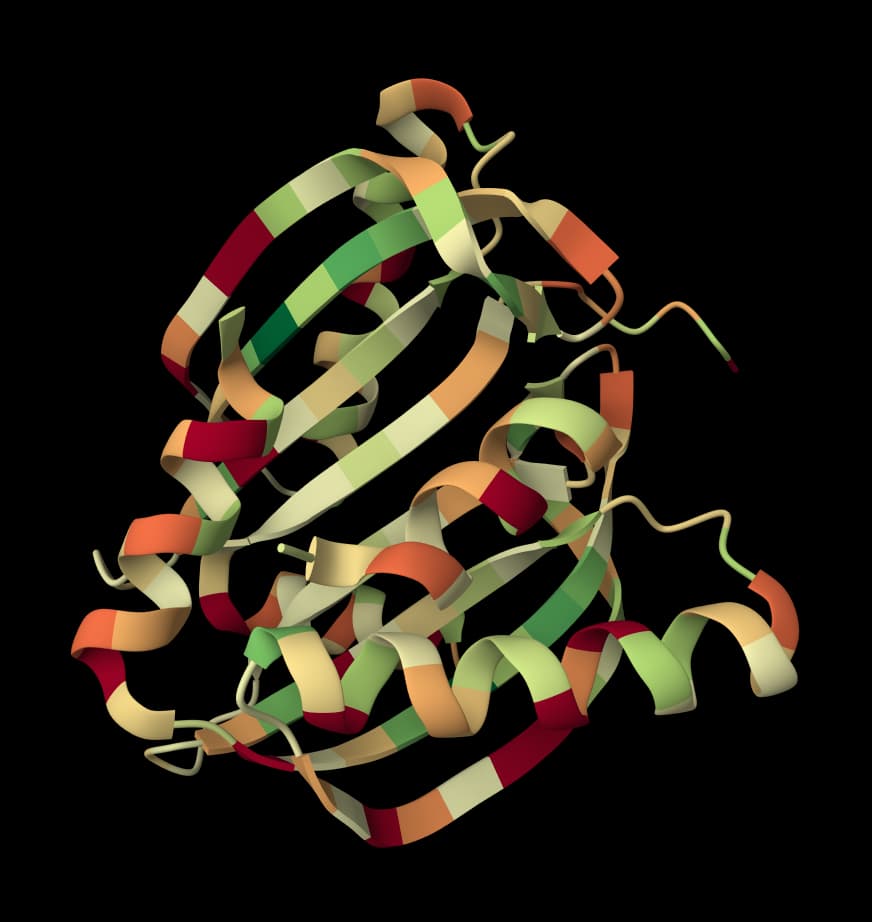
Score interprotein interactions in AlphaFold and Boltz predictions
Input
What is IPSAE?
ipSAE (interaction prediction Score from Aligned Errors) is a replacement for AlphaFold's ipTM score, developed by Roland Dunbrack Jr. at the Fox Chase Cancer Center. It addresses a fundamental flaw in how AlphaFold evaluates protein-protein interactions: ipTM averages predicted alignment quality across all residue pairs between chains, including disordered regions and non-interacting domains that drag the score down even when the actual interface is well-predicted.
The problem becomes acute with full-length protein sequences. A kinase dimer predicted with high confidence at its interface can receive a mediocre ipTM simply because both chains contain long disordered tails. Trimming those tails raises the ipTM score despite the structure prediction being identical — a clear sign the metric is measuring the wrong thing.
ipSAE fixes this by filtering out residue pairs with high predicted aligned error (PAE) before scoring, and adjusting the length normalization to reflect only high-confidence residues. In a benchmark of 40 heterodimers and 70 non-interacting pairs run with full-length UniProt sequences, ipSAE separated true from false interactions more effectively than ipTM.
Beyond ipSAE itself, the tool also computes ipTM, pDockQ, pDockQ2, and LIS (Local Interaction Score) — giving a comprehensive view of interface quality from a single run.
How does ipSAE work?
AlphaFold's ipTM is derived from the TM-score formula:
where scales with protein length. The ipTM applies this across chains, averaging over all interchain residue pairs regardless of prediction quality.
ipSAE modifies this in three ways:
-
PAE filtering: Only residue pairs where the predicted aligned error falls below a cutoff (default 10 Å) contribute to the score. Disordered regions and non-interacting domains are excluded automatically.
-
Adjusted normalization: The parameter is recalculated using only the count of residues that pass the PAE filter, not the total chain length. Short effective lengths () use .
-
Direct PAE values: Instead of AlphaFold's probability distributions over alignment errors, ipSAE uses the actual PAE distances as in the TM formula.
The score is computed asymmetrically — ipSAE(A→B) and ipSAE(B→A) — and the final value is the maximum of the two directions. The lower of the two, often called ipSAE_min, is a stricter alternative used in binder design.
Normalization variants
The tool reports three ipSAE variants differing in how is calculated:
| Variant | based on | Best for |
|---|---|---|
ipSAE | Number of residues with PAE below cutoff | General use |
ipSAE (d0=chain) | Summed length of both chains, as in ipTM | Isolating the effect of the PAE cutoff |
ipSAE (d0=domain) | Residues in either chain with any interchain PAE below the cutoff | One for the whole chain pair |
How to use IPSAE online
ProteinIQ runs the ipSAE scoring pipeline in the cloud — upload prediction files and get scores back without installing Python dependencies or writing command-line arguments.
Inputs
| Input | Description |
|---|---|
PAE data file | AlphaFold2 JSON, AlphaFold3 full-data JSON, or Boltz NPZ containing the full predicted aligned error matrix. AlphaFold3 summary-only JSON belongs in the optional confidence input. Max 50 MiB. |
Structure file | Corresponding PDB, ENT, CIF or mmCIF structure. Also accepts a PDB ID to fetch from RCSB. Max 50 MiB. |
Confidence summary JSON (optional) | Matching AlphaFold3 summary JSON containing chain_pair_iptm, or Boltz confidence JSON containing pair_chains_iptm. Supplies the predictor's interface confidence for comparison. Max 50 MiB. |
Boltz pLDDT NPZ (optional) | Matching Boltz NPZ containing the plddt array. Supplies residue confidence used by pDockQ and pDockQ2. Max 50 MiB. |
Use files from the same prediction with the same residue and chain ordering. Without optional confidence files, the native program uses its missing-confidence fallback values. Those values do not establish poor interface quality.
Settings
| Setting | Description |
|---|---|
PAE cutoff | Residue pairs with PAE above this value (in Å) are excluded from scoring. Range 1–30, default 10. Lower values are more stringent. In the original benchmark, true and false pairs separated better as the cutoff was lowered; AlphaFold DB uses 10 Å. |
Distance cutoff | Cα–Cα distance threshold (in Å) for counting interface residues in the native report. It does not change ipSAE, and pDockQ and pDockQ2 use a fixed 8 Å contact distance. Range 5–30, default 15. |
Analysis | Default Between chains. Between domains (AlphaFold2) splits a single-chain AlphaFold2 PDB with the native af2rechain.py utility before scoring the domains. |
Domain starting residues | Required for domain analysis. Enter increasing PDB residue numbers as a JSON array, such as [123,141,409]. Each number starts a new domain; the first domain begins at the first residue. |
Output columns
| Column | Description |
|---|---|
Chain Pair | The two chains being scored (e.g., A–B). |
Type | asym for a directional value, where the first chain holds the aligned residues and the second is scored, or max for the larger of the two directions. The smaller asym value for a pair is ipSAE_min. |
ipSAE | Primary ipSAE score. Values near 1.0 indicate a confidently predicted interface; near 0 indicates no interaction. |
ipSAE (d0=chain) | ipSAE with set from the summed length of both chains. |
ipSAE (d0=domain) | ipSAE with set from the residues in either chain with any interchain PAE below the cutoff. |
ipTM | The interface predicted TM-score reported by the structure predictor, for comparison. |
pDockQ | Interface quality estimate calibrated against DockQ scores. |
pDockQ2 | pDockQ variant that combines interface pLDDT with PAE, calculated for each chain pair. |
LIS | Local Interaction Score — the mean of (12 − PAE) / 12 over interchain residue pairs with PAE below 12 Å. |
Residues Chain 1/2 | Number of residues in each chain with interchain PAE below the cutoff. In asym rows these are the aligned and scored chains; in max rows, the larger of the two directional counts. |
The table retains native report precision and row order. It also includes the native chain identifiers, cutoff values, ipTM_d0chn, effective residue counts, d0 values, contact-residue counts and model name. total_pairs counts distinct unordered chain pairs; score_rows counts the directional and maximum rows separately.
Downloads include the complete pair report, per-residue report, PyMOL coloring script and execution logs. Domain analysis also returns the rechained PDB used for scoring, which workflows can pass to another structure tool.
Interpreting results
ipSAE scores
ipSAE ranges from 0 to 1. A high score means AlphaFold confidently predicts the interface with low alignment error. A score near zero means AlphaFold found no confident interchain contacts — strong evidence against a physical interaction.
The key advantage over ipTM is visible in borderline cases. For the RAS-binding domain of RAF1 with KRAS, padded with 120 disordered residues on each chain, ipTM reports 0.59 (ambiguous), while ipSAE reports 0.80 (clearly positive). For full-length RAF1 with RIPK1, a pair not known to interact, ipTM gives 0.28 while ipSAE returns 0.0.
pDockQ and pDockQ2
pDockQ estimates the DockQ quality of a predicted complex based on interface pLDDT and contact count:
| pDockQ | Expected quality |
|---|---|
| > 0.5 | Acceptable or better |
| 0.23–0.5 | Incorrect or borderline |
| < 0.23 | Likely incorrect |
pDockQ2 refines this with per-residue analysis and tends to be more reliable for complexes with multiple interfaces.
Limitations
- ipSAE scores are only meaningful for predictions from AlphaFold2, AlphaFold3, or Boltz — it requires a PAE matrix, which experimental structures do not produce.
- Like all confidence metrics, ipSAE reflects model certainty, not ground truth. A high score means AlphaFold is confident, not that the interaction necessarily occurs in vivo.
- Optimal PAE cutoff values may vary by application. The default of 10 Å works well in published benchmarks, but compare scores only at the same cutoff. Short peptides are scored strictly: below about 27 confidently placed residues, is fixed at 1.0 Å.
Related tools

DeepRank-GNN-esm
Score every protein interface with ESM-2 and a graph neural network

DockQ
Assess docking quality between model and native structures

MolProbity
Validate protein structures with clashscore, Ramachandran, rotamer, and geometry checks.

PDBsum
Generate structural summary reports and diagrams for a single protein PDB structure.

PoseBusters
Validate generated and docked ligand poses with structure, chemistry, and reference-pose checks.

PLIP
Profile protein-ligand interactions from a PDB complex structure.

StaB-ddG
Predict mutation effects on protein binding

AllMetal3D
Predict metal and water binding sites in proteins with 3D CNN models.

DSSP
Assign helices, sheets, turns, bends, and PPII structure from atomic coordinates.

LocScale
Physics-informed local sharpening for cryo-EM density maps.