The best PyRx and AutoDock Tools alternatives in 2026
What to use for Vina now that both sit on an aging toolchain

Matic Broz, PhD18 min
A search for how to run AutoDock Vina still leads to PyRx and AutoDockTools, as it has for a decade. The citation counts show why. Crossref lists 3,319 papers citing the PyRx chapter and 24,320 citing the AutoDock4 and AutoDockTools4 paper, against 35,850 for Vina itself.[3][4][5][31] The PyRx chapter is cited about once for every eleven citations of Vina, which is a lot of people who learned docking by clicking through a wizard.
The program you would download today is not the one those papers used. PyRx 1.2 is a perpetual license sold at $994.58 for academics and nonprofits (with a coupon) and $1,989.16 for everyone else, and the free download is version 0.8 and earlier, which the site calls an old version that is no longer supported.[1] Underneath both PyRx and AutoDockTools sits MGLTools, which the Sanner Lab page describes as a toolkit whose graphical interfaces the lab is moving to Qt, with a latest release of 1.5.7 and patched Linux builds from late 2022.[6][7]
You can dock without any of it. Vina's own tutorial prepares the receptor and ligand with Meeko, a Python package, and Vina itself is a library you can call from a script.[9][10] The harder question is what to put in place of the click-through: a command-line recipe, a browser tool, or another desktop interface. ProteinIQ runs two of the picks below, PDBFixer and AutoDock Vina, so we have a stake in how they read. The other five are free or paid software we have nothing to gain from, and each one gets its limits named.
The best PyRx and AutoDock Tools alternatives
- PDBFixer for repairing the receptor before docking
- Meeko for writing the PDBQT files Vina reads
- AutoDock Vina on ProteinIQ for running both steps in a browser account
- MolModa for docking inside a browser tab, with nothing uploaded
- DockingPie for docking from inside PyMOL
- AMDock for a free desktop interface to Vina on Linux
- SAMSON AutoDock Vina Extended for a commercial interface with flexible side chains
What makes a good alternative to PyRx and AutoDock Tools?
PyRx and AutoDockTools did three jobs at once: they fixed the receptor, converted both molecules to PDBQT and drew the search box, then ran Vina and showed the poses. An alternative has to cover the same ground, either as one tool or as a chain, so we judged each pick on which of those steps it handles and which it leaves to you. We also checked whether it still gets releases, whether it runs on a current operating system, and what it costs.
We read each project's own page, repository or paper on November 6, 2026, and recorded versions, release dates, licenses and prices from them. We left out tools that dock with something other than Vina, such as GNINA, DiffDock and Glide, which the molecular docking software comparison covers, and anything free only as a time-limited trial. A few tools that handle only one step, such as UCSF ChimeraX and the ADFR suite, appear under other tools to consider because they fix one part of the problem without replacing the rest.
The best PyRx and AutoDock Tools alternatives at a glance
| Tool | Best for | Steps it covers | Where it runs | Biggest gap | License or price |
|---|---|---|---|---|---|
| PDBFixer | Repairing the receptor | Receptor cleanup only | Python, ProteinIQ | Does not write PDBQT | Free, MIT-style |
| Meeko | Writing PDBQT files | Receptor and ligand PDBQT, export of poses | Python command line | No interface, no box picker | Free, LGPL-2.1 |
| AutoDock Vina on ProteinIQ | Preparing, docking and viewing in one place | All three | Web, account needed | Not for tens of thousands of ligands | Free, 200 credits a month |
| MolModa | Private docking in a browser tab | All three | Web, runs locally | Slow on large screens | Free, GPL-2.0 |
| DockingPie | Docking inside PyMOL | Box, docking, viewing | PyMOL plugin | Last release in 2022 | Free, GPL-3.0 |
| AMDock | A free Vina and AutoDock4 interface | All three | Linux desktop | Last release in 2022 | Free, GPL-3.0 |
| SAMSON AutoDock Vina Extended | Flexible side chains and large ligand sets | Box, docking, viewing | SAMSON desktop | Paid for commercial use | Free for academic use; $167.90 a month commercial |
Best tools for preparing receptors and ligands for Vina
This is the half of PyRx that AutoDockTools did, and the half where leaving the old toolchain changes your files. Receptor repair now belongs to PDBFixer or to the preparation step inside a hosted tool, and PDBQT conversion belongs to Meeko. Neither does the other's job, which is why the pair works as a chain.
PDBFixer (Python, web)
PDBFixer pros:
- Repairs the usual faults of a crystal structure in one pass: missing heavy atoms, missing loops, nonstandard residues and alternate locations
- Lets you decide which heterogens, waters and chains stay, which Vina's results depend on
PDBFixer cons:
- Writes a coordinate file, not PDBQT, and assigns no AutoDock partial charges, so a Meeko or ADFR step still follows
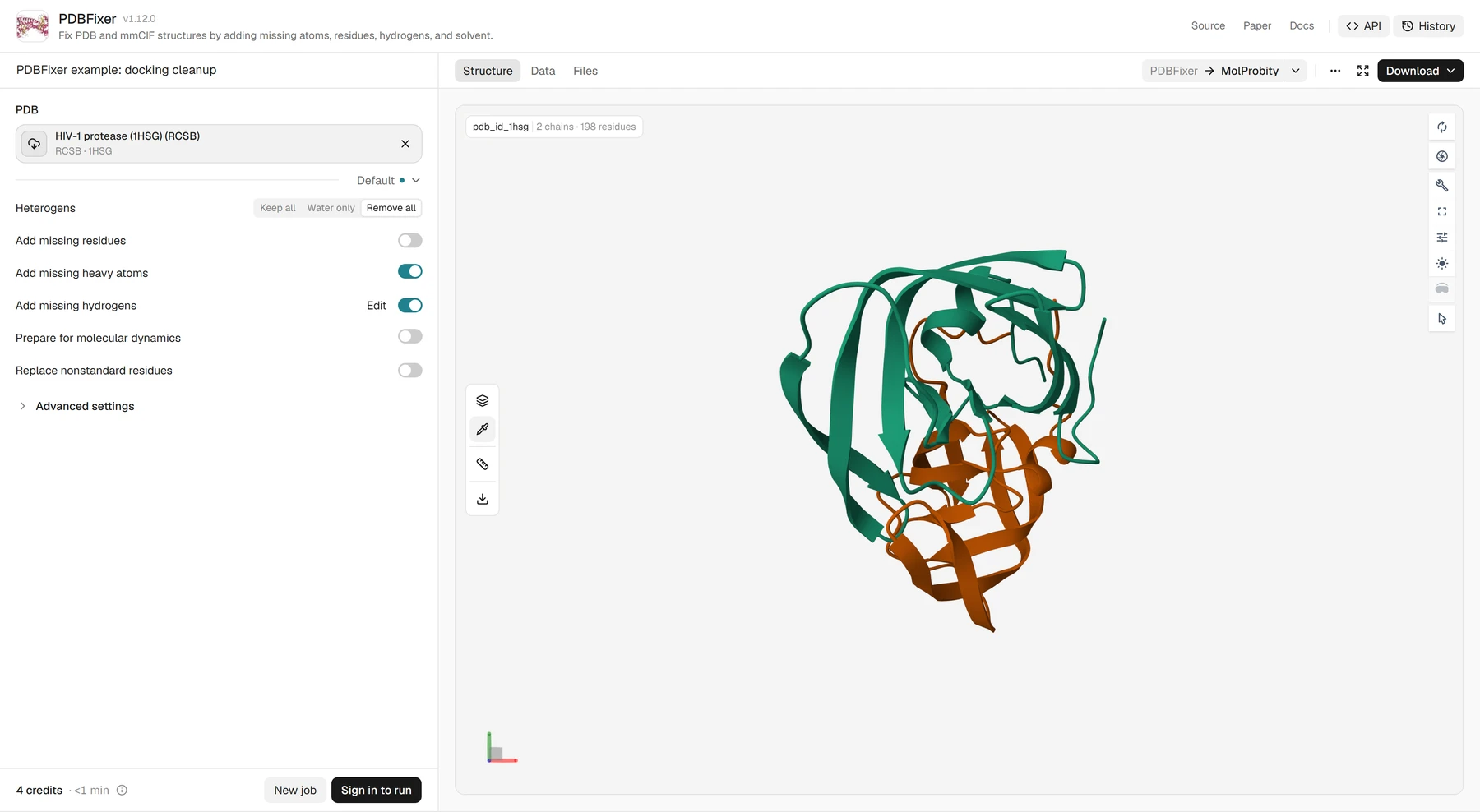
PDBFixer comes from Peter Eastman's OpenMM project at Stanford, where it prepares structures for molecular dynamics, and it is distributed under a permissive MIT-style license. Its README lists the repairs: missing heavy atoms and hydrogens, missing loops, nonstandard residues converted to standard ones, alternate locations resolved, and unwanted chains and heterogens deleted.[14] The 1.12 release came out on October 30, 2025.[14] It is part of the OpenMM project, whose reference paper is Eastman and colleagues' OpenMM 7.[15]
Docking cares about exactly the things PDBFixer controls. A cofactor you meant to keep can disappear with the other heterogens, and a pocket side chain truncated in the crystal structure changes the shape of the pocket Vina sees. In the example above, we kept the settings a docking run would want for 1HSG: all heterogens removed, missing heavy atoms rebuilt and hydrogens added at pH 7.0. The result is a protein-only file of 2 chains and 198 residues.
You do not always need it before Vina on ProteinIQ, because the Vina tool repairs standard residues with missing atoms during its own preparation (see below). PDBFixer earns its place when you want to choose what stays, rebuild loops, replace a nonstandard residue or use the same cleaned file in another program.
PDBFixer price: Free and open source. On ProteinIQ a cleanup costs 4 credits, and a free account gets 200 credits a month.
Meeko (Python, command line)
Meeko pros:
- The preparation tool Vina's own documentation uses, written by the lab that maintains Vina
- Prepares ligands for flexible macrocycle, covalent and hydrated docking, and converts Vina's output back to a bonded SDF
Meeko cons:
- A Python package with command-line scripts, no interface, and no way to pick the search box by clicking
Meeko is the Forli lab's package for turning small molecules and receptors into PDBQT files, and it is distributed under LGPL-2.1.[13] The version 0.8.0 release is dated August 27, 2026, and the one before it, 0.7.1, came out on October 23, 2025.[13] It ships three commands. mk_prepare_ligand.py converts a ligand, mk_prepare_receptor.py converts a receptor and can write the box file, and mk_export.py turns Vina's PDBQT output back into SDF.[9][10]
This is the step that replaces AutoDockTools in the Vina documentation. Its basic docking tutorial prepares both files with Meeko and mentions the ADFR suite's prepare_receptor only as an alternative that needs a receptor that already has all of its hydrogens.[10] Meeko's ligand preparation also carries the information that PDBQT loses. A PDBQT file has no bond orders, and mk_export.py uses what Meeko stored to restore them, which a plain Open Babel conversion has to guess.
Installing it is one line in a Python environment, pip install -U numpy scipy rdkit vina meeko gemmi prody, or the equivalent conda-forge command.[9] What you give up against PyRx is the picture: you choose box coordinates by reading them off a viewer, and the molecule never appears in a window of its own.
Meeko price: Free and open source.
Best way to run Vina without installing anything
Two tools run the whole chain from a browser, and they differ in where the computing happens. One runs on a server and handles larger jobs; the other runs inside your own tab and never uploads your structures.
AutoDock Vina on ProteinIQ (web)
AutoDock Vina on ProteinIQ pros:
- Receptor repair, PDBQT preparation, the box and the 3D result viewer sit in one form, with single-ligand, co-docking and batch modes
- Pins Vina 1.2.7 and records the preparation settings with every job
AutoDock Vina on ProteinIQ cons:
- Needs an account to run, and is built for individual jobs and small panels, not libraries of tens of thousands
ProteinIQ runs the official Vina Python package at version 1.2.7, the latest release, dated February 26, 2025 and distributed under Apache 2.0.[12] Version 1.2 added simultaneous docking of several ligands and Python bindings, which is what makes the hosted modes possible.[11] Receptor preparation uses Meeko 0.7.1 for complete structures. For structures with standard residues missing atoms, it can repair them with PDB2PQR 3.7.1 first, and you can pick either method yourself. A receptor you upload as PDBQT is used unchanged.
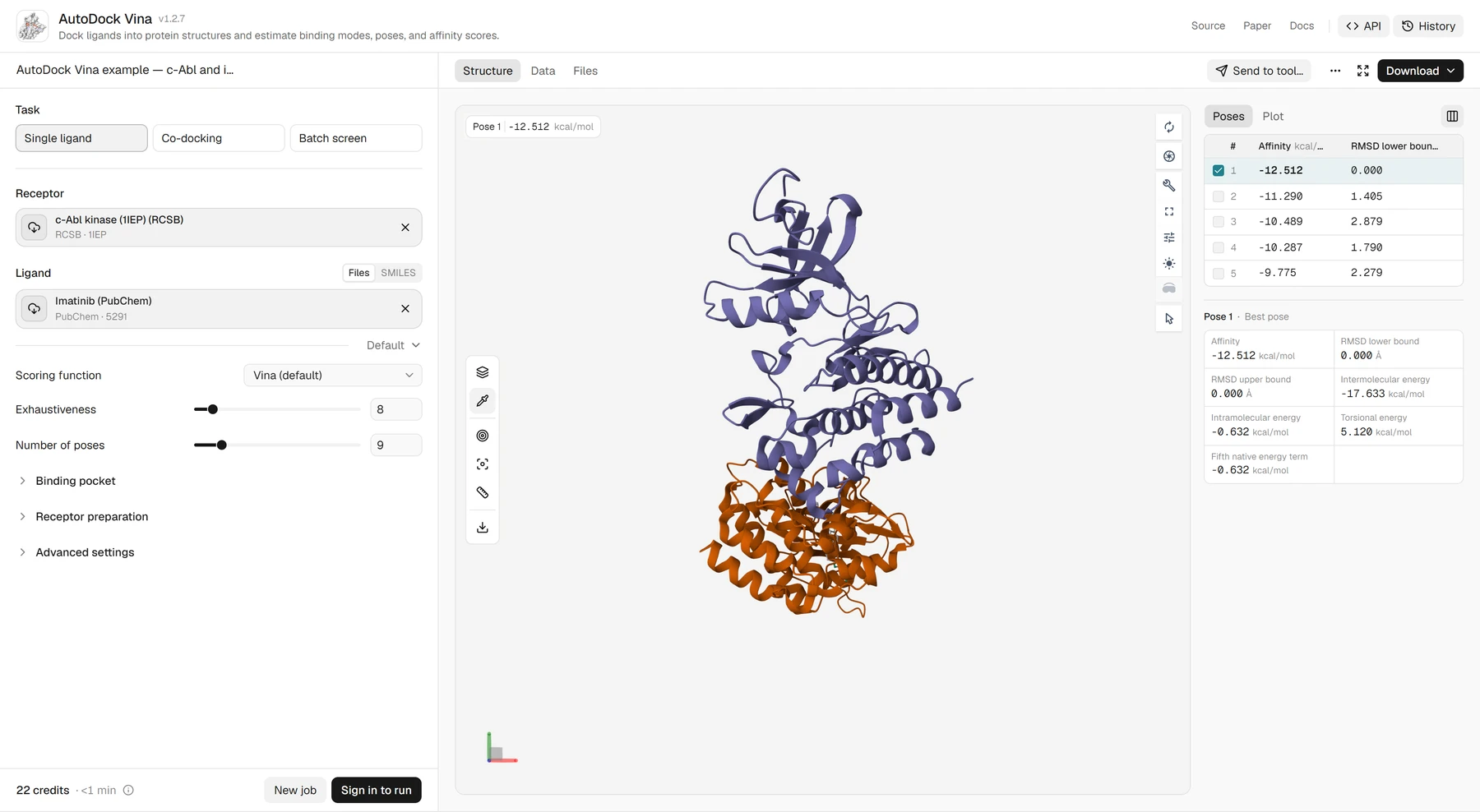
You fetch the receptor by PDB ID and the ligand by name or SMILES, and the Automatic box places itself around a co-crystallized ligand. The first figure is a redocking test: imatinib docked into its own crystal structure, 1IEP, returns a best pose of −12.512 kcal/mol, followed by −11.290. That number ranks poses of one ligand in one setup; as a docking score is not a binding affinity, it should not be read as a Kd.
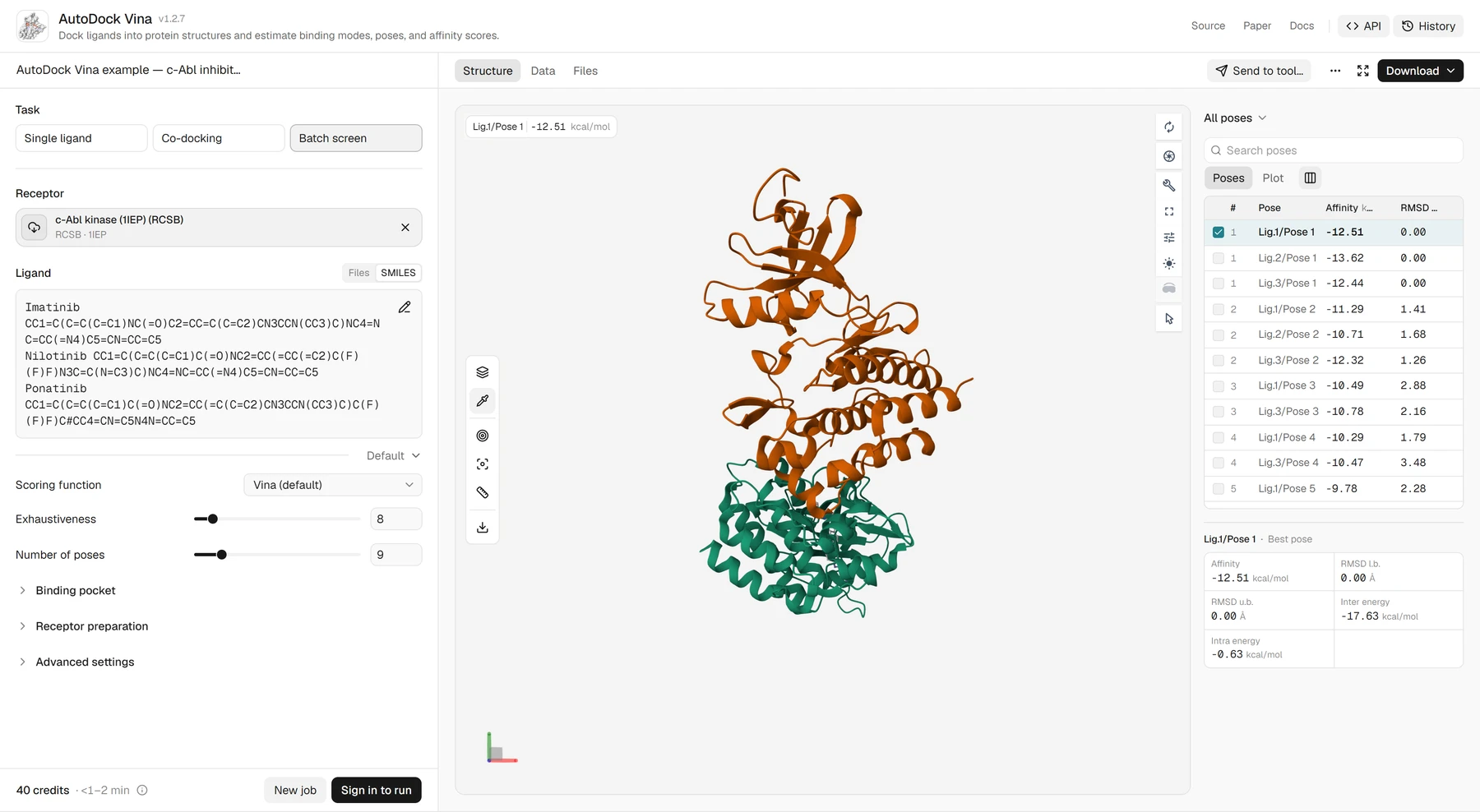
Modes cover what PyRx's wizard did for libraries. Co-docking takes up to 5 ligands at once, and batch mode takes up to 10 independent ligands, each limited to one connected molecule and 32 rotatable bonds. The second figure is a batch of imatinib, nilotinib and ponatinib against the same box, listed in one table. For a bigger library you want scripted Vina, or a virtual screening setup, not a form.
AutoDock Vina price: Free and open source. On ProteinIQ the quote for a single-ligand run starts at 15 credits and the example above cost 21; the batch of three cost 37. A free account gets 200 credits a month.
MolModa (web)
MolModa pros:
- Runs entirely in your browser, so structures never leave your machine
- Free for academic and commercial use, with no login or registration
MolModa cons:
- Browser-compiled programs run more slowly, and the authors say it is poorly suited to tens of thousands of compounds
MolModa comes from Jacob Durrant's lab at the University of Pittsburgh, and the Nucleic Acids Research paper describes it as downloading the analysis software to your browser and running the calculations there.[16] Protein preparation uses Reduce compiled to WebAssembly, ligand protonation and 3D coordinates come from Open Babel, pockets can be found with fpocket3 and docking runs a WebAssembly build of Vina 1.2.3.[16] It is the closest thing to PyRx's single-window experience, and unlike PyRx it needs no installation at all.
The price of running locally is speed. In the authors' benchmark a compound took about 10.1 seconds, and browser memory limits the size of a screen.[16] The latest release, 2026.8.4, dated August 4, 2026, added nucleic-acid receptors and PoseView diagrams.[17] The code is GPL-2.0, and the project is young: the paper has 31 Crossref citations against 3,319 for PyRx's chapter.[17][31]
MolModa price: Free. Code under GPL-2.0.
Best desktop interfaces for Vina
If you still want a program on your own machine with buttons, three remain. One lives in PyMOL, one is a free interface that replaced the old Python 2 toolchain with a Python 3 port, and one is commercial.
DockingPie (PyMOL plugin)
DockingPie pros:
- Runs Vina, Smina, RxDock and ADFR from inside PyMOL, so the box and poses live in the viewer you already use
- Supports consensus docking, comparing programs on the same ligand
DockingPie cons:
- Last release in November 2022, and on open-source PyMOL you install some dependencies by hand
Serena Rosignoli and Alessandro Paiardini published DockingPie in Bioinformatics in 2022, as a plugin that docks with Smina, AutoDock Vina, RxDock and ADFR, and uses AutoDockTools modules, Open Babel and sPyRMSD behind the interface.[18][19] It runs on Windows, macOS and Linux wherever PyMOL does, under GPL-3.0.[19]
The case for it is the viewer. You pick the pocket residues on the structure you already have open and see every pose in the same window. The case against it is age: the latest tagged release is 1.2.1 from November 26, 2022, and the last commit was in June 2024.[19] Check that your PyMOL version matches the one it asks for before relying on it. The paper has 90 Crossref citations.[31]
DockingPie price: Free and open source.
AMDock (Linux)
AMDock pros:
- A complete interface for Vina and AutoDock4 that handles preparation, the box, docking and results
- Moved off the Python 2 toolchain, bundling a Python 3 port of AutoDockTools
AMDock cons:
- Last release in January 2022, and the README describes a Linux build and a Linux-only conda install
Mario Valdés-Tresanco and colleagues published AMDock in Biology Direct in 2020 as a graphical tool that assists docking with Vina and AutoDock4.[20] The current environment installs AutoDockTools_py3, PyMOL, Open Babel and PDB2PQR on Python 3.9, so it no longer depends on the old Python 2 MGLTools.[21] Of the desktop options, it is the nearest in spirit to PyRx, and it was cited 381 times by Crossref's count.[31]
It is also the clearest picture of the aging problem. The last release, 1.6.2, is from January 3, 2022, and the last commit from August 2023.[21] If it works for you today on a Linux machine, it is a free way to keep a click-through workflow, but plan for no fixes.
AMDock price: Free and open source, GPL-3.0.
SAMSON AutoDock Vina Extended (desktop)
SAMSON AutoDock Vina Extended pros:
- Adds flexible side chains, ligand minimization and an interactive grid box to Vina inside SAMSON's molecular editor
- Free for academic and nonprofit non-commercial use
SAMSON AutoDock Vina Extended cons:
- Commercial use is $167.90 a month, and the extension sits in a paid plan on SAMSON's pricing page
OneAngstrom's extension for SAMSON, version 5.4.1 for SAMSON 2026 R1 (updated October 28, 2026), runs Vina with flexible side chains, ligand minimization and an interactive grid box, and the page says it docks and ranks thousands of ligands.[23] It is the only pick here with active development on a desktop interface. Academic and nonprofit use is free; commercial use is priced at $167.90 a month or $1,672.90 a year, with a 30-day trial.[23]
The pricing page lists the extension under the Expert plan, and the free plan includes one free extension of your choice. We could not confirm from the pages whether Vina Extended can be that one, so check before you count on it.[24] The listed prices are indicative conversions of a euro price.
SAMSON AutoDock Vina Extended price: Free for academic and nonprofit non-commercial use; $167.90 a month or $1,672.90 a year commercial.
Is PyRx still free, and can you still use AutoDockTools?
PyRx's current versions are paid. The site sells 1.2 as a perpetual license, at $994.58 for academics and nonprofits using a coupon and $1,989.16 otherwise, and sells bundles that add Smina or Dockamon.[1] The free option is version 0.8 and earlier, which the site calls no longer supported. PyRx 1.2, released May 27, 2025, added binding-site detection, a box option built from a detected site and AlphaFold DB fetching, and the newest release, Dockamon-PyRx 1.2, came out on July 5, 2025.[2]
AutoDockTools still downloads. The Sanner Lab page serves MGLTools 1.5.7 for Windows, macOS and Linux with no registration, plus patched Linux builds 1.5.6p1 and 1.5.7p1 dated late 2022, and says MGLTools does not work under macOS Catalina.[6][7] The ADFR suite that supplies prepare_receptor ships its own Python 2.7 interpreter, which is the part of the toolchain that has aged most visibly.[8] If a pipeline already works, nothing forces you to move it. A new project is where the choice matters.
The Vina documentation does not call AutoDockTools unsupported; it lists it as the long-standing GUI alongside Meeko and the ADFR suite.[9] Treat the move off it as a maintenance decision, not a correctness one.
Other tools to consider
UCSF ChimeraX, version 1.12 from June 11, 2026, has a Dock Prep tool that deletes waters, repairs truncated side chains, adds hydrogens and assigns charges, but it writes Mol2 and not PDBQT.[25] ViewDock opens Vina PDBQT output beside results from other programs.[26] A UCSF developer said in 2023 that ChimeraX has no Vina interface, and we found no later release note adding one.[28] ChimeraX is free for academic, government, nonprofit and personal use.[27]
The ADFR suite's prepare_receptor and prepare_ligand remain the closest drop-in for ADT's PDBQT conversion, under a source-available license, but they need the Python 2.7 interpreter that ships with the suite.[8] AutoDockTools_py3 is a Python 3 translation whose README says it is under test.[22]
If you only need one pose and no setup, web servers dock with Vina too. CB-Dock2 runs Vina 1.1.2 with cavity detection and template fitting and has been cited 2,165 times by Crossref's count.[29][31] SwissDock 2024 offers Vina 1.2.5 or its Attracting Cavities engine and asks for ligand files with all hydrogens and 3D coordinates.[30]
Which alternative should you choose?
If you are replacing PyRx for one or two docking runs, start with AutoDock Vina on ProteinIQ or MolModa, depending on whether you are willing to sign in. The browser route is the shortest way to a pose, and MolModa is the one that never uploads a structure.
If you dock regularly or in bulk, learn the Meeko and Vina command line. It is two scripts and a config file, and it is what the Vina documentation teaches, so every error you meet is one other people have seen. PDBFixer belongs in front of it whenever the structure is not clean.
If you live in PyMOL, try DockingPie but check it against your PyMOL version first. If you are on Linux and want free buttons, AMDock still works but will not get fixes. If you need flexible side chains and are in industry, SAMSON is the only commercial option here, and academics can use it free.
Paying for PyRx still makes sense when a lab or course already runs on it, and its screening wizard and new binding-site detection are the thing you want. For a new project, the free chain above covers the same steps.
FAQ
Is PyRx free?
Version 0.8 and earlier is free, but the site says it is no longer supported.[1] PyRx 1.2 is a perpetual paid license, at $994.58 for academics and nonprofits with a coupon and $1,989.16 otherwise.[1]
What replaces AutoDockTools for Vina?
Meeko replaces it for file preparation, and the Vina documentation uses it in place of AutoDockTools in its basic tutorial.[10] For repairing a receptor first, use PDBFixer. ChimeraX Dock Prep repairs one too but does not write PDBQT.[25]
Do I still need MGLTools to run Vina?
No. Vina is a standalone program and Python library, and Meeko writes the PDBQT files it reads.[9] MGLTools 1.5.7 is still downloadable if you want to keep using it.[7]
Can I run AutoDock Vina in a browser?
Yes. MolModa runs Vina 1.2.3 inside your browser tab, and ProteinIQ runs Vina 1.2.7 on a server from a browser account.[16][12]
Is there a free PyRx alternative on Windows?
MolModa and ProteinIQ run in a browser on any system, and DockingPie runs wherever PyMOL does.[16][19] AMDock's README describes a Linux build.[21]