LogP vs logD: what lipophilicity numbers mean
Two partition coefficients that agree only when nothing is charged

Matic Broz, PhD12 min
What is the difference between logP and logD?
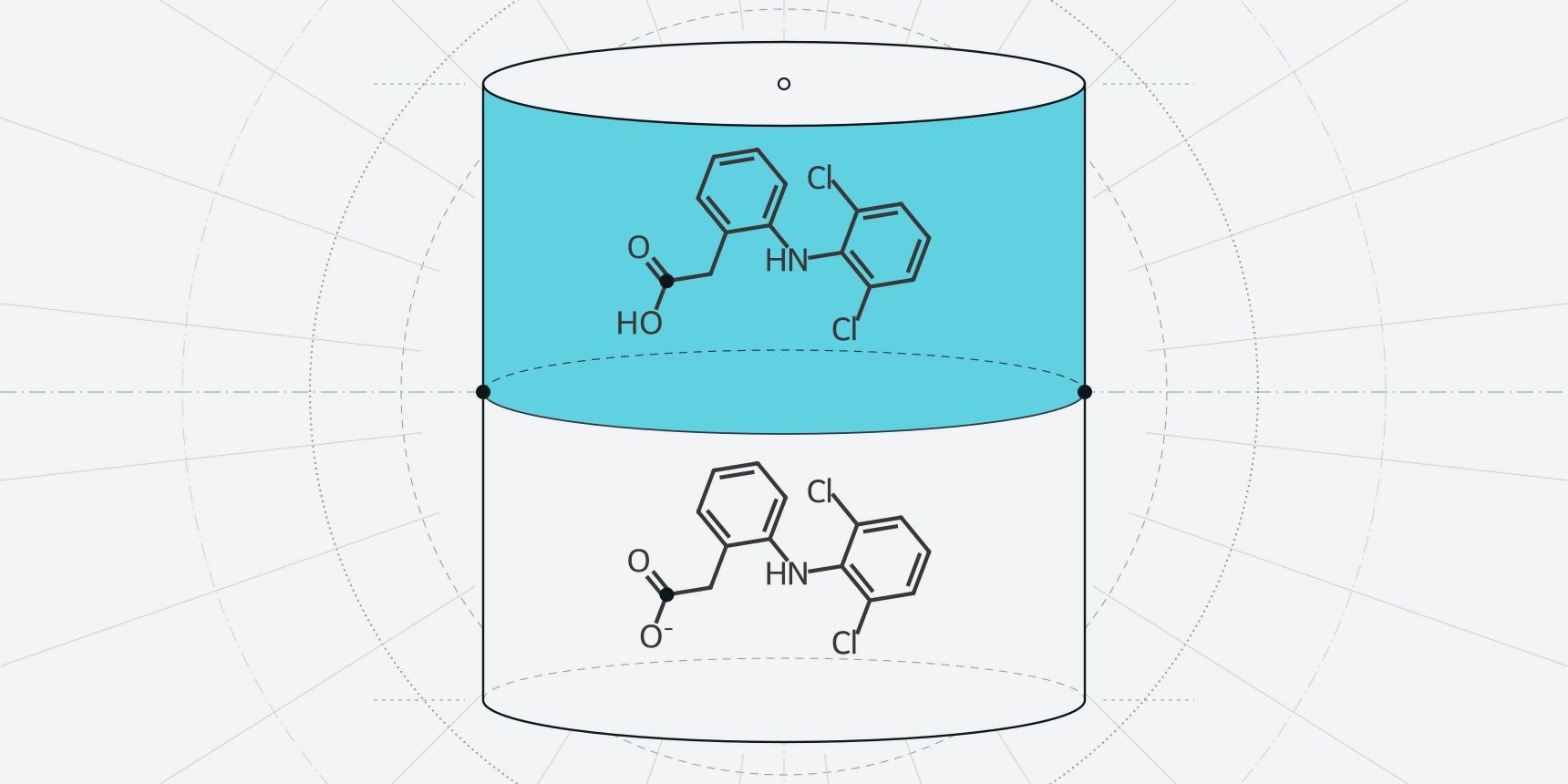
LogP is the logarithm of how the neutral form of a molecule divides between octanol and water. LogD is the same ratio counted over every form the molecule takes at a stated pH, charged ones included. For a compound that never ionizes the two are equal; for an acid or a base, logD is lower whenever part of it carries a charge.
The gap can be large. Diclofenac has a measured logP of 4.51, which reads as strongly lipophilic, yet its logD at pH 7.4, measured by AstraZeneca, is 1.08.[16][2] That is a 2,700-fold difference in how much of the drug sits in octanol, and the logD value is the one that applies in blood. ADMET-AI prints both kinds of number in the same row for every molecule, in columns named LogP and Lipophilicity, and the second one is a logD model.
Three things decide which number you are looking at: whether it describes only the neutral species (logP) or all species at one pH (logD), whether it was measured or calculated (cLogP), and the molecule's pKa, which sets how far apart the two drift.
 ADMET-AIAspirin: a calculated logP of 1.31 and a predicted logD7.4 of −0.99 in the same results row.Open example
What a log P value means
P is the equilibrium concentration of the neutral compound in octanol divided by its concentration in water. Octanol stands in for a cell membrane, a choice Leo, Hansch and Elkins set out in 1971.[1] A log P of 0 means equal concentrations, 3 means 1,000 to 1 in favour of octanol, and 5, the limit in Lipinski's rule of five, means 100,000 to 1. A negative log P means the compound prefers water: caffeine sits at −0.07, close to even.[16]
Measured values have their own spread. The OECD shake-flask method covers log P from −2 to about 4, and above that an HPLC method that infers log P from retention time covers 0 to 6, with results within about 0.5 units of shake-flask values.[4][5] PubChem lists 4.51, 4.26 and 3.9 for diclofenac from different sources, so even a "measured" logP can carry half a log unit of disagreement.[16]
How logD follows pH and pKa
LogD counts every species, so it depends on how much of the molecule is ionized. If only the neutral form enters octanol, the relation for a monoprotic acid is logD = logP − log₁₀(1 + 10^(pH − pKa)), and for a base the exponent becomes pKa − pH.[6] Each pH unit past the pKa costs one log unit of logD. Diclofenac, a carboxylic acid with pKa 4.15, is more than 99.9% ionized at pH 7.4; with these equations its logD7.4 comes out at 1.26, close to the 1.08 that AstraZeneca measured.
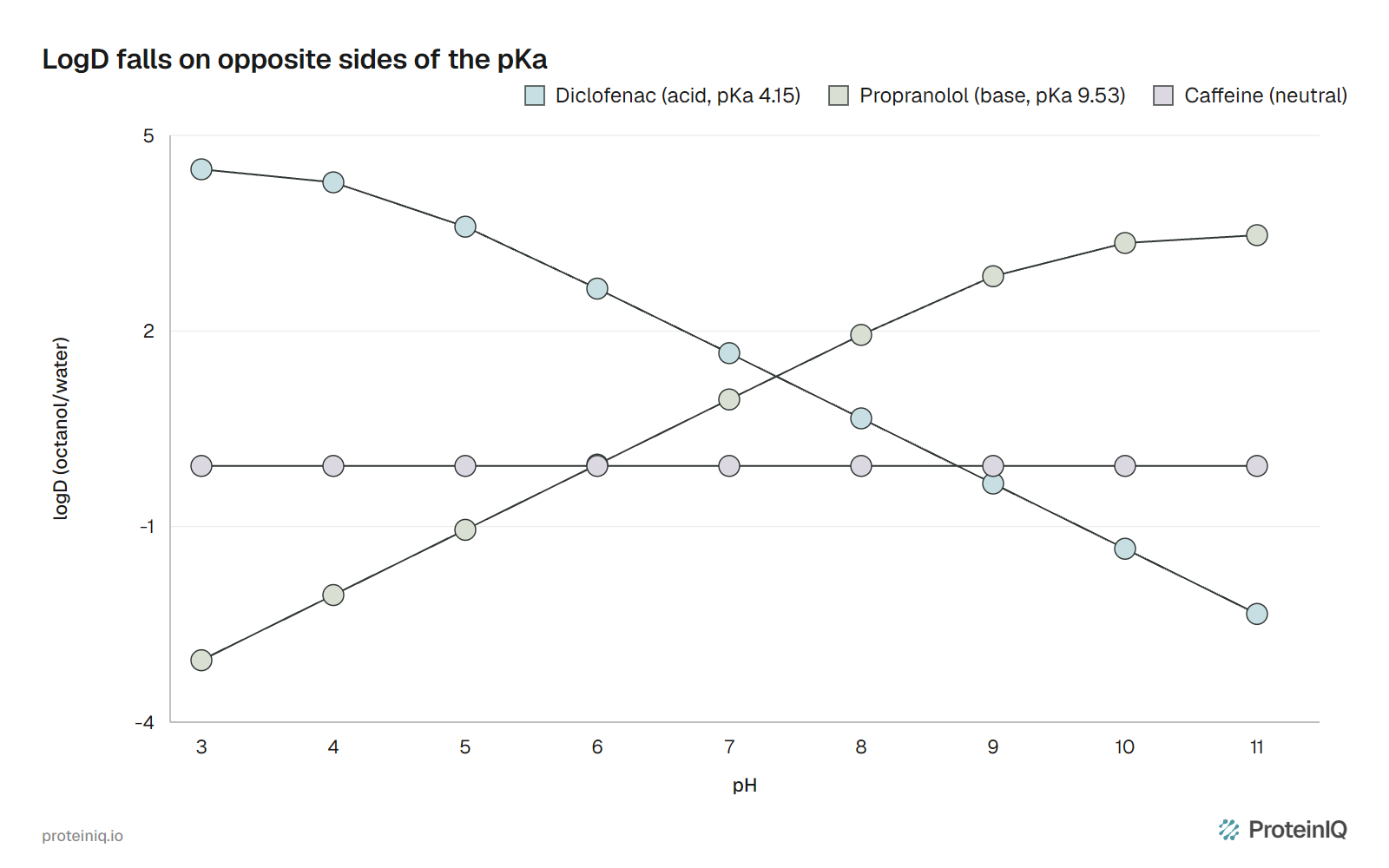
Figure 1 shows the mirror image. The acid is lipophilic in the stomach and loses lipophilicity as the pH rises; the base does the opposite. Propranolol (logP 3.48, pKa 9.53) and diclofenac happen to cross near pH 7.4, where both sit at a logD around 1.3, although their logP values differ by a full unit.
The catch is that ions do enter octanol, usually paired with a counterion from the buffer. Abraham and Acree found that the drop from a neutral molecule's partition to its ion's depends on the functional group; there is no constant offset.[7] Far from the pKa this puts a floor under logD, so measured profiles flatten where Figure 1 keeps falling. Near pH 7.4 the simple equation still shows which way logD moves and roughly how far.
To get the pKa itself, predict pKa online in SketchIQ. It runs MolGpKa in the browser and plots logD from pH 0 to 14, with the same assumption as Figure 1 that charged forms stay in water.
LogP vs cLogP
Very few logP values in a drug discovery spreadsheet were measured. Most are calculated, and "cLogP" means calculated logP in general. Strictly, ClogP is also the name of one program, the fragment method from Leo's group at Pomona College, now sold by BioByte.[8] Each calculator carries its own name, and Table 1 lists the ones a reader is most likely to meet.
| Name | Method | Where you meet it |
|---|---|---|
| ClogP | Sums fragment values with correction factors (Leo and Hansch) | BioByte, ChemDraw, older medicinal chemistry papers |
| Crippen logP (SlogP, MolLogP) | Sums contributions from classified atom types (Wildman and Crippen) | RDKit, MOE, SketchIQ, Molecular descriptors, ADMET-AI's LogP column |
| XLogP3 | Atom-additive model that starts from the measured logP of the most similar known compound | PubChem compound pages |
| MLogP | Regression on counts of structural features (Moriguchi) | Lipinski's rule of five, with its own limit of 4.15 |
The methods disagree more than their decimals suggest. For haloperidol, measured at 4.30, XLogP3 gives 3.2 and Crippen 4.43; for caffeine, measured at −0.07, Crippen gives −1.03.[16] XLogP3 matches imipramine and warfarin exactly, which may say more about the compounds it was built from than about a new scaffold. Lipinski's rule itself sets two different limits, cLogP over 5 or MLogP over 4.15, because the two methods run on different scales.[12]
Mannhold and colleagues tested 30 methods on 266 public compounds and 18 on in-house sets from Nycomed (882 compounds) and Pfizer (95,809).[11] Only seven stayed acceptable on both company sets, accuracy fell as molecules grew, and a two-term equation counting carbons and heteroatoms beat many of the programs.
Expect a calculated logP to be off by up to a log unit on an unfamiliar series; in our own check below, 77% of non-ionizable compounds fell within one unit of measurement. Treat smaller differences between analogues as noise.
To calculate log P for one molecule, draw it in SketchIQ, which shows a Crippen cLogP among its properties. For a list of SMILES, Molecular descriptors returns the same value with TPSA, donors and acceptors, and the Lipinski's rule of 5 calculator adds the violation count.
Aspirin through every lipophilicity number
The ADMET-AI example for aspirin puts logP and logD in one results row. The LogP column, calculated with RDKit's Crippen method, reads 1.310, close to the measured 1.19.[16] The Lipophilicity column reads −0.987. It comes from a Chemprop model trained on the AstraZeneca logD7.4 set described below, so it predicts logD at pH 7.4, not logP.[13]
Aspirin's carboxylic acid is almost fully ionized at pH 7.4, so a gap of 2.3 log units between the two columns is expected, not a disagreement between models. A reader who filters on "lipophilicity" without knowing which column they picked can be off by a factor of 200.
The other numbers split the same way. For the neutral molecule the calculators agree: measured logP 1.19, XLogP3 1.2, Crippen 1.31.[16] The logD estimates do not. With a pKa of 3.49, the Henderson-Hasselbalch equation gives a logD7.4 of −2.72, while ADMET-AI predicts −0.99.
Two explanations fit, and nothing here decides between them: ion partitioning puts a floor under aspirin's logD that the equation ignores, or the model never saw a value below −1.5, the lowest in its training set. Either way, aspirin at pH 7.4 is far less lipophilic than its logP suggests.
Calculated logP against 4,200 measured logD values
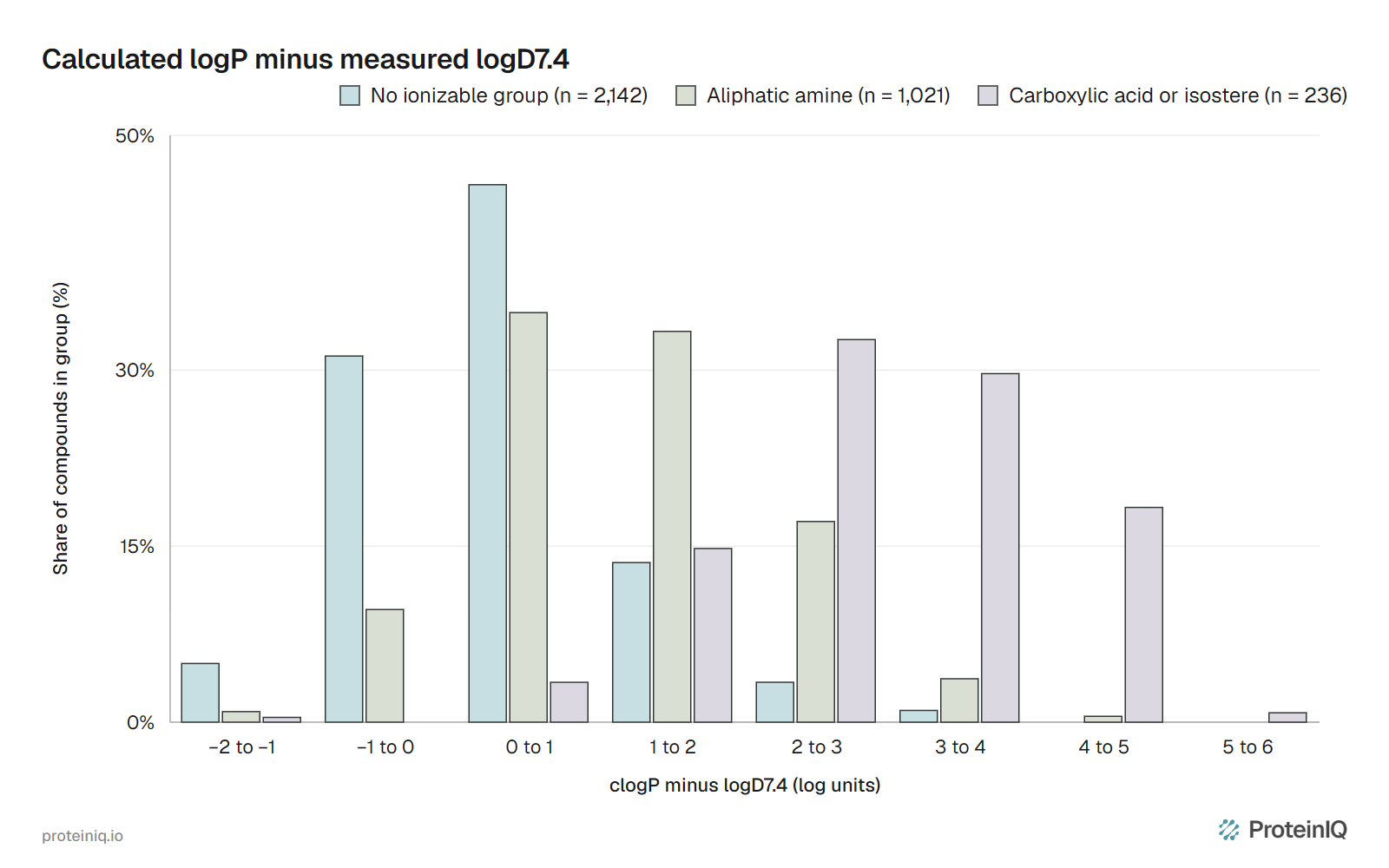
How far does calculated logP drift from logD in a real collection? AstraZeneca deposited shake-flask logD7.4 values for 4,200 compounds in ChEMBL, measured in octanol and pH 7.4 buffer.[2][3] We calculated the Crippen logP of each with RDKit 2025.03.5 and subtracted the measured logD. Values in the set run from −1.5 to 4.5, so we kept the 3,490 compounds with a calculated logP of 4.5 or less, where that window cannot cut the gap short.
For the 2,142 compounds with neither group, the median gap was 0.23 log units, and 77% fell within one unit. That is the baseline: calculation error plus any offset between Crippen's training data and this assay. Compounds with an aliphatic amine had a median gap of 1.14, and 21% exceeded two units. For the 236 carboxylic acids and isosteres the median was 2.96, 81% exceeded two units and only 3% fell within one.
Subtract the baseline and ionization alone costs acids about 2.7 log units at pH 7.4 and amines about 0.9. Amines probably lose less because many have a pKa only one or two units above 7.4, which leaves a measurable neutral fraction, while carboxylic acids with a pKa of 4 to 5 are almost entirely charged. A substructure match is a rough proxy for ionization, and a morpholine or a weakly basic piperazine behaves more like a neutral compound than its label suggests.
Which lipophilicity number to use
The most common mistake is using a logP where the decision depends on charge. Table 2 matches questions to the number that answers them.
| Question | Use | Check |
|---|---|---|
| Does a compound pass a rule-of-five or similar filter? | The calculated logP the rule was defined with | Which method: Lipinski's limit is 5 for cLogP and 4.15 for MLogP |
| Is an analogue more lipophilic than its parent, with no change in ionizable groups? | Calculated logP from one method | That the difference exceeds about one log unit |
| Will an acid or base cross membranes, bind plasma proteins or reach the brain? | logD7.4, measured or from logP and pKa | The pKa of every ionizable group |
| How does absorption change along the gut? | logD at the local pH, acidic in the stomach and near neutral in the intestine[6] | Whether the compound changes charge in that range |
| How efficiently does potency come from lipophilicity? | Lipophilic ligand efficiency, pIC50 minus cLogP or logD | That compared compounds use the same lipophilicity measure |
Leeson and Springthorpe defined lipophilic ligand efficiency with calculated logP and argued that potency bought with lipophilicity is a poor bargain.[14] Waring's review ties higher lipophilicity to poorer solubility, faster metabolism and more off-target binding.[15] Whichever measure a project chooses, record its name next to every value, because "logP 3" from ChemDraw, RDKit and a shake flask are three different numbers.
Lipophilicity tools on ProteinIQ
Calculate logP first, add pKa for anything ionizable, then predict logD and the properties that depend on it, as in an ADMET prediction workflow.
- SketchIQ: draw a molecule to see its cLogP, predicted pKa and logD at any pH
- Molecular descriptors: calculate Crippen logP, TPSA and other descriptors for a list of SMILES
- Lipinski's rule of 5: check logP, size and hydrogen bonding against the rule's limits
- ADMET-AI: predict logD7.4 (the Lipophilicity column), solubility, permeability and toxicity endpoints for a library
- Admetica: a second set of ADMET models to compare against ADMET-AI
 Molecular descriptorsCalculate Crippen logP, TPSA, donors and acceptors for every SMILES in a file.Open tool
Frequently asked questions
Is logP the same as logD?
Only for a molecule that carries no charge at the pH in question. LogP describes the neutral form alone, while logD includes every form present, so for an acid or base logD is lower. Diclofenac has a logP of 4.51 but a measured logD7.4 of 1.08.[16][2]
What is a good log P value for a drug?
Lipinski's rule flags a calculated logP above 5, because such compounds tend to dissolve and absorb poorly.[12] In our count of 2,104 approved small-molecule drugs, 12.8% exceed that limit. For an acid or base, logD7.4 is the better guide to how the molecule behaves in the body.
What does a negative log P mean?
The compound prefers water to octanol. A logP of −1 means ten times more in water than in octanol at equilibrium. Caffeine, at −0.07, sits almost exactly at the point where the two phases hold equal amounts.[16]
What is the difference between logP and cLogP?
LogP is a measured property; cLogP is a calculated estimate of it. Methods such as ClogP, Crippen logP and XLogP3 can differ from each other and from measurement by a log unit or more, as they do for haloperidol.[16] Always note which method produced a value.
How do you calculate log P?
Draw the molecule in SketchIQ or paste its SMILES into Molecular descriptors, which use the Crippen atom-contribution method.[9] To get logD instead, combine that logP with the pKa of each ionizable group, or use a model trained on measured logD such as ADMET-AI's Lipophilicity endpoint.