Antibody developability assessment
Screen a set of antibody or nanobody candidates for surface patches, viscosity, polyreactivity, aggregation, solubility and humanness, then hand your team one table of flags before any gene is ordered.
Number and model the domains
Number the variable domains so CDRs are read the same way across candidates, and predict a structure for the checks that need one. ANARCII does the numbering, and ImmuneBuilder models antibodies and nanobodies.
Profile surface patches
TAP2 and TNP compare CDR length and surface patches with clinical-stage antibodies and nanobodies. DeepSP predicts aggregation and charge descriptors from sequence, and Aggrescan3D scores aggregation per residue on a structure.

TAP2
Profiles a paired Fv for CDR length, hydrophobic and charge patches, and Fv charge symmetry against 664 clinical-stage antibodies.
TNP
Profiles a nanobody for CDR3 length and compactness and surface patches against 36 clinical-stage nanobodies.

DeepSP
Predicts 30 spatial aggregation and charge descriptors from paired Fv sequences without a structure.

Aggrescan3D
Scores aggregation propensity per residue on a modeled or experimental structure.
Predict viscosity and polyreactivity
Both classifiers take a paired Fv sequence and return a low or high call. DeepViscosity predicts viscosity at 150 mg/mL and PolyXpert predicts polyreactivity. Neither replaces a measured assay.
Check solubility, humanness and liabilities
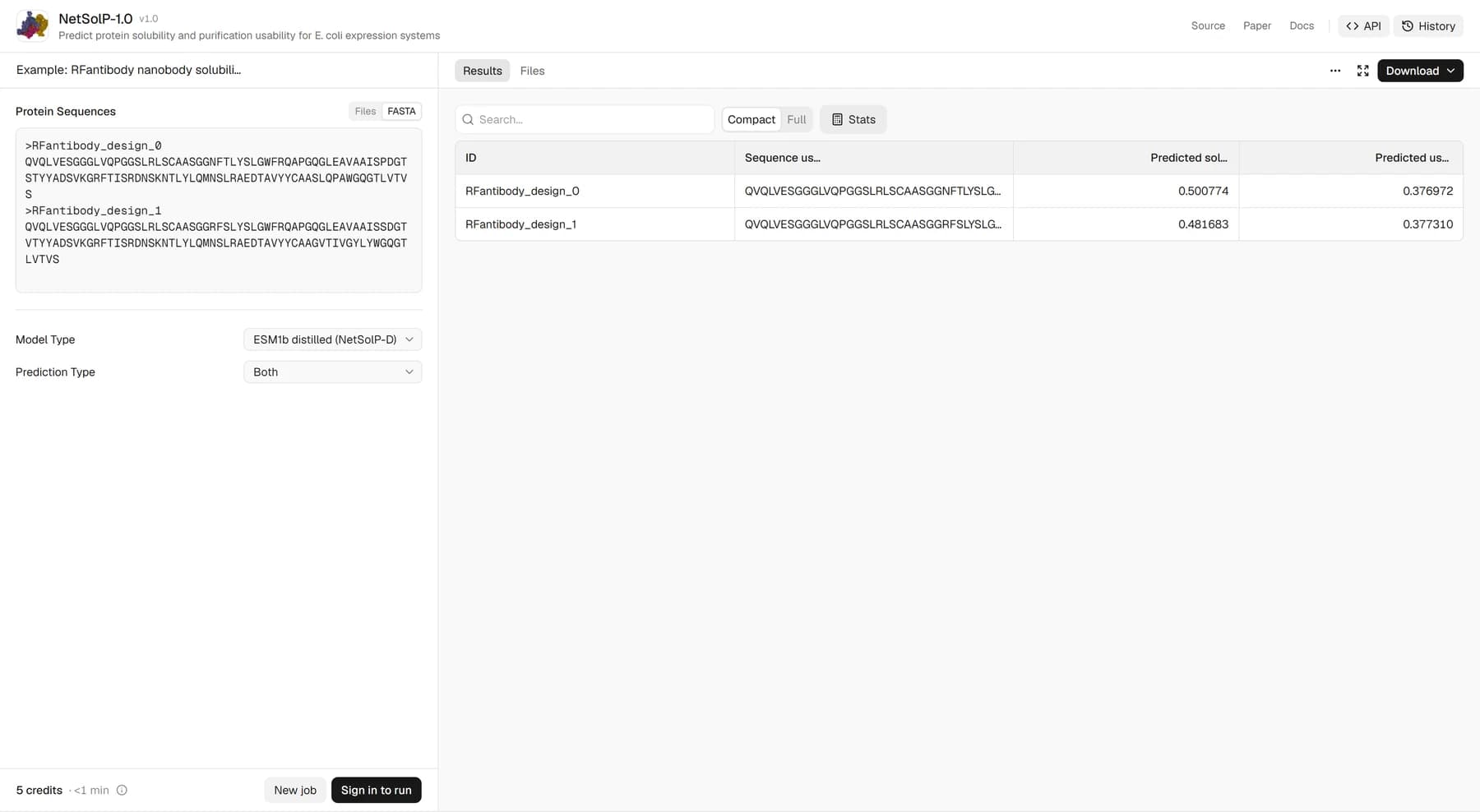
NetSolP and Protein-Sol predict solubility from sequence, BioPhi scores humanness, and the glycosylation finder lists N-linked sequons, including those in CDRs. NetSolP puts two RFantibody nanobody designs at 0.50 and 0.48.

NetSolP-1.0
Predicts solubility and usability for expression from sequence.
Protein-Sol
Estimates solubility from sequence features as a second opinion.

BioPhi
Scores humanness with OASis and shows the non-human peptides in each chain.

Glycosylation site finder
Finds N-linked glycosylation sequons, including those in CDRs.


More antibody engineering workflows
What is antibody developability assessment?
Antibody developability assessment is the process of predicting whether an antibody or nanobody candidate can be expressed, purified, formulated and stored as a drug, using its sequence and a modeled structure instead of laboratory assays. It looks for the properties that cause trouble in manufacturing: aggregation, high viscosity at injection concentrations, poor solubility, polyreactivity, unusual charge and hydrophobic surface patches, and sequence motifs that degrade or carry a glycan.
A design or panning campaign rarely ends with one winner. It ends with 20 to 500 sequences that all bind, and the question shifts from "which one binds best" to "which ones will survive CMC". Two candidates with the same affinity can differ sharply in viscosity at 150 mg/mL or in how much of the protein aggregates, and you usually learn that only after synthesis, expression and weeks of bench work.
Computational assessment puts that filter first. It cannot replace the assay, but it can move the worst offenders to the bottom of the list so that the first round of expression and chromatography covers candidates that stand a chance.
When to use antibody developability assessment
Run the checks when a candidate set is still too large to express:
- A design campaign or display selection has produced dozens to hundreds of binders and you need to cut the list before ordering genes.
- Affinity maturation or humanization has produced variants of one lineage and you want to see whether they gained a liability.
- A lead has a suspicious early result, such as late elution on a hydrophobic interaction column, and you want to see which region drives it.
- You are comparing nanobody and antibody formats before choosing which to develop.
Strengths and limitations
Most of the models here need only paired variable-domain sequences, so a whole panel can be scored before any protein exists. Because they test different properties, a candidate that looks clean on surface patches can still be flagged for viscosity or polyreactivity, and the disagreement tells you which assay to run first.
The models are trained on small public datasets. DeepViscosity, for example, learned from 229 antibodies, so a candidate far from that chemistry can receive a confident score that carries little information. Flags describe position in a reference set, not pass or fail, and formulation, Fc and concentration effects are outside what a variable-domain sequence can say.
Which properties decide whether a candidate can be made
Developability is not one number. Each property has its own mechanism and its own follow-up assay, so a report should keep them separate. The table maps the properties a CMC team asks about to the ProteinIQ tool that estimates them.
| Property | Why it matters | Where it is estimated |
|---|---|---|
| Surface hydrophobicity and charge patches | Drive self-association, nonspecific binding and fast clearance | TAP2 for antibodies, TNP for nanobodies, DeepSP |
| Viscosity at high concentration | Limits subcutaneous dosing, which needs concentrated formulations | DeepViscosity |
| Polyreactivity | Predicts off-target binding that shortens half-life | PolyXpert |
| Aggregation propensity | Aggregates cost yield and raise immunogenicity concern | Aggrescan3D on a modeled structure, CANYA on sequence |
| Expression solubility | Poor solubility fails at the first purification | NetSolP, Protein-Sol |
| Humanness | Non-human 9-mers raise the risk of an anti-drug response | BioPhi |
| N-linked glycosylation sites | A sequon in a CDR adds heterogeneity and can alter binding | Glycosylation site finder |
| Sequence stability indicators | Instability index, hydropathy and charge flag odd compositions | Protein stability prediction |
The checks ProteinIQ runs
The surface-patch tools work on a modeled Fv, so the first step for most of them is a structure. TAP2 and TNP build it themselves with ABodyBuilder2 and NanoBodyBuilder2, and Aggrescan3D reads any structure you give it, including one from ABodyBuilder3 or ImmuneBuilder. Sequence-only tools skip that step, which makes them the cheapest first pass.
TAP2 reports five metrics for a paired VH and VL: total CDR length, surface hydrophobicity (PSH), positive and negative charge patches (PPC, PNC) and the symmetry of Fv charge (SFvCSP). Each gets a green, amber or red flag against a fixed reference set of 664 clinical-stage therapeutics. TNP does the same for single-domain VHH, adding CDR3 length and compactness, against 36 clinical-stage nanobodies.
DeepSP predicts 30 spatial descriptors for each candidate (spatial aggregation propensity and positive and negative charge maps across the CDRs and variable domains), and its published models matched molecular dynamics values with an average correlation of 0.87.
DeepViscosity feeds those descriptors to 102 neural networks and returns a low or high class at the 20 cP threshold, measured at 150 mg/mL, plus a mean probability. It does not predict a viscosity in cP.
PolyXpert classifies paired Fv sequences as low or high polyreactivity with a fine-tuned ESM-2 model. BioPhi scores humanness with OASis, which counts how many 9-mers of a sequence appear in at least a chosen share of human repertoires. Its documentation states that it does not predict aggregation, viscosity or specificity, so it complements the other tools rather than replacing them.
| Tool | Input | Returns | Scale |
|---|---|---|---|
| TAP2 | One VH and one VL | Five metrics with flags, modeled PDB | One pair per job; run a set as a batch |
| TNP | One or more VHH in FASTA | Six metrics with flags, modeled PDB | Several nanobodies per job |
| DeepSP | CSV of Name, Heavy_Chain, Light_Chain | 30 spatial descriptors | Up to 100 antibodies per job |
| DeepViscosity | The same CSV | Viscosity class, mean probability, descriptors | Up to 100 per job, 32 credits per job |
| PolyXpert | TSV of Name, VH, VL | Class probabilities and label | Up to 1,000 pairs per job on the largest plan |
| BioPhi | Paired VH and VL FASTA | OASis identity, percentile, non-human peptides | 30 credits per paired antibody |
| Aggrescan3D | One structure | Residue scores, per-chain summaries | 5 credits per structure |
Running a whole candidate set as one batch
A developability review is a table of candidates against checks, and the table is only useful if every candidate went through every check with the same settings.
In ProteinIQ the sequence-table tools take the whole panel in one file, so one DeepSP job covers up to 100 antibodies and one PolyXpert job up to 1,000 on the largest plan. For tools that handle one antibody at a time, batch mode creates one job per candidate, up to 250 in one batch on a paid plan, and shows the credit estimate before you submit.
Each job keeps its inputs, settings, tool version and files, so the results can be exported side by side and shared with the CMC and project teams. The workflow template runs BioPhi, NetSolP and Protein stability prediction from one FASTA of sequences; the structure-based and table-based checks run as separate jobs and join it by candidate name.
How to assess antibody developability online
- Trim every candidate to its variable domains. Remove signal peptides and constant regions, keep each VH with its own VL, and give each pair a stable name. If the boundaries are uncertain, number the sequences with ANARCII and keep the numbered region.
- Build one table of candidates (Name, Heavy_Chain, Light_Chain) and run DeepSP, DeepViscosity and PolyXpert on it. These need no structure and return a result for every row in one job.
- Run TAP2 on each pair, or TNP on each nanobody, as a batch. Download the metric tables and keep the modeled PDB files for the candidates you may inspect later.
- Score humanness with BioPhi at one fixed prevalence threshold for the whole project, then screen the sequences with NetSolP and Protein-Sol for expression solubility.
- Check CDRs for N-linked glycosylation sequons with the Glycosylation site finder, and run Aggrescan3D on the modeled structures of candidates that reached the shortlist to see which residues drive an aggregation signal.
- Merge the outputs by candidate name. Mark each candidate with its red and amber flags, note which properties disagree between tools, and choose the assays to run first.
How to read the flags
A red TAP2 flag means a metric lies outside the range seen among clinical-stage antibodies, not that the candidate will fail. Amber marks a tail of that range. TAP2 keeps its five metrics separate and gives no overall score, and so does TNP, so ranking by number of red flags is a convention you choose, not a result the tool reports.
Treat the same candidate across tools as a weight of evidence. A high PSH, a high DeepSP aggregation descriptor and a high-viscosity class from DeepViscosity point at the same hydrophobic CDR surface, and that is a stronger case for an assay than any one of them. A single red flag with everything else clean usually deserves a look at the residue table, not a rejection.
Check the modeled structure before trusting a surface metric. TAP2 and TNP store the predicted error of each residue in the B-factor column, and their structures come from predictors with no fixed seed, so a metric close to a band edge can move between runs. Repeat the run and compare numbers, not colors.
Two cautions apply to the sequence classifiers. DeepViscosity assigns the high class when the mean probability is at least 0.5, and a value of 0.8 means the ensemble leans high, not that the viscosity is 80 cP. NetSolP's published decision threshold is 0.69, but its scores are model outputs rather than calibrated probabilities, and it was trained for expression in E. coli, which is not how most antibodies are made.
What developability predictions cannot tell you
These tools score variable-domain sequence and a predicted Fv. They do not model the Fc, the formulation buffer, the pH, excipients, concentration effects or the production cell line, and they do not scan for deamidation or isomerization motifs. A clean profile therefore does not clear a candidate, and a red flag does not eliminate one.
Use the output to decide the order of work.
Express and test the candidates with the fewest flags first, add the best of the flagged ones as controls for the assay, and treat the predicted properties as hypotheses that hydrophobic interaction chromatography, size-exclusion chromatography, self-interaction and viscosity measurements confirm or reject. After the first panel, compare what each tool predicted with what the assays measured and weigh it accordingly next time.
For the numbers behind the methods, see the TAP paper by Raybould and colleagues, the DeepViscosity study and the BioPhi paper. Background on origin and immunogenicity is in the guide to humanized and fully human antibodies, and on the wider design cycle in what antibody engineering is.
How antibody developability assessment works
The featured workflow runs one FASTA of antibody sequences through three sequence-level checks in parallel: humanness, expression solubility and stability indicators. Structure-based and table-based checks such as TAP2, DeepSP, DeepViscosity and PolyXpert run as separate jobs and are joined by candidate name.
- Trim and name the candidates. Reduce each candidate to its variable domains, keep every heavy chain with its own light chain, and give each antibody a stable identifier in one FASTA file.
- Score humanness with BioPhi. Count the 9-mers of each variable domain that appear in human repertoires, keeping one prevalence threshold for the whole project.
- Screen solubility with NetSolP. Predict the probability that each sequence stays soluble and usable after expression, and compare candidates against the published 0.69 decision threshold.
- Compare composition with Protein stability prediction. Report instability index, aliphatic index, hydropathy and charge at a chosen pH as separate columns, not one stability score.
- Join the flags and choose the first assays. Merge these tables with the structure-based profiles by candidate name, mark disagreements, and pick which candidates and which assays go first.
Inputs and outputs
Check formats before running, then inspect and download the result from every workflow step.
Inputs
Variable-domain sequences
FASTACSVTSVPaired VH and VL for antibodies, or a single VHH for nanobodies, without signal peptides or constant regions and with a stable name per candidate.
Predicted or experimental structures
PDBmmCIFNeeded only for Aggrescan3D. Use a model from ABodyBuilder3 or ImmuneBuilder, or a crystal structure, one structure per job.
Project thresholds
Write down the BioPhi prevalence threshold, the flags that exclude a candidate and the pH for charge estimates before reading results.
Outputs
Surface-patch profiles
CSVJSONPDBTAP2 and TNP metrics with green, amber and red flags and the modeled structure used to calculate them.
Viscosity and polyreactivity calls
CSVDeepViscosity class and mean probability, PolyXpert class probabilities, and the 30 DeepSP descriptors behind them.
Humanness and solubility scores
CSVXLSXBioPhi OASis identity, percentile and non-human peptides, plus NetSolP and Protein-Sol solubility scores.
Residue-level aggregation scores
PDBCSVAggrescan3D scores per residue, written into the B-factor column of the scored structure.
Read the flags in context
Background guides on the methods, scores, and numbers behind these workflows.
Proteins · 16 min
Protein aggregation: causes, prediction and prevention
Protein aggregation is the self-association of protein molecules into amorphous clumps, soluble oligomers or ordered amyloid fibrils. Learn why proteins aggregate, how aggregates are measured, what TANGO, AGGRESCAN, CamSol, Aggrescan3D, Protein-Sol and NetSolP predict from sequence and structure, and how formulation, mutations and expression conditions prevent it, with a worked Aggrescan3D run on transthyretin.
Antibodies · 12 min
Human vs humanized vs chimeric antibodies: the origin of every FDA-approved antibody
Of 159 antibody products the FDA licensed by September 2026, 52% are humanized, 34% fully human, 9% chimeric and 5% murine, by ProteinIQ's label-by-label count. The fully human share has held near one-third since 2015. Free CSV.
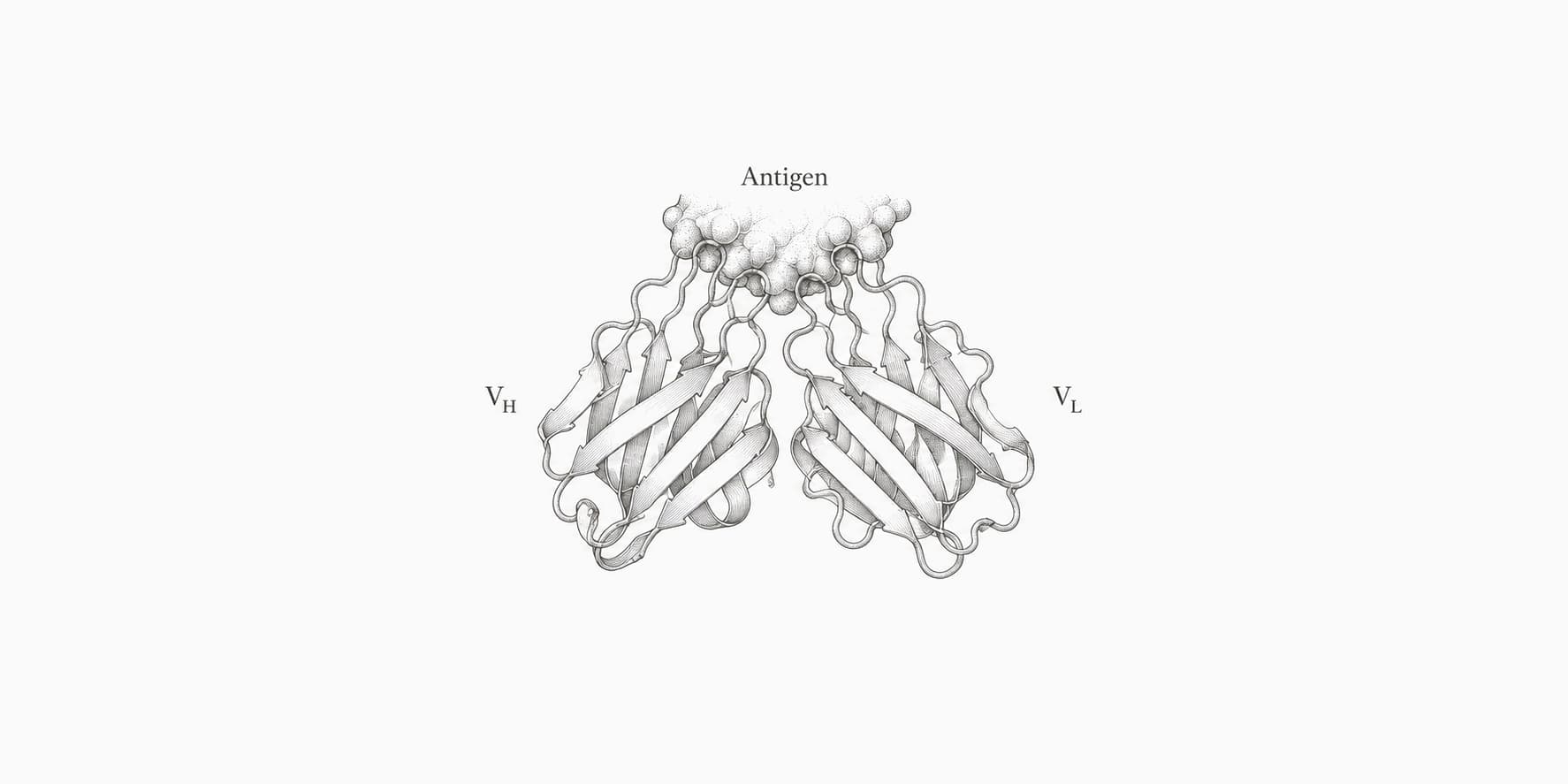
Antibodies · 13 min
Antibody variable regions: VH, VL, CDRs and frameworks
VH and VL domains, the six CDRs and eight framework regions they contain, how Kabat, Chothia and IMGT draw CDR boundaries, and how V(D)J recombination and somatic hypermutation create variable-region diversity.
Frequently asked questions
Providers do not publish a fixed price for a complete developability assessment. Curia describes an entry package of in silico sequence liability and immunogenicity analysis with a one-week turnaround, and Evotec describes in silico property and structure analysis with reporting, but both ask for a quote. The wet-lab packages that add polyspecificity, stability and forced degradation testing are quoted on request.
A quote depends on the number of candidates, whether the work is computational only or includes assays, and how much expert interpretation is added.
ProteinIQ is self-service. The Free plan includes 200 credits, and paid plans start at $9 per month for Lite, with Plus at $29 and Pro at $99. A paired antibody costs 30 credits in BioPhi, a DeepViscosity job of up to 100 antibodies costs 32 credits, and an Aggrescan3D structure costs 5, all quoted before the run. Batch mode needs a paid plan, and done-for-you projects are scoped separately.
DeepSP and DeepViscosity take up to 100 antibodies in one job, PolyXpert up to 1,000 pairs on the largest plan, and TNP several nanobodies per FASTA. TAP2, BioPhi and Aggrescan3D process one antibody or structure per job, so use batch mode, which runs up to 250 jobs per batch on paid plans.
Not for most checks. DeepSP, DeepViscosity, PolyXpert, BioPhi, NetSolP and Protein-Sol start from sequence. TAP2 and TNP build a model themselves, and Aggrescan3D needs a structure you provide, such as one from ABodyBuilder3 or ImmuneBuilder.
None of them on its own. Disagreement usually means the tools measure different properties, for example a clean TAP2 profile with a high polyreactivity call. Read it as a reason to measure that property first, and use the residue-level tables to see which region drives each flag.
TNP profiles single-domain VHH against clinical-stage nanobodies, and BioPhi accepts a heavy chain alone when VHH input is enabled, with a warning to validate solubility separately. TAP2, DeepSP, DeepViscosity and PolyXpert expect a paired VH and VL.
Each job stores its inputs, settings and result files in your job history, and tables can be downloaded as CSV. Do not submit sequences that must never be stored outside your own systems.
AI answers from our docs. No sign-in needed.
Run your first analysis today
Start with 200 free credits and no installs. Upgrade when your project needs more compute.