PolyXpert
Screen paired antibody variable domains for low or high polyreactivity.
What is PolyXpert?
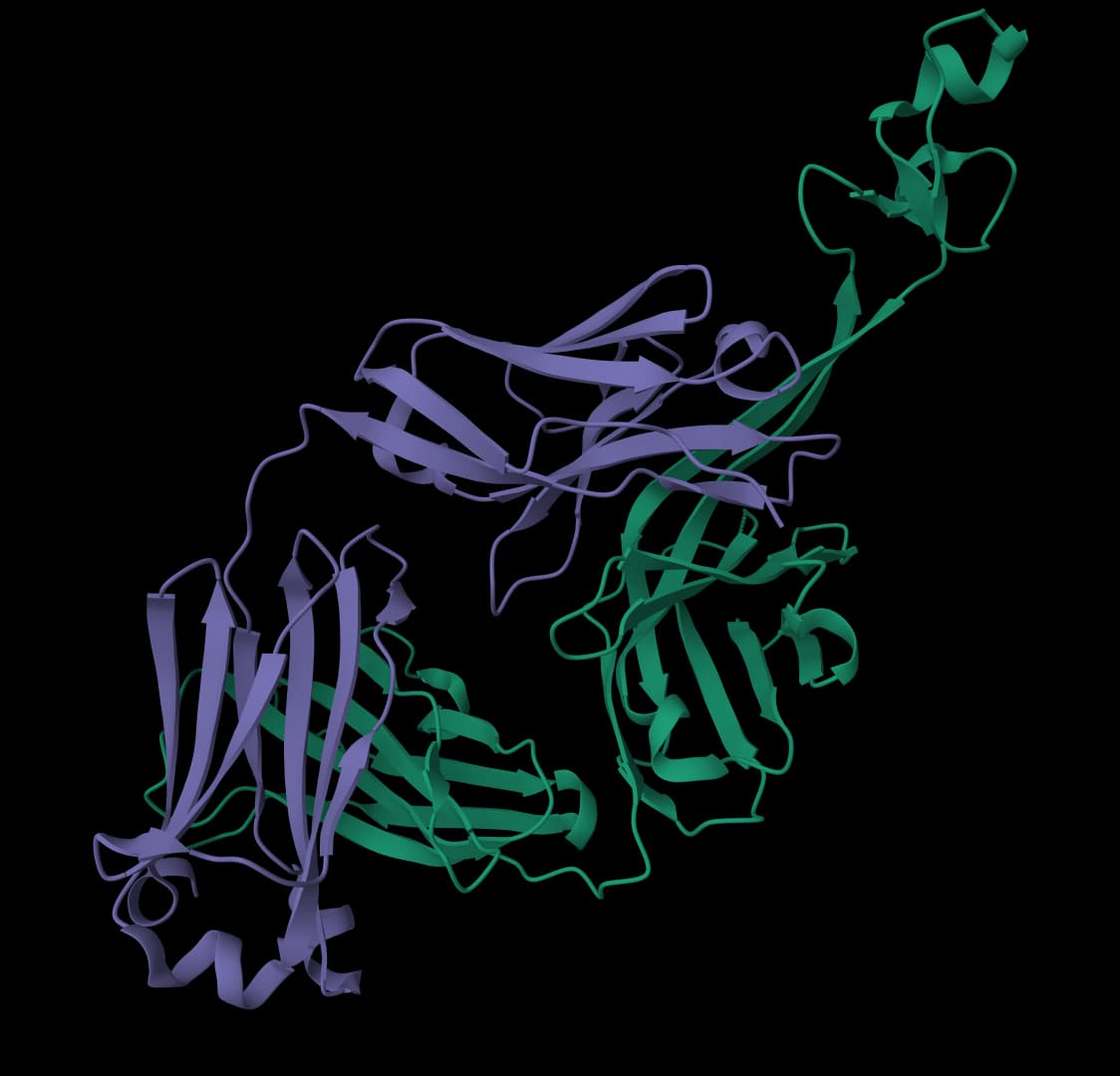
PolyXpert is a sequence-based classifier for predicting low or high polyreactivity in paired antibody variable domains. It jointly evaluates heavy-chain and light-chain Fv sequences with a fine-tuned ESM-2 150M protein language model and returns the probability assigned to each class together with the selected binary label.
The published study reported an area under the receiver operating characteristic curve of 0.9672 on its external independent test dataset, with sensitivity of 90.10% and specificity of 90.08%. These values describe performance on the study dataset. They do not establish the same accuracy for every antibody type, discovery campaign, or experimental assay.
Cost
PolyXpert jobs start at 30 credits. The calculator groups antibody pairs into 16-pair inference batches and scales with the longest paired sequence in the submitted TSV, with an additional allowance for unusually long inputs. The exact credit price is calculated before submission.
How to use PolyXpert online
Paste or upload one tab-separated table containing Name, VH, and VL columns. ProteinIQ sends the table unchanged to the published PolyXpert command-line workflow, which jointly evaluates each heavy/light pair and returns low- and high-polyreactivity probabilities, a binary label, the native prediction file, logs, submitted input, and provenance.
Inputs
The header is case-sensitive. The input must use tabs rather than commas, even when it is prepared in spreadsheet software. Extra columns are accepted but ignored by the classifier.
| Column | Required | Description |
|---|---|---|
Name | Yes | Identifier for the paired antibody. Unique text identifiers are recommended so every result remains easy to trace. |
VH | Yes | Heavy-chain Fv amino acid sequence. |
VL | Yes | Light-chain Fv amino acid sequence. |
Name	VH	VL
antibody_1	QVQLVQSGGGLVQPGGSLRLSC...	DIQMTQSPSSLSASVGDRVTITC...
antibody_2	EVQLVESGGGLVQPGGSLRLSC...	EIVLTQSPATLSLSPGERATLSC...
Save uploaded tables as .tsv or .txt. Blank VH or VL values are rejected. Values that spreadsheet parsers interpret as missing, including an unquoted NA, are also invalid sequence cells.
ProteinIQ plan limits range from 5 to 1,000 antibody pairs per job. The hosted maximum is 1,000 rows, 1 MiB of UTF-8 table text, and 250,000 paired VH/VL characters in any one row. The active limit is shown before submission.
Standard uppercase amino acid sequences are recommended. The published workflow replaces uppercase O, B, U, and Z with X. It does not automatically uppercase lowercase input, and other unsupported characters can be mapped to the model tokenizer's unknown token rather than rejected.
Settings
PolyXpert has no adjustable scientific settings. ProteinIQ preserves the fixed published inference behavior.
| Protocol element | Fixed value |
|---|---|
| Classifier | Fine-tuned ESM-2 150M protein language model |
| Sequence context | Paired VH and VL tokenization |
| Maximum tokenized length | 512 tokens across the pair, including special tokens |
| Long-sequence handling | Longest-first truncation performed by the source tokenizer |
| Batch size | 16 antibody pairs, with input order preserved |
| Job name | Optional label used to identify the ProteinIQ job |
Outputs
The result page presents the source predictions as a copyable table and keeps the complete run artifacts available for download.
| Column | Meaning |
|---|---|
Name | Source-emitted antibody identifier. |
proba_0 | Model probability assigned to low polyreactivity. |
proba_1 | Model probability assigned to high polyreactivity. |
pred_label | Source label selected by the larger probability: 0 for low or 1 for high polyreactivity. |
proba_0 and proba_1 sum to approximately 1 for each row. The interactive table can round values for display, while the native result file retains the source-generated numeric serialization.
Downloadable files
| File | Contents |
|---|---|
pred_results_<timestamp>.txt | Native tab-separated PolyXpert predictions in submitted row order. |
polyxpert_input.tsv or polyxpert_input.txt | Exact submitted table used for the run. |
polyxpert_source.log | Source command output and diagnostics. |
polyxpert_provenance.json | Pinned source commit, model checksums, runtime versions, command, input summary, and artifact checksums. |
How PolyXpert works
The source reads each VH/VL pair, replaces uppercase O, B, U, and Z with X, and separates the sequence characters into the token format expected by the model. VH and VL are then tokenized together, padded within the submitted dataset, and truncated to a combined maximum of 512 tokens when necessary.
The fine-tuned ESM-2 classifier produces two logits for each antibody pair. A softmax transformation converts those logits into proba_0 and proba_1, and the class with the larger value becomes pred_label. The public command-line release does not return a user-adjustable threshold, residue-level explanation, or attention map.
Interpreting PolyXpert results
The label is a direct binary model decision, not an experimental measurement or a universal developability threshold. A label of 0 indicates that the model assigned more probability to the low-polyreactivity class; a label of 1 indicates more probability for the high-polyreactivity class.
Probabilities are most useful for prioritizing candidates evaluated with the same model edition and input preparation. Results near an even split indicate that neither class strongly dominates the model output. Values close to 0 or 1 show a stronger model preference, but they should not be interpreted as calibrated assay success or failure rates.
PolyXpert is intended to supplement early antibody screening. Candidate selection and engineering decisions should confirm polyreactivity with appropriate experimental assays and consider other developability properties.
PolyXpert and related antibody tools
| Tool | Primary result | Best suited to |
|---|---|---|
| PolyXpert | Binary low/high polyreactivity label with class probabilities | Rapid sequence-only prioritization of paired VH/VL candidates by predicted polyreactivity. |
| DeepSP | 30 regional spatial aggregation-propensity and charge-map descriptors | Comparing modeled spatial surface features without assigning a polyreactivity class. |
| TAP2 | Five structure-informed developability metrics with clinical-reference flags | Broader assessment of CDR length, hydrophobicity, charge patches, and Fv charge symmetry. |
| ANARCII | Antibody numbering and domain annotation | Checking variable-domain boundaries or numbering unusual antibody sequences. |
Troubleshooting
| Problem | Resolution |
|---|---|
| The table is treated as one column | Export it as tab-separated text, not CSV, and verify that tabs separate Name, VH, and VL. |
| A required column is missing | Use the exact case-sensitive headers Name, VH, and VL. |
| A sequence is reported as blank | Check for empty cells or values such as NA that the source parser treats as missing. |
| Results for very long sequences seem unexpected | Review the submitted domains. The source truncates paired input beyond 512 model tokens using longest-first truncation. |
| An identifier changes or loses leading zeros | Use unambiguous text identifiers rather than numeric-looking names, because source table parsing can infer numeric values. |
| The run fails during source execution | Open polyxpert_source.log and retain the job ID when contacting support. |
Important limitations
-
PolyXpert is sequence-only and cannot directly represent conformational dynamics or spatial arrangements that may contribute to polyreactivity.
-
The training data were screened against four polyreactivity reagents. Dataset composition, antibody type, and assay differences can affect performance on new candidates.
-
The published benchmark metrics describe specific internal and external datasets and should not be treated as guaranteed performance for another sequence distribution.
-
Paired inputs longer than 512 model tokens are truncated, so part of one or both submitted sequences can be omitted from inference.
-
The public command-line release returns class probabilities and labels but does not return residue-level attention or an explanation for an individual prediction.
-
PolyXpert does not replace experimental polyreactivity assays or broader developability assessment.
Related tools

TNP
Characterize nanobody developability with sequence, structure, and surface-property metrics.

CANYA
Predict protein aggregation nucleation propensity from amino acid sequences.

Protein-Sol
Predict protein solubility from sequence with feature-level and windowed profile outputs.

AbLang
Restore residues and generate antibody-specific representations or likelihood scores.

Aggrescan3D
Analyze aggregation-prone regions in a protein structure.

AllMetal3D
Predict metal and water binding sites in proteins with 3D CNN models.

DeepSP
Generate 30 sequence-derived spatial descriptors for paired antibody variable domains.

DeepViscosity
Screen paired antibody Fv sequences for high-concentration viscosity risk.

EvoIF
Score single and multi-site protein mutations with evolutionary and inverse-folding profiles.

PROPKA 3
Predict pKa values of ionizable groups in proteins based on 3D structure.