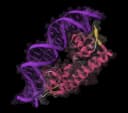
EvoIF predicts the relative fitness of protein variants from a resolved or predicted backbone structure, a homolog alignment, and an inverse-folding profile. It ranks substitutions by how compatible each variant appears with evolutionary sequence variation and the supplied structure, including combinations of substitutions in the same variant.
The score is useful for prioritizing candidates before deep mutational scanning or targeted experiments. It is not a measured activity, binding affinity, stability change, or probability that a variant will succeed. A high score indicates that EvoIF assigns the mutant a higher sequence likelihood than the wild type in this structural and evolutionary context.
ProteinIQ runs EvoIF from a single-chain protein structure, a CSV of single or combined mutations, and a homolog alignment whose query matches the structure. It returns a dimensionless log-odds score for every submitted variant, the mutated sequence, optional experimental scores, and downloadable native results and preparation files.
| Input | Accepted format | Requirements |
|---|---|---|
Protein Structure | PDB or ENT file, or an RCSB PDB entry | Exactly one protein model and one protein chain. Residues must be standard amino acids, include a CA atom, and use contiguous numeric residue IDs with no insertion codes. |
Mutations | CSV or TXT | A comma-separated file with a case-sensitive mutant header and at least one row. DMS_score is optional. |
Homolog Alignment | FASTA, A3M, FA, FAS, or TXT | The first record is the query. After gaps are removed, it must exactly equal the sequence extracted from the submitted structure. All sequences use uppercase canonical amino-acid codes and optional gaps. |
Inverse-Folding Profile | NPZ file, optional | A source-compatible profile with a log_p array. When omitted, ProteinIQ creates the profile with ProteinMPNN. |
The structure sequence establishes the mutation numbering. If the structure begins with MKT..., K2R means lysine at the second residue of that structure, regardless of numbering in a UniProt entry, construct, or original PDB file.
Each mutation uses the form wild-type residue + 1-based position + mutant residue. Separate substitutions in a combined variant with a colon.
mutant,DMS_score
A23V,0.18
G41D:L85F,-0.62For prediction-only ranking, omit the DMS_score column:
mutant
A23V
G41D:L85FThe wild-type letter must match the submitted structure at the stated position. EvoIF rejects out-of-range sites and mismatches such as A23V when residue 23 in the structure is not alanine. The 20 canonical amino acids are supported for both wild-type and mutant letters.
The homolog alignment supplies within-family evolutionary evidence. Its query record must represent the exact construct in the structure, not a longer full-length sequence or an alignment with unresolved terminal residues retained. Gaps are allowed in the alignment, but the ungapped first sequence must match the PDB-derived sequence exactly.
Alignments with more than 2,048 sequences are reproducibly subsampled to 2,048 records. The selected Random seed controls that sampling. Keeping the same seed makes repeated runs with the same inputs comparable.
Most jobs do not need a precomputed profile. When no NPZ file is supplied, ProteinIQ runs the documented ProteinMPNN preparation step and passes the resulting profile to EvoIF. A precomputed profile is mainly useful when the same structure is being scored repeatedly and an existing compatible profile should be reused.
| Setting | Description |
|---|---|
Random seed | Seed used only when an alignment contains more than 2,048 sequences. The default is 1024. It does not change the submitted mutations or structure. |
The main result table contains one row per submitted variant. EvoIF preserves the source ordering by mutation-site tuple, which can differ from the order in the upload.
| Column | Meaning |
|---|---|
Mutation | Submitted single-site or colon-separated multi-site variant. |
Mutated Sequence | Sequence after applying the listed substitutions to the structure-derived sequence. |
Experimental DMS Score | The submitted DMS_score, if provided. It remains blank for prediction-only jobs. |
EvoIF Log-Odds Score | Dimensionless model score. Larger values favor the mutant relative to the wild type under EvoIF's model. |
For a single substitution, the score is the difference between the model log probability of the mutant amino acid and the wild-type amino acid at that site. For a multi-site variant, EvoIF sums that difference across its listed sites:
Scores are best used to rank variants of the same protein run with the same structure and profiles. A score of 1.0 is not twice as favorable as 0.5, and scores from unrelated proteins should not be compared as a common experimental scale. Positive scores favor the mutant model likelihood; negative scores favor the wild type. Neither direction alone proves increased expression, catalytic activity, affinity, or thermostability.
| File | Contents |
|---|---|
evoif_scores.csv | The display-ready mutation table. |
EVOIF_INPUT.source.csv | Native per-assay EvoIF output. Prediction-only jobs contain internal placeholder targets required by the source evaluation format. |
results.source.csv | Native assay-level Spearman correlation, Pearson correlation, MAE, and RMSE when experimental scores were submitted. |
evoif.log.txt | Native EvoIF evaluation log. |
prepared_structure.pdb | The cleaned single-chain structure passed to the method. |
prepared_homolog_alignment.fasta | The alignment after EvoIF preparation. |
prepared_mutations.csv | The mutation CSV used for scoring. |
input.npz | The uploaded or automatically generated inverse-folding profile. |
evoif_execution.log | Captured preparation and evaluation output. |
Assay-level correlation and error values are meaningful only when DMS_score values were submitted. They measure agreement with that particular assay and its score orientation, not general accuracy for the target protein.
Protein fitness landscapes are too large to map experimentally. EvoIF combines two complementary forms of evolutionary evidence with sequence and structure context. The homolog alignment captures residue preferences within the target family. The inverse-folding profile captures whether residues are plausible for the submitted three-dimensional backbone, including structural constraints that can generalize beyond close homologs.
EvoIF fuses those profile signals with a sequence-structure model and produces an amino-acid probability distribution at each residue. Variant ranking then uses the log-odds difference between mutant and wild-type residues. ProteinMPNN supplies the automatic inverse-folding profile when one is not uploaded.
The model was evaluated by its authors on ProteinGym deep mutational scanning assays. That benchmark supports mutation ranking, but it does not turn the output into an assay-specific predictor. A catalytic assay, expression screen, or binding selection can favor mechanisms that are absent from the structure and alignment.
EvoIF is a strong fit when a candidate mutation list, a reliable single-chain structure, and a homolog alignment already exist. It can rank both individual substitutions and specified combinations, so it works well after literature curation, active-site selection, or a first design pass.
For generating broadly compatible sequences from a backbone rather than scoring a fixed mutation list, use ProteinMPNN. For another inverse-folding perspective based on a geometric protein language model, ESM-IF1 can design or score sequences against a structure. If no experimental structure is available, a predicted backbone from AlphaFold2 can provide a starting point, but uncertain regions in that model add uncertainty to the mutation ranking.
The method is not suitable for proteins requiring multiple chains, ligands, post-translational modifications, noncanonical residues, or residues with PDB insertion codes. It also cannot infer a new biological objective from structural compatibility alone. Final candidates still need assay conditions that measure the intended property.

Predict multiple protein developability properties from amino-acid sequences using a multitask ProstT5 adapter.

Predict protein thermostability changes (ΔΔG) for point mutations using a graph neural network. Enables computational saturation mutagenesis screening to identify stabilizing mutations.

Predict protein stability using validated BioPython methods: Instability Index, Aliphatic Index, GRAVY, flexibility analysis, and charge distribution

Faithful static-mode Aggrescan3D tool for per-residue aggregation propensity analysis from a single protein structure.

Predict protein aggregation nucleation propensity from amino acid sequences using the Lehner Lab CANYA neural network.

Predict pKa values of ionizable groups in proteins and protein-ligand complexes from 3D structure. PROPKA calculates environment-driven pKa shifts for standard ionizable residues, terminal groups, and supported ligand atom types.

Predict protein solubility from amino acid sequence using the University of Manchester Protein-Sol method.

Predict metal and water binding sites in protein structures using 3D convolutional neural networks (AllMetal3D + Water3D).

Predict protein hydration sites from a structure using a diffusion model with ESM features and a confidence-filtering head.

Compute 200+ RDKit molecular descriptors, drug-likeness rule violations, and structural fingerprints for QSAR, virtual screening, and ML workflows
EvoIF predicts the relative fitness of protein variants from a resolved or predicted backbone structure, a homolog alignment, and an inverse-folding profile. It ranks substitutions by how compatible each variant appears with evolutionary sequence variation and the supplied structure, including combinations of substitutions in the same variant.
The score is useful for prioritizing candidates before deep mutational scanning or targeted experiments. It is not a measured activity, binding affinity, stability change, or probability that a variant will succeed. A high score indicates that EvoIF assigns the mutant a higher sequence likelihood than the wild type in this structural and evolutionary context.
ProteinIQ runs EvoIF from a single-chain protein structure, a CSV of single or combined mutations, and a homolog alignment whose query matches the structure. It returns a dimensionless log-odds score for every submitted variant, the mutated sequence, optional experimental scores, and downloadable native results and preparation files.
| Input | Accepted format | Requirements |
|---|---|---|
Protein Structure | PDB or ENT file, or an RCSB PDB entry | Exactly one protein model and one protein chain. Residues must be standard amino acids, include a CA atom, and use contiguous numeric residue IDs with no insertion codes. |
Mutations | CSV or TXT | A comma-separated file with a case-sensitive mutant header and at least one row. DMS_score is optional. |
Homolog Alignment | FASTA, A3M, FA, FAS, or TXT | The first record is the query. After gaps are removed, it must exactly equal the sequence extracted from the submitted structure. All sequences use uppercase canonical amino-acid codes and optional gaps. |
Inverse-Folding Profile | NPZ file, optional | A source-compatible profile with a log_p array. When omitted, ProteinIQ creates the profile with ProteinMPNN. |
The structure sequence establishes the mutation numbering. If the structure begins with MKT..., K2R means lysine at the second residue of that structure, regardless of numbering in a UniProt entry, construct, or original PDB file.
Each mutation uses the form wild-type residue + 1-based position + mutant residue. Separate substitutions in a combined variant with a colon.
mutant,DMS_score
A23V,0.18
G41D:L85F,-0.62For prediction-only ranking, omit the DMS_score column:
mutant
A23V
G41D:L85FThe wild-type letter must match the submitted structure at the stated position. EvoIF rejects out-of-range sites and mismatches such as A23V when residue 23 in the structure is not alanine. The 20 canonical amino acids are supported for both wild-type and mutant letters.
The homolog alignment supplies within-family evolutionary evidence. Its query record must represent the exact construct in the structure, not a longer full-length sequence or an alignment with unresolved terminal residues retained. Gaps are allowed in the alignment, but the ungapped first sequence must match the PDB-derived sequence exactly.
Alignments with more than 2,048 sequences are reproducibly subsampled to 2,048 records. The selected Random seed controls that sampling. Keeping the same seed makes repeated runs with the same inputs comparable.
Most jobs do not need a precomputed profile. When no NPZ file is supplied, ProteinIQ runs the documented ProteinMPNN preparation step and passes the resulting profile to EvoIF. A precomputed profile is mainly useful when the same structure is being scored repeatedly and an existing compatible profile should be reused.
| Setting | Description |
|---|---|
Random seed | Seed used only when an alignment contains more than 2,048 sequences. The default is 1024. It does not change the submitted mutations or structure. |
The main result table contains one row per submitted variant. EvoIF preserves the source ordering by mutation-site tuple, which can differ from the order in the upload.
| Column | Meaning |
|---|---|
Mutation | Submitted single-site or colon-separated multi-site variant. |
Mutated Sequence | Sequence after applying the listed substitutions to the structure-derived sequence. |
Experimental DMS Score | The submitted DMS_score, if provided. It remains blank for prediction-only jobs. |
EvoIF Log-Odds Score | Dimensionless model score. Larger values favor the mutant relative to the wild type under EvoIF's model. |
For a single substitution, the score is the difference between the model log probability of the mutant amino acid and the wild-type amino acid at that site. For a multi-site variant, EvoIF sums that difference across its listed sites:
Scores are best used to rank variants of the same protein run with the same structure and profiles. A score of 1.0 is not twice as favorable as 0.5, and scores from unrelated proteins should not be compared as a common experimental scale. Positive scores favor the mutant model likelihood; negative scores favor the wild type. Neither direction alone proves increased expression, catalytic activity, affinity, or thermostability.
| File | Contents |
|---|---|
evoif_scores.csv | The display-ready mutation table. |
EVOIF_INPUT.source.csv | Native per-assay EvoIF output. Prediction-only jobs contain internal placeholder targets required by the source evaluation format. |
results.source.csv | Native assay-level Spearman correlation, Pearson correlation, MAE, and RMSE when experimental scores were submitted. |
evoif.log.txt | Native EvoIF evaluation log. |
prepared_structure.pdb | The cleaned single-chain structure passed to the method. |
prepared_homolog_alignment.fasta | The alignment after EvoIF preparation. |
prepared_mutations.csv | The mutation CSV used for scoring. |
input.npz | The uploaded or automatically generated inverse-folding profile. |
evoif_execution.log | Captured preparation and evaluation output. |
Assay-level correlation and error values are meaningful only when DMS_score values were submitted. They measure agreement with that particular assay and its score orientation, not general accuracy for the target protein.
Protein fitness landscapes are too large to map experimentally. EvoIF combines two complementary forms of evolutionary evidence with sequence and structure context. The homolog alignment captures residue preferences within the target family. The inverse-folding profile captures whether residues are plausible for the submitted three-dimensional backbone, including structural constraints that can generalize beyond close homologs.
EvoIF fuses those profile signals with a sequence-structure model and produces an amino-acid probability distribution at each residue. Variant ranking then uses the log-odds difference between mutant and wild-type residues. ProteinMPNN supplies the automatic inverse-folding profile when one is not uploaded.
The model was evaluated by its authors on ProteinGym deep mutational scanning assays. That benchmark supports mutation ranking, but it does not turn the output into an assay-specific predictor. A catalytic assay, expression screen, or binding selection can favor mechanisms that are absent from the structure and alignment.
EvoIF is a strong fit when a candidate mutation list, a reliable single-chain structure, and a homolog alignment already exist. It can rank both individual substitutions and specified combinations, so it works well after literature curation, active-site selection, or a first design pass.
For generating broadly compatible sequences from a backbone rather than scoring a fixed mutation list, use ProteinMPNN. For another inverse-folding perspective based on a geometric protein language model, ESM-IF1 can design or score sequences against a structure. If no experimental structure is available, a predicted backbone from AlphaFold2 can provide a starting point, but uncertain regions in that model add uncertainty to the mutation ranking.
The method is not suitable for proteins requiring multiple chains, ligands, post-translational modifications, noncanonical residues, or residues with PDB insertion codes. It also cannot infer a new biological objective from structural compatibility alone. Final candidates still need assay conditions that measure the intended property.

Predict multiple protein developability properties from amino-acid sequences using a multitask ProstT5 adapter.

Predict protein thermostability changes (ΔΔG) for point mutations using a graph neural network. Enables computational saturation mutagenesis screening to identify stabilizing mutations.

Predict protein stability using validated BioPython methods: Instability Index, Aliphatic Index, GRAVY, flexibility analysis, and charge distribution

Faithful static-mode Aggrescan3D tool for per-residue aggregation propensity analysis from a single protein structure.

Predict protein aggregation nucleation propensity from amino acid sequences using the Lehner Lab CANYA neural network.

Predict pKa values of ionizable groups in proteins and protein-ligand complexes from 3D structure. PROPKA calculates environment-driven pKa shifts for standard ionizable residues, terminal groups, and supported ligand atom types.

Predict protein solubility from amino acid sequence using the University of Manchester Protein-Sol method.

Predict metal and water binding sites in protein structures using 3D convolutional neural networks (AllMetal3D + Water3D).

Predict protein hydration sites from a structure using a diffusion model with ESM features and a confidence-filtering head.

Compute 200+ RDKit molecular descriptors, drug-likeness rule violations, and structural fingerprints for QSAR, virtual screening, and ML workflows