AlphaMissense: what the scores mean and how to see them on a structure
A 0 to 1 pathogenicity score, three classes and a lot of caveats

Matic Broz, PhD14 min
What does an AlphaMissense score mean?
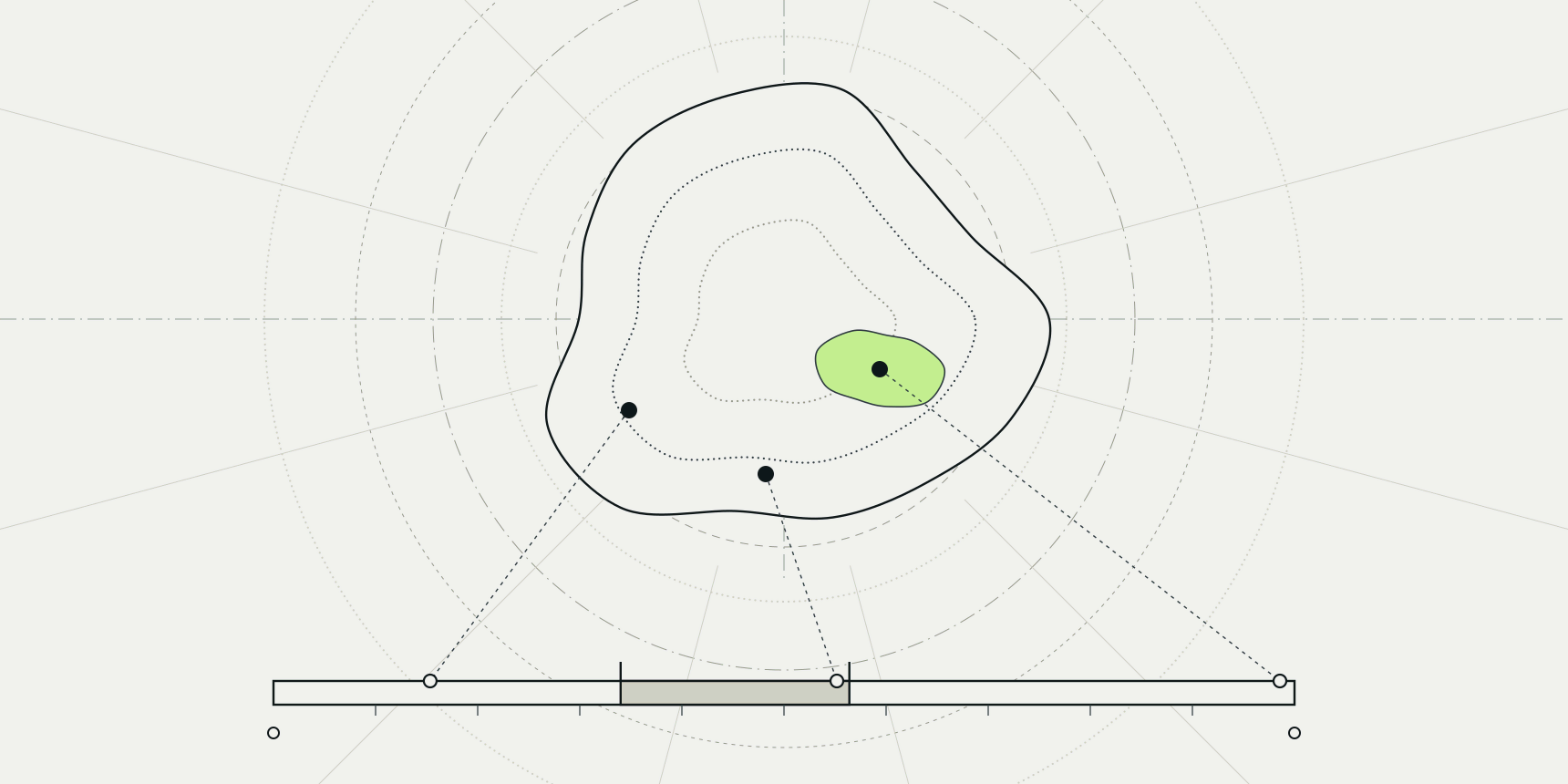
AlphaMissense is a model from Google DeepMind that predicts how likely a single amino acid change in a human protein is to cause disease.[1] Each change gets a score from 0 to 1, where higher means more likely pathogenic. Scores below 0.34 are called likely benign, scores above 0.564 likely pathogenic, and anything between the two ambiguous.[2]
The label can read like a verdict, and TP53 shows why it is not one. ClinVar lists R175H, R337H and S106R in the tumour suppressor p53 as pathogenic.[6] AlphaMissense scores R175H at 0.99, R337H at 0.55 and S106R at 0.15, which makes them likely pathogenic, ambiguous and likely benign. Same gene, same ClinVar label, three different answers from the model.
Which of those answers deserves trust depends on what the model was built to do and what ClinVar can and cannot tell you. The rest of this page covers both, then puts the scores on a structure of p53 so you can see where in the protein they are high.
How AlphaMissense was built
DeepMind started from AlphaFold and fine-tuned it on human and primate variant population frequency databases.[1] Variants seen often in healthy populations count as benign evidence, and variants that are rare or never seen count as the opposite.[4] The network combines structural context with evolutionary conservation to turn that signal into a per-variant score.
The training labels are therefore not clinical diagnoses. The paper states that the model reaches its results "without explicitly training on" clinical and experimental benchmarks.[1]
ClinVar still plays a role in two places. It is a test set, and the EMBL-EBI description says the raw scores are rescaled with a logistic regression fitted on ClinVar data so that they behave like probabilities.[4] The data release describes the final score as interpretable as the predicted probability that a variant is clinically pathogenic.[2]
That ClinVar link matters when you compare the two. ClinVar was used to calibrate and to evaluate, so agreement with it is expected and is weaker evidence than agreement with an independent source.
Where the 0.34 and 0.564 cut-offs come from
The cut-offs were chosen so that each confident class reaches 90% precision on a ClinVar test set, using precision and recall curves.[4] Variants that cannot meet that precision in either direction land in the middle band and are labelled ambiguous. Across the whole human proteome, the paper classifies 89% of missense variants as either likely benign or likely pathogenic.[1]
Two details are easy to miss. The thresholds were set once for the whole proteome, so nothing guarantees that 90% holds in any single gene. And the ambiguous band is a statement about the model's confidence, not about biology: a score of 0.5 does not mean the variant is half pathogenic.
| Class | Score range | What it is meant to say |
|---|---|---|
| Likely benign | Below 0.34 | Benign class set for 90% precision on a ClinVar test set |
| Ambiguous | 0.34 to 0.564 | The model cannot reach 90% precision either way |
| Likely pathogenic | Above 0.564 | Pathogenic class set for 90% precision on a ClinVar test set |
The data release and its licence
The release holds predictions for all possible single nucleotide missense variants in about 19,000 human protein-coding genes, 71 million in total, and for all possible single amino acid substitutions in about 20,000 UniProt canonical isoforms, 216 million protein variants.[2] A further 60,000 non-canonical isoforms are in the files, but the release says they were not thoroughly evaluated and should be used with caution.[2]
Two limits follow from that. It is human only, and it covers missense changes only: there are no stop gains, insertions, deletions or splice effects, and nothing about non-coding variants.
The data are licensed CC BY 4.0, with the copyright held by DeepMind Technologies Limited, so they can be reused with attribution.[2] DeepMind does not release the trained weights, and the repository states that its code is a reference and not meant for scoring new variants.[3]
How to see AlphaMissense scores on a structure
A score list is hard to interpret without a structure, because a high score in a buried core and a high score in a floppy tail mean different things. The PDB viewer by ProteinIQ can draw the scores on the protein itself, and a model from AlphaFold DB is the easiest way in, since AlphaFold DB models are indexed by the same UniProt accession that AlphaMissense uses. Type P04637 into the search box to open the TP53 model.

Once the chain is mapped to its UniProt entry, the Sequence menu offers an AlphaMissense track beside UniProt features and Variants. The track colours each residue by its mean score over all 19 possible substitutions, from blue below 0.34 through grey to red above 0.564. Clicking a residue lists every substitution at that position, highest score first.
Colour chain by AlphaMissense paints the same colours onto the 3D structure. Substitution table shows a heatmap of every position and substitution in the chain.
The Variants track marks reported variants, and clicking one shows its ClinVar clinical significance, the conditions linked to it and, for human proteins, its AlphaMissense score.
We read the AlphaFold DB file for P04637 (AF-P04637-F1-aa-substitutions.csv, 7,467 substitutions over 393 positions) and ran it through the same parser the viewer uses, to check the numbers the track shows. The viewer rounds to two decimals, so a score of 0.9963 appears as 1.00.
What the p53 track shows
The position means separate p53 into regions at a glance. Over the DNA-binding domain, residues 102 to 292 in UniProt, the mean per-position score is 0.75, and 146 of its 191 positions are above the 0.564 cut-off.[6] Over residues 1 to 101, the transactivation and proline-rich region, the mean is 0.27 and only 15 of 101 positions pass the cut-off. The oligomerization segment, residues 325 to 356, sits in between at 0.59.
This lines up with the confidence of the structure itself. The AlphaFold DB model of p53 has a mean pLDDT of 75.06, and 117 of its 393 residues (29.8%) fall below 50.[5] We counted them in the model file: 60 lie in residues 1 to 101, 57 after residue 292, and none inside the DNA-binding domain, whose mean pLDDT is 95.5. A red core and blue tails is the expected picture, since a disordered stretch tolerates most substitutions.
The PAE plot is the next thing to check, because it says whether the domains are placed correctly relative to each other.
The track is a map of where the model thinks substitutions hurt, not of where cancer variants occur. Whether a given position is dangerous still depends on which of the 19 substitutions you mean, which is the next problem.
Position mean or the exact substitution
The mean hides a lot. Arginine 337 has a mean of 0.89 over its 19 substitutions, a clearly red position, but the specific change R337H scores 0.55, just below the 0.564 cut-off. Opening the position's list in the viewer shows the spread, and Mutate to X builds the chosen mutant on the structure so you can look at what it touches.
If you only look at the coloured residue, you are looking at the average of changes that include much harsher ones than the one a patient carries.
For the other direction, use the substitution table: a position can be grey on average and still contain a few substitutions above 0.564. Report the substitution, not the residue.
Six TP53 variants side by side
We took six well-studied missense variants in p53, with ClinVar clinical significance from the EBI Proteins API and scores from the AlphaFold DB substitution file.[5][6] The first four sit at well-studied positions in the DNA-binding domain. R337H and S106R are the two that do not fit neatly.
| Variant | ClinVar | AlphaMissense score | AlphaMissense class |
|---|---|---|---|
| R175H | Pathogenic | 0.9857 | Likely pathogenic |
| R248Q | Pathogenic | 0.9963 | Likely pathogenic |
| R273H | Pathogenic | 0.9889 | Likely pathogenic |
| Y220C | Pathogenic | 0.8515 | Likely pathogenic |
| R337H | Pathogenic | 0.5518 | Ambiguous |
| S106R | Pathogenic | 0.1535 | Likely benign |
Agreement at R175H, R248Q, R273H and Y220C is what you would hope for, and these four sit in the part of the protein where the track is darkest red. R337H is a near miss: its score is 0.0122 below the pathogenic cut-off, so the model calls it ambiguous with the score right at the edge. S106R is the clean disagreement. ClinVar reports it as pathogenic from three submitted records, and AlphaMissense puts it at 0.15 in a position whose mean is 0.13.
We cannot say from the score alone which side is wrong. A missense change can be pathogenic for reasons a structure-and-conservation model does not see, such as its effect on RNA splicing, and a ClinVar label can also be wrong or outdated. What the table does show is that a single concordant example proves very little, and that a disagreement is a reason to look at the evidence behind the ClinVar record, not to override it.
How often the two agree across p53
To put numbers on that, we grouped every p53 missense variant that had a ClinVar classification and a score. Variants with only pathogenic or likely pathogenic submissions went in one group, benign or likely benign in another, and variants of uncertain significance in a third. Variants with mixed submissions were counted separately.
| ClinVar group | Variants | Likely pathogenic | Ambiguous | Likely benign |
|---|---|---|---|---|
| Pathogenic or likely pathogenic | 653 | 511 | 35 | 107 |
| Benign or likely benign | 471 | 59 | 33 | 379 |
| Uncertain significance | 895 | 270 | 98 | 527 |
Of the 653 pathogenic or likely pathogenic variants, 511 (78%) are called likely pathogenic and 107 (16%) likely benign. Of the 471 benign or likely benign ones, 379 (80%) are called likely benign and 59 (13%) likely pathogenic. Read the other way, 511 of the 570 variants the model calls likely pathogenic and with a clear ClinVar label are pathogenic in ClinVar (90%), but only 379 of the 486 it calls likely benign are benign there (78%).
So the 90% precision target holds for the pathogenic call in this one gene and falls short for the benign call. That is one gene with a ClinVar record heavily weighted towards a few cancer hotspots, so it is a reason for caution, not a measurement of AlphaMissense in general. The 895 variants of uncertain significance are the point of the tool, and the model splits them: 30% likely pathogenic, 11% ambiguous and 59% likely benign.
Limits of the viewer track
The track works for human proteins whose chain maps to a canonical UniProt entry. Other species show a note instead of the track, and isoforms such as P04637-2 have no scores. The viewer also compares the chain's sequence with the UniProt sequence, and a chain that differs at more than one residue in ten gets no scores, because the numbering might land on the wrong residues.
That rule matters for crystal structures. A PDB entry that carries engineered stabilizing mutations, a truncated construct or a tag can still be fine, but a heavily modified construct will lose the track. In that case open the AlphaFold DB model of the same accession, and load your own structure beside it as described in how to open a PDB file. The scores are fetched again after a page reload.
What AlphaMissense is not
AlphaMissense is a research tool. The release says it has not been validated for, and is not approved for, any clinical use, and it describes its predictions as having varying confidence, with caution advised.[2][3]
A score is not a diagnosis, it does not say whether a given person will develop a condition, and it should not be used to decide on treatment. If you are asking about a variant you or a family member carry, the people to ask are a clinician and a genetic counsellor, who will use ClinVar-style evidence and family history that no predictor sees.
Inside research, the score predicts pathogenicity, not mechanism, so it does not say whether a variant destabilizes the fold, breaks a binding site or changes splicing. Reading it next to the structure is how you start to ask which.
Reading scores next to a structure
A workable routine is to open the AlphaFold DB model first and look at pLDDT to see which regions are even well defined. Turn on the AlphaMissense track and see whether the red residues cluster in the core, at interfaces or in the active site. Then check the exact substitution in the list, and compare with ClinVar and the literature before drawing any conclusion. Where the model is uncertain about the arrangement, say so.
For a quick second opinion on substitutions across a sequence that is not human, a protein language model gives a different signal. ESM-C Mutation Scoring ranks every single substitution by how much the model prefers it to the original residue, and it is not limited to human proteins.
AlphaMissense tools on ProteinIQ
Start by loading the protein and reading its confidence, then add the variant layer and compare with other predictors.
| Task | Tool |
|---|---|
| Open a protein by UniProt accession, show ClinVar variants and AlphaMissense scores, mutate a residue | PDB viewer |
| Download an AlphaFold DB model or a UniProt record | UniProt download |
| Score every substitution with a protein language model | ESM-C Mutation Scoring |
Frequently asked questions
What is a good AlphaMissense score?
There is no good score, only a direction. Scores run from 0 to 1, and higher means the model thinks the change is more likely pathogenic. Below 0.34 is likely benign, above 0.564 is likely pathogenic, and the band between is ambiguous.[2]
How many variants does AlphaMissense cover?
The release covers all possible single nucleotide missense variants in about 19,000 human protein-coding genes, 71 million in total, and 216 million amino acid substitutions across about 20,000 canonical isoforms.[2] The paper classifies 89% of missense variants as likely benign or likely pathogenic.[1]
Is AlphaMissense trained on ClinVar?
It is not trained on clinical labels in the usual sense. It was fine-tuned from AlphaFold on human and primate population frequency data, and the paper says it gets its results without explicitly training on the benchmarks it is tested on.[1] ClinVar is used to set the probability scaling and the class cut-offs and to evaluate the model, so agreement with ClinVar is not independent confirmation.[4]
Can I use AlphaMissense scores commercially?
The predictions are licensed under CC BY 4.0, which allows reuse with attribution. The copyright is DeepMind Technologies Limited.[2]
Does AlphaMissense work on mouse or other non-human proteins?
No. The predictions cover human proteins only, and the PDB viewer shows a note instead of the track for other species.[2]
Can AlphaMissense diagnose a genetic disease?
No. The authors state that it has not been validated for, and is not approved for, clinical use.[3] Use it to prioritize variants for research and follow up with a clinical geneticist for any question about a person.