CYP inhibition and drug interactions
Why an assay says yes or no and a patient sees a fold change

Matic Broz, PhD15 min
Why does CYP inhibition cause drug interactions?
CYP inhibition is one drug blocking a cytochrome P450 enzyme that would otherwise clear a second drug, so the second drug builds up in the blood. CYP3A4 is the enzyme most often involved. Cytochromes P450 from the CYP1, 2 and 3 families biotransform 70 to 80% of drugs in clinical use, and CYP3A4 is the most highly expressed of them in the liver.[1]
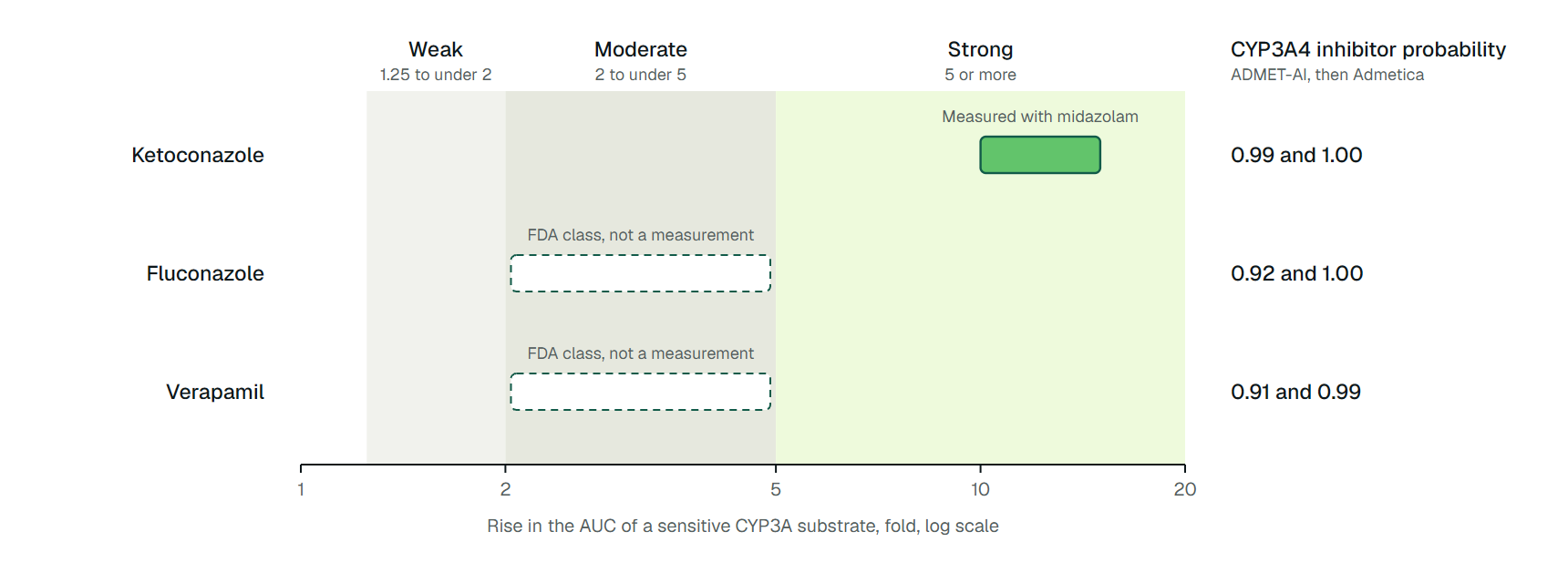
The effect can be large. Olkkola and colleagues gave nine volunteers either ketoconazole, itraconazole or placebo for four days and then a single dose of the sedative midazolam. Both antifungals raised the midazolam area under the curve (AUC) 10 to 15 times, and the impairment in psychomotor tests lasted at least 6 hours.[2] A model trained on lab assays calls ketoconazole and fluconazole the same thing, a CYP3A4 inhibitor, while the FDA grades fluconazole as only a moderate one.[3]
That is the gap this article is about. A laboratory assay returns a yes or a no for each enzyme. A patient meets a fold change in exposure, anywhere from barely measurable to more than 10, and the fold change depends on how strongly the inhibitor binds, how much of it reaches the enzyme, how much of the victim drug that enzyme normally clears and whether the inhibition is reversible. The sections below take those in turn, then look at where drug-induced liver injury (DILI) fits and what prediction models can and cannot say.
 AdmeticaProfile small-molecule ADMET properties across 22 Chemprop-based prediction models.Open tool
How the FDA grades interaction strength
The FDA grades an inhibitor by what it does to a sensitive substrate of the same enzyme. A strong inhibitor raises the substrate AUC at least 5-fold, a moderate one 2-fold to less than 5-fold and a weak one 1.25-fold to less than 2-fold.[4] The ICH M12 guidance, which the FDA adopted in August 2024, uses the same bins, and the FDA's index table groups its example drugs by them.[3]
Table 1 lists the index drugs the FDA names for the six enzymes it covers. An index substrate is one whose AUC is predictably changed, and a sensitive index substrate rises at least 5-fold with a strong index inhibitor.[3] Midazolam and triazolam are the sensitive CYP3A pair, which is why midazolam shows up in so many interaction studies, including the one above.
| Enzyme | Index substrates | Strong inhibitors | Moderate inhibitors |
|---|---|---|---|
| CYP3A | Midazolam, triazolam | Clarithromycin, itraconazole | Erythromycin, fluconazole, verapamil |
| CYP2D6 | Desipramine, dextromethorphan, nebivolol | Fluoxetine, paroxetine | Mirabegron |
| CYP2C9 | S-warfarin, tolbutamide (moderately sensitive) | None listed | Fluconazole |
| CYP2C19 | Omeprazole, lansoprazole (moderately sensitive) | Fluvoxamine | None listed |
| CYP2C8 | Repaglinide | Gemfibrozil | Clopidogrel |
| CYP1A2 | Caffeine, tizanidine | Fluvoxamine | None listed |
The table also shows why one drug can appear in several rows. Fluconazole is a moderate inhibitor of both CYP3A and CYP2C9, and fluvoxamine is a strong inhibitor of CYP1A2 and CYP2C19.[3] A CYP3A4 inhibition result describes one enzyme, not the drug.
Ki, R-values and the static model
An IC50 from a CYP assay depends on the probe substrate concentration, so regulators work with the inhibition constant Ki. For a competitive inhibitor the two are related by the Cheng-Prusoff equation, and the difference between IC50 and Ki is the first thing to settle when comparing numbers from two labs.[5]
M12 turns Ki into a screening decision with unbound concentrations. Reversible inhibition can be excluded if the unbound Ki exceeds 50 times the unbound maximum plasma concentration at steady state, so Cmax,u/Ki,u is below 0.02.[4] For an orally dosed CYP3A inhibitor, the intestine gets its own test: inhibition in the gut is excluded if Ki,u is above 0.1 times the dose divided by 250 mL.[4] A 100 mg dose of a 400 g/mol drug dissolved in 250 mL is 1 mM, so Ki,u would need to exceed 100 µM, a far higher cutoff in concentration terms than the plasma test gives for the same drug.
When screening cannot exclude the risk, M12 points to mechanistic static models. The simplest version, for one enzyme in the liver, predicts the AUC ratio (AUC with the inhibitor over AUC without) from the unbound inhibitor concentration [I], the Ki and the fraction of the victim drug's clearance that goes through the enzyme, fm.[4]
The equation has a ceiling. For a victim drug that depends on the enzyme for 90% of its clearance (fm = 0.9), an inhibitor at [I]/Ki = 0.02 gives an AUCR of 1.018, at 1 gives 1.82 and at 9 gives 5.26. Even a complete block caps the ratio at 1/(1 − 0.9) = 10. We calculated these values from the equation above to show its shape; they are illustrations, not data for a real drug. M12's full equation adds a gut term and a time-dependent term, which is how a measured ratio can exceed what the liver alone allows.[4]
Reversible and time-dependent inhibition
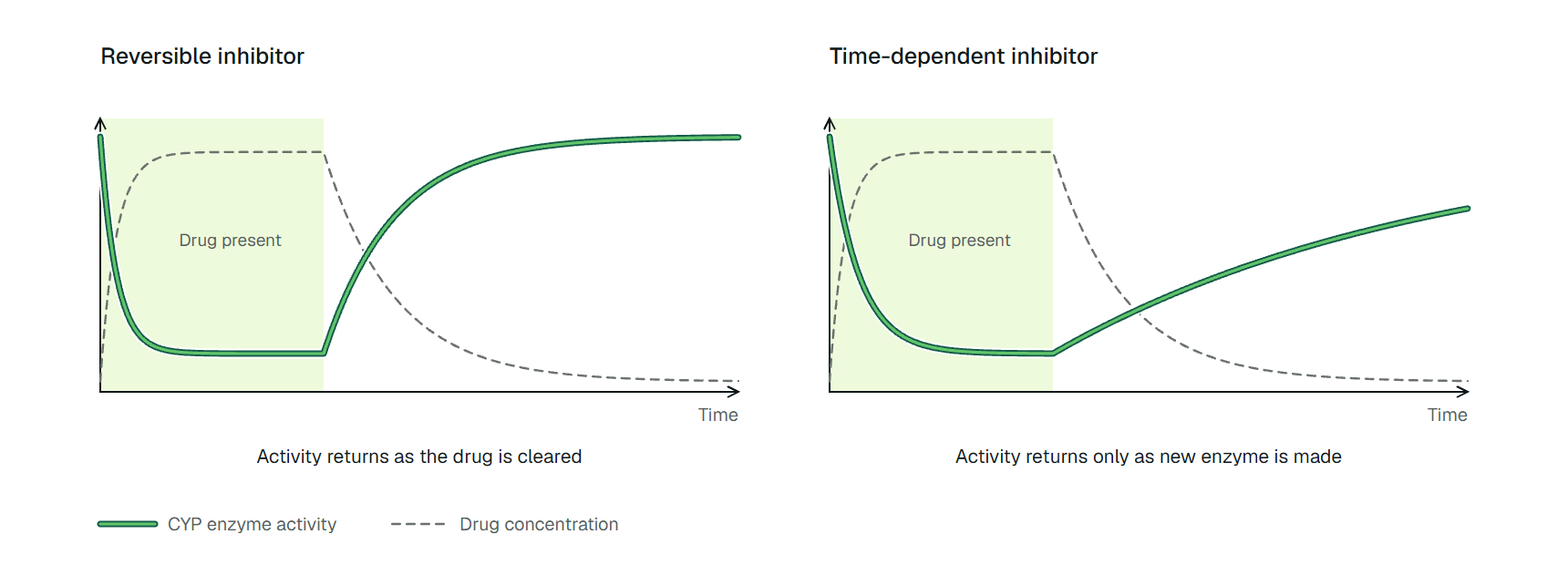
A reversible inhibitor binds the enzyme and lets go. Once its concentration falls, at a rate set by the drug's half-life, the enzyme works again. A time-dependent inhibitor, usually a mechanism-based inactivator, is converted by the enzyme into a species that inactivates it, and the enzyme stays disabled until the cell makes new protein.[6] The inhibition then outlasts the drug.
Grapefruit is the familiar example. Its furanocoumarins are metabolized by CYP3A4 to reactive intermediates that bind the enzyme's active site, so intestinal CYP3A4 stays impaired until new enzyme is synthesized.[7] Bailey and colleagues report that the effect on a co-administered drug falls to 50% of its maximum when the interval is 10 hours and to 25% at 24 hours, so a once-daily medicine can be affected whenever the juice was drunk.[7] The oral drug felodipine, which reaches the blood as only about 15% of the dose, is a sensitive example because the gut wall does most of the metabolism.[7]
The two kinds also need different assays. The standard IC50 test misses time-dependent inhibition unless the drug is preincubated with the enzyme and its cofactor first, and M12 notes that some inhibitors are more potent after preincubation.[4] Figure 1 shows how recovery differs, and the assays differ in three more ways.
The cutoffs below are the basic-method values in ICH M12 as adopted by the FDA, and kdeg is the enzyme degradation rate constant.[4]
- Constants measured: Ki for a reversible inhibitor, KI and kinact for a time-dependent one.
- Screening assay: an IC50 with no preincubation for a reversible inhibitor, an IC50 shift after about 30 minutes of preincubation with NADPH for a time-dependent one, where a left shift of 1.5-fold or 2-fold or more flags a candidate.
- Basic cutoff for excluding clinical risk: Cmax,u/Ki,u below 0.02 for reversible inhibition, and 1 + kobs/kdeg below 1.25 for time-dependent inhibition.
The time-dependent cutoff uses the inactivation rate at five times the unbound Cmax, kobs = kinact × 5Cmax,u / (KI,u + 5Cmax,u).[4] M12 gives a hepatic CYP3A4 half-life of 36 hours, which corresponds to a kdeg of 0.00032 per minute, and a ratio of 1.25 means the inactivation rate has reached a quarter of the degradation rate.[4] Ratios above 1.25 send the drug to static or PBPK modeling and, if that does not settle it, to a clinical study.
When an interaction ended a drug
Two withdrawn drugs show what a large fold change does, and both exceeded the size anyone had planned for.
Terfenadine, an antihistamine, depends on CYP3A4 for clearance. Honig and colleagues gave six healthy volunteers ketoconazole on top of steady-state terfenadine. Unmetabolized terfenadine accumulated and the corrected QT interval lengthened, and four of the six had to stop ketoconazole early because of electrocardiographic abnormalities.[8]
Cerivastatin is cleared by CYP2C8 and CYP3A4. Gemfibrozil is a strong CYP2C8 inhibitor that also inhibits the transporter OATP1B1.[4][9] In a crossover study of 10 volunteers, 3 days of gemfibrozil raised the AUC of cerivastatin to 559% of placebo, a 5.6-fold increase, with individual values from 138% to 995%.[10] Cerivastatin was withdrawn from the market in 2001 after 52 deaths attributed to rhabdomyolysis, with higher risk among patients who also took gemfibrozil.[11] Neither drug was withdrawn for liver injury, so both illustrate the interaction half of this subject, not the liver half.
How drug-induced liver injury connects to CYP
DILI is liver damage caused by a drug, and the FDA calls it the most frequent single cause of safety-related drug withdrawals over the past 50 years.[12] Its signature in trials is Hy's law: a drug that raises ALT or AST at least 3-fold above the upper limit of normal more often than control, with some of those subjects also reaching bilirubin above 2 times the upper limit without cholestasis, and no other explanation.[12]
CYP enters in two ways. The FDA's guidance states that a drug may be metabolized to a hepatotoxic metabolite, with acetaminophen, halothane and isoniazid as examples, and that most hepatotoxic drugs have been oxidatively metabolized by the CYP450 system.[12] So an inhibitor can increase exposure to a toxic parent drug, or reduce the formation of a toxic metabolite, and which of the two happens depends on the compound. A CYP inhibition result does not tell you the direction.
The second link is data, not biology. The FDA's DILIrank 2.0 ranks 1,336 approved drugs: 217 as most-DILI-concern (16.2%), 351 as less-DILI-concern (26.3%), 414 as no-DILI-concern (31.0%) and 354 as ambiguous (26.5%).[13] The first version of the list, by Chen and colleagues, covered 1,036 drugs.[14] Models for DILI are trained on far smaller sets than CYP models: Therapeutics Data Commons holds 475 drugs in its DILI set, against 12,328 compounds in its CYP3A4 inhibition set, about 26 times as many.[15][16]
What prediction models can say about CYP3A4 inhibition
The CYP inhibition data in most benchmarks come from one screen. Veith and colleagues measured potency for 17,143 compounds against recombinant CYP1A2, 2C9, 2C19, 2D6 and 3A4 with a bioluminescent assay.[17] The Therapeutics Data Commons version of the CYP3A4 set has 12,328 compounds, a binary label and a scaffold split, and ranks models by area under the precision-recall curve. The top entry scores 0.916, and Chemprop, the graph neural network family used by Admetica, scores 0.862.[16]
Those scores say the models rank compounds well against that assay. They say nothing about fold change in a patient, because the label is one yes or no per compound from one in vitro system, with no fm, no unbound concentration and no time-dependent term. Admetica returns a probability for CYP1A2, 2C9, 2C19, 2D6 and 3A4 inhibition and substrate status, and no DILI endpoint; ADMET-AI includes DILI as one of its toxicity outputs.
Three CYP3A inhibitors where the label and the grade disagree
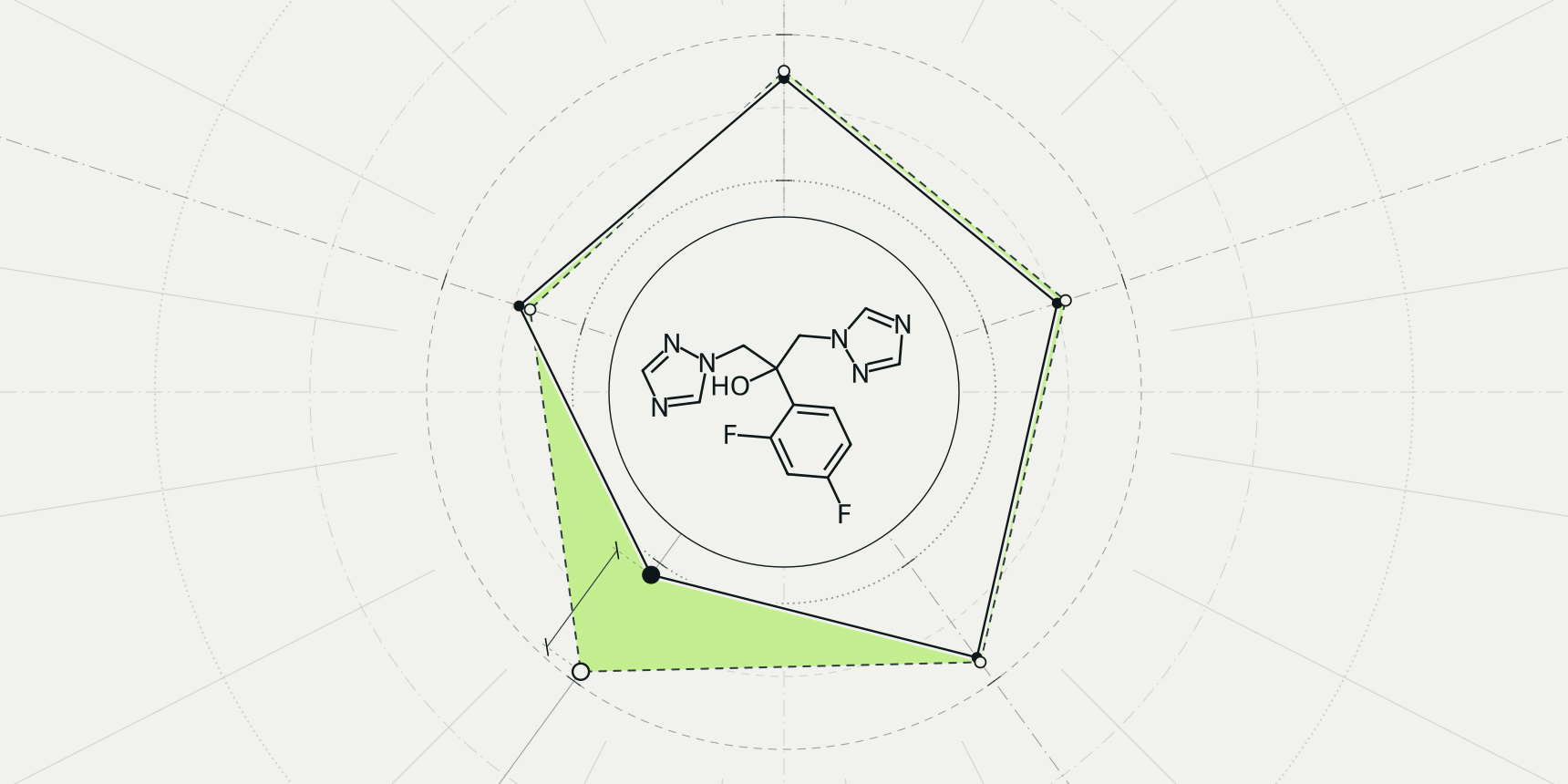
In a comparison of ADMET prediction models, we ran 12 approved drugs through ADMET-AI 2.0.1 and Admetica 1.4.1. Three of them are CYP3A inhibitors that the FDA grades differently, and Figure 2 sets the two views side by side. The probabilities are reproduced from that comparison, and they are the model outputs, not measured values.
All three score above 0.9 in both models, so the models have the direction right and say nothing about size. A 10-fold rise and a 2-fold rise fall in different FDA classes with different consequences for a sensitive substrate, and a probability above 0.9 gives no way to tell them apart.
Ketoconazole is also not on the FDA's clinical index list even though the midazolam data put it in the strong class, a reminder that the grade belongs to a pair of drugs and a study design, not to the inhibitor alone.[3]
From a prediction to a decision
Treat a CYP probability as a reason to run an assay, and the assay result as a reason to apply the static model. Table 2 turns the sections above into a sequence.
| Question | Start with | Add | Check |
|---|---|---|---|
| Is this compound likely to inhibit CYP3A4 at all? | Model probability from a CYP panel | Second model on the same SMILES | Disagreement between models, and distance from the training chemistry |
| How potent is it? | IC50 with a probe substrate | Convert to Ki with Cheng-Prusoff | Cmax,u/Ki,u above or below 0.02 |
| Does it inactivate the enzyme? | IC50 shift with and without NADPH | KI and kinact if the shift is 1.5-fold or more | 1 + kobs/kdeg against 1.25 |
| Will the gut wall matter for an oral drug? | Dose divided by 250 mL | Ratio to Ki,u | Whether (dose/250 mL)/Ki,u is above 10 |
| Is liver injury a concern? | DILI model and structural alerts | DILIrank class of close analogues | Whether a reactive metabolite is possible |
The first four rows each end in a cutoff that either excludes the risk or sends the compound to modeling and, if modeling cannot settle it, to a clinical study with a sensitive index substrate.[4]
CYP and liver injury tools on ProteinIQ
The usual order runs from a quick probability to a numerical conversion to a structural check. Predict inhibition first, convert the assay result to Ki next and screen the same structures for liver and reactivity alerts last. The ADMET prediction use case walks through the sequence.
- Admetica: predict CYP1A2, 2C9, 2C19, 2D6 and 3A4 inhibition and substrate probabilities
- ADMET-AI: get a second model for the same endpoints, plus a DILI probability
- IC50 to Ki calculator: convert an IC50 into a Ki
- Structural alert screening: flag problem substructures that suggest reactive metabolites
- eToxPred: score general toxicity probability
 IC50 to Ki calculatorTurn an IC50 into pIC50 and an assay-independent Ki, with the equation and every substituted value shown.Open tool
Frequently asked questions
What is CYP3A4 inhibition?
CYP3A4 inhibition is a drug blocking the enzyme that clears many other drugs, so those drugs reach higher blood levels. CYP3A4 is the most highly expressed CYP in the liver, and the CYP1, 2 and 3 families handle 70 to 80% of drugs in clinical use.[1]
What is the difference between a strong and a moderate CYP inhibitor?
A strong inhibitor raises the AUC of a sensitive substrate at least 5-fold, and a moderate one by 2-fold to less than 5-fold.[4] For CYP3A the FDA names clarithromycin and itraconazole as strong index inhibitors, and erythromycin, fluconazole and verapamil as moderate ones.[3]
Why does time-dependent inhibition matter more than its IC50 suggests?
A time-dependent inhibitor inactivates the enzyme, so the effect lasts until new enzyme is made, not until the drug is cleared.[6] Grapefruit does this to intestinal CYP3A4, and the effect on a co-administered drug is still 25% of its maximum after 24 hours.[7]
Can a drug interaction cause liver injury?
The link is indirect. The FDA notes that a drug may be metabolized to a hepatotoxic metabolite and that most hepatotoxic drugs are oxidatively metabolized by CYP450.[12] An inhibitor can therefore change liver exposure to a parent drug or a metabolite, but the two best-known interaction withdrawals here, terfenadine and cerivastatin, were not liver injuries.[8][11]
How many drugs are ranked for DILI risk?
The FDA's DILIrank 2.0 ranks 1,336 approved drugs, of which 217 are in the most-DILI-concern class.[13] The first DILIrank, published in 2016, had 1,036.[14]
Can software predict CYP3A4 inhibition?
Yes, as a probability that a compound inhibits CYP3A4 in an in vitro assay. The best model on the 12,328-compound TDC benchmark scores 0.916 AUPRC, and the Chemprop baseline scores 0.862.[16] The output does not give the fold change a patient would see.