How much is the pharmaceutical industry worth?
The global pharmaceutical market generated about 1.94 trillion US dollars in medicine spending in 2025. IQVIA expects it to exceed 2.6 trillion US dollars by 2030.
The pharmaceutical industry is worth about USD 1.94 trillion a year by worldwide spending on medicines. That is the 2025 market size before confidential rebates and off-invoice discounts.
Combined stock-market value and contribution to the wider economy are separate measures.
How much is the pharmaceutical industry worth?
Global medicine spending reached about USD 1.939 trillion in 2025. IQVIA expects the market to exceed USD 2.6 trillion by 2030, with annual growth of 5% to 8%.[1][2]
IQVIA defines this market as money spent purchasing medicines from manufacturers before off-invoice discounts and rebates. The amount manufacturers receive is lower because list-price data do not subtract confidential rebates, government discounts, and clawbacks.
A 2026 company filing that reproduces IQVIA's market series puts spending at USD 1.664 trillion in 2023, USD 1.774 trillion in 2024, and USD 1.939 trillion in 2025. Its forecast rises to USD 2.63 trillion to USD 2.66 trillion in 2030.[2]
The chart uses reported values through 2025. Forecast points and labels from 2026 onward show the midpoint of each published range.[1][2]
Market capitalization answers a different question: what investors think listed companies are worth at a given moment. It changes every trading day and excludes private companies, so there is no stable figure for how much all pharmaceutical companies are worth.
How much does the pharmaceutical industry spend on advertising and marketing?
US prescription-drug advertising totaled about USD 10.1 billion in 2024 across television, digital, paid social, print, radio, and outdoor media. Television accounted for roughly half of the total.[3]
IQVIA's narrower measure puts direct-to-consumer television advertising above USD 6 billion in 2024. It counted 75 drug brands that each spent at least USD 10 million on television.[4]
Advertising is only one part of marketing. The most complete peer-reviewed US estimate found USD 26.9 billion in prescription-drug and disease-awareness marketing in 2016, measured in 2016 dollars. USD 20.3 billion went to health professionals, while USD 6 billion went to consumer prescription-drug advertising.[5]
The professional total included USD 13.5 billion in free samples, USD 5.6 billion in prescriber detailing, and USD 979 million in direct physician payments tied to specific drugs. Disease-awareness campaigns added USD 430 million.[5]
These figures should not be combined across years. The 2024 figure tracks paid prescription-drug media, while the 2016 study also counted samples, sales visits, physician payments, and unbranded disease promotion.
How much profit does the pharmaceutical industry make?
There is no audited global profit total for every pharmaceutical company. One documented benchmark is more than USD 112 billion in combined 2022 profit across ten large drug companies.[7]
Profit margin is easier to compare across companies than a cash total. A JAMA study of 35 large pharmaceutical companies from 2000 through 2018 found a median annual net income margin of 13.8%, compared with 7.7% for 357 other large public companies. The pharmaceutical group reported USD 1.9 trillion in cumulative net income on USD 11.5 trillion in revenue over the 19-year period.[6]
The same study found a 76.5% median gross margin and a 29.4% median margin for earnings before interest, taxes, depreciation, and amortization. Gross, operating, and net margins measure different stages of the income statement. The authors also cautioned that the gap narrowed after controlling for company size, R&D spending, and time trends.[6]
Profit studies of public companies leave failed startups and private firms outside the sample. Results also move sharply when patents expire, acquisitions close, or a major product launches. A long-run margin and a defined company sample are more informative than an unsourced claim about total “Big Pharma profit.”
How much does the pharmaceutical industry spend on lobbying?
The US pharmaceutical and health products industry spent a record USD 457.3 million on federal lobbying in 2025. It spent another USD 131 million in the first quarter of 2026.[8]
This category is broader than prescription-drug manufacturers. It includes pharmaceutical and biological products, diagnostics, medical devices, nutritional products, and other health-product organizations.
The longer record shows how exceptional recent spending is. From 1999 through 2018, the industry spent USD 4.7 billion on federal lobbying, an inflation-adjusted average of USD 233 million a year. It also contributed USD 414 million to federal candidates and political groups and USD 877 million to state candidates and committees over that period.[9]
Lobbying is separate from campaign contributions and advertising. Adding the three together would mix spending governed by different laws and recorded in different databases.
How many pharmaceutical and biotechnology companies are there?
There is no official worldwide company census. Biotechgate lists 23,710 biotechnology companies in its database, while Citeline counted 7,057 companies with active pharmaceutical R&D pipelines at the start of 2026.[10][11]
The two figures cover different groups. Biotechgate includes therapeutic and diagnostic developers, R&D services, contract manufacturers, genomics, agricultural biotech, food, industrial biotech, and other biological businesses. Citeline's narrower count covers companies developing drugs.
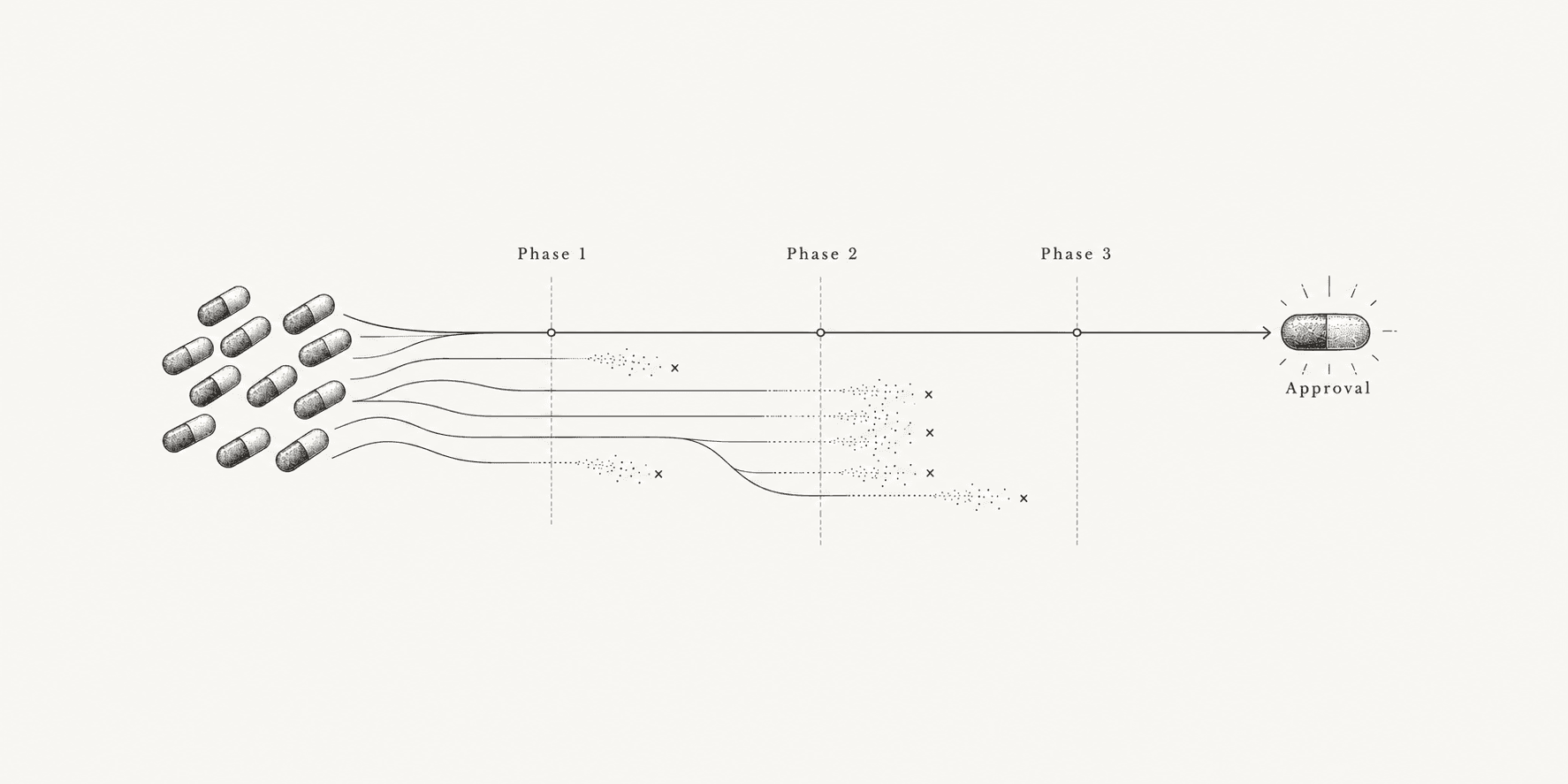
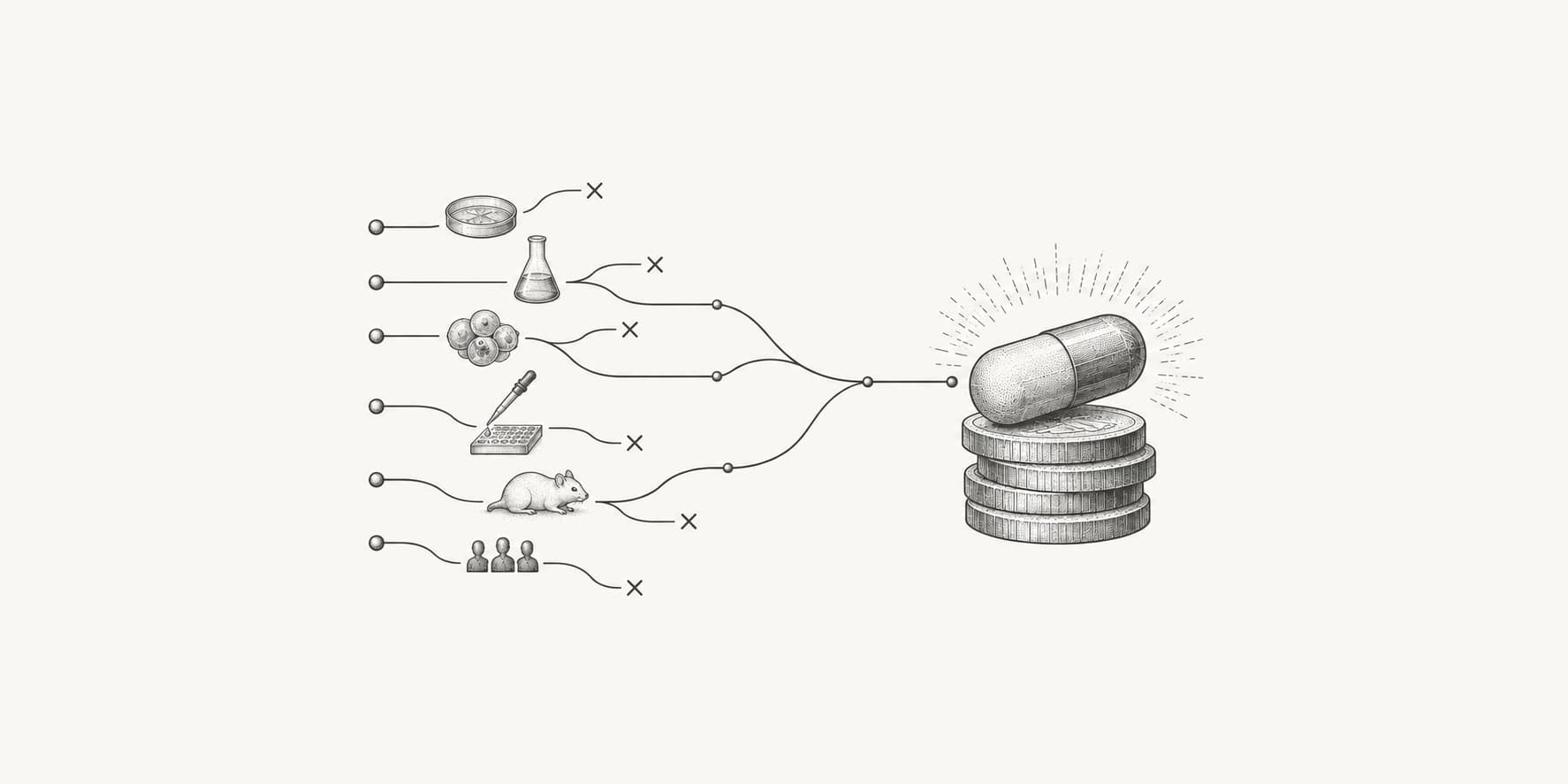
Those pharmaceutical R&D companies had 22,940 active candidates at the start of 2026. They move through a pipeline that can include laboratory screening, molecular docking, preclinical work, and clinical trials. The medicine count is much smaller because about nine in ten clinical candidates fail, and the programs that succeed carry the cost of failed research.[11]
The best available global employment estimate puts direct pharmaceutical employment at 7.8 million people in 2022. An industry-commissioned economic model estimated another 44.7 million jobs in supplier industries and 22.4 million jobs supported by worker spending, for 74.9 million direct, indirect, and induced jobs combined.[12]
Direct employment is the cleaner workforce figure. The 74.9 million total comes from an economic-impact model rather than company payrolls.
ProteinIQ. "How much is the pharmaceutical industry worth?" Published July 30, 2026. Accessed [your access date]. https://proteiniq.io/guides/how-much-is-the-pharmaceutical-industry-worth