How many ribosomes are in a cell?
A fast-growing E. coli cell has about 72,000 ribosomes, budding yeast has about 200,000, and a typical mammalian cell has roughly 1 million to 10 million.
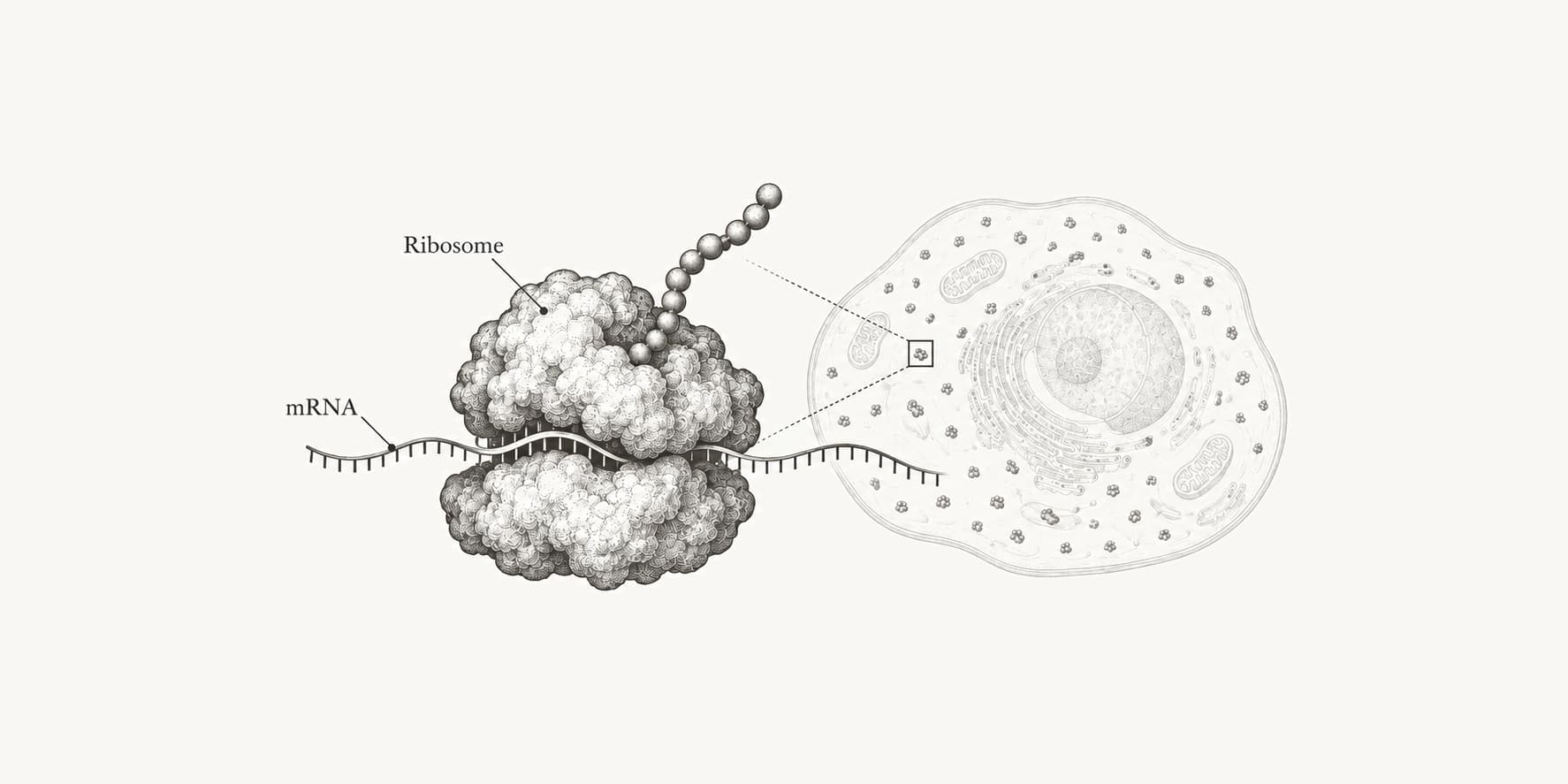
A cell can contain from a few thousand to about 10 million ribosomes. The count changes with the organism, cell size, growth rate, and demand for new protein.
Useful reference points are 6,800 to 72,000 ribosomes in an E. coli cell, about 200,000 in budding yeast, and roughly 1 million to 10 million in a typical mammalian cell. Human cells are usually discussed within that mammalian range because there is no universal count for every cell type.
How many ribosomes are in a cell?
A fast-growing E. coli cell has about 72,000 ribosomes, a budding yeast cell has about 200,000, and a typical mammalian cell has roughly 1 million to 10 million.[1][2][3]
The bacterial number can change tenfold without changing species. E. coli growing slowly with a doubling time near 100 minutes has about 6,800 ribosomes per cell. At a 24-minute doubling time, the count rises to about 72,000, and ribosomes account for more than one-third of cellular dry mass.[1] This growth-rate effect is why a single “ribosomes per bacterial cell” figure is incomplete.
Reviews of protein synthesis in Saccharomyces cerevisiae place the average near 200,000 ribosomes per cell. A rapidly dividing yeast cell can synthesize nearly 13,000 protein molecules per second across its full ribosome population.[2]
Mammalian cell types and states differ widely. A Nature review gives 1 million to 10 million ribosomes for a typical mammalian cell and notes that the fraction actively translating at any moment is not known.[3] For a human cell, “several million” is more defensible than one exact count.
The chart shows reported range endpoints rather than treating a midpoint as a measured count.[1][2][3]
How fast do ribosomes make proteins?
Ribosomes add roughly 10 to 20 amino acids per second in growing bacteria and about 5 to 10 amino acids per second in yeast and mammalian cells.[1][3][4][5]
In E. coli, translation runs near 20 amino acids per second during fast growth and closer to 10 during slow growth.[1] Ribosome-profiling work in yeast uses an average near 6 amino acids per second, while the U.S. National Institute of General Medical Sciences gives about 10 amino acids per second for a human ribosome.[4][5]
Protein length converts those rates into time. A typical bacterial protein of about 267 amino acids can be elongated in roughly 15 to 27 seconds. A typical human protein of about 375 amino acids takes roughly 40 seconds at 10 amino acids per second, or about one minute after allowing for initiation and termination.[4][8] For other proteins, dividing the amino-acid length of a translated coding sequence by the elongation rate gives a baseline, though codon identity, mRNA structure, nutrient supply, pauses, and cellular stress all change the real translation time.
How many proteins does one ribosome make?
One active human ribosome usually completes an average-sized protein in about one minute, but there is no fixed lifetime total for one ribosome.[4]
The output depends on protein length and elongation speed. In one published mammalian-cell model, a ribosome translating a 500-amino-acid protein at 5 amino acids per second finishes one chain every 100 seconds, or 0.6 protein molecules per minute while active.[3]
That review also illustrates the scale at cell level. If a cell has 5 million ribosomes, half are active, and each makes a 500-amino-acid protein at 5 amino acids per second, the cell produces 1.5 million protein molecules per minute.[3] The result is a calculation built from explicit assumptions, not a measured constant for every human cell. It counts protein molecules, not the number of distinct proteins in the proteome.
How many ribosomes are in a polysome?
A polysome contains at least two ribosomes translating the same mRNA, but its count can range from a few ribosomes to several dozen.[7]
The number is constrained by the length of the coding sequence and how often new ribosomes initiate translation. In one highly translated bacterial mRNA, researchers measured a packing density of 1.3 ribosomes per 100 nucleotides.[6] Other mRNAs are less densely packed because initiation is often the limiting step.
Electron microscopy of eukaryotic double-row polysomes found an average of 8 to 10 ribosomes, while the heaviest observed structures contained up to 40.[7] Each ribosome makes its own protein chain, so ten ribosomes on one mRNA can produce ten copies in parallel without requiring ten separate mRNA molecules.