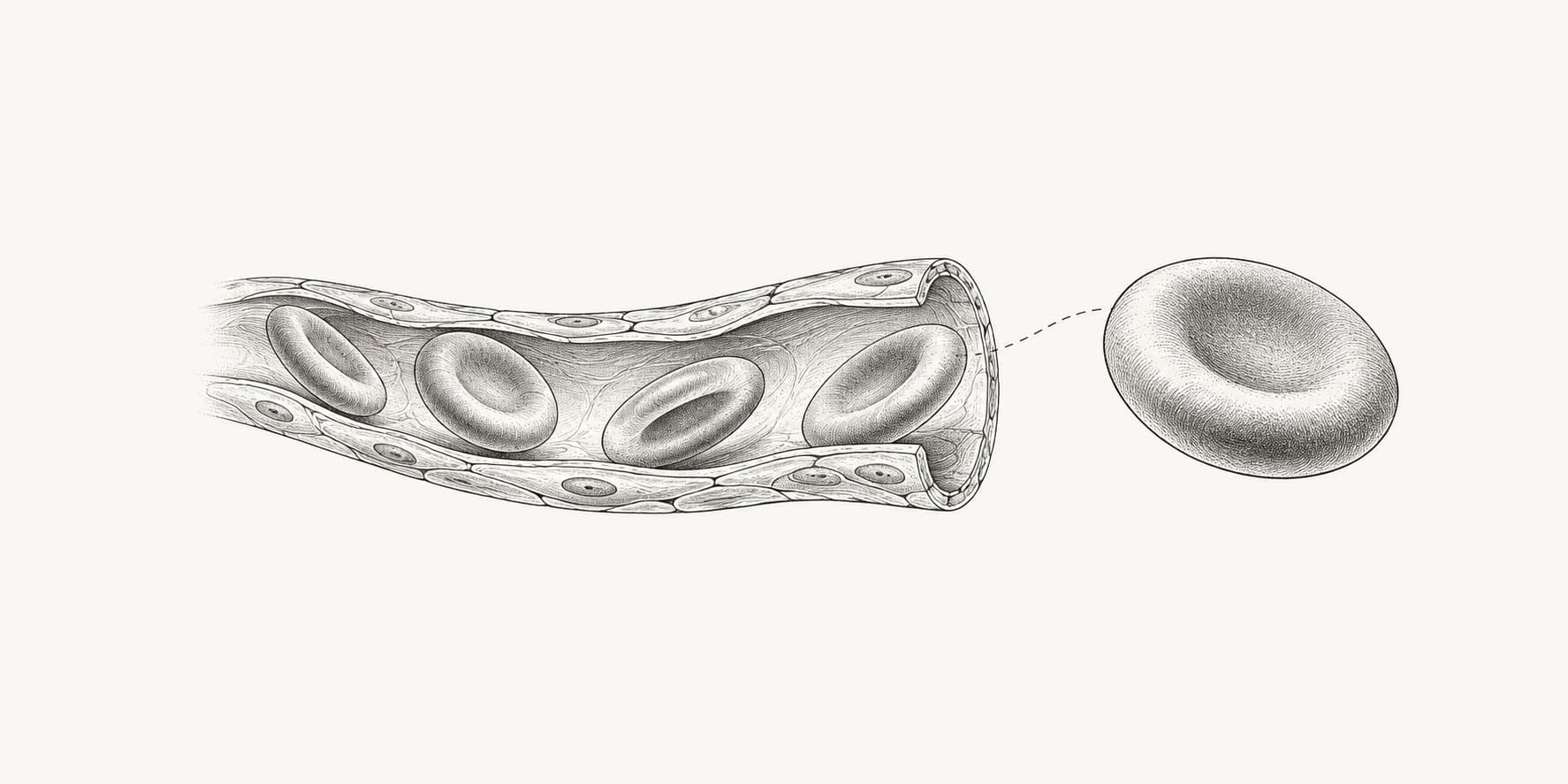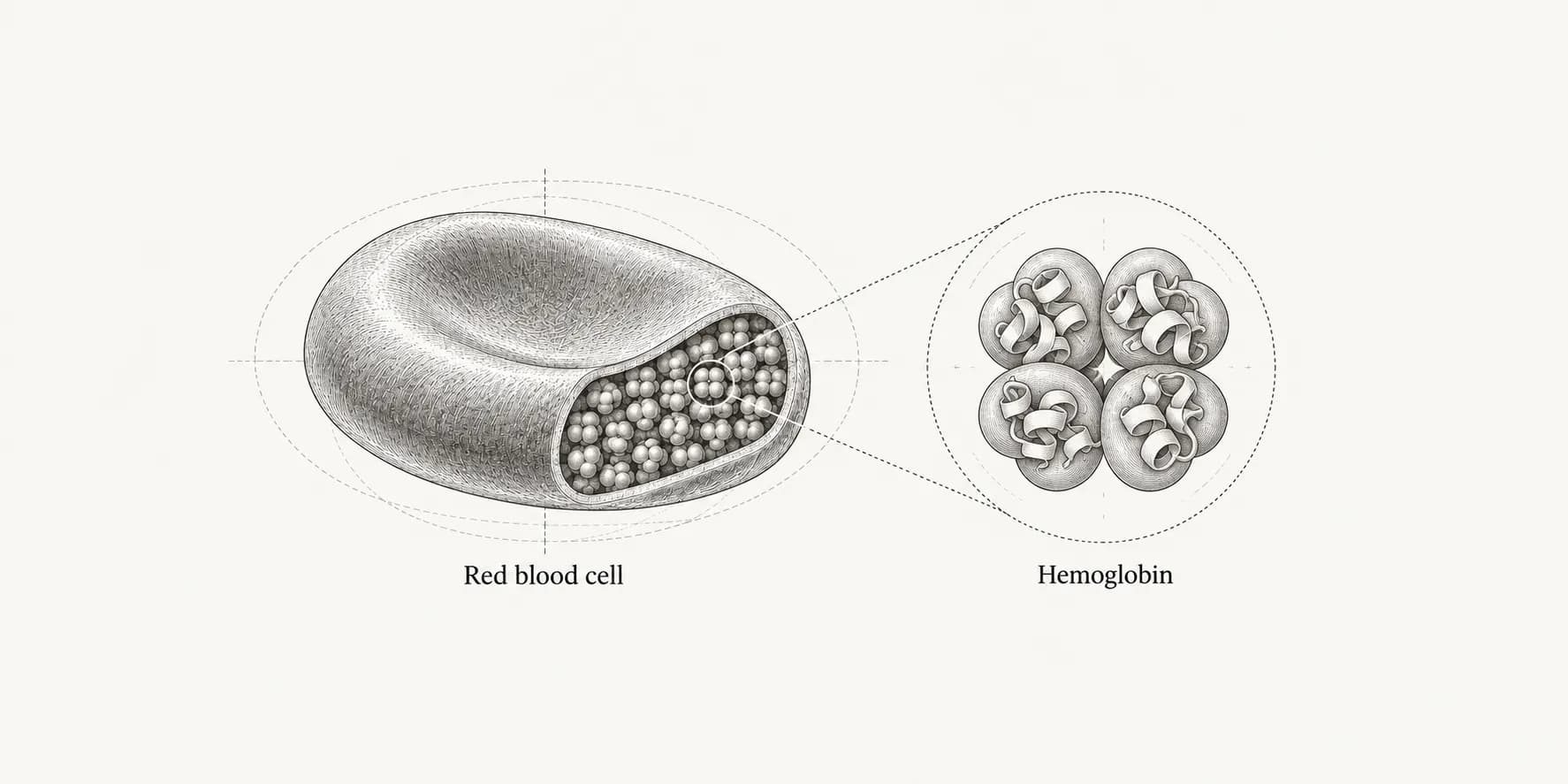
A typical adult red blood cell contains about 270 million hemoglobin molecules. Each molecule carries four iron-containing heme groups, so one cell holds roughly 1.1 billion hemes and can bind up to about 1.1 billion oxygen molecules at once. Hemoglobin, spelled haemoglobin in British English, is the protein that carries oxygen in the blood and gives red cells their color.
No instrument counts these molecules one at a time. The figure is calculated from the mass of hemoglobin in an average red cell and the molecular weight of a single hemoglobin molecule, which is why textbooks quote anything from 250 to 300 million while describing the same quantity. Converting the laboratory reference interval for healthy adults, we obtain about 250 to 310 million.
How many hemoglobin molecules are in a red blood cell?
The commonly quoted answer is about 270 million per cell, the value tabulated in the BioNumbers database from a 2008 review by Pierigè and colleagues.[1] A hemoglobin molecule here means the complete four-chain protein: two alpha chains of 141 amino acids and two beta chains of 146, 574 amino acids in all, with one heme group bound to each chain.[2][3][4]
The count is calculated rather than observed. Hematology laboratories report the mean corpuscular hemoglobin of a blood sample, the average mass of hemoglobin in one red cell, in picograms, where a picogram is a trillionth of a gram.[5] In a study of 1,826 healthy adults from five Nordic countries, 95% had values between 27.1 and 33.3 picograms.[6] Turning a mass into a count then needs only the mass of one molecule, which follows from its sequence.
UniProt lists 15,258 daltons for the full alpha chain sequence and 15,998 for beta, both including the initiator methionine that the cell later removes.[2][3] Subtracting that residue (131 daltons) leaves 15,127 daltons for the mature alpha chain and 15,867 for the mature beta chain, which agrees to within a dalton with a sum of average residue masses. The protein molecular weight calculator sums only the amino acid chain, so the four heme groups, 616.5 daltons each,[7] are added separately:
A dalton is one gram per mole, so a mole of hemoglobin, or 6.022 × 10²³ molecules, weighs about 64.5 grams. Dividing a cell's hemoglobin mass by this molar mass and multiplying by Avogadro's number gives the count. Each picogram corresponds to about 9.3 million molecules, so a cell holding 29 picograms, well inside the healthy interval, contains about 270 million:
Applying the same conversion to the ends of the healthy interval, we calculated 253 million molecules at 27.1 picograms and 311 million at 33.3 picograms. Because every molecule has four chains, the same cell holds about 540 million alpha chains and 540 million beta chains, so a count of alpha chains alone is twice the number of molecules and a count of all chains is four times as large. For scale, tallying 270 million molecules at one per second would take more than eight years, a reminder that the number is inferred from mass rather than counted.
Why do textbooks quote 250, 270, or 300 million hemoglobin molecules per cell?
Each value rests on a different assumed hemoglobin mass per cell, and healthy red cells genuinely differ in how much hemoglobin they contain. The quoted values below fall inside the range that healthy adults span, apart from the lowest, which sits about 1% under its lower limit.
| Source | Molecules per cell | Hemoglobin per cell |
|---|---|---|
| LibreTexts, Biology for Majors II | 250 million | 26.8 pg |
| BioNumbers, citing Pierigè et al. (2008) | 270 million | 28.9 pg |
| OpenStax Anatomy and Physiology 2e | 300 million | 32.1 pg |
| BioNumbers derivation from concentration and volume | 307 million | 33 pg |
| Healthy adults, Nordic reference interval | 253 to 311 million | 27.1 to 33.3 pg |
The BioNumbers entry shows how loosely the figure is anchored. It records 270 million with a note that the review gave no measurement method, then derives a value of its own from concentration, volume, and molar mass, using 330 grams per liter, about 100 cubic micrometers, and 64,458 grams per mole, and obtains 307 million with Avogadro's number rounded to 6 × 10²³.[1] The gap of about 14% within one entry is comparable to the spread between textbooks, and it reflects different assumed hemoglobin masses rather than different molar masses: 330 grams per liter in 100 cubic micrometers is 33 picograms, at the upper end of the healthy interval, whereas 270 million corresponds to 29. Our 64,454 grams per mole and BioNumbers' 64,458 differ by less than 0.01%, so the molar mass is not where the disagreement arises.
People differ about as much as the books do. Mean corpuscular hemoglobin is an average over the millions of cells in a blood sample, and it shifts with health: iron deficiency anemia lowers the amount of hemoglobin per cell, and anemia caused by a vitamin B deficiency raises it.[5] The figure of 270 million is therefore a typical value for a healthy adult, not a constant of the species.
Proteomic quantification can depend on the same measurement. Gautier and colleagues' absolute proteome of purified red cells, for example, used the mean corpuscular hemoglobin content of the cells as its standard, so hemoglobin in that dataset is anchored to the laboratory value rather than counted separately.[9]
Finally, the molecules being counted are mostly one protein. Adult blood contains more than 95% hemoglobin A, 2% to 3% hemoglobin A2, and 0.8% to 2% fetal hemoglobin.[10] Hemoglobin A2 is likewise a tetramer, built from alpha and delta chains, so the minor forms do not change the picture.[11]
How many oxygen molecules can one red blood cell carry?
A red blood cell can carry about 1.1 billion oxygen molecules when every heme is occupied. Each heme contains one iron ion that binds one oxygen molecule, so each hemoglobin molecule can carry four.[4] Multiplying 270 million molecules by four gives 1.08 billion, and the healthy interval of 253 to 311 million molecules gives 1.0 to 1.2 billion. OpenStax's textbook figure of 300 million molecules and 1.2 billion oxygen molecules sits at the upper end of that range.[4]
The same arithmetic counts iron, because each heme holds a single iron ion: the hemoglobin in a red cell contains about 1.1 billion iron atoms. The oxygen figure is a capacity, reached only when every heme carries oxygen, not the amount delivered on any single trip through the circulation.
How much of a red blood cell is hemoglobin?
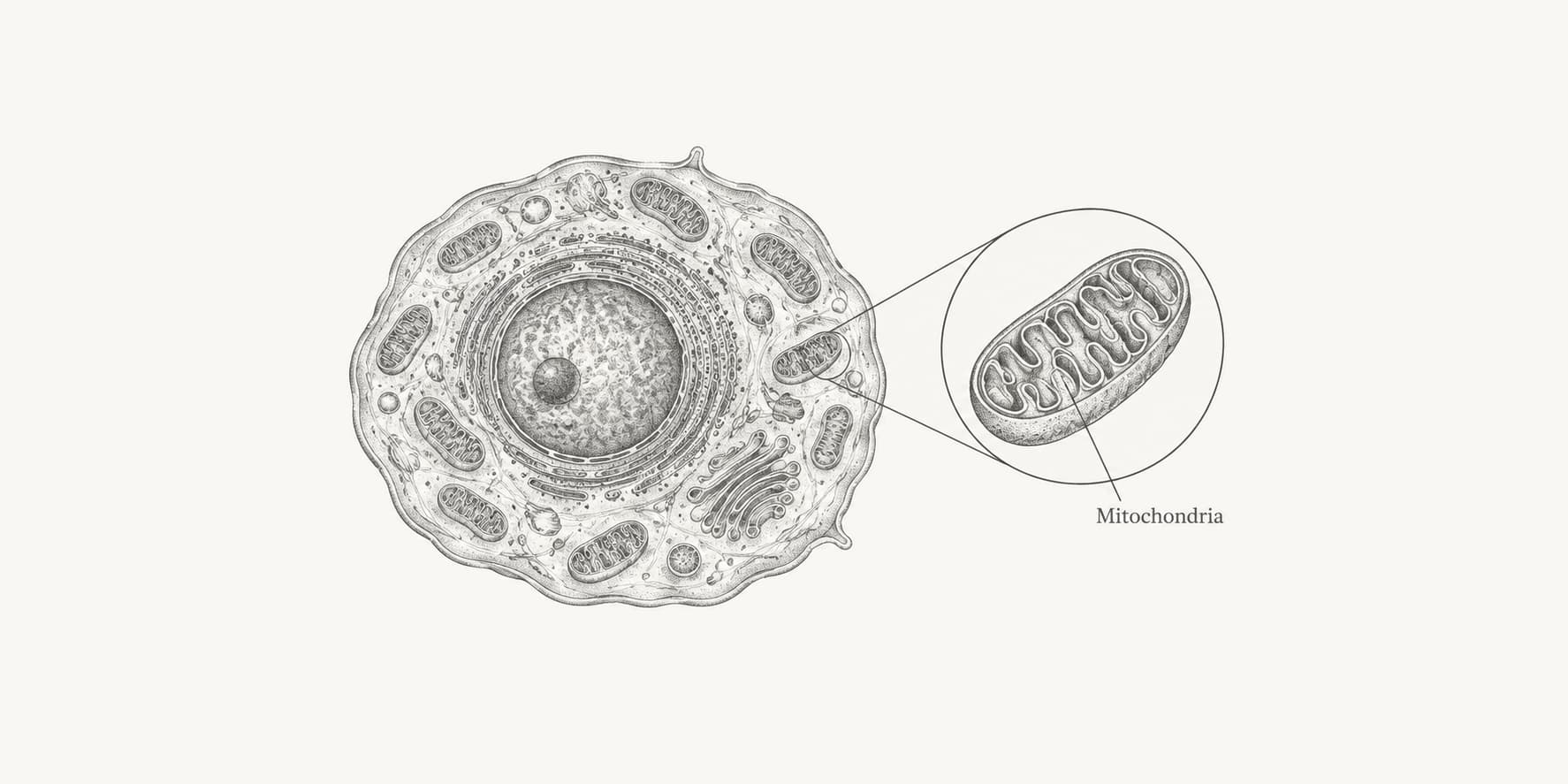
Red cells are densely packed with hemoglobin: healthy adults have 317 to 357 grams of hemoglobin per liter of red cells, so each milliliter holds about a third of a gram.[6] Hemoglobin accounts for about 98% of the protein in a mature red cell.[12] Mature red cells lack major organelles such as mitochondria and the machinery for making protein, which leaves the interior to hemoglobin and makes it the most abundant protein in these cells.[12]
The packing and the per-cell count describe the same cell, because mean corpuscular hemoglobin equals cell volume multiplied by hemoglobin concentration. The Nordic reference population had red cell volumes of 82 to 98 femtoliters.[6] Multiplying the midpoints of the two intervals, 90 femtoliters and 337 grams per liter, we calculated 30 picograms of hemoglobin per cell, or about 280 million molecules.
Taken together, the figures describe one cell at three levels. Its interior holds about a third of a gram of hemoglobin per milliliter, that amounts to roughly 30 picograms per cell, and that mass is divided into 64.5-kilodalton molecules, each able to bind four oxygen molecules, numbering about 270 million in the commonly quoted figure. The mass and the molecule are well constrained, while the number between them varies by tens of millions from person to person, which is why it belongs with its range. Multiplied by the tens of trillions of red blood cells in the body, the same per-cell figure sets the body's supply of hemoglobin.