How many ATP are produced in cellular respiration?
Complete aerobic respiration produces about 30 to 32 ATP molecules per glucose in human cells. Most of this ATP comes from oxidative phosphorylation.
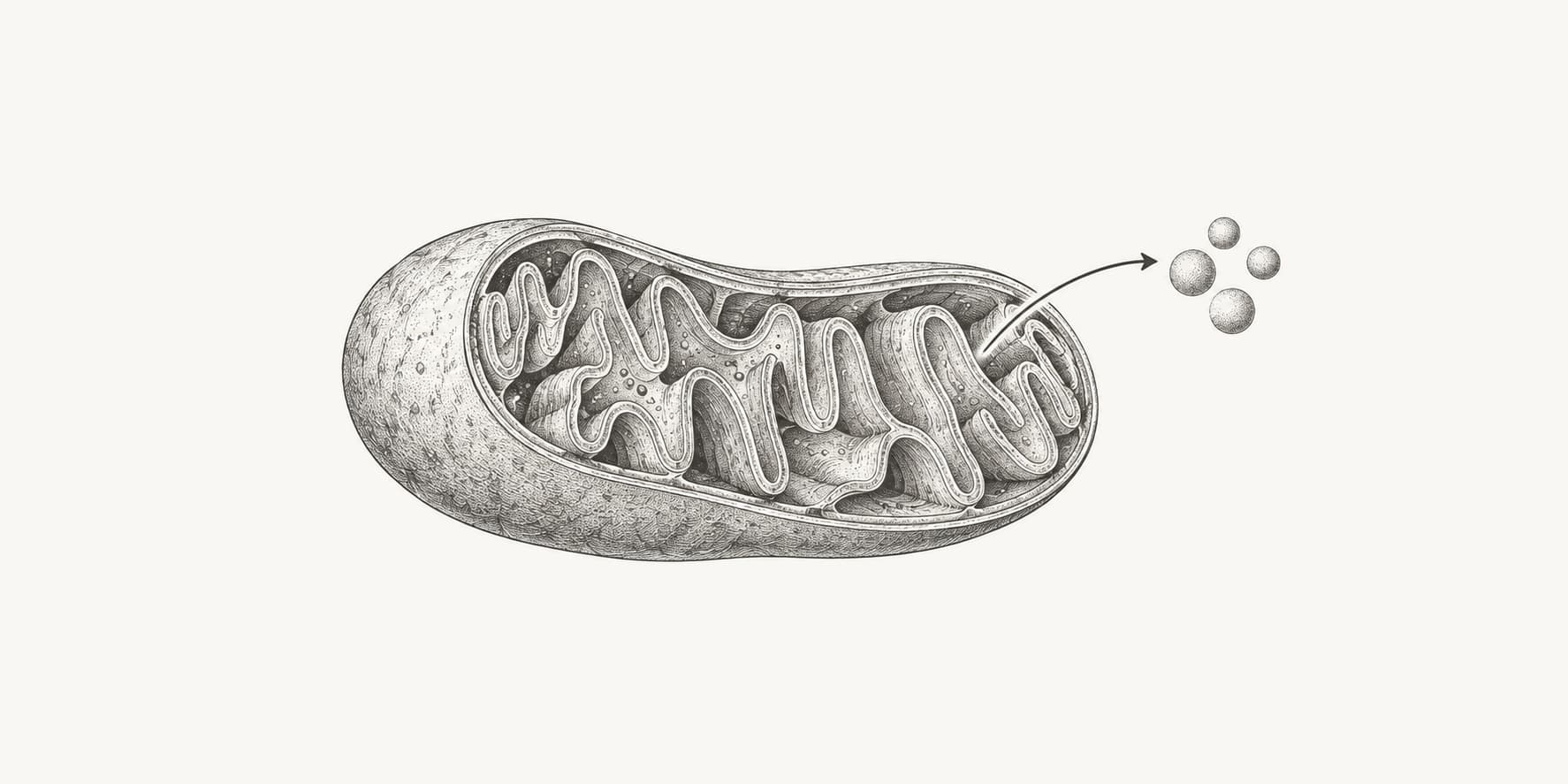
Complete aerobic cellular respiration produces about 30 to 32 ATP molecules per glucose in human cells. Four ATP equivalents form directly, while oxidative phosphorylation produces the remaining 26 to 28.
The total is a biochemical accounting estimate, not a fixed output measured from every glucose molecule. Mitochondrial coupling, electron shuttles, and the cell's use of pathway intermediates can change the realized yield.
How many ATP are produced in cellular respiration?
Cellular respiration produces about 30 to 32 ATP molecules for each glucose molecule fully oxidized in a human cell.[1][3]
The stages contribute:
| Stage | Direct ATP or GTP | NADH | FADH₂ | Carbon dioxide |
|---|---|---|---|---|
| Glycolysis | 2 net | 2 | 0 | 0 |
| Pyruvate oxidation | 0 | 2 | 0 | 2 |
| Citric acid cycle | 2 | 6 | 2 | 4 |
| Total formed before oxidative phosphorylation | 4 | 10 | 2 | 6 |
The totals come from one glucose molecule. Glycolysis produces two net ATP, while two turns of the Krebs cycle produce two GTP or ATP equivalents. The 10 NADH and 2 FADH₂ carry electrons to oxidative phosphorylation, where most ATP forms.[2]
Balancing the simplified overall equation gives one glucose plus six oxygen molecules forming six carbon dioxide and six water molecules.[2] This is the net chemical balance. Individual reactions within respiration both consume and produce water, so counting every mechanistic water molecule gives a different result from the net six.
What stage of cellular respiration produces the most ATP?
Oxidative phosphorylation produces about 26 to 28 of the 30 to 32 ATP attributed to one glucose molecule, far more than any other stage.[1][4]
Glycolysis and the citric acid cycle each contribute two ATP equivalents through substrate-level phosphorylation. Together, those direct reactions account for four ATP per glucose. The other roughly 87% comes from the electron transport chain and ATP synthase in the inner mitochondrial membrane.
Oxidative phosphorylation uses the electrons carried by NADH and FADH₂ to pump protons across the membrane. ATP synthase then uses the proton gradient to phosphorylate ADP. The conventional yields are about 2.5 ATP per mitochondrial NADH and 1.5 ATP per FADH₂.[1][4]
Why do cellular respiration estimates range from 30 to 32 ATP?
The 30-to-32 ATP range mainly reflects how cells transfer the electrons from the two NADH formed during glycolysis into mitochondria.
Glycolytic NADH forms in the cytosol, but NADH cannot cross the inner mitochondrial membrane directly. Electron shuttles carry its reducing power into mitochondria. The malate-aspartate shuttle transfers its electrons to mitochondrial NADH, giving about five ATP from the two glycolytic NADH. This produces the 32-ATP total.
The glycerol 3-phosphate shuttle passes the same electrons to the respiratory chain at a lower-energy entry point. They yield about three ATP instead, producing the 30-ATP total. Proton leak and the diversion of intermediates into other pathways can lower the realized yield further, which is why 30 to 32 is best treated as a conventional maximum for complete aerobic oxidation rather than a guarantee for every cell.[1][4]
Why do some sources say cellular respiration produces 36 or 38 ATP?
The older 36- and 38-ATP totals assign three ATP to each NADH and two ATP to each FADH₂. Modern estimates use about 2.5 ATP per NADH and 1.5 ATP per FADH₂.[4]
The earlier whole-number ratios were based on a simplified view of the electron transport chain's coupling sites. Later measurements of proton pumping, ATP synthase stoichiometry, and the cost of moving phosphate, ADP, and ATP across the inner mitochondrial membrane produced the lower ratios.[4]
With modern accounting, complete aerobic respiration of glucose is therefore usually reported as about 30 or 32 ATP in human cells. Organisms with different respiratory chains or ATP synthase structures can have different theoretical yields.