How many ATP does beta oxidation produce?
Complete oxidation of one palmitate molecule yields 106 net ATP under conventional modern accounting. The beta-oxidation spiral supplies 28 ATP equivalents, while its eight acetyl-CoA supply 80 more.
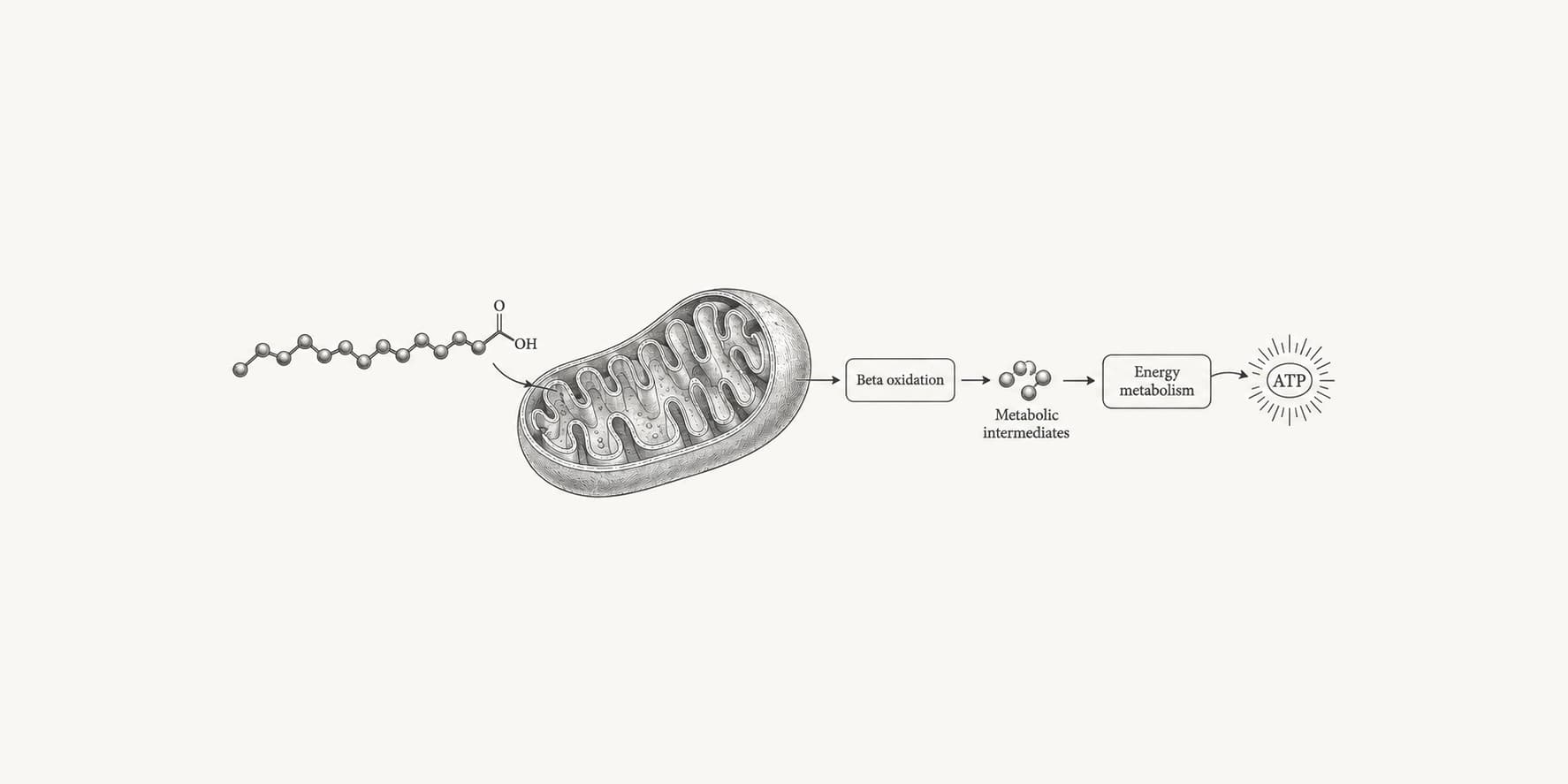
Complete oxidation of one palmitate molecule yields 106 net ATP under conventional modern accounting. Palmitate is the 16-carbon saturated fatty acid used for the standard beta-oxidation calculation.
The beta-oxidation spiral itself makes no ATP directly. It produces NADH, FADH₂, and acetyl-CoA, which support ATP production through the Krebs cycle and oxidative phosphorylation.
How many ATP does beta oxidation produce?
Beta oxidation of palmitate supports a net yield of 106 ATP molecules when its products are completely oxidized.[1]
Seven beta-oxidation cycles produce 7 NADH, 7 FADH₂, and 8 acetyl-CoA. The NADH and FADH₂ from the spiral support 28 ATP through oxidative phosphorylation. Oxidation of the eight acetyl-CoA supports another 80 ATP. Activating palmitate to palmitoyl-CoA costs two ATP equivalents, reducing the gross total of 108 to 106.[1][2]
This is a theoretical accounting yield. Cells may capture less because proton leak, mitochondrial uncoupling, and competing uses of acetyl-CoA or electron carriers reduce the ATP recovered.
How is the 106 ATP yield from palmitate calculated?
The 106-ATP total is calculated as 17.5 ATP from 7 NADH, 10.5 ATP from 7 FADH₂, and 80 ATP from 8 acetyl-CoA, minus 2 ATP equivalents for fatty-acid activation.[1][3]
The calculation is:
7 NADH × 2.5 ATP + 7 FADH₂ × 1.5 ATP + 8 acetyl-CoA × 10 ATP − 2 ATP = 106 ATP.
One palmitate molecule requires seven cycles, not eight. Each of the first six cycles removes one two-carbon acetyl-CoA unit. The seventh and final cycle splits the remaining four-carbon chain into two acetyl-CoA molecules, bringing the total to eight.[1][2]
How does fatty-acid length change ATP yield?
Longer saturated fatty acids produce more ATP because every additional two-carbon unit adds one acetyl-CoA and, except at the end of the chain, another beta-oxidation cycle.
For a saturated, even-chain fatty acid with n carbon atoms, conventional net ATP yield is 7n − 6. This formula assumes 2.5 ATP per NADH, 1.5 per FADH₂, 10 per acetyl-CoA, and a two-ATP-equivalent activation cost.[2][3]
The chart values are ProteinIQ calculations using the 7n − 6 formula. Each additional pair of carbon atoms adds 14 ATP to the conventional net yield.
The formula does not apply unchanged to odd-chain or unsaturated fatty acids. Odd chains finish with propionyl-CoA rather than two acetyl-CoA molecules. Double bonds in unsaturated fatty acids bypass or alter some oxidation steps, usually lowering the ATP yield compared with a saturated fatty acid of the same length.[2]
Why do some sources report 129 ATP from palmitate?
The older 129-ATP estimate assigns 3 ATP to each NADH and 2 ATP to each FADH₂, while the modern 106-ATP estimate uses about 2.5 and 1.5 ATP, respectively.[3][4]
Under the older ratios, palmitate yields 21 ATP from its seven beta-oxidation NADH, 14 from its seven FADH₂, and 96 from eight acetyl-CoA. Subtracting two ATP equivalents for activation gives 129 ATP.
Measurements of mitochondrial coupling support lower, non-integer ATP-to-oxygen ratios. The 106-ATP figure is therefore the standard modern answer, but it should be described as a conventional maximum for complete oxidation rather than a fixed output from every palmitate molecule.[3][4]