The best phylogenetic tree software in 2026
Which program to use for building and viewing trees

Matic Broz, PhD18 min
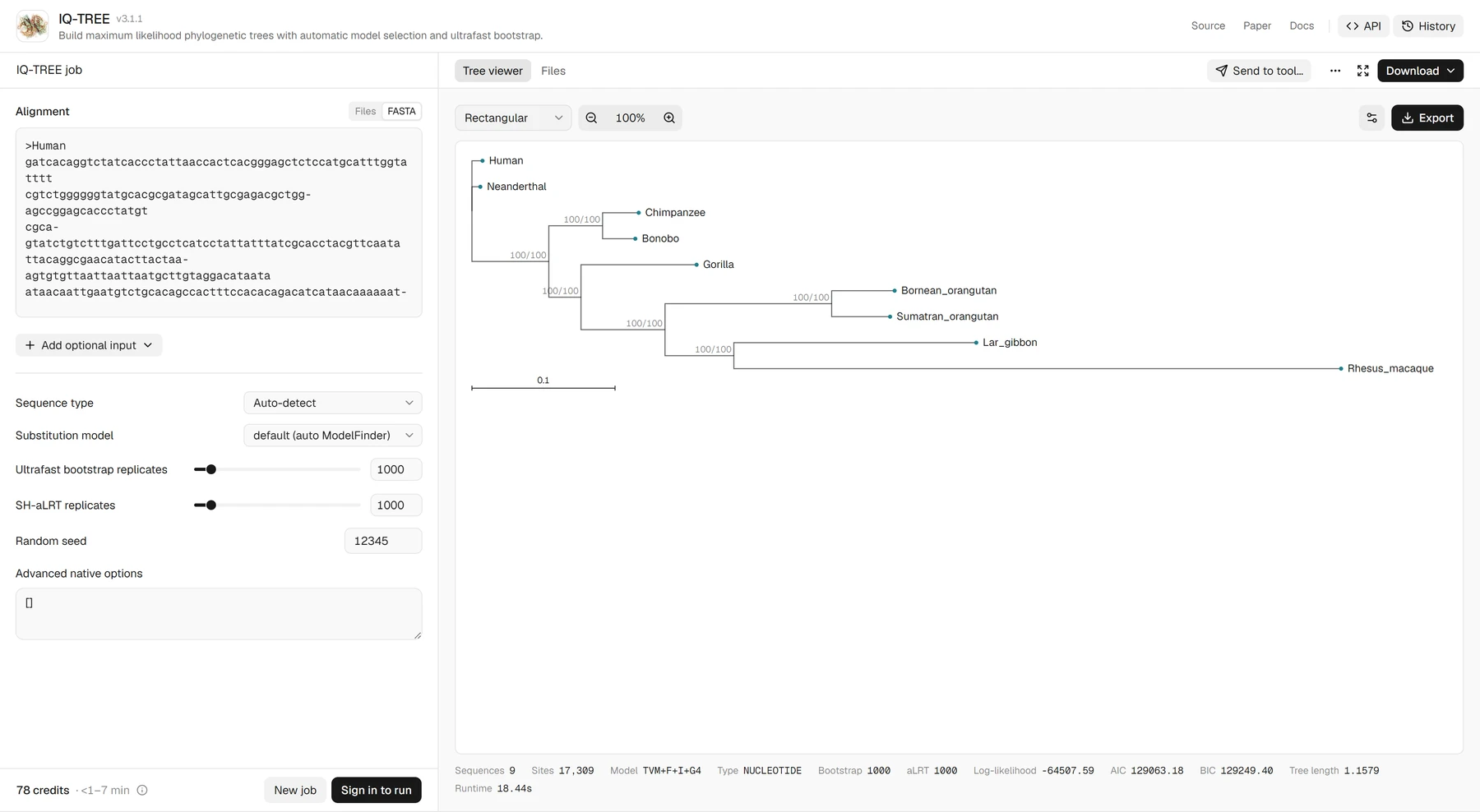
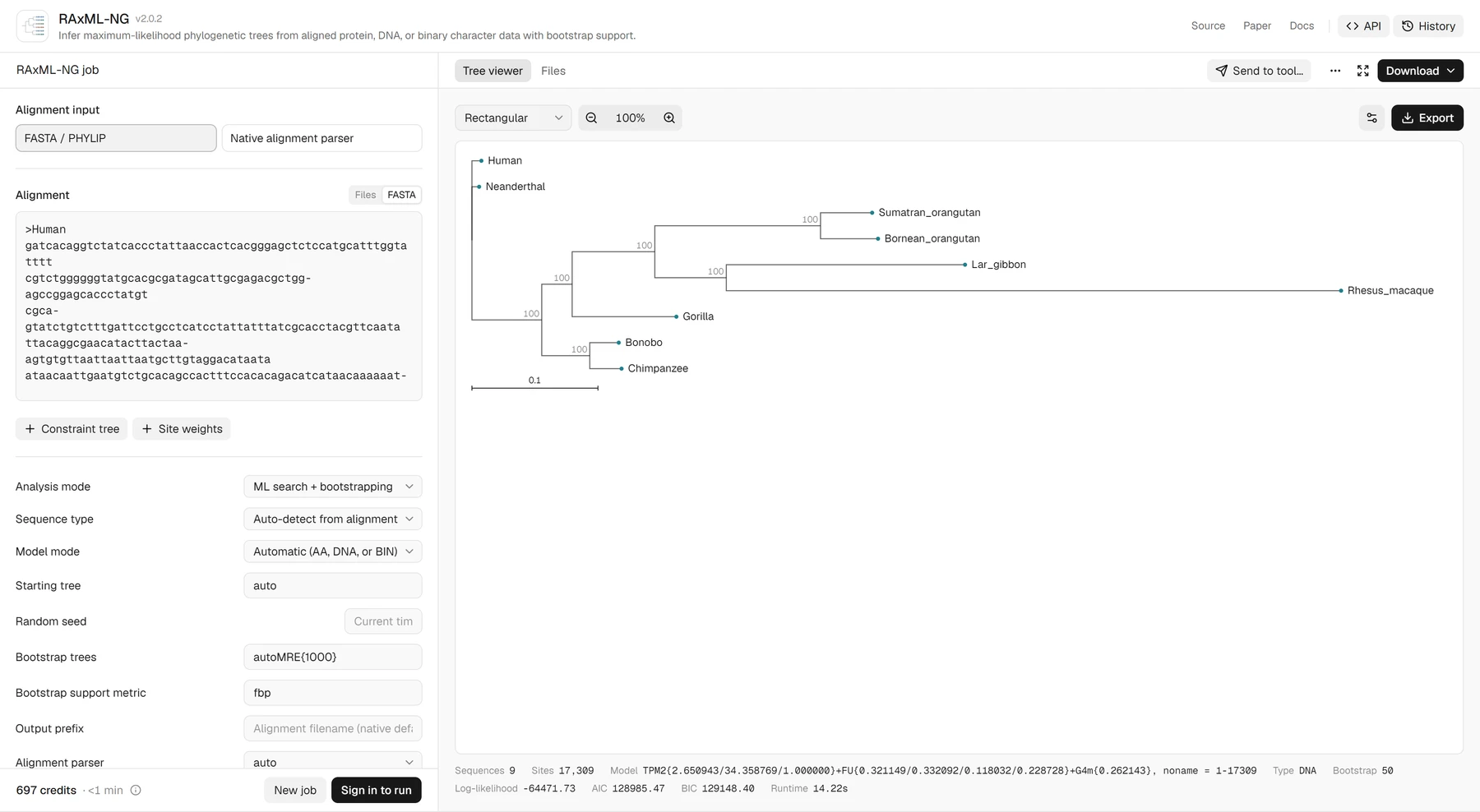
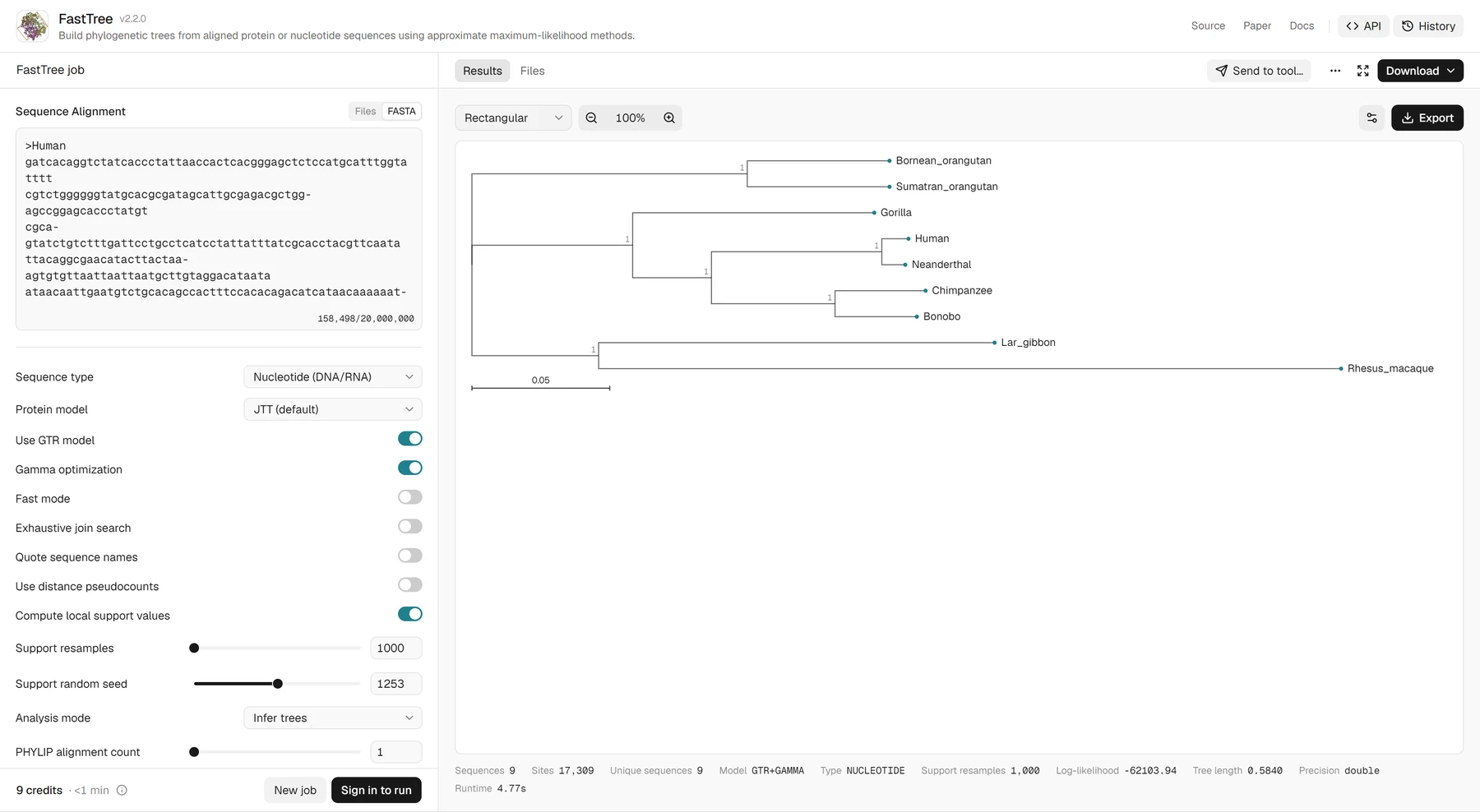
We aligned nine primate mitochondrial genomes, the set behind the phylogenetic tree explainer, and built a tree three ways. IQ-TREE, RAxML-NG and FastTree returned the same unrooted tree in 18, 14 and 5 seconds. On a small, clean dataset the choice of program hardly shows, which is why most advice about it misses the cases where it does.
Those cases are the real decision: thousands of sequences where a full likelihood search takes days, a question about when two lineages split rather than how they branch, a figure a reviewer will scrutinize, or a lab where nobody wants a command line. Different programs are built for each, and several of the best are free.
ProteinIQ runs IQ-TREE, RAxML-NG and FastTree below, so read our enthusiasm with that in mind. All three are open source, and you can run them anywhere you like.
The best phylogenetic tree software
- IQ-TREE for most maximum likelihood trees
- RAxML-NG for taxon-rich alignments and a second opinion
- FastTree for alignments too large for a full search
- MrBayes for Bayesian trees with posterior probabilities
- BEAST X for time-scaled trees
- MEGA for a point-and-click desktop program
- PearTree for viewing and exporting trees
- iTOL for annotating and sharing trees
And Geneious Prime, for labs that want one paid suite.
What makes good phylogenetic tree software?
Two jobs hide behind the name. Inference finds the tree and its branch lengths from an alignment, by maximum likelihood or Bayesian methods. Viewing draws that tree, annotates it and exports a figure. Few programs do both well, so we judged them separately.
For inference we looked at whether the program finds high-scoring trees in independent benchmarks, whether it chooses a substitution model for you, how it measures support and how it scales. A bootstrap of 95, an ultrafast bootstrap of 95 and a posterior probability of 0.95 are three different statements, and no comparison table should line them up.
We checked every version, license and price on the project's own pages on November 3, 2026. We ran IQ-TREE, RAxML-NG and FastTree on one MAFFT alignment of nine primate mitochondrial genomes, 17,309 columns long.[27] We left out software that is free only as a trial, projects without recent maintenance, and tools for a narrower job than tree building.
The best phylogenetic tree software at a glance
| Program | Best for | Method | Support values | Biggest gap | License or price |
|---|---|---|---|---|---|
| Geneious Prime | One paid suite for alignment, trees and annotation | Distance built in, other methods as plugins | Depends on the builder | Price | Commercial, from $200 a year |
| IQ-TREE | Most maximum likelihood trees | Maximum likelihood | Ultrafast bootstrap, SH-aLRT, bootstrap | Command line only | GPL-2.0 |
| RAxML-NG | Taxon-rich alignments, a second opinion | Maximum likelihood | Bootstrap, transfer bootstrap | No native Windows build | AGPL-3.0 |
| FastTree | Very large alignments | Approximate maximum likelihood | Local support values | Lower-scoring trees than full searches | GPL-3.0 |
| MrBayes | Bayesian trees and model choice | Bayesian MCMC | Posterior probability | Command line only | GPL-3.0 |
| BEAST X | Time-scaled trees | Bayesian MCMC | Posterior probability | Rooted, time-measured trees only | LGPL-2.1 |
| MEGA | A desktop program with a graphical interface | Maximum likelihood, distance, parsimony | Bootstrap | Closed source, no Bayesian trees | Free for research and teaching |
| PearTree | Viewing and exporting trees | Viewer | Shows what the tree file holds | Does not infer trees | MIT |
| iTOL | Annotating and sharing trees | Viewer | Shows what the tree file holds | Saving annotations needs a subscription | Free mode, then €60 a year |
The paid option for phylogenetic tree software
Geneious Prime (desktop)
Geneious Prime pros:
- One interface for alignment, tree building, annotation and sharing
- Builds trees with its own distance method and with plugins for RAxML, FastTree, MrBayes and PhyML
Geneious Prime cons:
- Everything it runs for trees is free elsewhere, and the suite costs $620 a year for academics
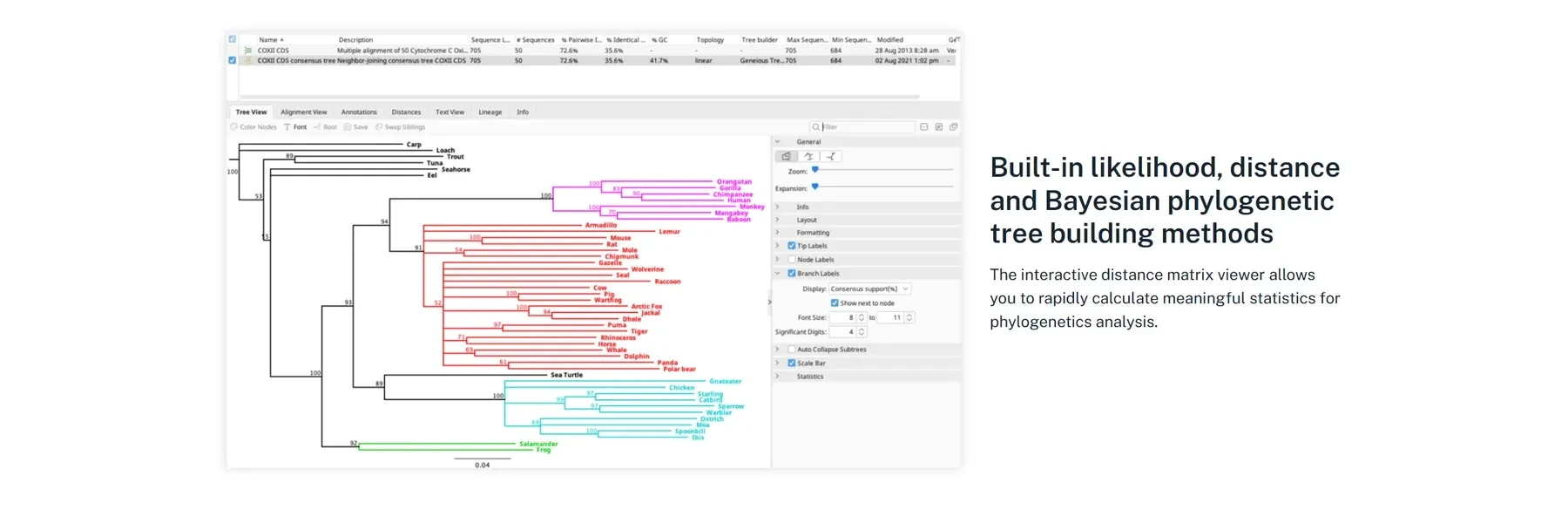
Geneious Prime, now part of Dotmatics, is the desktop suite many labs license for sequence work. Its product page advertises likelihood, distance and Bayesian tree building after an alignment step in the same window.[24] The plugins page lists RAxML, FastTree, MrBayes and PhyML for phylogenetics; IQ-TREE is not on that list.[25]
Plans are priced per user per year: 620 for academics and $2,150 for companies, with team and enterprise tiers above that and a free trial.[26] What you pay for is the workspace around the programs, not better inference. If your lab already lives in Geneious, keep it. If you only need trees, the free programs below do the same calculations.
Geneious Prime price: Commercial. 620 for academics, $2,150 for corporate users.
Best phylogenetic tree software for maximum likelihood trees
Maximum likelihood is the usual choice for a single best tree with support values. IQ-TREE is the default for most projects, and RAxML-NG is the program to run next to it when the tree matters or the alignment has many taxa.
IQ-TREE (Windows, macOS, Linux, web)
IQ-TREE pros:
- Chooses the substitution model with ModelFinder, then adds ultrafast bootstrap and SH-aLRT support in the same run
- Reached the best-observed likelihood on every dataset in an independent benchmark
IQ-TREE cons:
- A command-line program with no native desktop interface
IQ-TREE 3, from Thomas Wong, Bui Quang Minh and colleagues, appeared in Molecular Biology and Evolution in 2026. It adds mixture models as an alternative to partitioned models, gene and site concordance factors, and a sequence simulator.[1] The current release is 3.1.4, from September 2026, under the GPL-2.0 license.[2]
In 2018, Zhou and colleagues compared fast likelihood programs on 19 empirical phylogenomic datasets with hundreds to thousands of genes and up to 200 taxa. IQ-TREE reached the best-observed likelihood on every dataset, with RAxML a close second.[3] That predates IQ-TREE 3 and RAxML-NG, so read it as a track record, not a current ranking.
A run needs an aligned FASTA, PHYLIP or NEXUS file. On ProteinIQ, which runs IQ-TREE 3.1.1, ModelFinder chose TVM+F+I+G4 for our alignment, and 1,000 ultrafast bootstrap plus 1,000 SH-aLRT replicates finished in 18 seconds. Every node scored 100/100, which fits an alignment of 17,309 columns and says nothing about harder data.
IQ-TREE price: Free and open source. On ProteinIQ, a job costs 20 credits up to 40,000 alignment characters, then one credit per 2,000; our example cost 78. A free account starts with 200 credits and gets 100 a month.
RAxML-NG (Linux, macOS, web)
RAxML-NG pros:
- Stops bootstrapping by itself once the replicates agree, and adds transfer bootstrap support
- On taxon-rich datasets it often finds higher-scoring trees than IQ-TREE
RAxML-NG cons:
- Linux and macOS binaries only; Windows users go through the Windows Subsystem for Linux
- The AGPL-3.0 license is the strictest of the group, so companies building on it should read it
RAxML-NG is a from-scratch rewrite of the greedy tree search in RAxML and ExaML by Alexey Kozlov, Alexandros Stamatakis and colleagues. Their paper adds terrace detection and transfer bootstrap support, and version 2.0 added adaptive search heuristics, automatic model selection and fast branch support metrics.[4][5]
Kozlov and colleagues report that on taxon-rich datasets RAxML-NG often finds higher-scoring trees than IQ-TREE, while IQ-TREE's results are more stable.[4] That is the practical case for running both on a tree that will carry a paper: if they agree, you have a check, and if they disagree you have found the part of the tree to worry about.
On our alignment, RAxML-NG picked TPM2+FU+G4m and reached the same unrooted tree as IQ-TREE in 14 seconds. The two programs chose different models, so compare their trees rather than their likelihood scores. ProteinIQ runs version 2.0.2; the current release is 2.0.4, from October 2026.
RAxML-NG price: Free and open source under AGPL-3.0. On ProteinIQ, a job starts at 20 credits and grows with alignment size; our 155,781-residue example quoted 697, about nine times IQ-TREE's 78 for the same file.
Best phylogenetic tree software for very large alignments
FastTree (Linux, Windows, web)
FastTree pros:
- Handles alignments of up to about a million sequences
- Finished our example in under five seconds
FastTree cons:
- Trees score lower in likelihood than those from full searches
FastTree 2, from Morgan Price, Paramvir Dehal and Adam Arkin, builds a starting tree by a heuristic form of neighbor joining, then improves it with minimum-evolution and likelihood moves. The authors found it slightly more accurate than PhyML 3 with default settings and, for large alignments, 100 to 1,000 times faster than maximum likelihood methods that use full SPR searches.[6]
Their headline run was 237,882 distinct 16S rRNA sequences in 22 hours and 5.8 GB of memory on a desktop computer.[6] The price of that speed shows in the 2018 benchmark: FastTree was the fastest program but produced lower likelihoods and more dissimilar topologies than the others.[3] Its author notes that most splits a fuller search finds and FastTree misses have poor support.[7]
Use it as a first pass, or when the alignment is too large for anything else. The current release is 2.2.0, under GPL-3.0 according to its repository, and the Linux and Windows executables need a CPU with AVX2.[7][8]
FastTree price: Free and open source. On ProteinIQ, a job starts at 5 credits; our example cost 9.
Best phylogenetic tree software for Bayesian and time-scaled trees
Bayesian programs return a distribution of trees, not one best tree. MrBayes is the classic choice for topology and model comparison. BEAST X adds a molecular clock, so its trees carry dates.
MrBayes (Windows, macOS, Linux)
MrBayes pros:
- Compares models with Bayes factors from stepping-stone sampling
- Mixes molecular and morphological characters in one analysis
MrBayes cons:
- Command line only, and you have to judge convergence yourself before trusting a tree
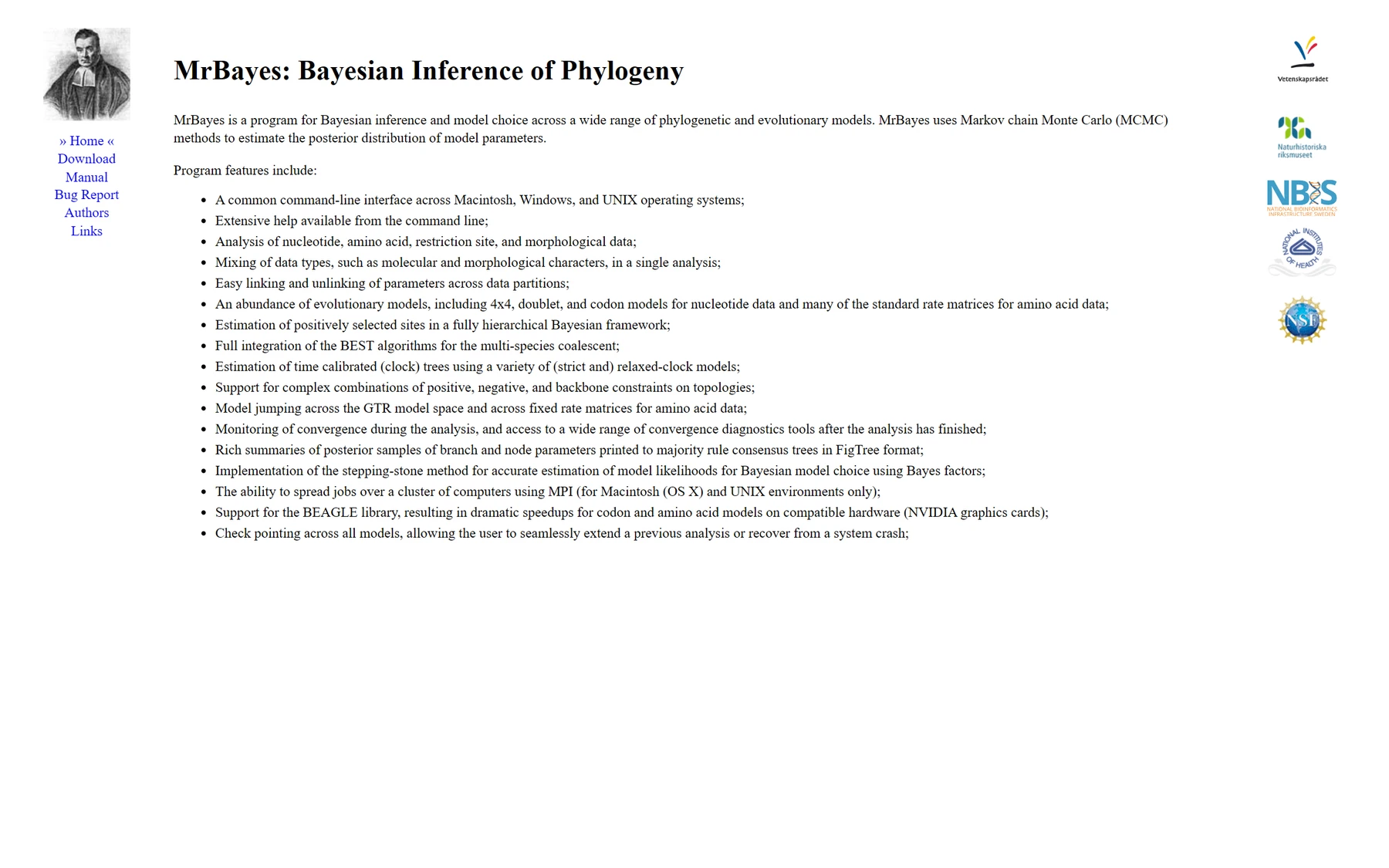
MrBayes has been a standard Bayesian program since its 2001 release. MrBayes 3.2, published in Systematic Biology in 2012, added convergence diagnostics, parallel runs, checkpointing and new models, along with a speedup of about 2× with SSE instructions and more than 50× with the BEAGLE library for codon models.[9]
The program is still maintained. Version 3.2.9, released in October 2026, fixes the proposal ratio in the node slider move for trees without a molecular clock, an error present since 3.2.4.[10] If you ran non-clock analyses with an affected version, read the release notes before trusting the old results.
The project page lists the program as a command-line tool for Macintosh, Windows and UNIX.[11] Choose it when you want posterior probabilities on a topology and don't need dates.
MrBayes price: Free and open source under GPL-3.0.
BEAST X (Windows, macOS, Linux)
BEAST X pros:
- Infers rooted, time-measured trees under strict or relaxed molecular clocks
- Uses the BEAGLE library for fast likelihood calculations
BEAST X cons:
- Estimates only rooted, time-measured trees, so it is the wrong tool for a quick topology
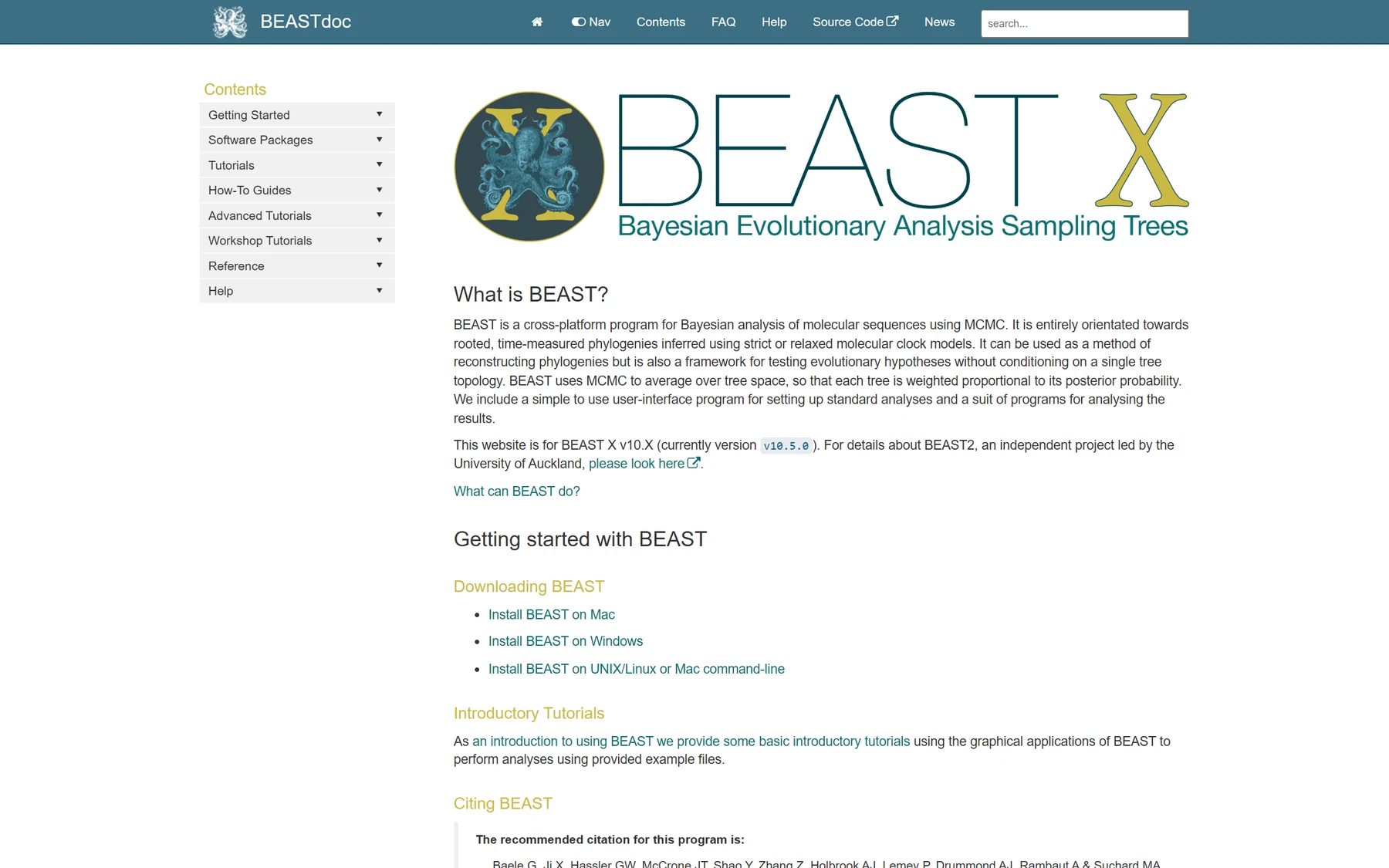
BEAST X, the 10.x line of BEAST, was published in Nature Methods in 2025 by Guy Baele, Philippe Lemey, Andrew Rambaut, Marc Suchard and colleagues. It adds a Hamiltonian Monte Carlo approach for sampling missing predictor values and a shrinkage-based local clock model, with a focus on pathogen genomics.[12]
The workflow has a few stages. BEAUti sets up the analysis and writes an XML file, BEAST samples trees from it, and TreeAnnotator summarizes the samples into a maximum clade credibility tree.[31][23] The current release is v10.5.0, from July 2025, under LGPL-2.1.[13]
BEAST X is a separate project from BEAST 2, which is led from the University of Auckland.[14] Both estimate dated trees, so the choice between them is mostly about which models and packages you need.
BEAST X price: Free and open source under LGPL-2.1.
Best phylogenetic tree software for point-and-click analysis
MEGA (Windows, macOS, Linux)
MEGA pros:
- Alignment, model selection, tree building and dating in one graphical program
- MEGA 12 adds an adaptive bootstrap and faster model selection
MEGA cons:
- Closed source, and it cannot infer Bayesian trees
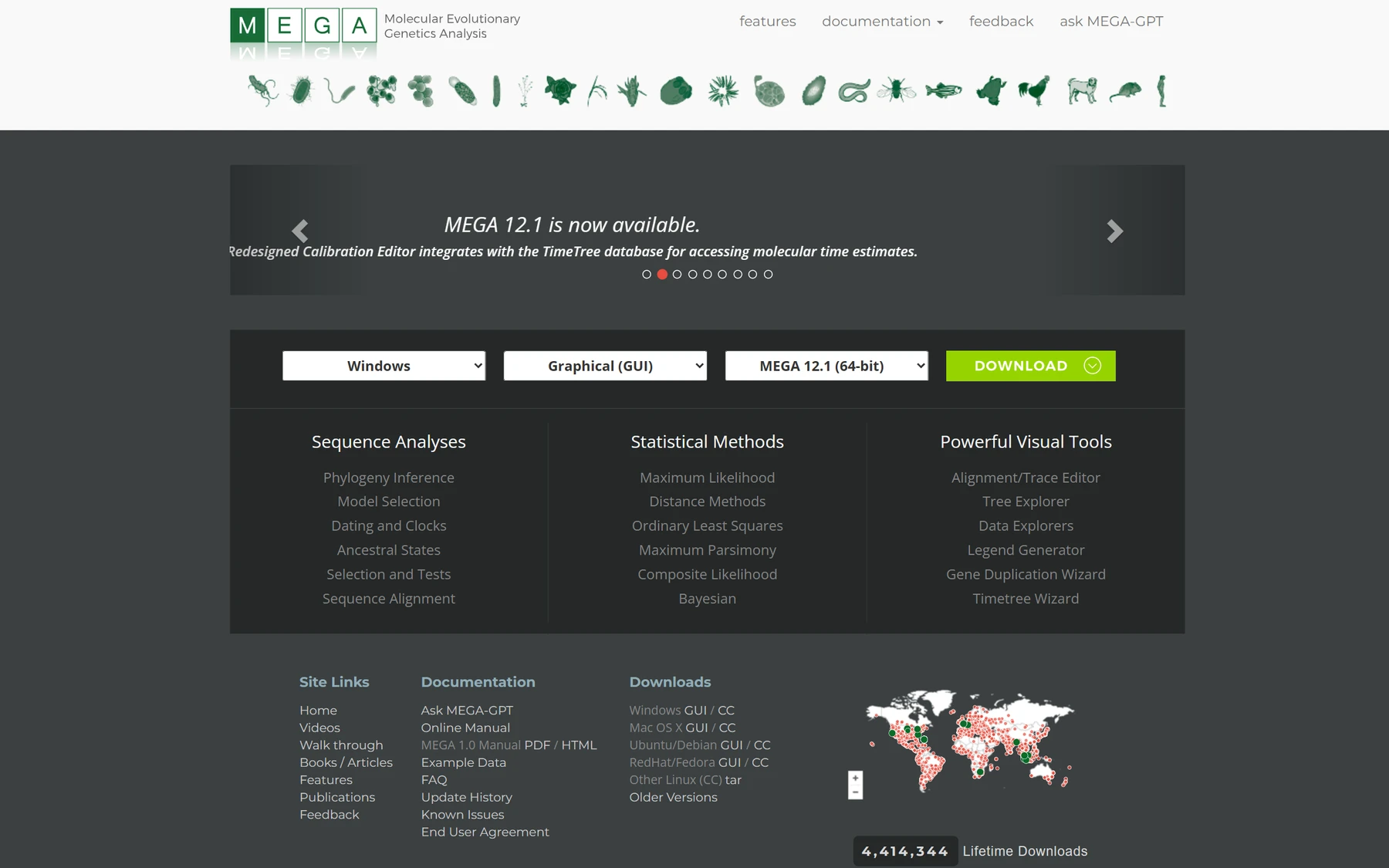
MEGA, written by Sudhir Kumar and colleagues, wraps alignment, model selection, tree building and dating in one graphical program. The download page lists releases from MEGA1 to MEGA12, with a graphical build or the command-line MEGA-CC for Windows, macOS and Linux.[30] Its feature table covers maximum likelihood, distance and parsimony trees with bootstrap support, but the Bayesian column applies only to ancestral sequences.[18]
The MEGA12 paper, from December 2024, added an adaptive bootstrap for maximum likelihood, which replaces a fixed replicate count with a stopping rule; the paper's example uses a standard error threshold of 5%.[16] MEGA 12.1 followed with a redesigned calibration editor that pulls dates from the TimeTree database.[17]
The download page lists no price. Its terms grant use for personal research and teaching, forbid modifying the program or passing on registered copies, and do not address commercial use, so read the agreement before using it at a company.[30]
MEGA price: Free to download for research and teaching under MEGA's end user agreement. Not open source.
Best phylogenetic tree software for viewing and annotating trees
A tree from an inference program is a text file. Viewers turn it into a figure, and the two below differ in where they run and what they charge.
PearTree (web and desktop)
PearTree pros:
- Runs in the browser with nothing to install, and is MIT-licensed
- Opens NEXUS and Newick files, including BEAST trees with posterior support and node height bars
PearTree cons:
- Views and annotates trees only; it does not infer them
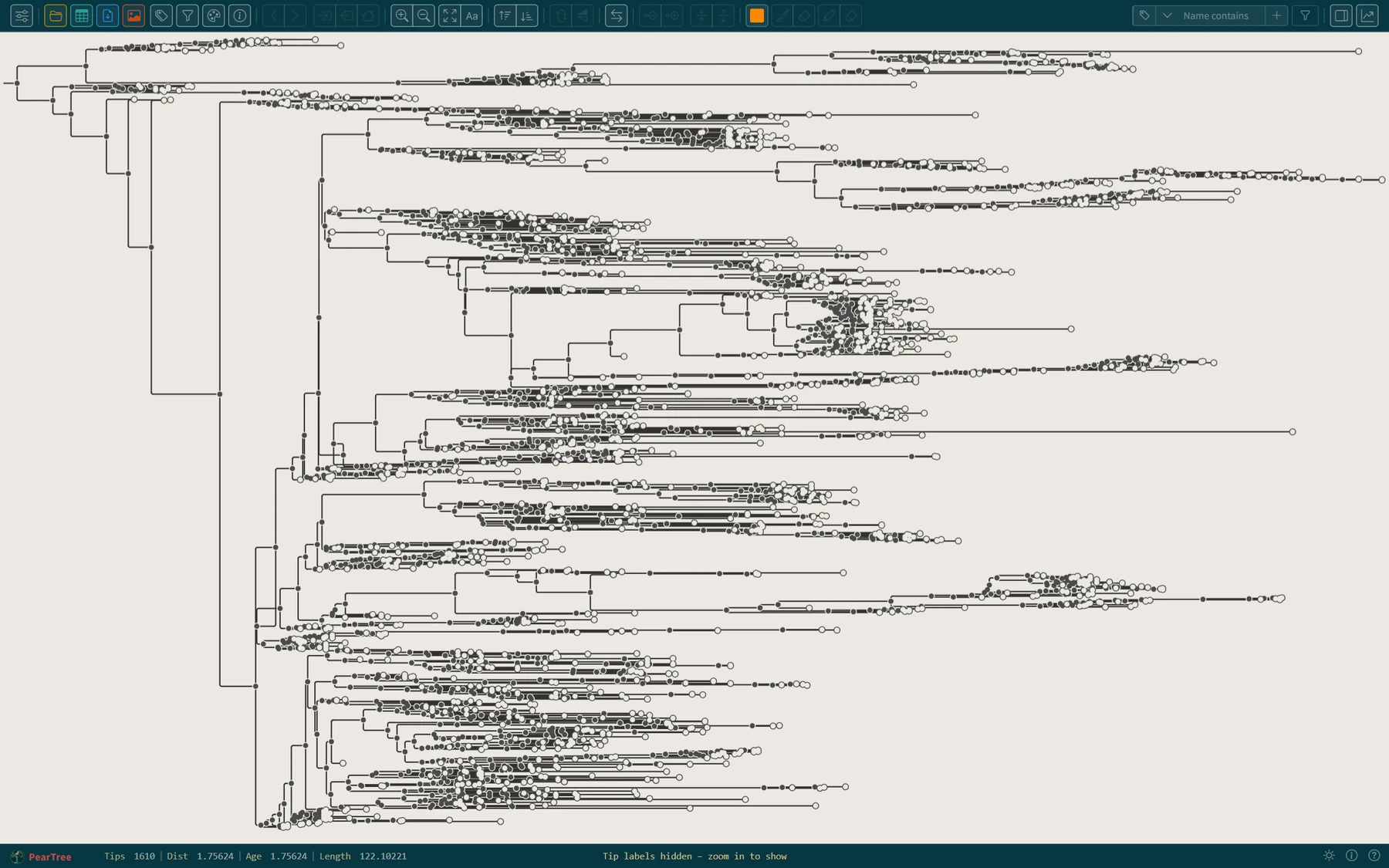
PearTree comes from the ARTIC Network. The BEAST documentation describes it as a browser-based viewer and the successor to FigTree, and walks through ordering branches, adding a time axis, showing posterior support, coloring tips by sampling country and exporting a figure.[23] The latest release is v1.3.2, from October 2026.[22]
The same documentation lists FigTree among its older and unsupported software.[23] If you still reach for FigTree out of habit, PearTree opens the same kinds of files.
PearTree price: Free and open source under the MIT license.
iTOL (web)
iTOL pros:
- Annotates trees with 19 dataset types and exports to SVG, PDF, EPS and PNG
- Displays trees of 50,000 or more leaves
iTOL cons:
- In free mode, annotations cannot be saved, so you must export the figure right away
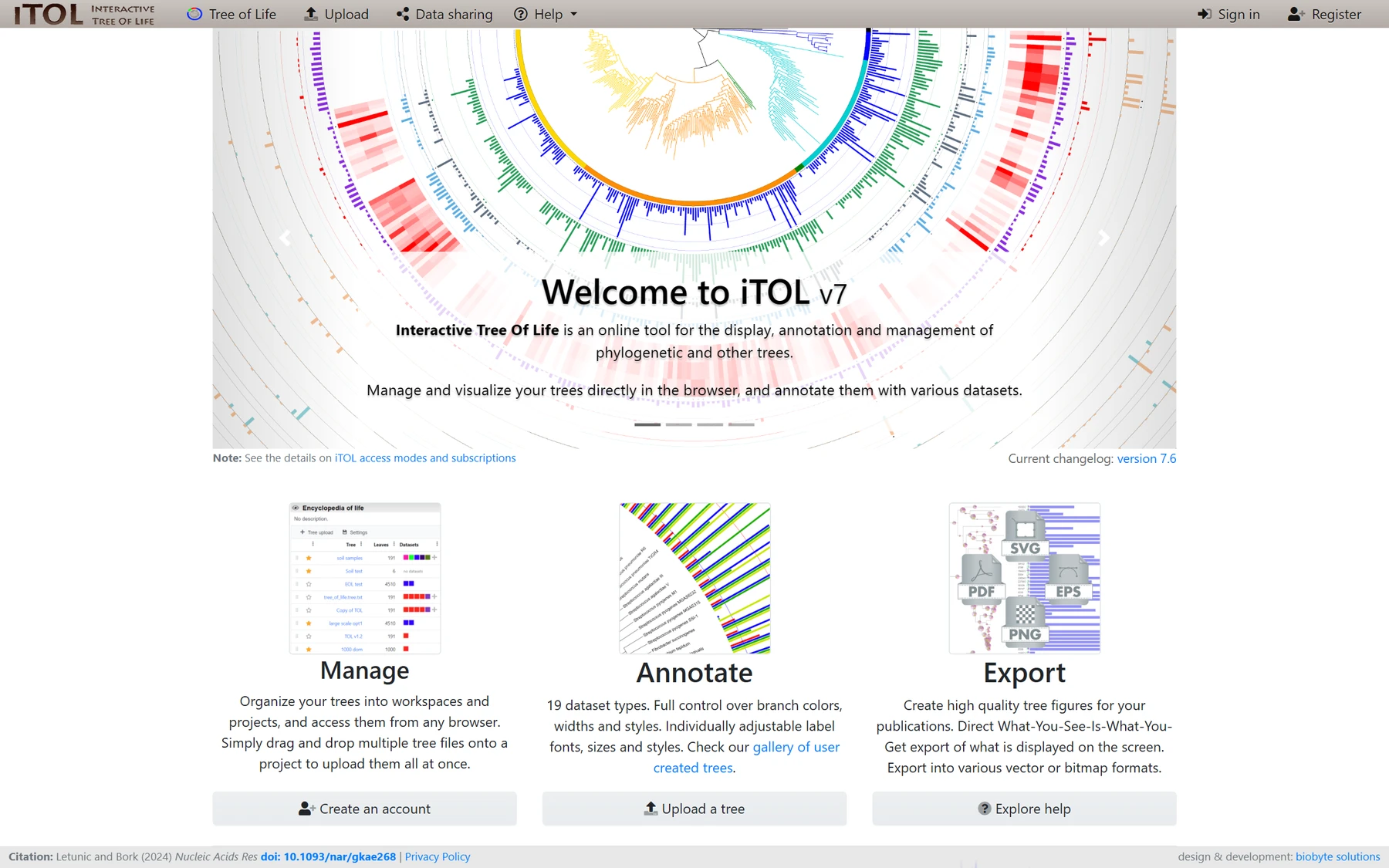
Interactive Tree Of Life, from Ivica Letunic and Peer Bork and hosted at EMBL, displays, annotates and manages trees in the browser. The 2024 paper describes version 6, and the site now shows v7.[19] Its strength is layering data on a tree: colored ranges, bars, heatmaps and labels on circular or rectangular layouts.
The access model matters. Free mode keeps an account with unlimited projects and up to 2,500 trees, and every annotation feature works, but annotations and views are not saved. A Standard subscription saves them and adds batch upload, and what you saved stays available after it ends.[20] For an individual, Standard costs €60 a year, and the annotation editor for Excel, LibreOffice and Google Sheets brings that to €96.[21]
iTOL price: Free access mode. Individual Standard subscription €60 a year; with the annotation editor €96 a year.
Do you need to align sequences first?
Yes, for every program above. They take an alignment of homologous sequences, and a misaligned column becomes false signal in the tree. MAFFT, Clustal Omega and MUSCLE5 are the usual aligners, and we used MAFFT 7.526 for the example; the multiple sequence alignment page compares them. Gather the sequences in a FASTA file first. Of the programs here, only MEGA and Geneious Prime align inside the same window.
Other phylogenetic tree software to consider
BEAST 2 estimates dated trees like BEAST X but is a separate project, now at version 2.7.8 under LGPL-2.1. Many of its models and methods are packages that you install through its package manager, which is the main reason to choose it.[14][15]
PhyML is a long-standing maximum likelihood program, and its latest release dates from May 2026.[28] In the 2018 benchmark it often failed to finish concatenated analyses of large datasets, so it is better suited to single genes and modest alignments than to a supermatrix.[3]
RevBayes, at version 1.4.1 since July 2026, is a Bayesian program with its own scripting language for building custom models.[29] It earns its learning curve when MrBayes and BEAST cannot express the model you need.
Which phylogenetic tree software should you choose?
For most projects, align the sequences, run IQ-TREE with ModelFinder and ultrafast bootstrap, and be done. If the tree will carry a paper or the alignment has many taxa, run RAxML-NG as well and look at where the two disagree. If you have thousands of sequences, start with FastTree to see the shape of the tree before spending hours on a full search. The phylogenetic analysis page covers the whole workflow.
Use MrBayes when you want posterior probabilities on a topology, and BEAST X when you want dates. Use MEGA if you would rather click than type commands and can do without Bayesian inference. For figures, PearTree is free and fast, and iTOL is the better tool for annotation and sharing once you accept its subscription model.
Pay for Geneious Prime when your lab needs one supported interface for sequences, alignments and trees, and the cost is a line in someone's budget. Don't pay for it to get better trees, because every method it runs is available free elsewhere.