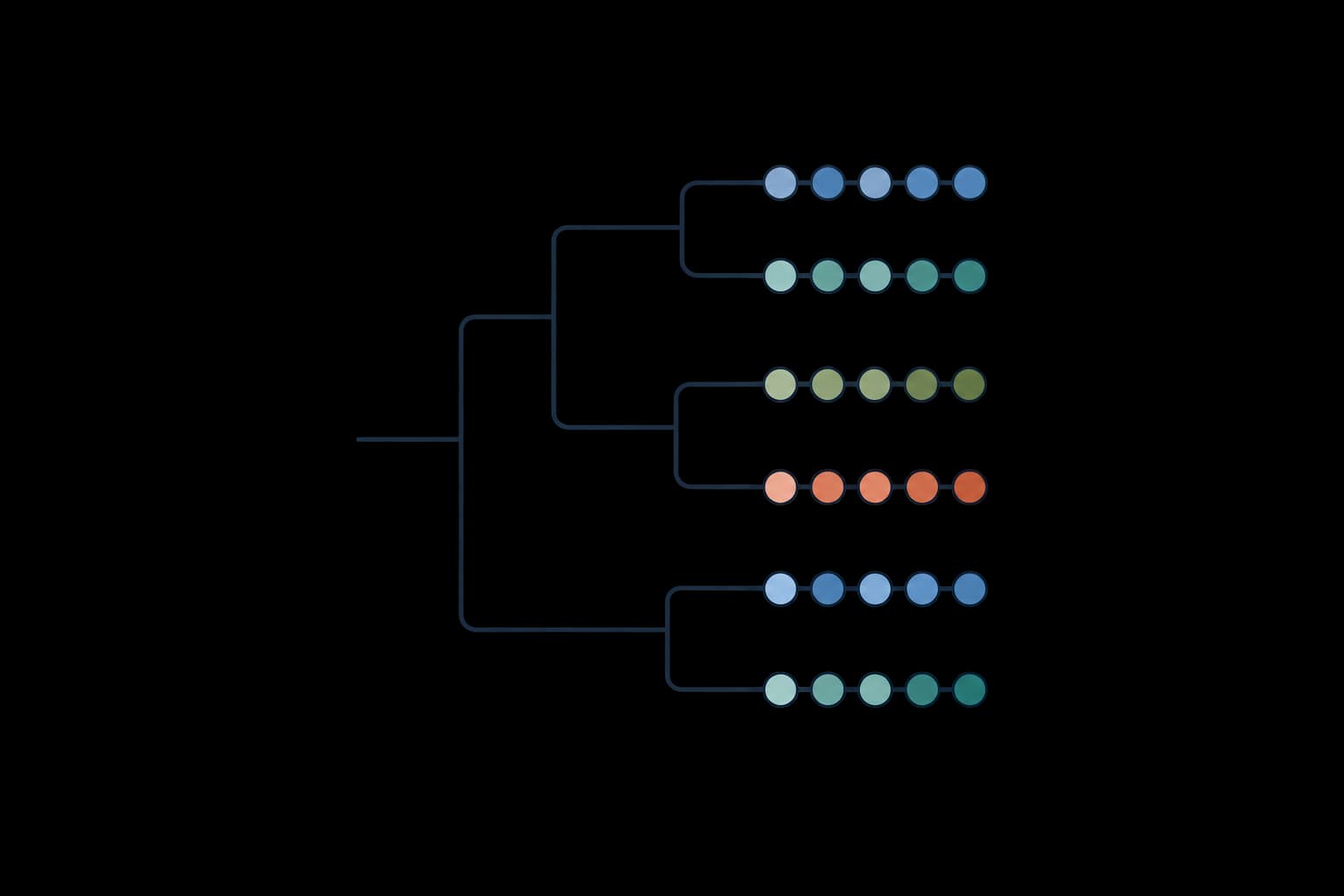
RAxML-NG
Infer maximum-likelihood phylogenetic trees from aligned protein, DNA, or binary character data with bootstrap support.
What is RAxML-NG?
RAxML-NG infers phylogenetic trees from an existing multiple sequence alignment using maximum likelihood. It is the current-generation rewrite of RAxML and ExaML, built for faster likelihood calculations, more stable optimization, and large alignments where branch support still matters.
The practical point of RAxML-NG is not just tree building. It is tree building under explicit evolutionary models, with branch lengths, likelihood scores, and bootstrap support that can stand up in downstream comparative analyses. That makes it a better fit than approximate methods when the topology will be interpreted biologically or used in a manuscript.
ProteinIQ runs the verified RAxML-NG 2.0.2 release. This release includes fixes for automatic model selection during bootstrapping, bootstrap support metrics, and alignment-format detection that are not present in the older 2.0.0 binary.
This tool expects an alignment, not raw sequences. If the sequences are not already aligned, start with MAFFT, MUSCLE5, or Clustal Omega before running tree inference.
How does RAxML-NG work?
RAxML-NG searches tree space for the topology and branch lengths that maximize the likelihood of the observed alignment under a substitution model. In practice, that means comparing many candidate trees, optimizing branch lengths and model parameters, and keeping the trees that improve the score.
The rewrite improved several pieces of the original RAxML search procedure. The published implementation fixes missed topological moves from earlier versions, improves optimization for models such as LG4X, adds transfer bootstrap expectation (TBE), and reports terraces in tree space when the data structure implies many equally scoring topologies. It also incorporates site-repeat optimizations and parallelization improvements that matter on taxon-rich datasets.
One consequence of maximum likelihood inference is that alignment quality dominates the final result. RAxML-NG can optimize a tree very efficiently, but it cannot rescue a poor alignment, mixed paralogs, or a nucleotide alignment forced into a protein model.
How to use RAxML-NG online
RAxML-NG runs on ProteinIQ from a pre-aligned protein, DNA, or binary character dataset in FASTA or PHYLIP format, or use the native parser for CATG, VCF, compressed variant files, and RBA input. Submit the alignment, choose whether to run ML search, bootstrapping, or both, and the job returns every native result file written by RAxML-NG, including Newick trees, model information, binary alignment/checkpoint data, reduced alignments when needed, and the execution log.
Inputs
| Input | Description |
|---|---|
Alignment | One aligned protein, DNA, or binary (0/1) dataset in FASTA, PHYLIP, or plain text containing one of those formats. At least 4 sequences with unique, Newick-compatible taxon names are required. |
Model file | Required in partition model mode. Upload native model and site-range definitions as .txt. |
Constraint tree | Optional Newick topology constraint in .newick or .txt, for search or combined mode. |
Site weights | Optional .txt file of positive integer alignment-column weights. |
Job name | Optional label for the submitted job in the ProteinIQ interface. |
Each uploaded file can contain up to 50 MiB. Standard FASTA uses the taxon name before the first space in its header; the rest is a description. Long-label FASTA mode replaces spaces with underscores. Submitted file bytes are retained.
For Native alignment parser, choose CATG, VCF, or RBA in Alignment parser. Upload CATG as .txt, VCF as .vcf, compressed variant bytes as .gz, and binary alignments as .rba. Choose the sequence type or a custom/partition model explicitly; use Model embedded in RBA for an RBA file. RAxML-NG checks these inputs before inference and requires at least four taxa. Native-check files are also available to download.
Settings
| Setting | Description |
|---|---|
Analysis mode | ML tree search, Bootstrapping only, or ML search + bootstrapping. ML search is the native default. |
Sequence type | Auto-detect from alignment, Protein, DNA, Binary (0/1), or explicit multistate/10-state diploid data with a custom model. A custom GT16 model can infer its data type with automatic sequence type. Auto-detection recognizes binary matrices directly when their observed states are 0 and 1. Short nucleotide alignments made only of A, C, G, and N may need manual selection. |
Model mode | Automatic (AA, DNA, or BIN) asks RAxML-NG to select a model within the chosen family. Custom model string passes an explicit model such as GTR+G, LG+G8+F, or BIN+FO. Partition mode reads the supplied model file; embedded mode reads the RBA model. The result summary reports the effective optimized model from the native bestModel file. |
Custom model | Required only when Model mode is set to custom. Useful when a manuscript or lab workflow needs a specific model string instead of the family default. |
Starting tree | auto, adaptive, parsimony/random selectors, or a comma-separated mixture such as pars{10},rand{10}. Native consensus starts such as cons:MR are also supported; starting-tree file paths are excluded. pars{10} starts from 10 parsimony trees, rand{10} starts from 10 random trees. This only affects ML search workflows. |
Random seed | Optional positive integer used for reproducibility. Leave blank to preserve the native current-time seed. |
Bootstrap trees | The native default is autoMRE{1000}, which checks convergence and can stop before 1,000 trees. Enter a fixed integer from 1 to 1,000 or native per-metric counts such as fbp{100},sh{100}. Explicit per-metric counts must be unique and total at most 1,000. |
Bootstrap method | Bootstrap-only mode accepts FBP, RBS, PS, or PBS. TBE requires a reference tree and is therefore available only in the combined ML search + bootstrapping mode. |
Bootstrap support metric | Combined mode accepts comma-separated fbp, tbe, rbs, ps, pbs, ebg, sh, ic1, and ica. FBP and RBS cannot be combined. Each requested native support tree is retained. |
Output prefix | Optional prefix for native .raxml.* filenames. Leave blank to derive it from the submitted alignment name. |
Native controls
Collapsed option groups expose the native controls below. Native default or an empty optional numeric/text field leaves that argument out of the command. Automatic model selection requires model and branch optimization to remain enabled.
| Setting | Description |
|---|---|
Alignment input | Select standard FASTA/PHYLIP checks or the native alignment parser. |
Alignment parser | Select auto, FASTA, long-label FASTA, PHYLIP, CATG, VCF, or RBA. Auto leaves native format detection unchanged. |
Model and branch options
| Setting | Description |
|---|---|
Optimize model | Native default: on. Fixed models can disable optimization. |
Optimize branches | Native default: on. |
Partition branch linkage | Native default: scaled. |
Minimum branch length | Native default: 1e-6 substitutions per site. |
Maximum branch length | Native default: 100 substitutions per site. |
Branch optimizer | Select the native branch-length optimizer. |
Likelihood epsilon | Native default: 10 log-likelihood units for search/bootstrap. |
Triplet likelihood epsilon | Native default: 1000 log-likelihood units. |
FreeRate optimizer | Native default: auto. |
Model selection options | Native options separated by /, for example criterion=AIC/rhas=G/substitution-models=GTR. Omit to preserve native defaults. |
Model selection report | Native model-selection report format when emitted. |
Topology search options
| Setting | Description |
|---|---|
Topology optimizer | Native default: adaptive. |
Adaptive search | Native default is unchanged. Start uses adaptive starting-tree selection only. |
SPR radius | Native default: auto. |
SPR likelihood cutoff | A non-negative real number or off. Native default: 1.0. |
Search stopping rule | Use the native SPR stopping criterion. |
NNI tolerance | Native NNI tolerance. |
NNI epsilon | Native NNI likelihood epsilon. |
Pythia parsimony trees | Number of native parsimony trees used for alignment difficulty prediction. |
Parsimony SPR | Native parsimony starting-tree SPR refinement. |
Initial branch lengths | Native initialization of branch lengths. |
Alignment difficulty prediction | Native Pythia control within tree inference. |
Bootstrap and support options
| Setting | Description |
|---|---|
MRE convergence cutoff | Native default: 0.03. |
Download bootstrap alignments | Preserve every native bootstrap alignment as a downloadable file. |
SH-aLRT replicates | Native default: 1000. Hosted maximum: 1000. |
SH-aLRT epsilon | Native default: 0.1 log-likelihood units. |
Bootstrap starting trees | Native bootstrap starting-tree strategy. |
Alignment and output options
| Setting | Description |
|---|---|
Probabilistic alignment | Forward native probabilistic CATG/VCF handling. |
Pattern compression | Native default: on. |
Site repeats | Native default: on. |
Tip-inner optimization | Native default: off. |
Rate-category scalers | Leave native automatic scalers unchanged unless explicitly selected. |
Output decimal places | Native default: 6. |
Outgroup taxa | Comma-separated native taxon names. Changes the tree drawing/rooting only, without rerunning inference. |
Fully undetermined taxa | Native treatment of fully undetermined taxa. Default preserves the current early error. |
Duplicate sequences | Native treatment of identical sequences; this does not permit duplicate taxon names. |
Outputs
| Output file | When it appears | Meaning |
|---|---|---|
prefix.raxml.bestTree | ML search or combined mode | Best maximum-likelihood tree in Newick format. |
prefix.raxml.bestTreeCollapsed | ML search or combined mode | Best tree with near-zero branches collapsed. |
prefix.raxml.startTree | ML search or combined mode | Starting trees generated or used by the search. This can contain more than one tree. |
prefix.raxml.mlTrees | ML search or combined mode | Candidate ML trees from the starting-tree searches. |
prefix.raxml.bootstraps | Bootstrap or combined mode | Complete bootstrap replicate tree collection. The result reports the number actually generated when automatic stopping is used. |
prefix.raxml.support or metric-specific support tree | Combined mode | Final support-annotated tree, including suffixes such as supportTBE, supportRBS, supportPS, or supportPBS. |
prefix.raxml.bestModel | When emitted by RAxML-NG | Optimized model parameters and the effective model reported in the result summary. |
prefix.raxml.rba | When emitted by RAxML-NG | Native binary alignment used for efficient reuse or diagnosis. |
prefix.raxml.reduced.phy and prefix.raxml.reduced.partition | When RAxML-NG removes fully undetermined columns | Reduced alignment and matching partition definition. |
prefix.raxml.ckp | When retained by RAxML-NG | Native checkpoint for resuming or diagnosing an analysis. |
prefix.raxml.log | When emitted, including failed runs | Full native log, including final log-likelihood, AIC, and BIC when available. |
Failed or timed-out runs retain the native log, any partial/checkpoint files, and captured command output as diagnostic downloads. They do not produce a successful scientific result.
The tree viewer opens only a single final tree. Bootstrap-only runs return a multi-tree collection and are shown as downloadable files instead of being misread as one tree.
Understanding the results
RAxML-NG results are easiest to interpret in three layers: topology, branch lengths, and branch support.
Topology
The branching pattern is the inferred evolutionary hypothesis. Internal nodes define clades. A change in topology is biologically meaningful, so any region of the tree with weak support should be treated as unresolved rather than overinterpreted.
Branch lengths
Branch lengths are reported in substitutions per site. Longer branches indicate more inferred evolutionary change. Extremely long terminal branches often signal problematic sequences, alignment issues, contamination, or highly divergent taxa.
Support values
Branch support is available in combined mode. FBP, RBS, TBE, PS, and PBS use resampled data or parsimony trees; EBG predicts bootstrap support and SH reports an SH-like aLRT. IC1 and ICA quantify internode certainty. These metrics have different meanings and should not be treated as interchangeable. The percentage conventions below concern bootstrap support, rather than internode certainty.
| Support value | Interpretation |
|---|---|
>= 95 | Strong support for that clade in most datasets |
80-94 | Reasonable support, often usable but worth checking against alignment quality |
70-79 | Weak to moderate support, commonly treated with caution |
< 70 | Unstable split, usually not strong evidence for that relationship |
Those cutoffs are conventions, not laws. Deep trees with uneven taxon sampling can show lower classical bootstrap support even when the overall signal is meaningful. That is one reason TBE exists.
FBP vs TBE vs RBS
| Metric | What it emphasizes | When it is useful |
|---|---|---|
FBP | Exact recovery of the same bipartition across replicates | Standard reporting and direct comparison with older phylogenetics literature |
TBE | Similarity between splits rather than exact matching | Large trees where a few unstable taxa would otherwise deflate support for deep branches |
RBS | Rapid bootstrap workflow | Faster support estimation when runtime matters more than strict comparability with classical bootstrap |
TBE is not a valid metric for bootstrap-only generation in RAxML-NG 2.0.2. Use the combined mode when TBE support is required.
When to use RAxML-NG vs alternatives
RAxML-NG occupies the middle ground between very fast approximate tree builders and feature-rich ML packages with their own model-selection ecosystems.
| Tool | Best use case | Tradeoff |
|---|---|---|
| RAxML-NG | Maximum-likelihood inference when a solid ML search and standard bootstrap workflow are the priority | Requires a pre-aligned dataset and is slower than approximate methods |
| IQ-TREE | Analyses where built-in model selection and ultrafast bootstrap are central | Different search heuristics and support framework, often more feature-focused on model testing |
| FastTree | Very large alignments where speed matters more than exact ML optimization | Much faster, but approximate |
RAxML-NG is a strong default when the alignment is already prepared and the goal is a conventional ML tree with explicit bootstrap support. IQ-TREE is often the better choice when systematic model testing is part of the analysis plan. FastTree is better for exploratory work on very large datasets where approximate topology is good enough.
Related tools
- MAFFT: Builds multiple sequence alignments before phylogenetic inference.
- MUSCLE5: Alternative MSA method for protein or nucleotide datasets.
- Clustal Omega: Scalable alignment tool that fits naturally before tree building.
- IQ-TREE: Another maximum-likelihood phylogeny tool with strong model-selection features.
- FastTree: Approximate maximum-likelihood trees for very large alignments.
Based on the RAxML-NG paper by Kozlov et al. (2019) in Bioinformatics and the official RAxML-NG source repository.
Related tools

DockQ
Assess docking quality between model and native structures

MAFFT
Align protein or nucleotide sequences with selectable accuracy and speed trade-offs.

MMseqs2
Search and cluster protein or nucleotide sequences for homology discovery at large scale.

MUSCLE5
Align multiple protein or nucleotide sequences with high-accuracy PPP refinement.

pyRMSD
Pairwise RMSD matrices for PDB structure ensembles

RNAdistance
Compare RNA secondary structures by base-pair and tree distance.

AF-Cluster
Cluster MSAs to predict alternative protein conformations with AlphaFold2

ORF Finder
Identify potential protein-coding regions in DNA across all six reading frames with NCBI ORFfinder.

DR-BERT
Predict intrinsically disordered regions and per-residue disorder probabilities from protein sequences.

IgBLAST
Analyze antibody and T cell receptor variable domain sequences