How many neurons are in the human brain?
The usual adult estimate is 86 billion neurons, but the nine brains measured in two whole-brain studies contained about 62 to 95 billion. Roughly 80% of the neurons in the best-known estimate were in the cerebellum.
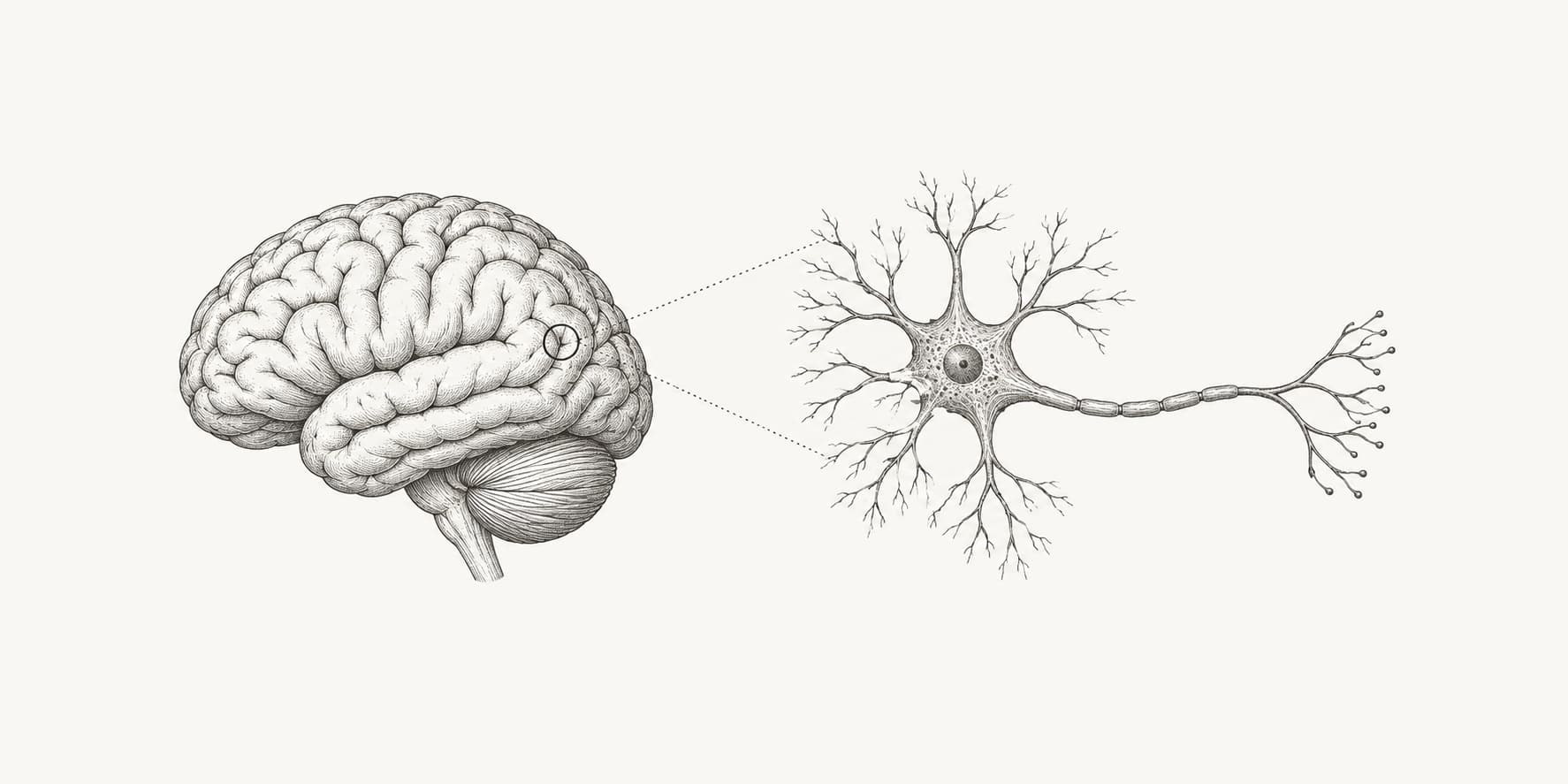
The usual answer is that an adult human brain contains about 86 billion neurons, or nerve cells. That is a useful estimate, not a count that applies to every person.
Only nine adult brains have been measured in the two modern whole-brain studies behind this debate. Their estimates ranged from about 62 billion to 95 billion neurons.
How many neurons are in an adult human brain?
An adult human brain is usually said to contain about 86 billion neurons, although direct whole-brain studies have measured roughly 62 billion to 95 billion.[1][2][3][4]
The 86-billion figure comes from a 2009 study of four men aged 50 to 71. It reported a mean of 86.1 billion neurons, with individual estimates from 78.82 billion to 95.40 billion.[1][3]
A second study using the same method examined five women aged 71 to 84 and reported a mean of 67.3 billion, with individual estimates from 62.1 billion to 72.1 billion. The samples are too small and too different in age, sex, and brain mass to show that one group generally has more neurons than another.[2][3]
A 2025 exchange in the journal Brain agreed that the exact population average is not known. One author argued that the available data do not justify a single figure; the response noted that estimates made with two counting methods fall between about 60 billion and 95 billion. “About 86 billion” is reasonable shorthand only when it is presented as an approximation.[3][4]
Scientists cannot count intact neurons one by one across an entire brain. The 2009 study used the isotropic fractionator, which turns brain tissue into a suspension of cell nuclei. It counted all nuclei, then used NeuN, a protein marker found in most neurons, to separate neuronal from non-neuronal cells.[1]
NeuN is associated with the RBFOX3 protein, whose sequence and annotations can be retrieved with ProteinIQ's UniProt download tool. The marker is not expressed by every neuron type, which is one reason the final total remains an estimate rather than a literal inventory.[3]
Which brain region has the most neurons?
The cerebellum contains by far the most neurons: about 69 billion, or 80% of the 86-billion total reported in the 2009 study.[1]
The cerebral cortex contained about 16.34 billion neurons, or 19% of the total. The remaining regions, including the brainstem, diencephalon, and basal ganglia, contained about 690 million, or less than 1%.[1]
These figures can seem backward because the cerebral cortex accounts for most of the brain's mass. The cerebellum packs enormous numbers of very small granule cells into a much smaller volume. A large brain region does not necessarily contain the most neurons.
How many neurons are in the brain at birth?
There is no reliable modern count for all neurons in a newborn brain. The often-repeated figure of 100 billion neurons at birth is a rough legacy estimate, not the result of a whole-brain census.
Direct studies with published regional totals cover the neocortex rather than the entire brain. A stereological study of 10 full-term newborns estimated a mean of 19.8 billion neurons in the cortical plate.[5]
A later study of 10 children from birth to age 3 estimated a mean of 20.7 billion neocortical neurons, with a range of 18.0 billion to 24.8 billion. It found no increase in neuron number with age across that period, while astrocyte and oligodendrocyte counts increased.[6]
Those results show that the neocortex has roughly its adult complement of neurons by birth. They do not support a precise whole-brain total, because the studies did not count every region and brain development continues after birth.
Are there more neurons or glial cells in the human brain?
Current evidence suggests that the whole human brain has more neurons than glial cells, not 10 times more glia than neurons. A major review placed the likely glial count closer to 40 billion to 50 billion, compared with roughly 60 billion to 95 billion neurons.[4][7]
The confusion comes partly from treating every non-neuronal cell as glia. The 2009 study counted 84.6 billion non-neuronal cells, close to its 86.1-billion neuron estimate, but that group also included endothelial cells and other cells lining blood vessels.[1][7]
The ratio changes sharply by region. The cerebellum has many more neurons than non-neuronal cells, while cerebral and subcortical tissue contains far more non-neuronal cells per neuron. A single ratio for the whole brain hides that variation.[1][7]
Even together, neurons and glia are a small share of the approximately 36 trillion cells in a reference adult human body. Most human cells are blood cells. Whole-brain studies also exclude neurons in the spinal cord and peripheral nervous system.