How many atoms are in the human body?
A 70-kilogram reference adult contains about 7 octillion atoms. Hydrogen accounts for roughly 62% of them, oxygen 24%, carbon 12%, and nitrogen 1%.
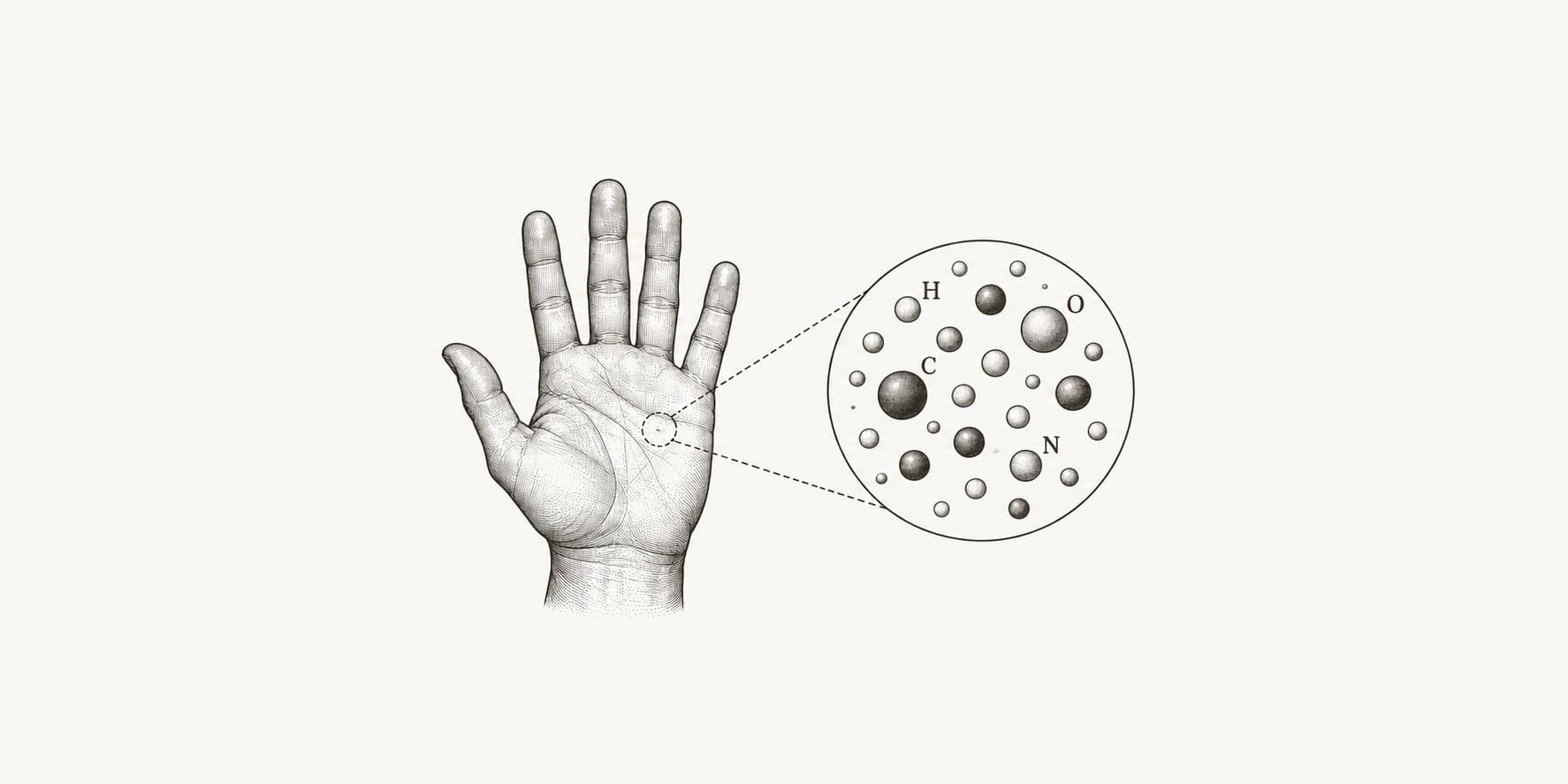
The human body contains about 7 octillion atoms, written as 7 × 1027. That is a 7 followed by 27 zeros.
This estimate describes a 70-kilogram (154-pound) reference adult. The total changes with body mass and composition, but 7 octillion is the right order of magnitude for an adult.
How many atoms are in the human body?
A 70-kilogram reference adult contains about 6.7 × 1027 atoms, which rounds to 7 × 1027 atoms.[1][2]
The estimate starts with the mass of each element in a reference body. The ICRP composition used here contains 43 kilograms of oxygen, 16 kilograms of carbon, 7 kilograms of hydrogen, 1.8 kilograms of nitrogen, 1 kilogram of calcium, and 0.78 kilograms of phosphorus. Together, these six elements account for 69.58 kilograms of the 70-kilogram reference body.[2]
For each element, we divide its mass by the molar mass derived from its atomic weight, then multiply by Avogadro's constant:
The current standard atomic weights come from the Commission on Isotopic Abundances and Atomic Weights, while the number of entities in one mole is fixed exactly by the International System of Units.[4][5]
The six elements above yield 6.71 × 1027 atoms. The remaining elements make only a small difference at this precision, so the result is conventionally rounded to 7 × 1027.
This calculation uses body mass rather than the number of cells in the human body. Cells vary enormously in size, and a substantial share of body mass lies in extracellular fluids, connective tissue, and bone mineral.
For adults with broadly similar body composition, the count scales to about 9.6 × 1025 atoms per kilogram. That puts a 60-kilogram person near 5.8 × 1027 atoms and an 80-kilogram person near 7.7 × 1027. These are proportional estimates, not measurements. Elemental composition also varies with age, sex, body size, and tissue composition.[7]
Which atoms are most common in the human body?
By number, about 62% of the atoms in the human body are hydrogen, 24% are oxygen, 12% are carbon, and 1% are nitrogen. Together, these four elements account for about 99% of the body's atoms.[3]
The chart uses BioNumbers' wet-weight atomic composition: hydrogen 62%, oxygen 24%, carbon 12%, nitrogen 1.1%, and seven other predominant elements together 0.9%.[3]
Hydrogen leads by atom share because it is the lightest element and because the body contains so much water. Roughly three in five atoms are hydrogen, one in four is oxygen, and about one in eight is carbon.
The ranking looks different by mass. Oxygen and carbon atoms are much heavier than hydrogen atoms, so oxygen contributes about 61% of the reference body's mass and carbon about 23%, while hydrogen contributes about 10%. Atom share and mass share answer different questions.
How many carbon atoms are in the human body?
A 70-kilogram ICRP reference body contains about 8 × 1026 carbon atoms, or 800 septillion.[2][4][5]
The calculation uses 16 kilograms of carbon:
Studies of body composition find substantial variation among adults, and published reference bodies do not all assign the same carbon mass.[7] The count remains on the order of 1027 carbon atoms, with 8 × 1026 as the result from this stated reference model.
Carbon is less common than hydrogen by atom count, but it supplies the covalent frameworks of proteins, lipids, carbohydrates, and nucleic acids. The body's carbon atoms are spread across an enormous range of compounds rather than stored as elemental carbon. Protein sequences alone use 20 standard amino acids, each with its own carbon skeleton.
How many molecules are in the human body?
There is no accepted total number of molecules in the human body. The body is a changing mixture of water, small compounds, ions, minerals, proteins, nucleic acids, membranes, and other structures, and not all of those substances exist as discrete molecules.
Water is the one large component that can be estimated cleanly. An average 70-kilogram man is about 60% water, or 42 liters.[6] Treating that as 42 kilograms of water gives about 1.4 × 1027 water molecules.
The water estimate is not a total molecule count. A water molecule has three atoms, while protein molecules can contain thousands of atoms and a chromosome contains one extremely long DNA molecule. Salts in body fluids are commonly present as ions, and bone mineral forms an extended crystal lattice rather than a collection of separate molecules.
For one defined compound, molecular descriptors can report its formula, atom counts, and molecular weight. A whole human body has no single molecular formula, so its atoms can be estimated more defensibly than its molecules.