How many bacteria are in the human body?
A 70-kilogram reference man carries about 38 trillion bacterial cells, nearly all in the colon. That is roughly one bacterium for every human cell.
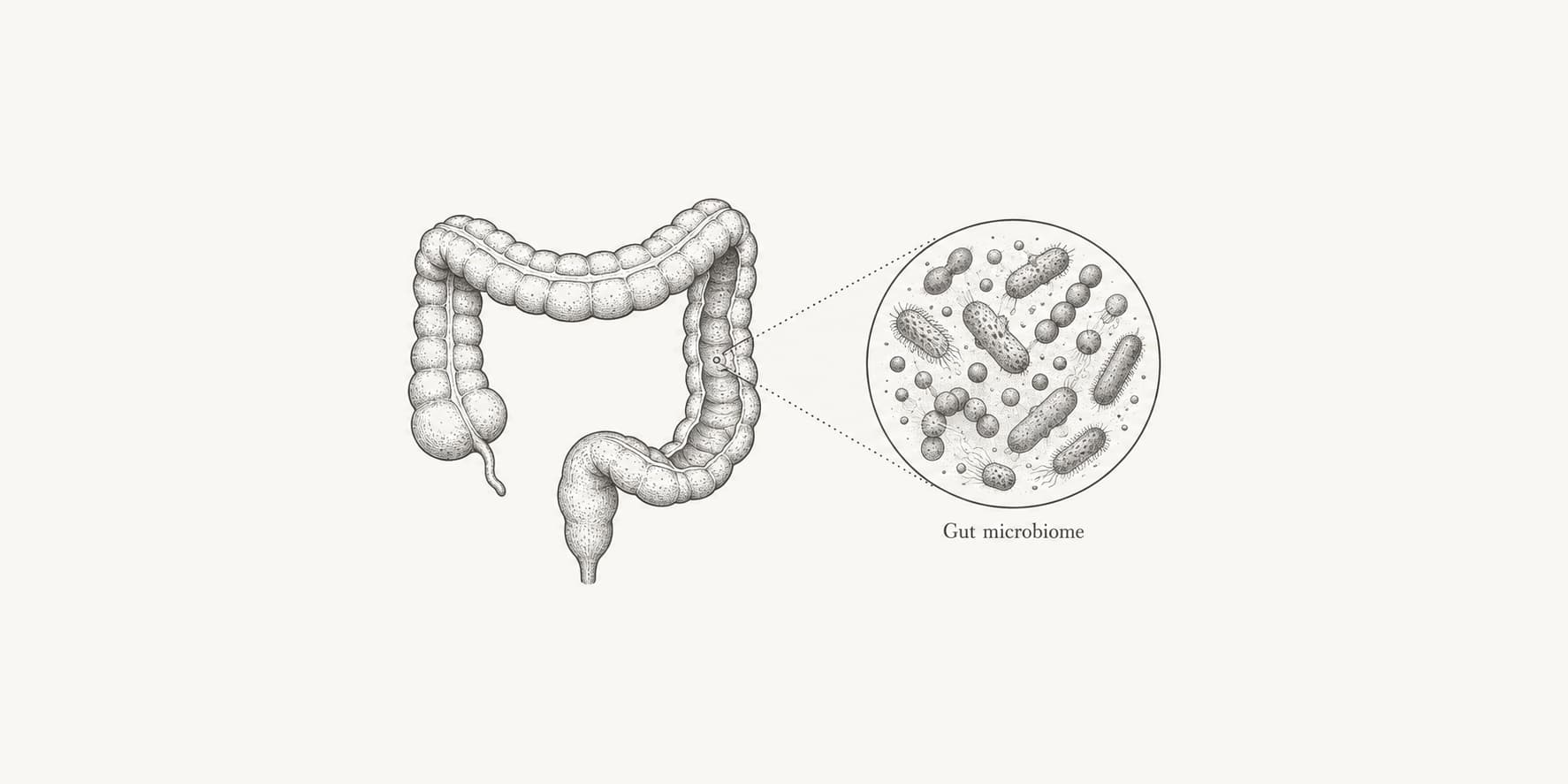
The human body carries about 38 trillion bacterial cells. Nearly all of them live in the colon.
That estimate is for a 70-kilogram reference man. It is close to the current estimate of 36 trillion human cells, so the bacteria-to-human-cell ratio is about 1:1. The old 10:1 claim was too high.
How many bacteria are in the human body?
A 70-kilogram reference man carries an estimated 38 trillion bacteria, with a standard error of about 25%.[1]
The estimate varies more between people than the headline number suggests. Sender and colleagues reported a population variation of 52% among reference-sized adult men. Colon size and bacterial concentration both differ, and a bowel movement can remove roughly one-quarter to one-third of the colon's contents.[1]
The total is a count of bacterial cells; species diversity is a separate measurement. Those cells span a diverse microbial community in which Escherichia coli is only one species.
Are there more bacteria than human cells?
Bacteria and human cells occur in almost equal numbers: about 38 trillion bacteria compared with 36 trillion human cells in a 70-kilogram reference man.[1][2]
Dividing those estimates gives about 1.06 bacterial cells per human cell, which rounds to a bacteria-to-human-cell ratio of 1.1:1. This is a ProteinIQ calculation that combines the 2016 bacterial estimate with the newer 2023 human-cell census.
The older 10:1 claim came from pairing rough estimates of 100 trillion bacteria and 10 trillion human cells. The 2016 census revised that ratio to 1.3:1 using 38 trillion bacteria and 30 trillion human cells; the 2023 human-cell total lowers it further to about 1.06:1.[1][2]
The ratio changes with body size, blood volume, colon contents, age, and individual microbiome density. Bacterial and human cells are present in the same order of magnitude.
Where do most bacteria in the human body live?
Almost all of the body's bacteria live in the colon, where the reference estimate is 38 trillion cells. Other body sites together contribute no more than about 1 trillion.[1]
The colon estimate combines about 0.4 liters of wet colon contents with a bacterial concentration of 92 billion cells per gram. Multiplying those values gives 38 trillion bacteria. The concentration comes from stool measurements, which are used as a proxy for the contents of the colon.[1]
The old 100-trillion estimate applied the colon's high bacterial density to a full liter of digestive-tract contents. The stomach and small intestine contain far fewer bacteria than the colon, so that assumption inflated the result. Bacteria also live on the skin and in the mouth, saliva, and other mucosal surfaces, but those sites add little to the whole-body count.[1]
How much do the bacteria in the human body weigh?
The bacteria in a 70-kilogram reference man have an estimated wet mass of about 200 grams, equal to roughly 0.3% of body weight.[1]
Their estimated dry mass is 50 to 100 grams. The 200-gram wet-mass estimate includes water and comes from a colon-content mass of about 400 grams, roughly half of which is bacterial biomass.[1]
Older claims of 1 to 3 kilograms were based on the same inflated bacterial count that produced the 10:1 ratio. Bacterial cells can match human cells in number while contributing little mass because they are much smaller.