How many platelets are in the human body?
A typical adult has about 1 trillion platelets circulating in the blood and about 1.5 trillion in the whole body when the spleen’s platelet pool is included.
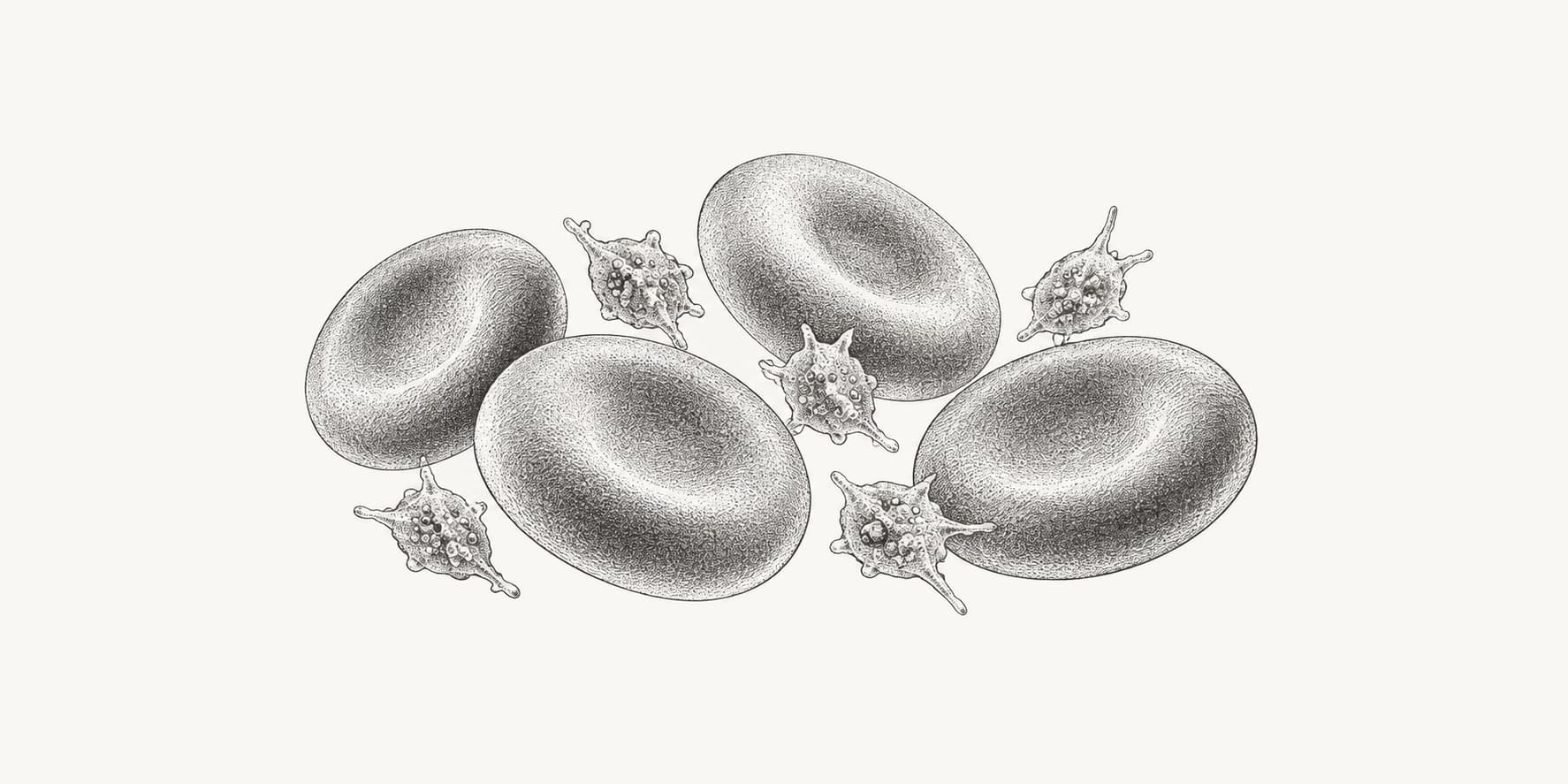
A typical adult has about 1.5 trillion platelets in the body. Roughly 1 trillion circulate in the blood, while about 500 billion form an exchangeable pool in the spleen.
The figures are calculated reference estimates. A laboratory platelet count measures concentration in a blood sample, so estimating a whole-body total also requires blood volume and the splenic pool.
How many platelets are in the human body?
A typical adult has about 1 trillion platelets in circulating blood and about 1.5 trillion across the blood and spleen.[1]
The estimate starts with 200,000 platelets per microliter and 5 liters of blood. Five liters contain 5 million microliters, so the circulating total is:
200,000 platelets per microliter × 5,000,000 microliters = 1 trillion platelets.
About one-third of the body's platelets are normally stored in the spleen. If the circulating 1 trillion represents the other two-thirds, the whole-body estimate is about 1.5 trillion.[1][2]
The chart scales the reference concentration used in the platelet life-cycle model from one microliter to the whole body. Its final value includes the spleen; the other values describe blood alone.[1]
The real total varies with blood volume and platelet concentration. Using the adult reference range of 150,000 to 450,000 platelets per microliter and nearly 5 liters of blood gives about 750 billion to 2.25 trillion circulating platelets. If the spleen holds one-third of the total, the corresponding whole-body range is about 1.1 trillion to 3.4 trillion.[2][4]
What is a normal platelet count?
A normal adult platelet count is commonly 150,000 to 450,000 platelets per microliter of blood, written as 150 to 450 × 109/L.[2]
The result describes concentration in circulating blood. Laboratories may use slightly different reference intervals, and a clinician interprets the result alongside symptoms, medical history, and other blood findings.
Platelets are small fragments shed by bone-marrow megakaryocytes. They are distinct from white blood cells, so “white platelets” is not a medical category. Platelets also number far fewer than the roughly 25 trillion red blood cells in a reference adult.
How many platelets are produced each day, and how long do they live?
A healthy adult produces about 100 billion platelets per day, and each platelet normally circulates for about 7 to 10 days.[3]
One hundred billion per day is about 1.2 million new platelets per second. This conversion is calculated by dividing 100 billion by the 86,400 seconds in a day.
Production and removal are normally balanced. Megakaryocytes release new platelets, while the spleen and liver clear aged platelets or platelets consumed in clot formation. The short lifespan explains why the body must replace such a large share of its circulating platelets every day.