How many nucleosomes are in a human cell?
A typical diploid human cell contains about 30 million nucleosomes before DNA replication. Each core wraps 146 to 147 base pairs of DNA around eight histone proteins.
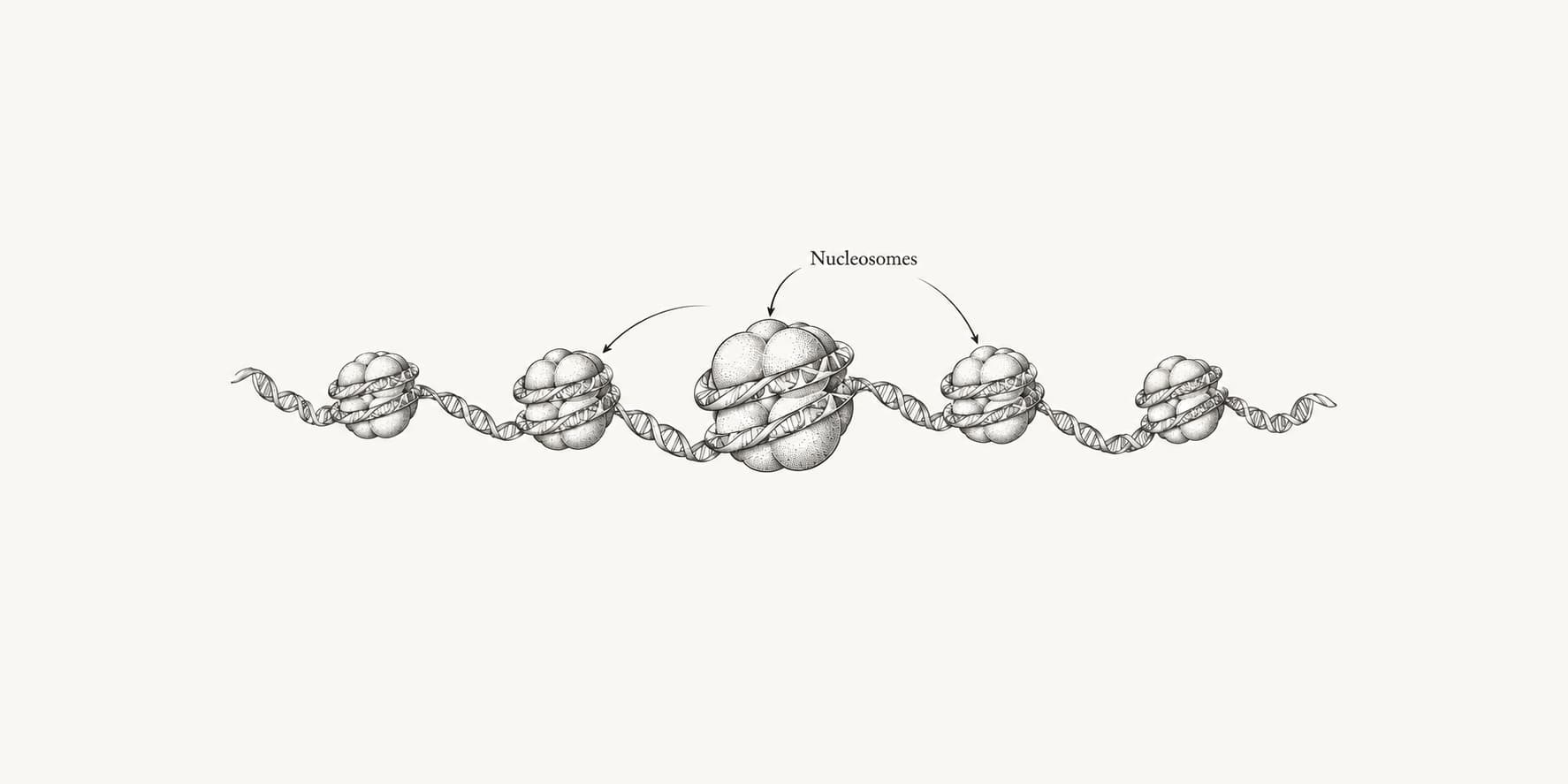
A typical diploid human cell contains about 30 million nucleosomes before it copies its DNA. The figure is an estimate: divide the cell's roughly 6.3 billion base pairs by about 200 base pairs per nucleosome repeat.
The count is about half as large in a sperm or egg cell and roughly doubles after DNA replication. Mature red blood cells have no nucleus, so they have no nuclear nucleosomes.
How many nucleosomes are in a human cell?
A typical diploid human cell contains about 30 million nucleosomes before DNA replication.[1][2]
One reference calculation gives 6.27 billion base pairs for a 46,XY cell and 6.37 billion for a 46,XX cell.[1] Dividing those totals by a conventional repeat length of 200 base pairs gives 31.4 million and 31.8 million nucleosomes, respectively.
The calculation estimates scale rather than reporting a direct physical count. Nucleosome spacing changes across genomic regions, cell types, disease states, and age.[6] A sperm or egg cell carries one genome copy, while a typical body cell carries two. A cell that has completed DNA replication temporarily has twice the ordinary DNA content.
How many base pairs are in a nucleosome?
A nucleosome core contains 146 to 147 base pairs, while a full repeating unit with linker DNA is often rounded to about 200 base pairs.[2][3]
The distinction explains why both answers appear in textbooks. The core particle is the DNA that sits directly on the histone octamer. Linker DNA connects one core to the next. The core plus its adjacent linker makes the repeating unit used to estimate the number of nucleosomes in a genome.
The chart uses the 146-base-pair core described in the original crystal structure, adds the roughly 20 base pairs protected by histone H1 for the chromatosome, and shows the conventional 200-base-pair repeat used in the cell-wide calculation.[2][3][5]
How much DNA is wrapped around a nucleosome?
About 146 to 147 base pairs of DNA wrap 1.65 turns around the nucleosome's histone core.[3][4]
The DNA follows a left-handed superhelix around the octamer. Histone H1 can bind near the DNA entry and exit points and protect about 20 additional base pairs, producing an H1-bound structure called a chromatosome.[5] Those extra bases are associated with the entry, exit, and linker region rather than wrapped around the core in the same way as the central 146 to 147 base pairs.
This first level of packaging helps fit about two meters of DNA inside a human nucleus while leaving the sequence accessible for transcription, replication, and repair.
How many histone proteins are in a nucleosome?
A nucleosome core contains eight histone proteins: two copies each of H2A, H2B, H3, and H4.[2][4]
The eight proteins form the histone octamer around which DNA is wrapped. Histone H1 binds at the DNA entry and exit region rather than joining the core octamer. An H1-bound chromatosome therefore has nine associated histone molecules. Measurements place the average H1-to-nucleosome ratio in nuclei at roughly 0.8 to 1.4, so H1 does not bind every nucleosome at a fixed one-to-one ratio.[5]
Nucleosome position and histone modifications help control how easily other proteins can reach DNA. They are among the regulatory signals that AlphaGenome predicts from DNA sequence.