What clashscore means and what counts as good
Reading MolProbity's clash count against structures like yours

Matic Broz, PhD12 min
TL;DR
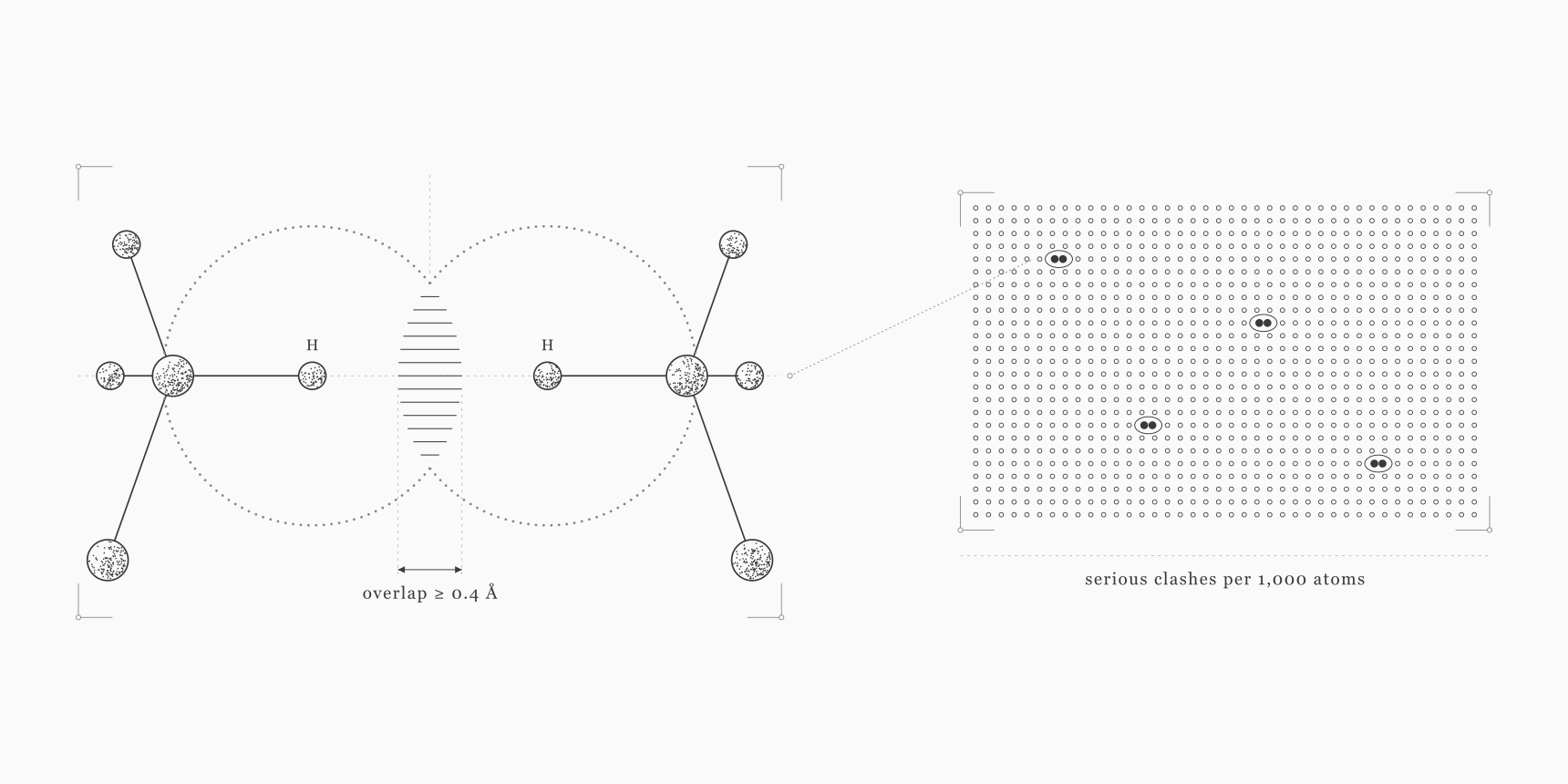
- Clashscore is the number of serious clashes per 1,000 atoms: pairs of atoms, hydrogens included, whose van der Waals surfaces overlap by 0.4 Å or more and that are not hydrogen-bonded.
- Lower is better and there is no fixed cutoff. In wwPDB reports the median X-ray clashscore is 2.9 at 1.0 Å, 4.7 at 2.0 Å and 10.4 at 3.0 Å.
- The same file can give different clashscores, because MolProbity in CCTBX places X-ray hydrogens at electron-cloud positions and wwPDB reports place them at nuclear positions.
- Relaxed predictions score near zero and unrelaxed ones can score above 20, so clashscore tests physical contacts, not whether a model is correct.
- High clashscores come down with rebuilding and refinement for experimental models, and with minimization or side-chain repacking for models that have no data.
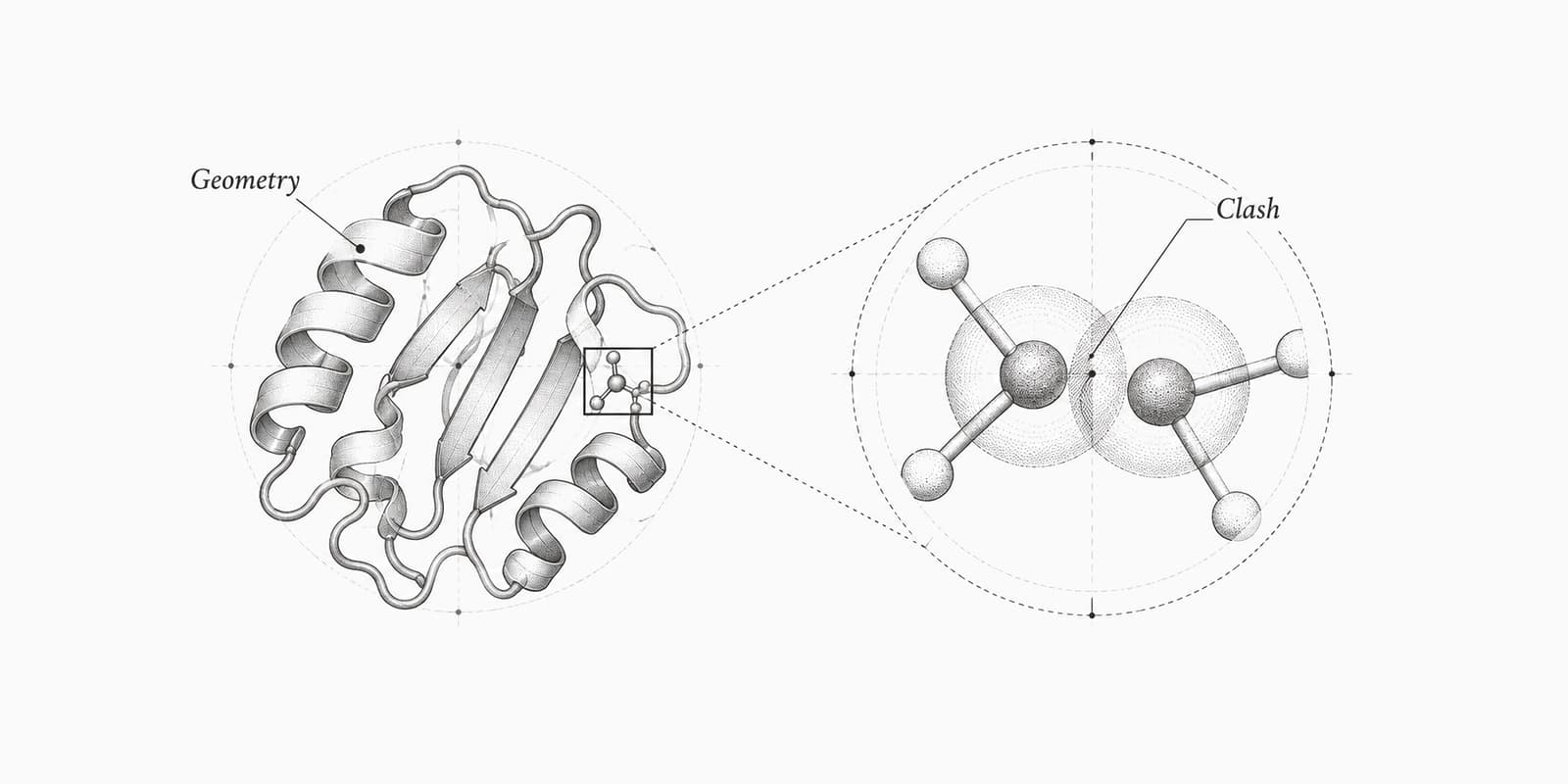
Ubiquitin's 1.8 Å crystal structure, 1UBQ, has a clashscore of 6.64 when you run it through MolProbity on ProteinIQ and 10.56 in its wwPDB validation report.[9] Neither number is wrong. Clashscore counts pairs of atoms that sit impossibly close, 0.4 Å or more inside each other's van der Waals surfaces, for every 1,000 atoms in the model. About half of those atoms are hydrogens that the software adds itself, and where it puts them changes the count.
So a clashscore means little until you know which program produced it, the resolution of the structure and whether the model went through energy minimization. This guide covers each of those, with typical values from about 112,000 PDB entries.
How MolProbity counts a clash
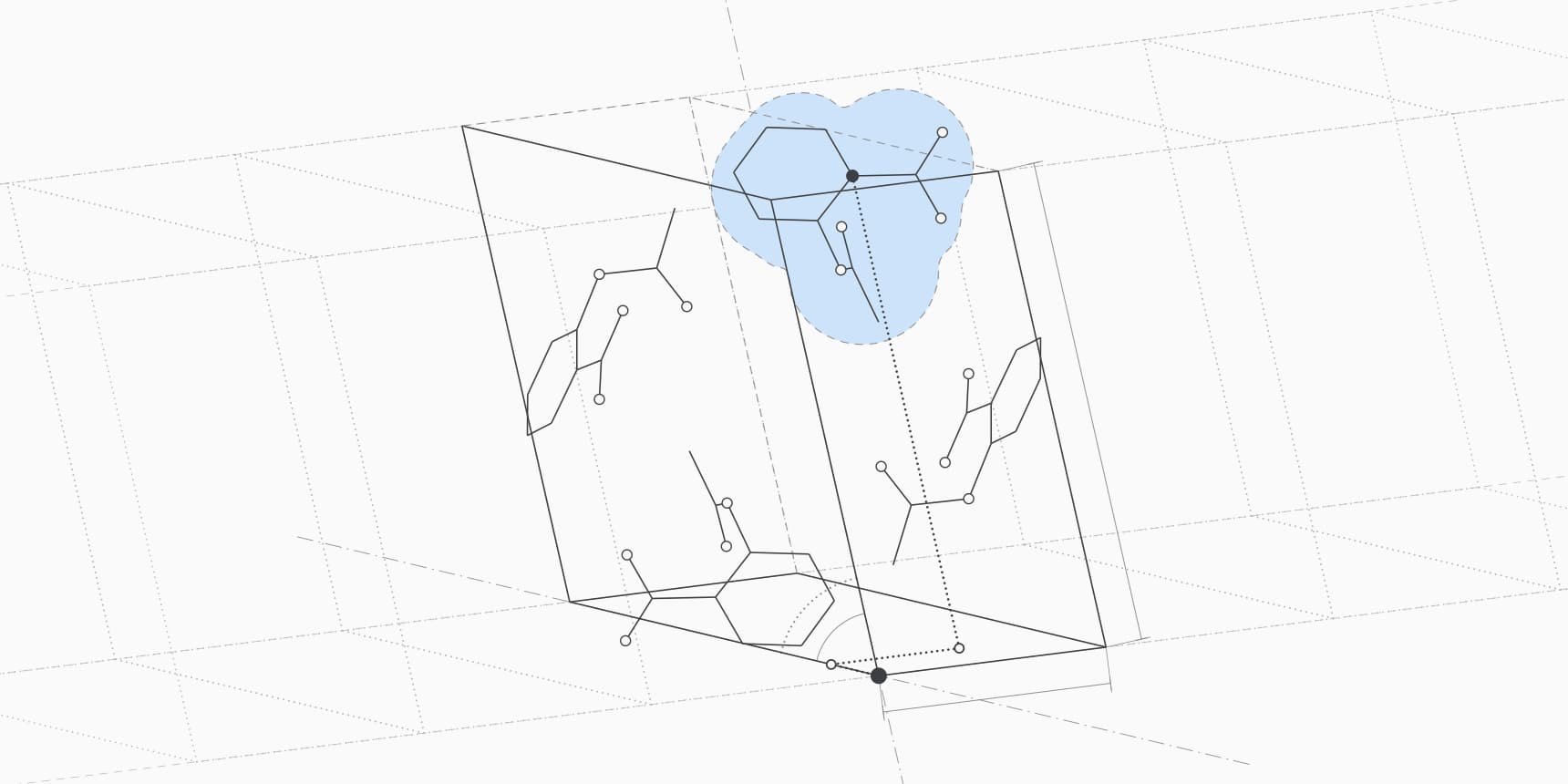
Most crystal structures are deposited without hydrogens, so MolProbity first runs Reduce to add them. Reduce places every hydrogen, rotates OH, SH and NH3 groups to their best positions (methyl groups are not optimized) and adds no hydrogens to waters.[1] If the file already contains hydrogens, the CCTBX code that runs MolProbity keeps them as they are instead of rebuilding them.[5]
Probe then rolls a sphere 0.25 Å in radius over the van der Waals surface of every atom and measures how far nonbonded atoms overlap.[1][3] When two atoms that are not a hydrogen-bond donor and acceptor overlap by 0.4 Å or more, the contact is a serious clash. An overlap that large cannot happen in a real molecule, so at least one of the two atoms is in the wrong place.[1]
The CCTBX source fills in the bookkeeping. Each atom pair counts once, at its worst overlap, and a pair that Probe also scores as a hydrogen bond is dropped. The clashscore is that count times 1,000, divided by the number of atoms with nonzero occupancy. Waters are left out of the atom count and contacts between two waters are ignored, but a protein atom pushed into a water still counts.[5]
The count is made on side chains as they were deposited. Reduce looks for Asn, Gln and His side chains fitted 180° backwards, but when CCTBX computes the clashscore it gives flips a prohibitive penalty and lists the recommended flips separately.[4][5] A backwards Asn amide stays in the clashscore until someone flips it in the model.
Why the same structure gets different clashscores
Hydrogen positions explain most disagreements. An X-ray experiment sees the electron cloud, which sits closer to the heavy atom than the hydrogen nucleus: 0.97 Å from carbon rather than 1.09 Å. Since 2018 MolProbity has carried both sets of distances, each with matching van der Waals radii.[2]
CCTBX uses electron-cloud positions for every model except neutron structures, while wwPDB validation reports place hydrogens at nuclear positions for all methods.[5][7] The longer bonds push hydrogens further into their neighbours, which is why 1UBQ scores 10.56 in its PDB report and 6.64 on ProteinIQ.
Hydrogens that arrive with the file are the second source. PDB Fixer, OpenMM and most simulation and modelling packages write hydrogens at nuclear positions, and CCTBX keeps them and scores them with electron-cloud radii. To compare such a model with X-ray clashscores, remove its hydrogens first, for example with Reduce's -Trim option, so they are rebuilt the same way as everyone else's.
Software version is the third. MolProbity releases before 2018 used one set of hydrogen distances for every method, which raised clashscores across the board, so older reports are not comparable with current ones either.[2] Compare structures that went through the same pipeline.
What a good clashscore looks like at each resolution
There is no single cutoff, because clashscore rises as resolution gets worse. The Duke MolProbity server ranks a clashscore against PDB structures within 0.25 Å of the same resolution.[1] ProteinIQ reports the raw value and marks 5 or below as excellent and 20 or below as good. To put those cutoffs in context, we pulled the wwPDB clashscore of every X-ray, cryo-EM and solution NMR entry in each resolution window from the RCSB PDB on October 29, 2026.[8]
| Method and resolution | Entries | 10% | 25% | Median | 75% | 90% | Above 20 |
|---|---|---|---|---|---|---|---|
| X-ray, 1.0 Å | 3,248 | 0.6 | 1.5 | 2.9 | 5.2 | 9.1 | 1.0% |
| X-ray, 1.5 Å | 18,747 | 1.2 | 2.1 | 3.4 | 5.4 | 8.3 | 0.7% |
| X-ray, 2.0 Å | 34,942 | 1.7 | 2.9 | 4.7 | 7.9 | 12.5 | 2.6% |
| X-ray, 2.5 Å | 18,544 | 2.5 | 4.1 | 7.1 | 12.8 | 20.3 | 10.4% |
| X-ray, 3.0 Å | 8,573 | 3.3 | 5.6 | 10.4 | 20.7 | 34.8 | 26.4% |
| X-ray, 3.5 Å | 2,158 | 4.1 | 6.7 | 11.6 | 23.2 | 44.1 | 28.9% |
| Cryo-EM, 2.5 Å | 1,748 | 2.0 | 3.3 | 5.1 | 7.6 | 10.9 | 1.3% |
| Cryo-EM, 3.0 Å | 4,952 | 2.5 | 4.2 | 6.3 | 9.1 | 12.6 | 2.2% |
| Cryo-EM, 3.5 Å | 4,019 | 2.9 | 4.8 | 7.5 | 11.1 | 16.2 | 5.7% |
| Cryo-EM, 4.0 Å | 1,832 | 3.2 | 5.5 | 8.6 | 13.5 | 20.0 | 10.0% |
| Solution NMR, all entries | 13,421 | 1.0 | 3.6 | 12.8 | 29.8 | 60.8 | 36.4% |
Read your value against its own row. A clashscore of 5 sits near the worst quarter of 1.0 Å crystal structures but beats the median at 2.5 Å, and a clashscore of 12.5 is worse than 90% of 2.0 Å structures but only median at 3.0 Å. At 3.0 Å a quarter of crystal structures exceed 20. NMR entries spread far wider than crystal structures at any resolution, so an NMR model is better judged against the goal of few clashes than against a cohort.
The numbers are wwPDB values with nuclear hydrogens. A clashscore from ProteinIQ or another CCTBX run on an X-ray model is usually lower than the one in its PDB report, so it will look somewhat better against this table than the deposited report would. The script and results are public; percentiles are interpolated from counts in 0.25-wide bins.
Old structures and cryo-EM models
Deposition date matters almost as much as resolution. For 2.0 Å crystal structures released before 2002, the median clashscore is 8.9 across 2,925 entries; for those released since 2020 it is 3.8 across 10,035. Chen and colleagues found the average clashscore flat until 2002 and improving once all-atom contact analysis was available, and Williams and colleagues reported that the improvement continued.[1][2] A 1990s structure with a clashscore of 9 was typical of its time.
Cryo-EM models clash less than crystal structures at the same nominal resolution: a median of 7.5 at 3.5 Å against 11.6 for X-ray. Most cryo-EM entries are recent, and refinement restraints clean up contacts even where the map cannot place atoms. Prisant and colleagues showed that such restraints can make validation look better than the model is, so a low clashscore at 3.5 Å says less about accuracy than the same value at 1.5 Å.[10]
Why low resolution and predicted models score differently
At 1 Å the density shows where each atom sits. At 3 Å many side chains are blobs, and their atoms are placed by geometry restraints and by the builder's judgment, not by the map. Probe sees only coordinates, so every side chain fitted into the wrong pocket shows up as clashes with its neighbours. That is why the median X-ray clashscore climbs fourfold from 1.0 to 3.5 Å in Table 1.
Predicted structures have no resolution and no data, and their clashscore depends on how the model was finished. AlphaFold 2 ends each prediction with an Amber relaxation, which its authors report removes stereochemical violations without improving accuracy.[11] The relaxed AlphaFold Database model of sperm whale myoglobin, run through the same CCTBX validation as ProteinIQ, has a clashscore of 0.00.
Skip that step and the picture changes. An unrelaxed AlphaFold2 model of the GCN4 leucine zipper matches its crystal structure to 0.58 Å Cα RMSD, yet has a clashscore of 23.3, as shown in the structure prediction confidence example. AlphaFold2 on ProteinIQ leaves AMBER relaxation off by default, so expect raw predictions to clash. Clashscore says whether contacts are physical; for whether the fold is right, read pLDDT and the predicted aligned error.
Docked complexes, designs, threaded mutants and hand-edited models are where clashscore earns its keep. Nothing in those pipelines guarantees physical contacts, and a high clashscore is often the first sign that a mutated side chain or a placed ligand sits on top of something.
How clashscore feeds the MolProbity score
The MolProbity score adds 0.426 × ln(1 + clashscore) to its rotamer and Ramachandran terms and a constant of 0.5.[6] The other two terms drop to zero once rotamer outliers are at or below 1% and Ramachandran favored is at or above 98%, so the clash term alone sets the best score a structure can reach. Table 2 shows that floor.
| Clashscore | Clash term | Lowest possible MolProbity score |
|---|---|---|
| 0 | 0.00 | 0.50 |
| 2 | 0.47 | 0.97 |
| 5 | 0.76 | 1.26 |
| 10 | 1.02 | 1.52 |
| 20 | 1.30 | 1.80 |
| 40 | 1.58 | 2.08 |
A structure with a clashscore of 20 cannot score better than 1.80, however good its backbone and rotamers are. Because the term is logarithmic, removing the last two clashes per 1,000 atoms lowers the score by 0.47, more than halving a clashscore from 40 to 20 (0.28).
How to fix a high clashscore
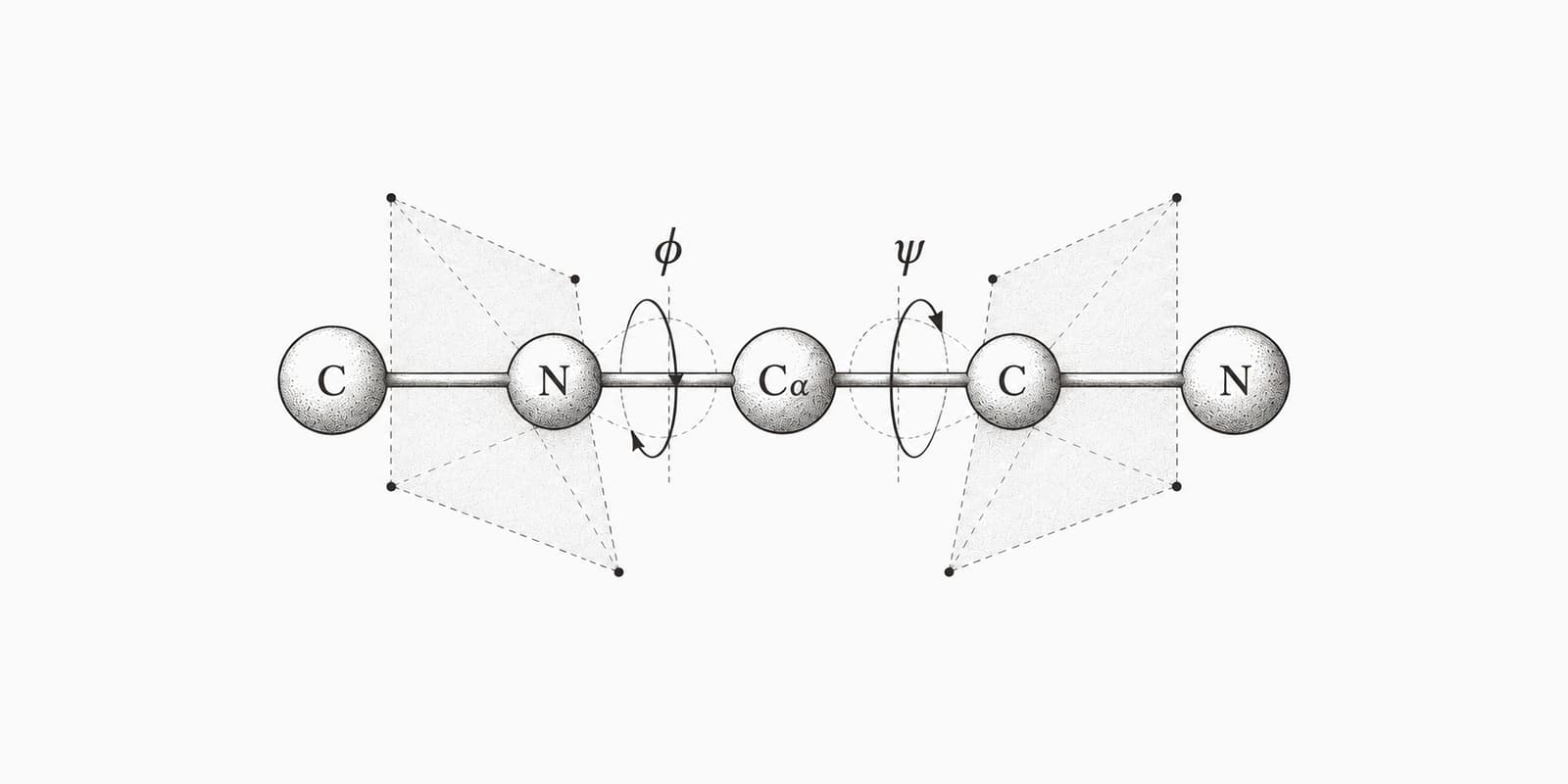
Start with the list, not the number. Each clash appears as a Clash row in the MolProbity outlier table with both atoms and the overlap in Å, and sorting by residue shows where they concentrate. One side chain in the wrong place usually accounts for several rows. Common culprits are Asn, Gln and His fitted backwards, branched side chains (Thr, Val, Ile, Leu and Arg) fitted backwards into ambiguous density, ligands with missing or misplaced hydrogens, and side chains missing atoms.[1]
Experimental structures
If you have the map or the reflections, fix clashes against the data. Apply the Asn, Gln and His flips that Reduce recommends, rebuild the flagged residues in Coot (ProteinIQ's MolProbity job returns a Coot script that steps through them) and refine again. Chen and colleagues report that at about 2.5 Å or better most outliers can be corrected this way, with an order-of-magnitude improvement in the MolProbity measures.[1]
Minimizing a crystal structure without its data also removes clashes, but it moves atoms away from the density that placed them. For a deposited structure you did not refine, a high clashscore is a reason to treat the flagged region with caution, not to rewrite it.
Predicted, docked and designed models
For models without data, the fix is physical. If side chains are truncated, PDB Fixer adds the missing heavy atoms and loops, and its Relax added atoms option minimizes only what it added; it does not move existing atoms, so clashes between them remain. To remove those, run Energy minimization only in OpenMM, or turn on AMBER relaxation when predicting with AlphaFold2.
Threaded mutants and designs often clash because a new side chain was dropped into a pocket built for the old one. Repacking the surrounding side chains with a packer such as SCWRL4 or FASPR picks rotamers that fit together, and a short minimization afterwards removes the small overlaps that their soft scoring tolerates.[12][13] Then strip the hydrogens these programs added before you validate, so that Reduce rebuilds them at the positions MolProbity expects.
Two limits apply to any fix. Williams and colleagues frame the goal as few clashes, as in the best reference structures, not zero.[2] And a clashscore pushed to zero by minimization proves only that the atoms no longer overlap: a relaxed model can still be the wrong conformation.
Clashscore tools on ProteinIQ
- MolProbity calculates clashscore with every clash listed by atom pair and overlap, alongside the Ramachandran, rotamer, Cβ and CaBLAM checks and the MolProbity score, and returns a Coot script for rebuilding.
- PDB Fixer completes truncated side chains and missing loops before minimization or validation.
- OpenMM relaxes a whole structure with energy minimization to remove clashes in models that have no experimental data.
- AlphaFold2 can run AMBER relaxation on its predictions, which is off by default.
Frequently asked questions
Is a lower clashscore better?
Yes. Clashscore counts serious overlaps per 1,000 atoms, so 0 is the best possible value and every clash raises it. For experimental structures, judge it against structures at similar resolution rather than against zero.
What is a good clashscore?
It depends on resolution. In wwPDB reports the median X-ray clashscore is 3.4 at 1.5 Å, 4.7 at 2.0 Å, 7.1 at 2.5 Å and 10.4 at 3.0 Å, so a value below the median for your resolution is better than typical. ProteinIQ marks 5 or below as excellent and 20 or below as good.
Why does my clashscore differ from the PDB validation report?
The wwPDB pipeline places hydrogens at nuclear positions, while MolProbity in CCTBX, which ProteinIQ runs, uses shorter electron-cloud distances for X-ray, cryo-EM and NMR models. The nuclear convention gives more overlaps, so the PDB report usually shows a higher clashscore for the same coordinates. 1UBQ scores 10.56 in its PDB report and 6.64 on ProteinIQ.
Does clashscore include hydrogens?
Yes, in both the clashes and the atom count. MolProbity adds hydrogens with Reduce when the file has none, and most clashes involve at least one hydrogen. If the file already has hydrogens, MolProbity keeps them, which is why hydrogens written by simulation software can change the result.
Can a clashscore be too low?
The value itself is never a problem, but it can hide one. A relaxed prediction scores near zero whether or not its fold is right, and restraint-heavy refinement at low resolution can clean up contacts in a model that still has backbone errors.[10] Read a low clashscore alongside the other checks and, for predictions, the model's confidence scores.