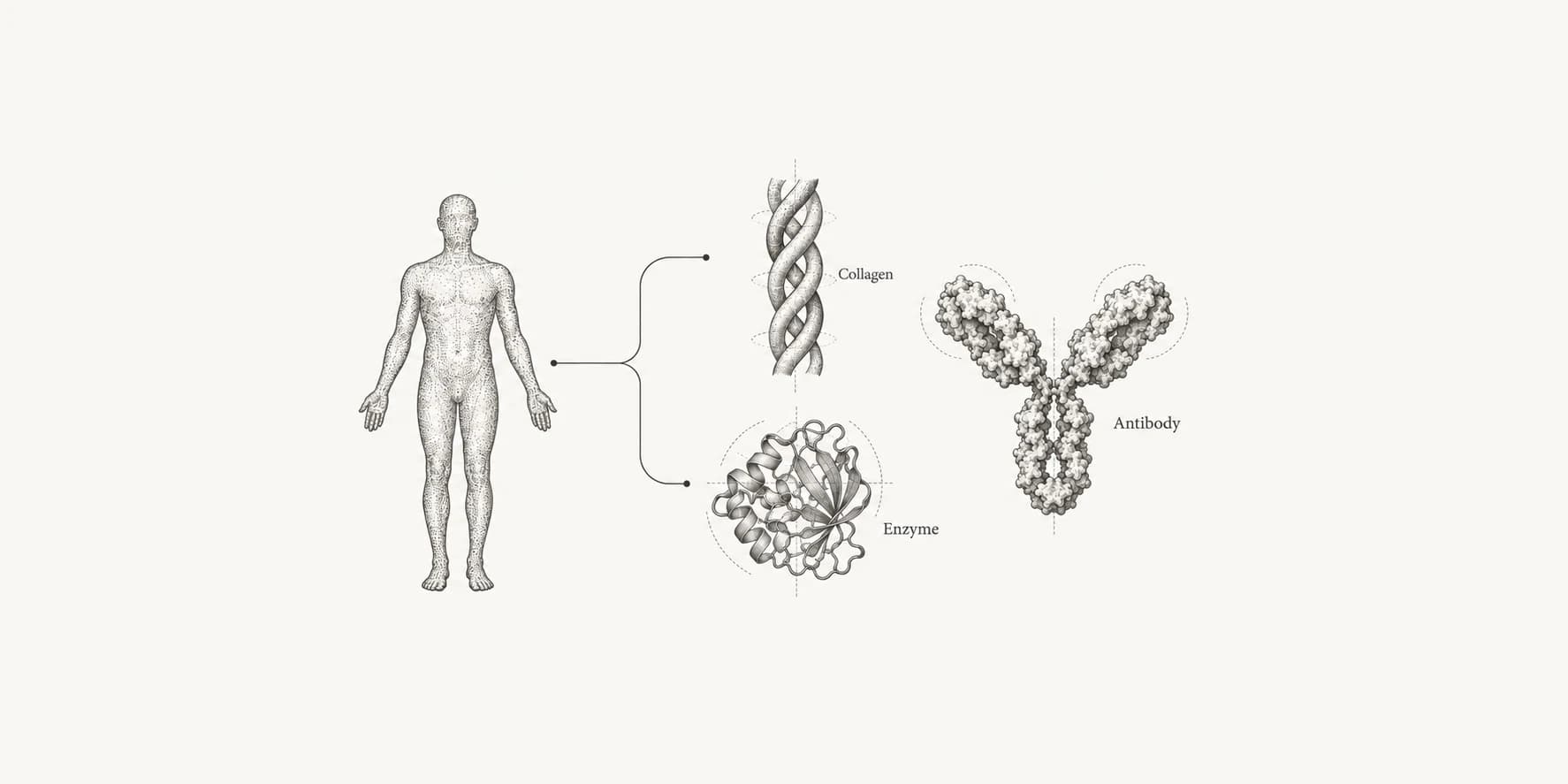
The human body makes nearly 20,000 different proteins, one reference protein for each of its roughly 19,400 protein-coding genes. Textbooks sort these into about seven broad types by the job they do, such as enzymes, structural proteins, and transport proteins, while reference databases use dozens of narrower classes that overlap. How many types there are therefore depends on whether a type means a distinct molecule, a role in the body, or a family of related proteins.
Families show how much variety a single role can hold. Collagen, the main structural protein of skin, bone, and tendon, comes in 28 types built from 44 genes. Beneath all of these proteins sit the same building blocks: 20 standard amino acids, or 21 once selenocysteine is included.
How many different proteins does the human body make?
The human body makes nearly 20,000 distinct proteins when each protein-coding gene is counted once. GENCODE release 50, the reference annotation of the human genome, lists 19,442 protein-coding genes.[1] A protein-coding gene is a stretch of DNA that holds the instructions for building a protein, so this figure is the length of the body's protein parts list. Nearly all of these parts are catalogued individually: 19,325 genes in the Human Protein Atlas map to a reviewed UniProt entry, whose sequence can be retrieved with UniProt Download.[2]
Larger totals count variants of the same parts. Most genes can be read in more than one way through alternative splicing, in which different segments of a gene's message are joined together, and GENCODE annotates 172,117 distinct protein sequences from its 19,442 protein-coding genes.[1] Chemical modifications made after a protein is built multiply the forms again. This is why popular sources quote anything from 20,000 to more than 100,000 human proteins: they are counting different things.
A list of 20,000 entries is too long to reason about one protein at a time. Biologists therefore group proteins by what they do, and that grouping is what most people mean when they ask about types of protein.
What are the main types of proteins in the body?
Most introductory textbooks describe about seven functional types of protein: enzymes, structural proteins, transport proteins, hormones, defense proteins, contractile proteins, and storage proteins. OpenStax Biology, a widely used open textbook, uses this seven-part scheme.[3]
| Type | What it does | Human examples |
|---|---|---|
| Enzymes | Speed up chemical reactions, including the digestion of food | Amylase, lipase, pepsin, trypsin |
| Structural | Build and support cells and tissues | Actin, tubulin, keratin, collagen |
| Transport | Carry substances through the blood and lymph | Hemoglobin, albumin |
| Hormones | Carry signals that coordinate body systems | Insulin |
| Defense | Recognize and help remove pathogens | Immunoglobulins (antibodies) |
| Contractile | Generate movement, including muscle contraction | Actin, myosin |
| Storage | Hold nutrients in reserve | Ferritin, which stores iron |
The scheme is a teaching tool rather than a census, and its boundaries are loose. Actin appears twice, as a structural protein of the cell skeleton and as a contractile protein of muscle.[3] The storage examples in the textbook come from seeds and egg white; in the human body, the clearest case is ferritin, which holds iron in the liver, spleen, and bone marrow.[5]
The larger gap is what the seven types leave out. Receptors that detect hormones at the cell surface, channels that let ions cross membranes, and transcription factors that switch genes on and off make up thousands of human proteins, yet none of them is an enzyme, a structural protein, or a carrier in the usual sense. Counting those proteins requires a finer classification.
How do scientists classify human proteins?
Reference databases replace the seven teaching types with dozens of narrower classes, each defined by a curated list of genes. The Human Protein Atlas, version 25.1, places 3,777 human genes in its enzyme class, 2,138 in transporters, 1,485 in transcription factors, and 743 in G protein-coupled receptors (GPCRs), the largest family of cell-surface receptors.[2]
Enzymes are the largest functional class. Their 3,777 genes are equal to 19.4% of the 19,442 protein-coding genes in GENCODE, or about one in five.[2][1]
These classes cannot be summed to reach the size of the proteome. A single gene can belong to several of them, and classes built on location overlap in the same way. The Human Protein Atlas predicts 15,915 genes that encode intracellular proteins, 5,573 that encode membrane proteins, and 1,902 that encode secreted proteins.[2] Together these add up to 23,390, well above the number of protein-coding genes, because a gene can be assigned to more than one location class.
Class sizes also depend on who draws the boundary. Lambert and colleagues curated a catalog of more than 1,600 likely human transcription factors, over a hundred more than the Human Protein Atlas class holds.[6][2] Neither figure is wrong; they apply different evidence thresholds to proteins whose DNA binding has not always been demonstrated directly.
Gene counts can also understate how many distinct molecules a class produces. The Human Protein Atlas lists 214 immunoglobulin genes, yet immune cells cut and join separate gene segments to assemble antibody chains, and Alberts and colleagues estimate that a person can make more than a trillion different antibody molecules even before meeting an antigen.[2][7] Antibodies are one protein type in the textbook scheme but number in the trillions at the level of individual molecules.
How many types of collagen are in the human body?
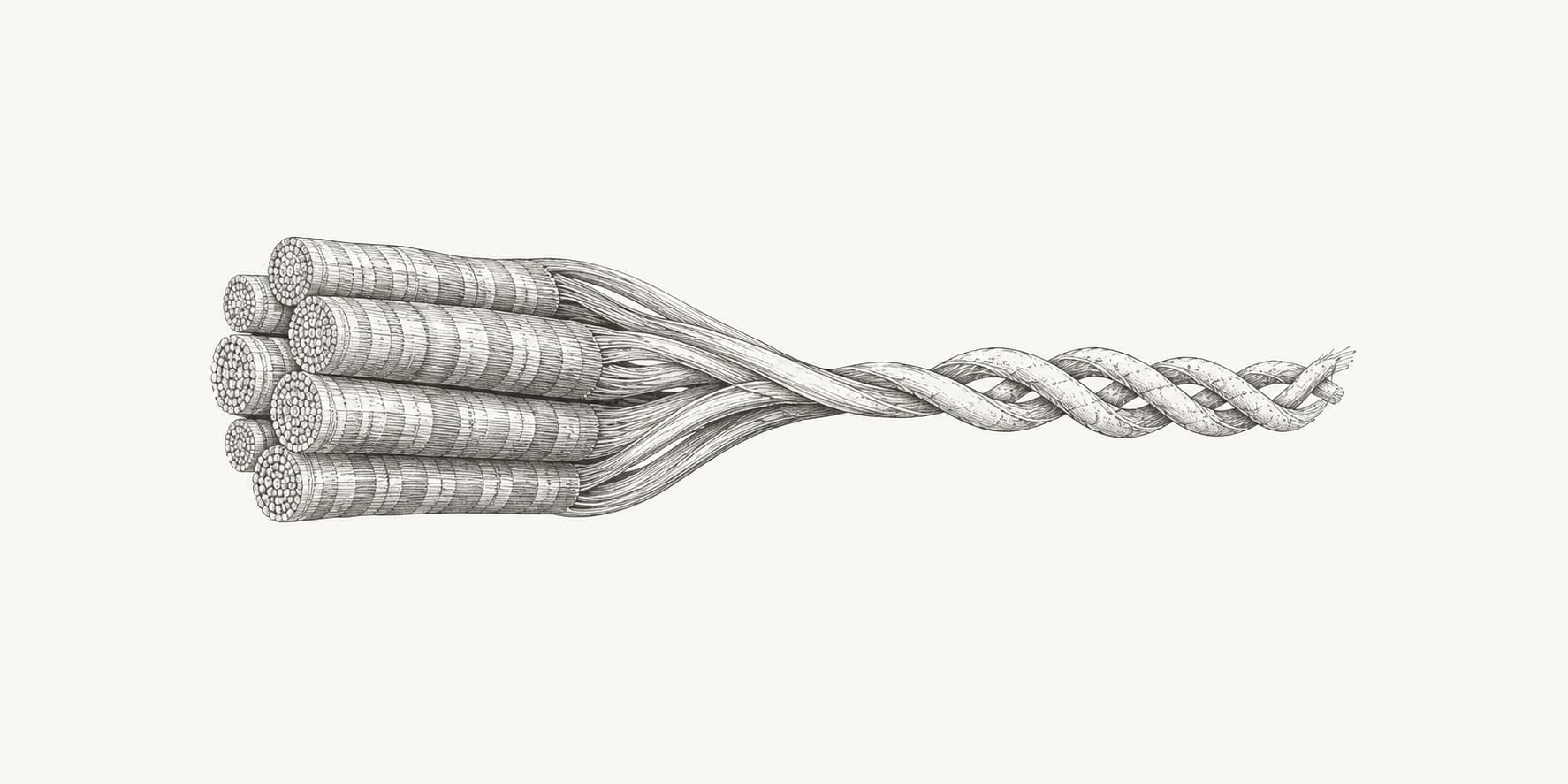
The human body has 28 types of collagen, numbered I to XXVIII, encoded by 44 genes.[4][8] Collagen is the main structural protein of the extracellular matrix, the material between cells that gives skin, bone, tendon, and cartilage their strength. It is usually named the most abundant protein in the body, although its share of total body protein is less certain than often claimed.
The number of genes exceeds the number of types because each collagen molecule is built from three chains, called α chains, wound into a triple helix. Some types use three identical chains; collagen II, for example, is made of three α1(II) chains. Others combine different chains: collagen I pairs two α1(I) chains with one α2(I) chain, and collagen IV draws on six different chains to form several molecular versions.[4] In HGNC's catalog of human gene names, the 44 genes follow this pattern, from a single gene for most types to six for collagen IV.[8]
Some sources give 29 types. A skin collagen described in 2007 was named collagen XXIX, but its gene turned out to be identical to the gene for the α5 chain of collagen VI, so it is no longer counted as a separate type.[4]
The 28 types are not equally common. Collagen I is usually said to account for more than 90% of the collagen in the human body, with types I to IV the most prevalent.[9] Most of the remaining types are minor components that shape how the major ones assemble. Collagen fibrils in skin are made of collagens I and III, those in the cornea of collagens I and V, and those in cartilage of collagens II, XI, and IX.[4]
| Family | Collagen types (genes) | What they form |
|---|---|---|
| Fibrillar | I, II, III, V, XI, XXIV, XXVII (11 genes) | Banded fibrils of skin, bone, tendon, cartilage, and cornea |
| FACIT | IX, XII, XIV, XVI, XIX, XX, XXI, XXII (10 genes) | Attachments on the surface of fibrils |
| Network | IV, VIII, X (9 genes) | Sheet-like networks, including basement membranes |
| Membrane | XIII, XVII, XXIII, XXV (4 genes) | Proteins spanning the cell membrane that can be shed as soluble forms |
| Multiplexins | XV, XVIII (2 genes) | Several triple helices separated by non-collagen segments |
| Beaded filament | VI (5 genes) | Beaded filaments |
| Anchoring fibril | VII (1 gene) | Anchoring fibrils that attach the epidermis to the dermis |
| Unassigned | XXVI, XXVIII (2 genes) | Less characterized collagens |
Collagen is not the only large structural family. Keratins, the filament proteins of skin cells, hair, and nails, are encoded by 54 functional genes in humans, 28 of type I and 26 of type II.[10] A single textbook type, structural protein, therefore contains families that each run to dozens of members.
How many types of amino acids make up human proteins?
Human proteins are built from 20 standard amino acids, the chemical units linked end to end to form a protein chain. Selenocysteine brings the genetically encoded set in humans to 21; it appears in the products of 25 human selenoprotein genes.[11][12] Nine of the standard 20 are essential, meaning the body cannot make them and must obtain them from food.[13]
Collagen shows that a finished protein can contain more than the encoded set. Its triple helix needs glycine at every third position, and its sequence is a long repeat of glycine followed by two other amino acids, most often proline and 4-hydroxyproline.[4] With glycine at every third position, about a third of each triple-helical region is glycine, a proportion that an amino acid composition calculator shows directly from a collagen sequence. Hydroxyproline, however, is not one of the 21 encoded amino acids. Enzymes create it by modifying proline after the chain is built, in a step that requires vitamin C, which is why vitamin C deficiency in scurvy produces weak connective tissue and bleeding gums.[9]
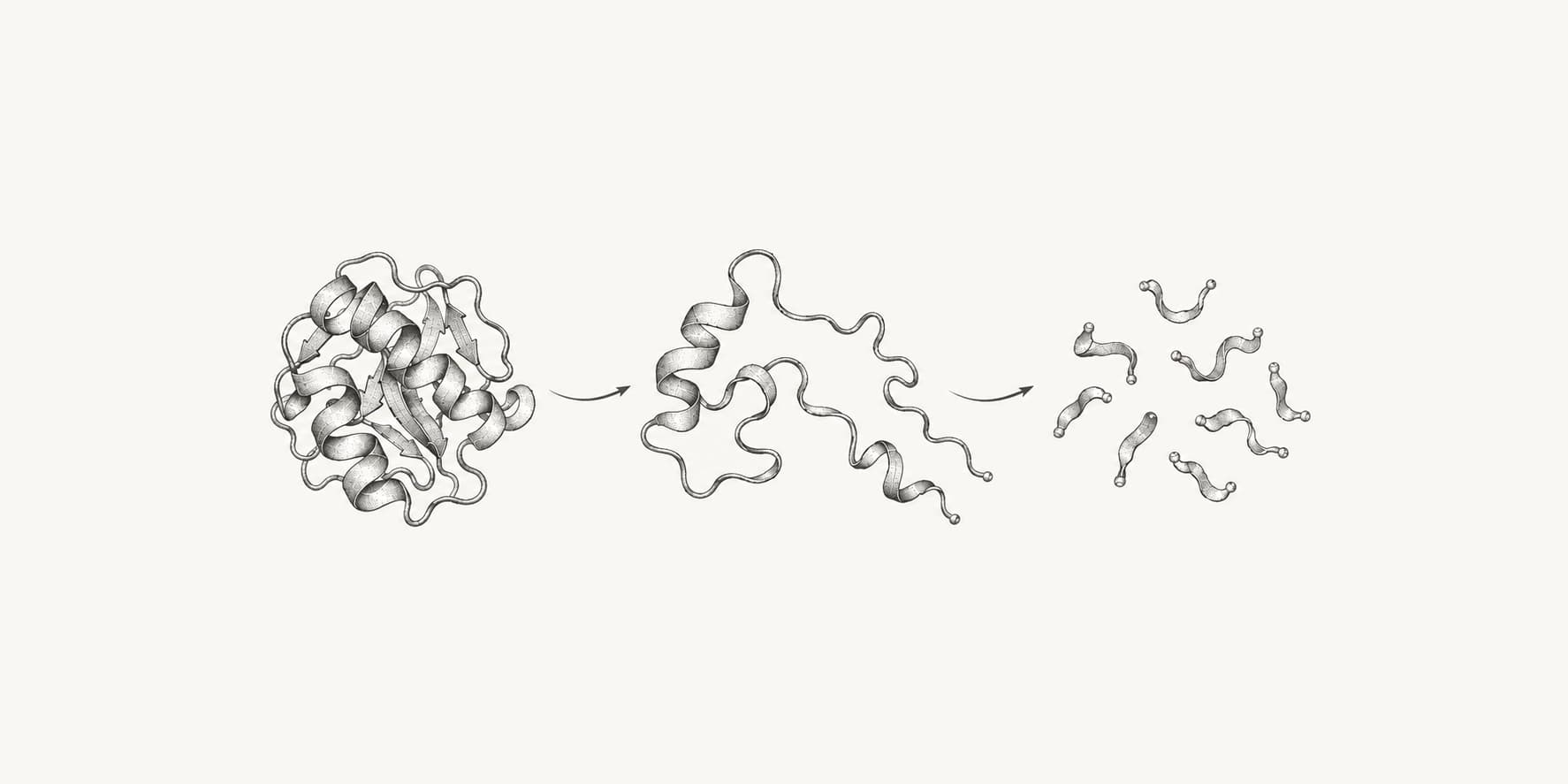
Taken together, these counts describe one system at four levels. About 21 kinds of amino acid build nearly 20,000 kinds of protein; those proteins fall into about seven broad roles, or dozens of overlapping database classes; and within a role, families such as the 28 collagens and 54 keratins specialize each job for a particular tissue. Each protein's role follows largely from its three-dimensional shape, which AlphaFold 2 and other protein structure prediction methods infer from the amino acid sequence. When someone asks how many types of protein the body has, the useful reply names the level: nearly 20,000 distinct proteins, about seven functional types, and many more molecular forms.