How long do proteins last in the body?
Protein half-lives range from minutes to a lifetime. There is no body-wide average because the result changes with the protein, tissue, measured pool, and method.
Proteins in the human body can last from less than an hour to an entire lifetime. There is no meaningful average for the whole human proteome, because studies measure different proteins, cells, tissues, and molecular pools.
In one cultured human-cell study, 803 newly synthesized proteins had a median half-life of 8.7 hours. Structural proteins in the eye lens and cartilage can remain for decades.
What is the average protein half-life?
There is no accepted average protein half-life for the human body. Reported values change with the cell or tissue, the protein pool, and the measurement method.
One study of 803 newly synthesized proteins in synchronized HepG2 human cells during DNA replication found a median half-life of 8.7 hours. Most values were between 4 and 14 hours.[2] That result describes proteins made during one cell-cycle phase, not all proteins in a cell or body.
A 2024 pulse-chase study used total protein mass as its denominator. It found that more than 90% of protein mass in dividing HEK293 cells and C2C12 mouse myoblasts belonged to pools with half-lives of 24 to 200 hours. Proteins with half-lives under 10 hours made up less than 2% of total mass but 10% to 20% of measurable newly synthesized protein mass.[8] Both studies can be correct because they sampled and weighted the proteome differently.
At the measured extremes, the mitochondrial lipid-transfer protein PRELID3B had a half-life of about 0.3 hours, or 18 minutes, in three human cell lines under blocked protein synthesis.[3] Radiocarbon dating found that crystallins in the central eye lens, formed around birth, undergo little or no subsequent turnover.[4]
These figures describe proteins made by the body. They do not describe how long dietary protein takes to digest or how long amino acids remain available after a meal.
What do protein half-life and turnover mean?
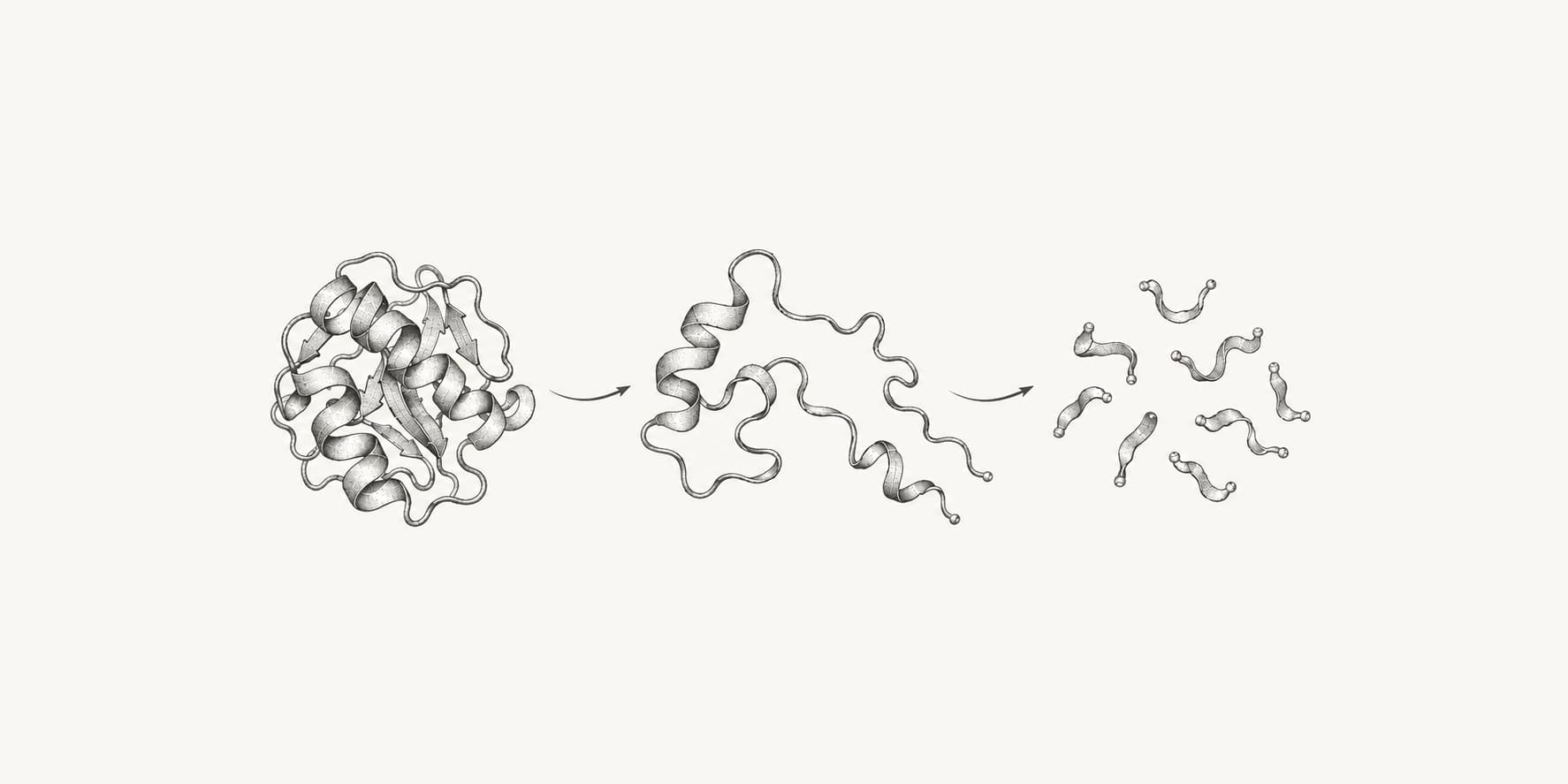
A protein's half-life is the time required for half of a measured protein pool to be removed. Protein turnover is the continuous replacement of old protein through degradation and new protein synthesis.[1]
Half-life describes a population of molecules, not the exact age at which each molecule disappears. It can include degradation, secretion, and dilution as cells divide. Stable-isotope labeling, pulse-chase experiments, radiocarbon dating, and translation-blocking assays also observe different parts of the process, so their results are not always directly comparable.
Sequence can affect stability, but sequence alone does not set a protein's lifespan. The instability index estimates whether a purified protein is likely to be stable from its amino-acid sequence. It cannot account for the cell's degradation machinery, the protein's binding partners, or tissue renewal.
How is protein half-life measured?
Protein half-life is measured by tracking the loss or replacement of a defined protein pool over time. The main methods disturb or label that pool in different ways, so their values should not be combined without checking the experimental design.
Dynamic SILAC and related metabolic-labeling methods feed cells or animals stable-isotope amino acids, then use mass spectrometry to follow old and newly made proteins. They can measure thousands of proteins at once, but amino-acid recycling, cell division, labeling duration, and the kinetic model affect the estimate.[1][6] Pulse-chase experiments label proteins during a defined pulse and follow the labeled pool during the chase. Using several pulse lengths helps capture both short- and long-lived pools.[8]
A cycloheximide chase instead blocks eukaryotic translation and follows the decline of an existing protein, often by western blot. It is useful for short-lived proteins, but cycloheximide blocks all translation and becomes cytotoxic during prolonged treatment, which makes it poorly suited to slowly degrading proteins.[9] Radiocarbon dating estimates when exceptionally long-lived proteins in tissues such as the eye lens were formed.[4]
Which proteins have the shortest and longest lifespans?
Short-lived proteins often regulate signaling, gene expression, and the cell cycle, while the longest-lived proteins tend to occur in structures with little capacity for replacement.
A 2021 study quantified 11,747 proteins across four human cell lines and classified 1,017 as short-lived, with half-lives of 8 hours or less. Roughly 100 measurements fell between 0 and 2 hours. PRELID3B was among the fastest at about 18 minutes, while the DNA-replication regulator Geminin lasted 3 to 4 hours.[3]
Eye-lens crystallins can remain for life because the mature cells in the lens nucleus cannot replace them.[4] Collagen also shows how strongly tissue changes the answer. A study based on amino-acid racemization estimated a half-life of 15 years for skin collagen and 117 years for articular-cartilage collagen.[5] Those estimates apply to collagen in those tissues, not to every collagen molecule in the body.
Proteins that persist for decades can accumulate chemical modifications because replacement is limited. This is one reason protein turnover matters to protein folding and proteostasis.
How does protein lifespan vary by tissue?
The same protein can have a half-life more than 150 times longer in one human cell type than another. Histone H1.2 lasted 18 hours in primary hepatocytes, 2,242 hours in B cells, and 2,741 hours in natural killer cells in the same study.[6]
The chart uses mean half-lives reported for primary, non-dividing human cells. Macro-H2A.1 ranged from 61 hours in hepatocytes to 1,950 hours in natural killer cells. Lamin B1 ranged from 388 to 3,215 hours.[6] These values came from the same dynamic-SILAC study, so the within-chart comparisons are more meaningful than comparisons across unrelated methods.
Whole tissues differ as well. In an isotope-labeling study of about 2,500 mouse proteins, average protein lifetime was 3.0 days in liver, 3.5 days in blood, and 9.0 days in brain.[7] These are mouse tissue averages, not human half-lives, but they show why a protein lifespan quoted without a tissue and measurement method is incomplete.