What is the most abundant protein on Earth?
Rubisco is the best-supported candidate. Its estimated global mass is about 0.7 gigatonnes, but no complete comparison of all proteins has proved the ranking.

Rubisco is the conventional answer to the question of Earth’s most abundant protein. A global analysis estimated about 0.7 gigatonnes, or 700 million metric tonnes, of Rubisco across the biosphere.
The ranking remains unproved because no study has compared Rubisco with every other widespread protein on a common global basis. Rubisco is the best-supported candidate.
What is the most abundant protein on Earth?
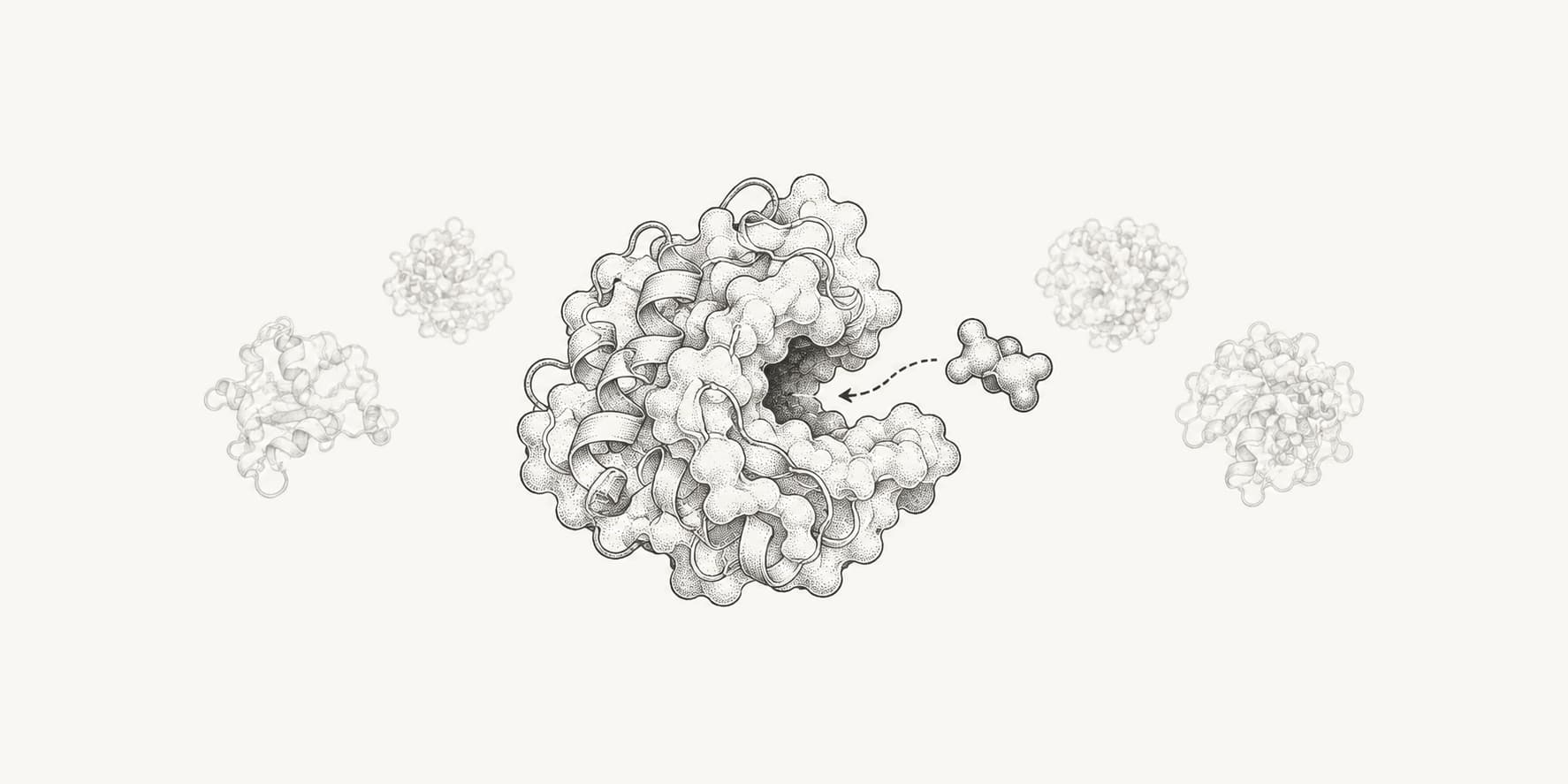
Rubisco, short for ribulose-1,5-bisphosphate carboxylase/oxygenase, is the best-supported candidate for the most abundant protein on Earth. Its estimated global mass is about 0.7 gigatonnes.[1]
The 2019 analysis estimated about 0.7 gigatonnes of Rubisco in terrestrial plants and another 0.03 gigatonnes in marine producers. More than 90% is in the roughly 2 × 10¹⁴ square meters of leaves on land. The authors report the rounded global total as about 0.7 gigatonnes.[1]
The same paper cautions that the superlative has not been tested against a comprehensive inventory of other widespread proteins. The evidence supports Rubisco as the conventional, best-quantified answer.[1]
The modern estimate puts terrestrial Rubisco at about 700 million metric tonnes. The same study estimated about 30 million tonnes in marine producers, compared the result with roughly 50 million tonnes of collagen in livestock, and traced the older Rubisco figure to a 40-million-tonne estimate from 1979.[1]
“Most abundant” here means estimated total mass across the biosphere. Rankings by molecule count, tissue concentration, or the number of distinct proteins answer different questions. In the human body, collagen is the conventional answer.
What is the most abundant enzyme on Earth?
Rubisco is also considered the most abundant enzyme on Earth because Rubisco is both a protein and an enzyme.[1][2]
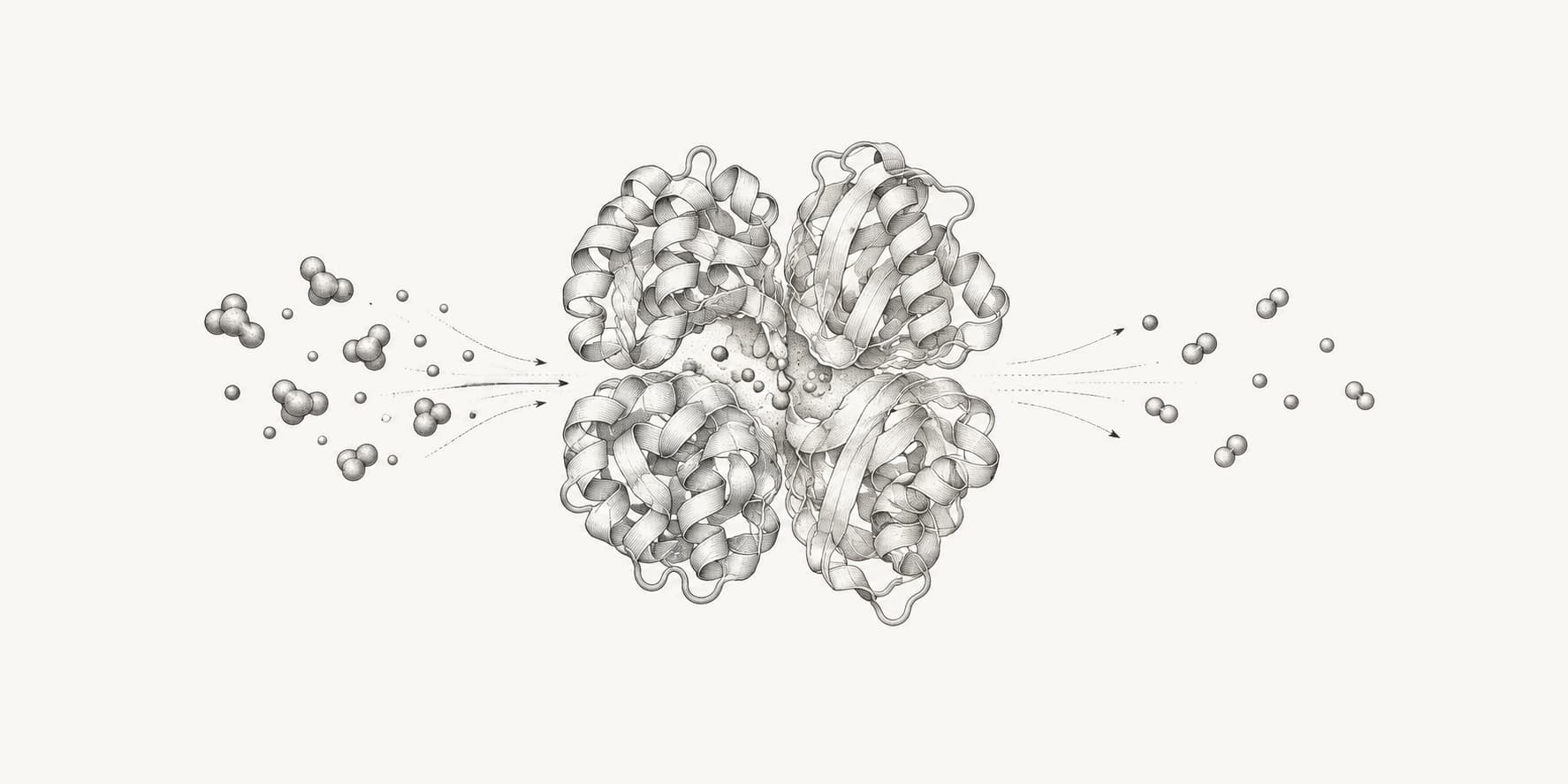
It catalyzes the reaction that adds carbon dioxide to ribulose-1,5-bisphosphate at the start of the Calvin-Benson cycle. This is the main route by which plants, algae, and cyanobacteria convert inorganic carbon into organic matter.
Raven estimated that more than 99.5% of the inorganic carbon assimilated by primary producers passes through Rubisco. Its global role, combined with the amount that photosynthetic organisms need, explains why the same molecule leads both the protein and enzyme answers.[2]
Abundance and speed are separate. Rubisco’s characteristic laboratory turnover is only a few reactions per active site per second, while the fastest enzyme processes millions.
Why is Rubisco so abundant?
Rubisco is abundant because photosynthetic organisms need a large amount of a relatively slow enzyme to sustain global carbon fixation.[1][2]
The global analysis estimated about 30 gigatonnes of dry leaves on land, with Rubisco accounting for roughly 3% of that mass. Rubisco also has to compete with oxygen and often works below its laboratory maximum because of darkness, temperature, shade, water supply, carbon dioxide availability, and other limits.[1]
The study estimated a time-averaged rate of about 0.03 reactions per second for terrestrial Rubisco and 0.6 per second in the ocean. Characteristic laboratory maxima were about 3 per second for terrestrial Rubisco and 4 per second for marine Rubisco.[1]
The comparison mixes field averages with laboratory maxima. The field estimates average activity across day and night and across the year, while the laboratory values describe maximum turnover under controlled conditions. Tools such as DLKcat estimate turnover for a specified enzyme-substrate pair, a different quantity from global time-averaged activity.
What is the most abundant carbohydrate on Earth?
Cellulose is the most abundant carbohydrate on Earth when the question refers to a polysaccharide or bulk carbohydrate material.[3]
Cellulose is a long, straight polymer of glucose units joined by β-1,4 glycosidic bonds. Plants deposit it in cell walls, which puts an enormous mass of cellulose into wood, stems, leaves, and roots.[3]
Glucose is the most abundant monosaccharide, so sources may give glucose when the question is restricted to single sugar units.[4] The answers are compatible: glucose is a monosaccharide, while cellulose is a polysaccharide made entirely from glucose.
What is the most abundant molecule on Earth?
Water is the clearest answer when “molecule” means a discrete molecular substance ranked by total planetary mass. The U.S. Geological Survey estimates that Earth holds about 1.386 billion cubic kilometers of water, including oceans, ice, groundwater, lakes, rivers, soil moisture, and atmospheric water.[5]
Much of the solid Earth consists of minerals with extended ionic or covalent structures rather than separate molecules, so there is no simple molecule-by-molecule census of the entire planet.
Within dry air, nitrogen is the most abundant molecule at about 78.08% by volume.[6] Within organic matter, cellulose is the standard answer. Water, nitrogen, and cellulose therefore answer three different versions of the same question: the planet’s molecular material, the atmosphere, and organic matter.