What is the fastest enzyme?
Catalase has the highest reported turnover number, decomposing up to 44 million hydrogen peroxide molecules per second per four-heme enzyme molecule.
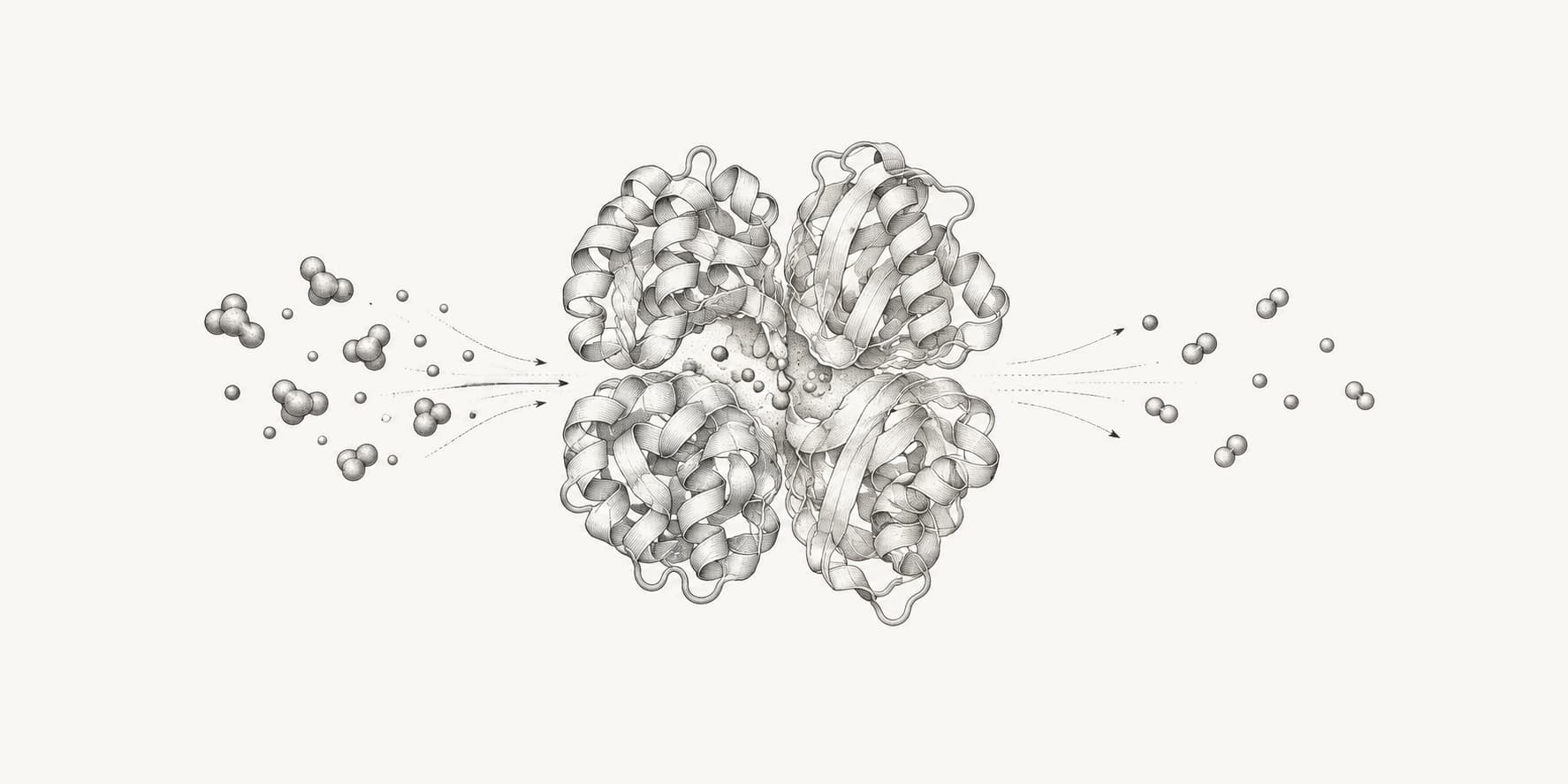
Catalase is the fastest known enzyme by maximum turnover number. Under optimal laboratory conditions, one complete catalase molecule can decompose an estimated 16 million to 44 million hydrogen peroxide molecules per second.
Carbonic anhydrase is also often called the fastest enzyme. That answer is based on catalytic efficiency, which measures how well an enzyme finds and converts its substrate when the substrate is scarce.
Rubisco is considered the most abundant enzyme on Earth, but abundance and catalytic speed are separate measurements.
What is the fastest enzyme?
Catalase has the highest reported turnover number of any enzyme, reaching an estimated 16 million to 44 million hydrogen peroxide molecules per second per complete four-heme molecule.[1][2]
Catalase protects cells by converting hydrogen peroxide, a reactive byproduct of metabolism, into water and oxygen:
2 H2O2 → 2 H2O + O2
A mammalian catalase molecule has four heme-containing subunits. Dividing the reported whole-enzyme maximum by four gives roughly 4 million to 11 million hydrogen peroxide molecules per active site per second.[1]
On this per-active-site comparison, the upper catalase estimate is about 1.1 million times the median natural enzyme turnover.[1][5]
The chart compares selected turnover numbers rather than results from one standardized experiment. The catalase point is the upper 44-million-per-tetramer estimate divided across four heme active sites; the carbonic anhydrase values are measured kcat values; and the median comes from an analysis of several thousand enzymes acting on natural substrates.[1][3][4][5]
The 44-million figure is an upper estimate under favorable laboratory conditions. Catalase does not maintain that rate in every living cell. Hydrogen peroxide concentration, temperature, pH, inhibitors, and enzyme damage all affect its activity.
Why is carbonic anhydrase often called the fastest enzyme?
Carbonic anhydrase is often called the fastest enzyme because some forms process more than one million carbon dioxide molecules per second and operate near the diffusion-controlled limit.[3]
Human carbonic anhydrase II has a turnover number of about 1.4 million per second and a catalytic efficiency, kcat/Km, of 1.5 × 10⁸ M-1 s-1.[3] SazCA, a carbonic anhydrase from the thermophilic bacterium Sulfurihydrogenibium azorense, reaches 4.4 million per second and 3.5 × 10⁸ M-1 s-1.[4]
Those efficiency values approach the rate at which enzyme and substrate can meet by diffusion in water. Enzymologists call this “catalytically perfect.” It does not give carbonic anhydrase a higher turnover number than catalase.
The best-studied human form is a zinc enzyme that converts carbon dioxide and water into bicarbonate and a proton. It is also a benchmark target in molecular docking, where inhibitors such as acetazolamide must coordinate the active-site zinc.
How is enzyme speed measured?
Scientists usually measure enzyme speed with turnover number, kcat, or catalytic efficiency, kcat/Km. These quantities answer different questions.
The turnover number is the maximum number of substrate molecules converted per enzyme active site per second when substrate is abundant. Catalytic efficiency also accounts for the substrate concentration needed to reach that speed, so it is more useful when substrate is scarce.
These values cannot rank an enzyme independently of its substrate and assay conditions. Temperature, pH, salt, cofactors, substrate identity, and the way enzyme concentration is counted can all change the result.
Most enzymes are much slower than the textbook record holders. An analysis of several thousand enzyme measurements found a median kcat of about 10 s-1, with roughly 60% of values between 1 and 100 s-1.[5] Computational tools such as DLKcat can estimate kcat for an enzyme-substrate pair, but experimental measurements remain the standard for comparing rates.