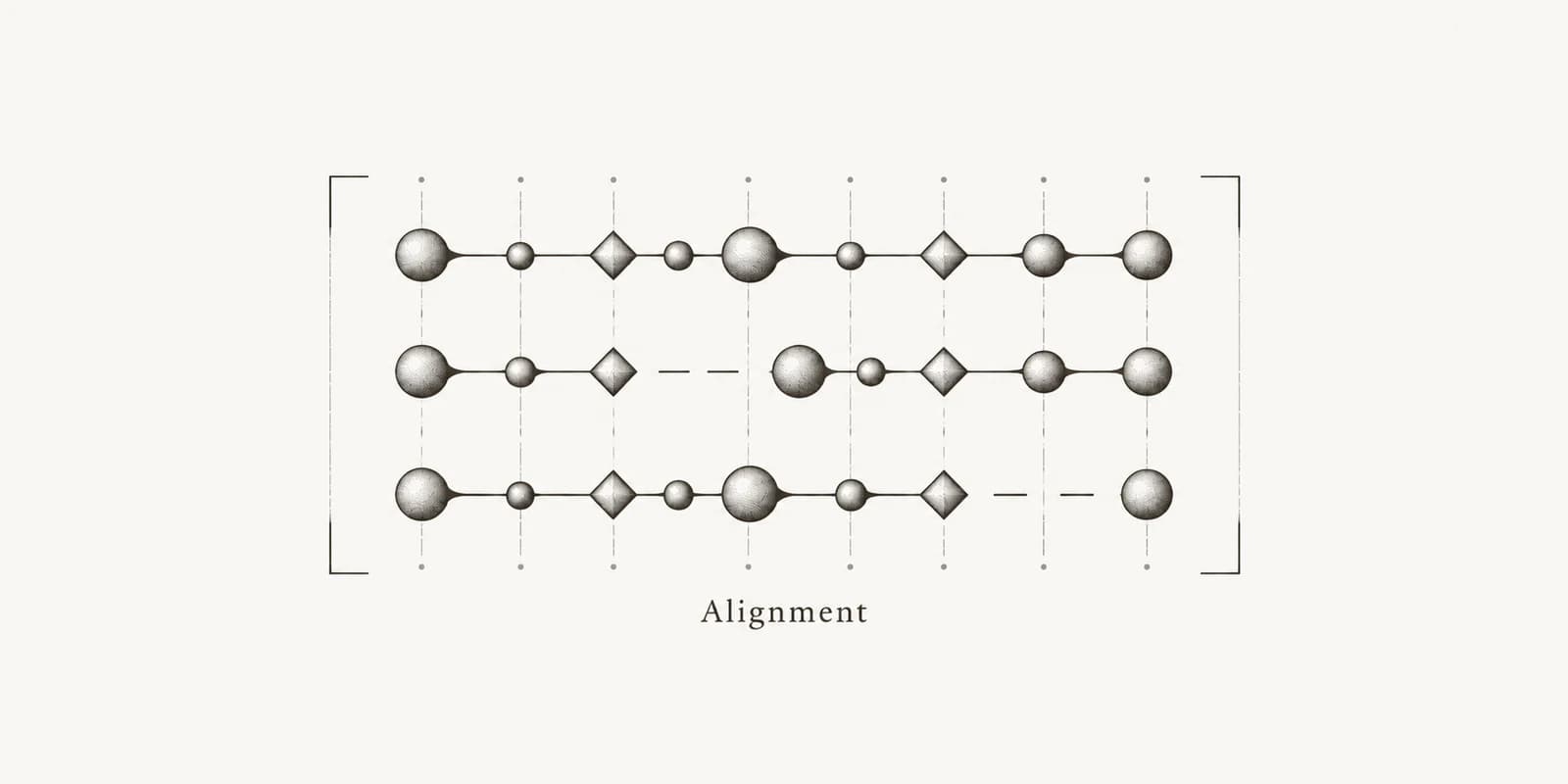
Clustal Omega lines up homologous protein, DNA, or RNA sequences so that each column holds residues that are thought to share a common origin. It is fast enough for tens of thousands of sequences and accurate on protein benchmarks.[1] It will still align sequences that are not related, so the result is only as meaningful as the set you submit.
Running Clustal Omega online takes a FASTA file and a few choices: sequence type, output format, and whether to refine the alignment. Paste or upload your sequences in Clustal Omega online, keep the defaults for a first run, and read the result in the MSA viewer before exporting it for phylogenetics, conservation analysis, or modeling.[2]
Open Clustal Omega online
Open the ProteinIQ Clustal Omega webserver and keep
Input mode on Align sequences.
Add your sequences
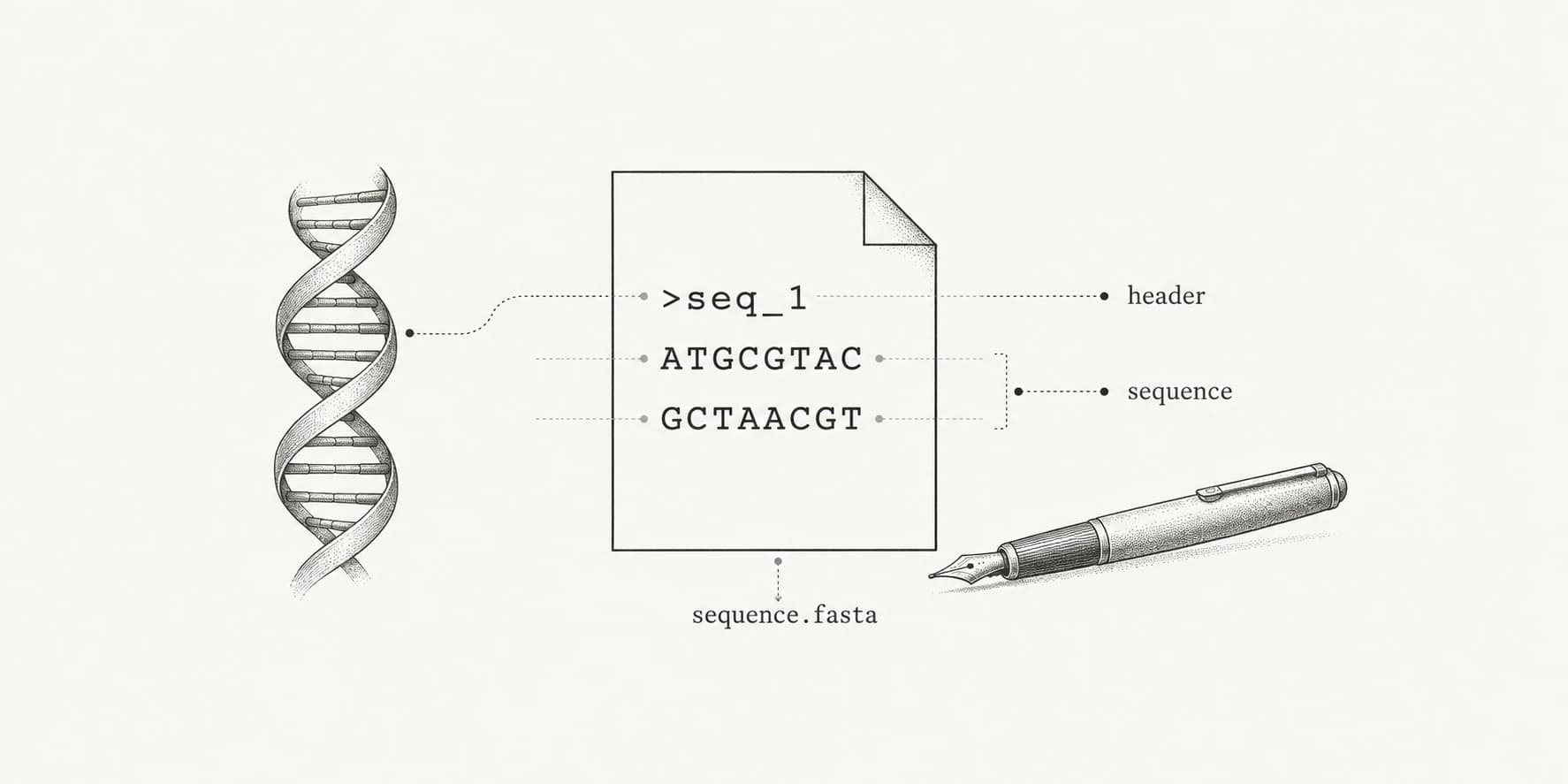
Paste or upload at least two homologous sequences, ideally as multi-record FASTA with a unique name for each sequence.
Check the main settings
Keep Sequence type on Auto-detect unless the sequences are short or
ambiguous, and choose the Output format your next tool expects.
Run the alignment
Click Align Sequences. Small jobs usually finish within seconds.
Inspect and export
Check conserved blocks and gap patterns in the MSA viewer, then download the
alignment from the Files tab.
What is Clustal Omega?
Clustal Omega is a multiple sequence alignment (MSA) program from the Clustal family, written from scratch in 2011 as the successor to ClustalW and Clustal X. It was designed to keep the progressive alignment strategy that made Clustal popular while scaling to very large datasets. The authors aligned more than 190,000 sequences on a single processor in a few hours.[1]
On the BAliBASE benchmark, Clustal Omega finished in 9 minutes with accuracy similar to Probcons and T-Coffee. Those consistency-based aligners took between 25 minutes and 22 hours on the same test set.[1] A later benchmark by the same group, which included a test based on secondary structure prediction, again found high protein alignment accuracy compared with alternative packages.[3]
Clustal Omega was developed and benchmarked mainly on proteins. DNA and RNA support was added in version 1.1.0, and the README states that the program has been most extensively tested on protein sequences.[4] ProteinIQ runs version 1.2.4, the most recent release in the official source history, which dates from December 2016.[2][5]
How does Clustal Omega work?
Clustal Omega is a progressive aligner. It decides which sequences are most similar, aligns those first, and then merges larger and larger groups until every sequence is included. Its two main changes from older Clustal versions are a faster way to build the guide tree (mBed) and a more sensitive way to align groups (HHalign).[1]
Distances between unaligned sequences
Before anything is aligned, Clustal Omega estimates how different each pair of sequences is using k-tuple distances. A k-tuple distance counts short shared words between two sequences, the same fast measure used in ClustalW. It is quick, but it only approximates the identity you would see after a full alignment.[4]
mBed clustering
Computing every pairwise distance takes time and memory proportional to N² for N sequences, which becomes impractical beyond roughly 10,000 sequences.[6] mBed avoids this by choosing a small set of seed sequences and describing every sequence by its distances to those seeds. The resulting vectors are clustered with k-means, and full distance matrices are calculated only inside each cluster, which has a soft maximum of 100 sequences.[1][4]
The result scales roughly with N log N instead of N². For fewer than 100 sequences, mBed in effect computes the full matrix anyway, so the speedup matters only for large inputs.[4]
The guide tree
Clustal Omega joins the distances into a guide tree with UPGMA, using code adapted from MUSCLE.[1] The tree only sets the order in which sequences and groups are merged. It is a computational shortcut, not an estimate of evolutionary history, even though it is written in Newick format like a phylogeny.
Profile hidden Markov model alignment
Each sequence or group of already aligned sequences is converted into a profile hidden Markov model (HMM). A profile HMM describes, column by column, which residues are likely, and how likely insertions and deletions are. HHalign then aligns two HMMs at a time following the guide tree.[1] In its original benchmark, aligning profile HMMs to each other found distant homologs more often and produced better alignments than sequence-profile methods.[7] The default substitution matrix is Gonnet, with a gap-opening penalty of 6 bits and a gap-extension penalty of 1 bit.[8]
Progressive alignment is greedy. Once two sequences are aligned and a gap is placed, that gap stays in every later merge. The README summarizes this as "once a gap, always a gap".[4]
Refinement iterations
Iteration reduces the cost of early mistakes. After the first alignment, Clustal Omega builds a new guide tree from full alignment distances and converts the whole alignment into an HMM. The sequences are aligned against that HMM, which transfers pseudocount information to each one, and then merged again along the new tree.[4]
The effect depends on the size of the dataset. In the original HomFam tests, iteration sometimes made small test cases slightly worse. From about 1,000 sequences upward the benefit grew with the number of sequences, and two iterations helped more than one on the largest sets.[1]
External profiles
Clustal Omega can also use an HMM built from a trusted alignment, such as a Pfam family, as an external profile. Across 94 HomFam test cases, adding the matching Pfam HMM raised average accuracy from 0.627 to 0.653 of correctly aligned reference positions.[1] In version 1.2.4, only the first HMM supplied this way is used.[4]
How to use Clustal Omega online
Here is the full workflow in Clustal Omega online.
1. Collect homologous sequences
Clustal Omega assumes the sequences share common ancestry along their length. If they don't, it still returns an alignment, but the columns are not biologically meaningful. Collect sequences from a defined family, for example with BLAST or HMMER, and fetch the records with UniProt download when you start from accessions.
Trim obvious mismatches before aligning. A multidomain protein mixed with single-domain relatives, a partial fragment, or a sequence in the opposite strand orientation can pull gaps into otherwise clean blocks.
2. Prepare the FASTA input
Multi-record FASTA is the safest input. Each record needs a header line that starts with > followed by the sequence on one or more lines. If you only have plain sequence text, TXT to FASTA or the guide on how to make a FASTA file covers the conversion.
The webserver also reads Clustal, Phylip, MSF, Stockholm, SELEX, and Vienna files, plus gzip-compressed FASTA. Each input file can be up to 50 MiB.[2]
Give every sequence a unique, short identifier. Clustal Omega accepts repeated names, but tree programs and alignment viewers can reject them or merge the rows. If you plan to export Phylip, make the first 10 characters unique, because the Phylip writer truncates names to that length.[2]
3. Choose the input mode
Input mode decides what Clustal Omega does with your files:
| Mode | Inputs | What happens |
|---|---|---|
Align sequences | One file with two or more sequences | Builds a new alignment from scratch |
Align two profiles | Two existing alignments | Aligns the two profiles while keeping each profile's internal columns fixed |
Add sequences to a profile | New sequences plus one existing alignment | Aligns the new sequences into a profile, then merges it with the existing alignment |
Add sequences to a profile needs at least two new sequences. To add a single sequence to an existing alignment, upload it as a one-sequence profile and use Align two profiles.[4]
4. Set the sequence type
Sequence type defaults to Auto-detect, which guesses protein or nucleotide from the characters in the file.[4] That works for typical protein and gene sequences. Set Protein, DNA, or RNA explicitly when sequences are short, contain many ambiguity codes, or could be read either way. The lac operator and let-7 examples below both set the type manually for this reason.
5. Decide on refinement iterations
Refinement iterations defaults to 0, which is also Clustal Omega's native default. ProteinIQ accepts whole numbers from 0 to 5.[2]
| Dataset | Starting point | Why |
|---|---|---|
| A few to a few hundred sequences | 0 or 1 | Benefit is small and not guaranteed; compare both if the alignment matters |
| Around 1,000 sequences or more | 1 or 2 | Iteration helped most on large sets in the original benchmark[1] |
| Very large exploratory runs | 0 | Each round adds run time |
Each combined iteration costs more than the first alignment. As a rough guide from the README, one guide-tree iteration adds about the time of the initial alignment, and each HMM iteration adds about three times the alignment stage.[4]
6. Choose the output format and order
Output format defaults to FASTA, which most downstream tools read, including FastTree, IQ-TREE, and RAxML-NG.
| Format | Use it for |
|---|---|
FASTA | Phylogenetics, structure modeling, and most scripts |
Clustal | Reading by eye; adds a conservation line under each block |
Phylip | Older phylogenetics programs that require it |
Stockholm | Pfam, Rfam, and HMMER-style workflows |
MSF, SELEX, Vienna (single-line FASTA) | Legacy software or tools that require these layouts |
Output order controls row order only. Input order keeps your order; Tree order groups similar sequences together following the guide tree. Neither changes the aligned columns.
7. Add optional outputs
Output distance matrix writes the pairwise distances Clustal Omega used, and Output guide tree writes the guide tree in Newick format. Both need at least three sequences.[2]
Clustal Omega can only write a distance matrix when it computes the full matrix, so ProteinIQ turns on full-matrix computation whenever you request the matrix, even if Use full distance matrix is off.[4] On large inputs, that changes run time and memory use from roughly N log N to N².
Remove existing alignment matters when your input file is already aligned. By default, Clustal Omega turns an aligned input into an HMM and uses it to guide the new alignment. Turn the switch on to discard that information and realign the ungapped sequences from scratch.[4]
The Advanced native controls group holds expert options such as input format, mBed cluster size, Kimura-corrected distances, and percent identity output. The documentation on the tool page lists each one.
8. Run and inspect the result
Click Align Sequences. The result has up to three tabs:
MSA viewershows the alignment with residue coloring, consensus and conservation tracks, sorting by similarity to the consensus, and a filter for gappy columns.Guide treeappears when you requested a Newick tree.Fileslists the alignment, any distance matrix or guide tree, and a run log with the settings used.
Clustal Omega examples
The three examples below are public ProteinIQ jobs. Open any of them to see the full result and rerun it with your own settings.
Example 1: vertebrate beta-globins
The beta-globin example aligns human (P68871), mouse (P02088), and chicken (P02112) beta-globin with Sequence type = Protein, Output format = Clustal, and Refinement iterations = 1.
All three sequences are 147 residues long, and the alignment has 147 columns, so no gaps were needed. The Clustal conservation line marks 91 columns with *, 24 with :, and 8 with .. Human and mouse beta-globin are identical at 80.3% of positions, and human and chicken at 69.4%. Gapless alignments are common for closely related orthologs of equal length. Families with insertions and deletions need closer inspection.
Example 2: E. coli lac operators with a distance matrix and guide tree
The lac operator example aligns the 21-nucleotide lacO1, lacO2, and lacO3 operator sequences with Sequence type = DNA, Use full distance matrix on, Output order = Tree order, and both optional outputs enabled.
The distance matrix reports 0.238 between lacO1 and lacO2, 0.429 between lacO1 and lacO3, and 0.524 between lacO2 and lacO3. The guide tree joins the closest pair, lacO1 and lacO2, first, which is why Tree order lists lacO3 at the top.
The matrix is worth reading carefully. In the final gapless alignment, lacO1 and lacO3 differ at 8 of 21 positions, a distance of 0.381, but the matrix says 0.429. Without refinement, the matrix holds the k-tuple distances computed before alignment, not the identity of the finished alignment.[4] Use it to understand the guide tree, and calculate percent identity from the alignment itself when you need it.
Example 3: human let-7 microRNAs in Stockholm format
The let-7 example aligns five mature human let-7 5p sequences from miRBase with Sequence type = RNA, Output format = Stockholm, and Refinement iterations = 2.
All five sequences are 22 nucleotides long and align without gaps. Seventeen of the 22 columns are identical across the family, including positions 2 to 8. Stockholm output suits Rfam and Infernal workflows, and the same alignment can go into RNAalifold to predict a consensus secondary structure.
How to read a Clustal Omega alignment
Each row is one input sequence, and each column is a set of residues that Clustal Omega treats as homologous. A - marks a gap, meaning that sequence has no residue at that position relative to the others. The alignment length is the number of columns, so it is always at least as long as the longest sequence.
In Clustal output, the line under each block summarizes each column:[8]
| Symbol | Meaning |
|---|---|
* | The same residue in every sequence |
: | Strongly similar residues, roughly a Gonnet PAM 250 score above 0.5 |
. | Weakly similar residues, roughly a score from above 0 up to 0.5 |
| blank | No conservation detected |
The : and . groups are defined for amino acids. For DNA and RNA alignments, only * is meaningful, and the other symbols should be ignored.[8]
Look at the alignment as a whole before trusting individual columns:
- Long blocks with few gaps usually reflect a conserved core.
- Scattered single-residue gaps inside conserved blocks often point to misalignment, a sequencing error, or a fragment.
- Columns where most sequences have a gap are often insertions in one or two sequences. They add little signal for phylogenetics and are a common target for trimming.
- Ragged ends usually reflect different start and stop points in the input, not biology.
How to check a Clustal Omega alignment
An alignment is a hypothesis about which residues share a common origin. Clustal Omega does not report a confidence score per column, so checking means looking for independent support.
Start with identity. Sequence-only alignment becomes unreliable below about 20% pairwise identity for proteins. For structural RNAs, the drop starts near 60%, and the best sequence aligners hold up only to about 55% average pairwise identity. Below that, use sequence-and-structure methods.[9]
Then compare against something you trust:
- Known catalytic or binding residues should fall in the same column across family members.
- If structures exist, compare the core against a structure-based alignment from US-align, which does not depend on sequence similarity.
- Align the same input with MAFFT or MUSCLE5. Regions where independent aligners agree are more trustworthy than regions where they differ.
- For a phylogeny, check whether the main clades survive alignment changes. Muscle5 was designed for this kind of test: it builds an ensemble of alignments and measures how often each inference holds up.[10]
Large alignments need extra care. Benchmarks of many aligners found that accuracy falls markedly as more sequences are added, mainly because small errors accumulate. Iterative refinement and adding sequences selectively partly offset this.[11]
Common Clustal Omega mistakes
Input problems are among the easiest ways to get a bad alignment, and Clustal Omega does not flag them. To show what three common input mistakes do, the beta-globin example was rerun in Clustal Omega 1.2.4 with one change at a time. The protein runs use UniProt P68871, P02088, P02112, and P00698; the DNA runs use the RefSeq coding sequences NM_000518.5, NM_008220.5, and NM_205489.2.
Aligning sequences that are not homologous
Chicken lysozyme is 147 residues long, the same length as the beta-globins, but it is not a globin. Added to the three globins, it was aligned without any warning. The alignment grew from 147 to 178 columns, every globin row received 31 gaps in four blocks, and lysozyme matched the globins at only 15% to 21% of aligned positions.
The globins still matched each other at the same 80.3% and 69.4% as before. The damage is in the gaps forced into them, which would add false insertions to any tree or conservation analysis built on this alignment. One row with far lower identity than the rest is the usual sign. Sorting the MSA viewer by Similarity to consensus makes such a row easier to find, and a BLAST or HMMER search before aligning prevents it.
Mixing strand orientations
Clustal Omega aligns nucleotide sequences exactly as submitted and does not check strand orientation. The three beta-globin coding sequences align in 444 columns with no gaps, and chicken is 73.9% identical to human. With the chicken gene reverse-complemented, the alignment grew to 495 columns, each row received 51 gaps, and chicken's identity to human fell to 49.6%.
Fix orientation before aligning with Reverse complement. When orientation is unknown for many sequences, MAFFT can detect and correct it with Nucleotide direction set to Adjust direction.[12]
Aligning protein-coding DNA directly
Aligning the alpha- and beta-globin coding sequences from human, mouse, and chicken as plain DNA gave two gaps, 6 and 18 nucleotides long. Both are multiples of three, so the reading frame survives, but each gap starts after the second base of a codon. Aligning the translated proteins instead puts the beta-globin gap after codon 20 rather than inside codon 19, and the alpha-globin gap after codon 49 rather than inside codon 47.
The two alignments agree on 97.4% of the nucleotide pairs matched between alpha and beta genes, so the difference is local. It sits at the indels, which is where codon-based analyses of substitution rates and selection are most sensitive. For those analyses, translate with DNA to protein, align the proteins, and map the codons back with a tool such as PAL2NAL.[13]
Other mistakes and how to spot them
| What you see | Cause | Fix |
|---|---|---|
| Realigning an exported alignment returns nearly the same columns | Gapped input of equal length is treated as an existing alignment and used to guide the new one[4] | Turn on Remove existing alignment |
| Distance-matrix values differ from identities in the alignment | Without refinement, the matrix holds k-tuple distances computed before alignment[4] | Calculate percent identity from the finished alignment |
| A tree program reports duplicate or truncated names | Repeated identifiers, or Phylip output cutting names to 10 characters[2] | Use unique names that differ within the first 10 characters, or export FASTA |
The Guide tree tab is used as a phylogeny | The guide tree is a UPGMA ordering aid built from approximate distances[1] | Build trees from the alignment with FastTree, IQ-TREE, or RAxML-NG |
| A two-sequence job with the distance matrix or guide tree turned on is rejected | Both optional outputs need at least three sequences[2] | Turn the outputs off, or use a pairwise alignment method[8] |
When to use another aligner
Clustal Omega is a sound default for protein families. The right alternative depends on what is different about your data.
| Your situation | Better choice | Why |
|---|---|---|
| Protein family, from a few to tens of thousands of sequences | Clustal Omega | Accurate on protein benchmarks and scales to very large sets[1] |
| Nucleotide sequences in mixed or unknown orientation | MAFFT with Adjust direction | Detects and reverse-complements sequences before aligning[12] |
| New or short sequences to add to a curated alignment | Clustal Omega Add sequences to a profile, or MAFFT Add sequences or Add fragments | Keeps the existing columns fixed[4][12] |
| A phylogeny or conclusion that must not depend on one alignment | MUSCLE5 with Diversified ensemble or Stratified ensemble | Reports how often an inference holds across many high-accuracy alignments[10] |
| Protein-coding genes for selection or codon-model phylogenetics | Align translated proteins, then map codons back | Keeps gaps between codons[13] |
| Proteins below about 20% identity with known or predicted structures | US-align | Sequence-only alignment becomes unreliable in this range[9] |
| Structural RNAs below about 55% to 60% identity | A sequence-and-structure RNA aligner | Sequence-only aligners lose accuracy in this range[9] |
When an alignment drives an important conclusion, run a second aligner on the same input. Regions where Clustal Omega and MAFFT or MUSCLE5 agree are more trustworthy than regions where they differ.
A practical Clustal Omega checklist
| When | Check | How |
|---|---|---|
| Before | Every sequence is homologous over the region you care about | Collect sequences from a BLAST or HMMER search, or a defined family |
| Before | Nucleotide sequences share one orientation | Fix outliers with Reverse complement |
| Before | Names are unique, within 10 characters if you need Phylip | Edit the FASTA headers |
| Before | Short or ambiguous sequences have the right type | Set Sequence type manually |
| Before | Gapped input is meant to guide the alignment | Otherwise turn on Remove existing alignment |
| After | No row is far less similar than the rest | Sort the MSA viewer by Similarity to consensus |
| After | Known functional residues share a column | Find them in the MSA viewer |
| After | Gaps in coding DNA fall between codons | Gap lengths are multiples of three, and gaps start between codons |
| After | Key conclusions survive a different aligner | Rerun with MAFFT or MUSCLE5 |
Clustal Omega tools on ProteinIQ
| Stage | Tools | What they add |
|---|---|---|
| Collect homologs | BLAST, HMMER, UniProt download | Find related sequences and fetch them as FASTA |
| Prepare input | TXT to FASTA, Reverse complement, DNA to protein | Fix the format or orientation, or translate coding DNA |
| Align | Clustal Omega | Alignment, optional distance matrix, and guide tree |
| Cross-check | MAFFT, MUSCLE5, US-align | Independent sequence or structure alignments |
| Use the alignment | FastTree, IQ-TREE, RAxML-NG, RNAalifold | Phylogenetic trees, or a consensus RNA secondary structure |
For background on choosing an approach, see multiple sequence alignment and phylogenetic analysis.
Clustal Omega FAQs
Is Clustal Omega free to use online?
The EMBL-EBI server is free, with a limit of 4,000 sequences or 4 MB of input, whichever is smaller.[8] On ProteinIQ, each job costs credits based on the residues in the sequence and profile inputs, starting at 5 credits. The three beta-globins (441 residues) cost 8 credits, and 10,000 residues cost 35. The Free plan starts with 200 credits, tops up to 100 credits each month, and accepts up to 10,000 residues per job; paid plans accept larger inputs.[2]
How many sequences can Clustal Omega align?
The algorithm itself handles very large sets; its authors aligned more than 190,000 sequences.[1] Online limits depend on the server. On ProteinIQ, each input file can be up to 50 MiB on paid plans, and a run stops if Clustal Omega itself runs for more than 25 minutes.[2]
Can Clustal Omega align DNA and RNA?
Yes. DNA and RNA support has existed since version 1.1.0, although the program has been tested most extensively on proteins.[4] For protein-coding genes, a codon-aware alignment is usually better. For structural RNAs with low sequence identity, use a method that also considers secondary structure.[9]
Should I use refinement iterations?
For small sets, the default of 0 is reasonable, and 1 is worth comparing when the alignment drives an important conclusion. For datasets near 1,000 sequences or larger, one or two iterations usually improve accuracy at the cost of longer run time.[1]
Can I make a phylogenetic tree with Clustal Omega?
Clustal Omega produces the alignment, not a phylogeny. Its optional guide tree is an alignment aid built with UPGMA. Export the alignment as FASTA and build the tree with IQ-TREE, RAxML-NG, or FastTree.
Can I align just two sequences with Clustal Omega?
Yes, two sequences are the minimum, but the distance matrix and guide tree outputs need at least three.[2] EMBL-EBI recommends a pairwise alignment tool for two-sequence comparisons, because multiple aligners are designed for three or more.[8]
Why are there no conservation symbols in my result?
The *, :, and . line is part of Clustal output only. FASTA, Stockholm, and the other formats do not include it. The MSA viewer shows a conservation track for every format.