Clustal Omega
v1.2.4Align multiple protein or nucleotide sequences and export FASTA, Clustal, or Phylip outputs.
Align multiple protein or nucleotide sequences and export FASTA, Clustal, or Phylip outputs.
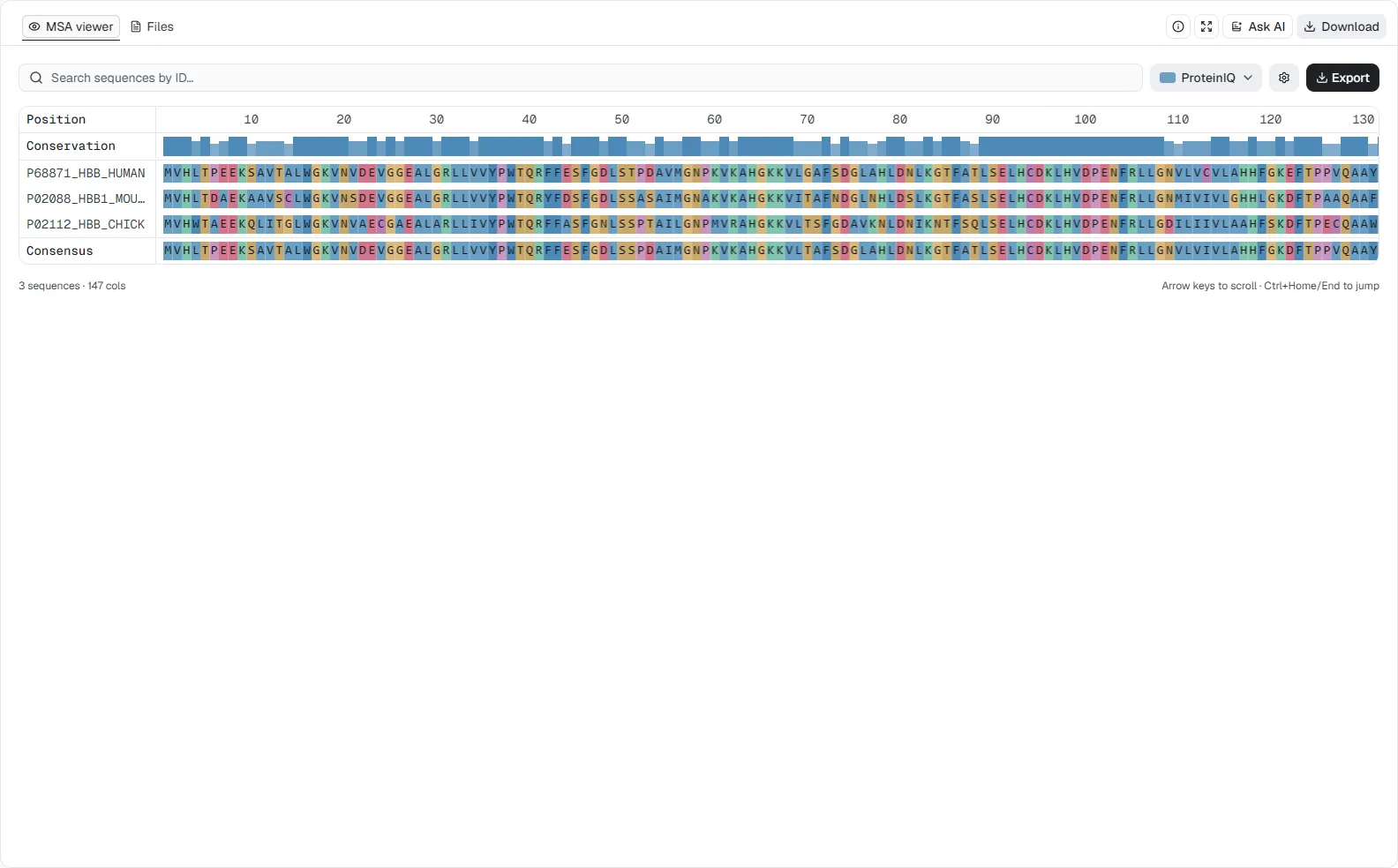
Clustal Omega online on ProteinIQ runs Clustal Omega 1.2.4 for multiple sequence alignment of protein, DNA, or RNA sequences. Three human, mouse, and chicken beta-globins came back as a 147-column alignment about 4 seconds after submission in the example job below, shown in an MSA viewer with consensus and conservation tracks and saved as FASTA, Clustal, Phylip, MSF, Stockholm, SELEX, or Vienna files.
Besides aligning a set of sequences, the server aligns two existing profiles or adds new sequences to a profile, and it can return the pair-distance matrix and the Newick guide tree behind the alignment. The sections below also cover how to prepare the input, which settings matter in practice, and how to check the finished alignment.
A Clustal Omega job costs at least 6 credits. The quote depends only on the residues in the sequence and profile inputs; headers, gaps, and line breaks do not count. The exact quote appears before submission.
| Sequences | 150 residues each | 300 residues each | 500 residues each | 1,000 residues each |
|---|---|---|---|---|
| 3 | 8 | 10 | 13 | 18 |
| 10 | 13 | 18 | 23 | 35 |
| 50 | 30 | 46 | 65 | 106 |
| 100 | 46 | 74 | 106 | 174 |
| 500 | 141 | 234 | 341 | 570 |
| 1,000 | 234 | 390 | 570 | 954 |
Each cell is a credit quote from the current calculator for one Align sequences job with ungapped FASTA input. In profile modes, the residues of both inputs are added together. The three example jobs below cost 8, 6, and 7 credits.
Distance matrices, guide trees, HMMs, HMM mappings, and pseudocount files do not change the quote. Neither do the output format, refinement iterations, the full distance matrix, or any advanced native control.
| Input mode | Inputs | Notes |
|---|---|---|
Align sequences | Sequences | At least 2 sequences; distance-matrix and guide-tree outputs need at least 3 |
Align two profiles | Profile 1, Profile 2 | A profile is an existing alignment whose columns are kept during profile alignment |
Add sequences to a profile | Sequences, Profile 1 | New sequences are aligned to the columns of the existing profile |
Sequence and profile inputs accept FASTA and A2M, Clustal, Phylip, MSF, Stockholm, SELEX, and Vienna (single-line FASTA). Text can be pasted or uploaded as a file with extensions such as .fasta, .fa, .aln, .sto, or .phy. Gzip FASTA uploads (.fasta.gz, .fa.gz, .fas.gz) are expanded automatically. Each file is limited to 50 MiB, including expanded gzip content.
The Free plan accepts up to 10 sequences in each sequence or profile input and 10,000 residues per job. Paid plans have no plan cap on sequence count or residues; the 50 MiB file limit still applies.
Ordinary FASTA descriptions and repeated identifiers are kept. The sequence input also accepts >name SEQUENCE shorthand entries and # comment lines in FASTA. Bare sequence lines without headers, FASTQ reads, and text with spaces before > are refused with a message that names the line. Use the TXT to FASTA converter or FASTQ to FASTA converter to fix such input. Profile files pass through unchanged.
| Input | Format | Description |
|---|---|---|
Distance matrix | .txt | Precomputed pairwise distances; Clustal Omega skips its own distance step |
Guide tree | .newick, .nwk | A Newick tree used instead of computing one |
HMM files | .hmm, .txt | Up to 128 HMMER-format profile HMMs that guide the alignment; filenames must be distinct |
Per-sequence HMM mapping | .txt | One sequence identifier per line followed by the uploaded HMM filenames, separated by spaces |
Pseudocounts | .txt | Native pseudocount parameters for HMM-guided alignment |
Every file named in an HMM mapping must also be uploaded under HMM files. With global HMM input, Clustal Omega applies its native behavior; adding several files does not mean every model contributes to every sequence.
The pseudocount file alternates a parameter name and its numeric value on separate lines, for example gapb followed by 0.5, then pca followed by 0.5. A name and value on one line does not follow the 1.2.4 parser's grammar.
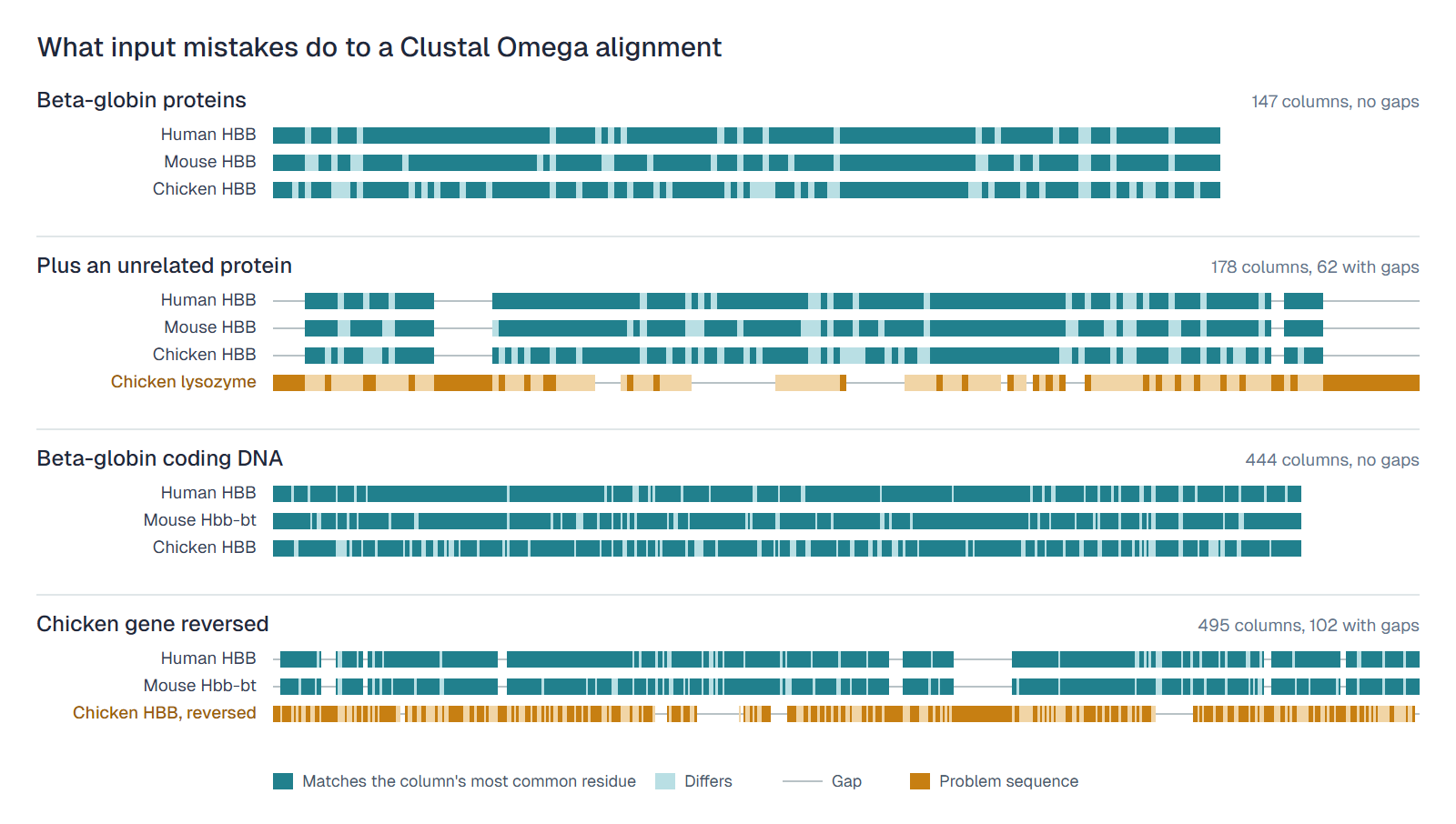
Clustal Omega aligns whatever it receives. The input check only refuses files it cannot read, such as FASTQ or text without headers, so problems with the biology have to be caught before submission.
An unrelated protein of similar length is aligned without a warning, and the gaps it forces appear in the homologous rows, as in the second panel. Nucleotide sequences are aligned exactly as submitted, so one gene in the opposite orientation breaks the alignment, as in the fourth panel. Fix orientation first with Reverse complement. A homology search with BLAST or HMMER before aligning prevents the first problem.
One job holds one sequence type, so protein and nucleotide records should not share an input. Auto-detect reads the characters, and short DNA is ambiguous because A, C, G, and T are also amino acid letters, so set Sequence type for short inputs.
Repeated identifiers are kept, so duplicate records are aligned as separate rows and each one counts toward the residue quote. Identical sequences add cost without adding information, and near-identical ones show distances close to 0 in the matrix. Remove duplicates before submitting unless every row matters to you.
Length outliers also cost quality. A fragment, or a multidomain protein among single-domain relatives, leaves long gap blocks in the other rows. Trim the set to the region all sequences share, or split it by domain. Sequences that are very divergent from the rest, below about 20% identity for proteins, may be aligned unreliably, so check them against a structure-based alignment (see Checking an alignment below).
| Parameter | Type | Default | Description |
|---|---|---|---|
Input mode | enum | Align sequences | Align sequences, Align two profiles, or Add sequences to a profile. |
Sequence type | enum | Auto-detect | Auto-detect, Protein, DNA, or RNA. Set it manually for very short or unusual sequences, where detection can be ambiguous. |
Output format | enum | FASTA | FASTA, Clustal, Phylip, MSF, Stockholm, SELEX, or Vienna (single-line FASTA). Only Clustal adds a conservation line. |
Refinement iterations | integer | 0 | Combined guide-tree and HMM iterations, 0 to 5. Each iteration rebuilds the guide tree from the previous alignment and realigns. |
Use full distance matrix | boolean | false | Compute every pairwise distance instead of the mBed approximation. Slower and more memory-hungry for large sets; not a guarantee of a better alignment. |
Output order | enum | Input order | Input order keeps your order; Tree order groups sequences by the guide tree. |
Remove existing alignment | boolean | false | Discard gaps and alignment information in the input and realign the ungapped sequences from scratch. |
Output distance matrix | boolean | false | Return the native pair-distance matrix. Turning it on also computes the full distance matrix. Needs at least 3 sequences. |
Output guide tree | boolean | false | Return the operational UPGMA guide tree in Newick format. Needs at least 3 sequences. |
| Parameter | Type | Default | Description |
|---|---|---|---|
Native input format | enum | Auto-detect | Select the native reader explicitly for sequence and profile files. The explicit Vienna reader can reject files that auto-detection accepts. |
Treat sequences as a profile | boolean | false | Treat aligned sequence input as a profile, including alignments without gaps. |
Full matrices during refinement | boolean | false | Use full pairwise distances during guide-tree iterations. |
Pileup alignment | boolean | false | Use the native pileup alignment path. |
Kimura-corrected distances | boolean | false | Apply Kimura correction to distances between aligned protein sequences. Cannot be combined with Percent identity matrix. |
Percent identity matrix | boolean | false | Write percent identities instead of distances. Cannot be combined with Kimura-corrected distances. |
Native automatic parameters | boolean | false | Let Clustal Omega choose parameters, which can override the full-matrix and iteration settings. Requested values stay in the run log. |
Show residue numbers | boolean | false | Add residue numbering where the selected output writer supports it. |
Output clustering diagnostic | boolean | false | Return the native clustering file when the selected mode produces one. |
Output posterior probabilities | boolean | false | Return native posterior output when the selected mode produces it. |
mBed cluster size | integer | 100 | Soft maximum of sequences per mBed cluster. |
Transitivity | integer | 0 | Native transitivity control. |
Maximum guide-tree iterations | integer | 2147483647 | Separate cap on guide-tree iterations. The default is the native unlimited value. |
Maximum HMM iterations | integer | 2147483647 | Separate cap on HMM iterations. A negative value skips writing the alignment in sequence modes, while tree, matrix, diagnostic, and log files can still be returned. |
Output line width | integer | 60 | Line width of the written alignment. |
The Clustal Omega 1.2.4 README describes the native file grammars and expert parameters.
The defaults are a sound starting point: Refinement iterations at 0, Input order, and FASTA output, which most downstream tools read. Use Clustal output when you want to read the alignment by eye, since only that format carries the conservation line.
Refinement is worth a comparison rather than a default. In the original benchmark, iteration sometimes made small sets slightly worse and helped most from about 1,000 sequences upward, where one or two iterations were useful (Sievers et al. 2011). Iterations do not change the credit quote, but they lengthen the run, and a job stops with a timeout error if Clustal Omega runs for more than 25 minutes.
Output order changes only the order of the rows, not the aligned columns. Turn on Remove existing alignment when an input file is already aligned and you want a fresh alignment of the bare sequences.
| Output | Contents |
|---|---|
MSA viewer | The alignment with residue color schemes, consensus and conservation tracks, sorting, gappy-column hiding, identity coloring, and PNG, JPG, or SVG export |
Guide tree | A tree view of the Newick guide tree, shown when Output guide tree is on |
Files | The alignment in the selected format, every requested auxiliary file, and a run log with the requested settings and native output |
| Distance matrix | _distmat.txt, a square matrix of pair distances or percent identities |
| Guide tree file | _guidetree.nwk, the operational UPGMA tree in Newick format |
| Diagnostics | _clustering.txt and _posterior.txt when requested and produced by the selected mode |
Requested distance-matrix and guide-tree files must be produced for the run to complete. Clustering and posterior files are marked omitted when the native mode does not write them.
Native reader and writer quirks are preserved. Some MSF files written by this version contain weights its own reader rejects, so FASTA or Stockholm is the safer choice for reuse in other programs.
Each row of the alignment is one input sequence, and each column holds residues that Clustal Omega treats as homologous. A - is a gap: that sequence has no residue at the position. The alignment length is the number of columns, so it is at least as long as the longest input.
Clustal output writes a conservation line under each block. EMBL-EBI's Clustal Omega FAQ defines the symbols:
| Symbol | Meaning |
|---|---|
* | A single, fully conserved residue in every sequence |
: | Conservation between groups of strongly similar residues, roughly Gonnet PAM 250 above 0.5 |
. | Conservation between groups of weakly similar residues, roughly a score above 0 and up to 0.5 |
| blank | No conservation detected |
In the beta-globin example, the 147-column line holds 91 *, 24 :, and 8 . columns, and 24 columns are blank. The : and . groups are defined for amino acids, so only * carries meaning in DNA and RNA alignments. The MSA viewer's conservation track works for every output format.
By default, the matrix holds uncorrected distances: 0 for identical sequences and 1 when no aligned residues are identical. Percent identity matrix writes identities instead, and Kimura-corrected distances corrects distances between aligned protein sequences.
These are the distances Clustal Omega uses to build the guide tree, not a summary of the finished alignment. For unaligned input, Clustal Omega measures them with the k-tuple method.
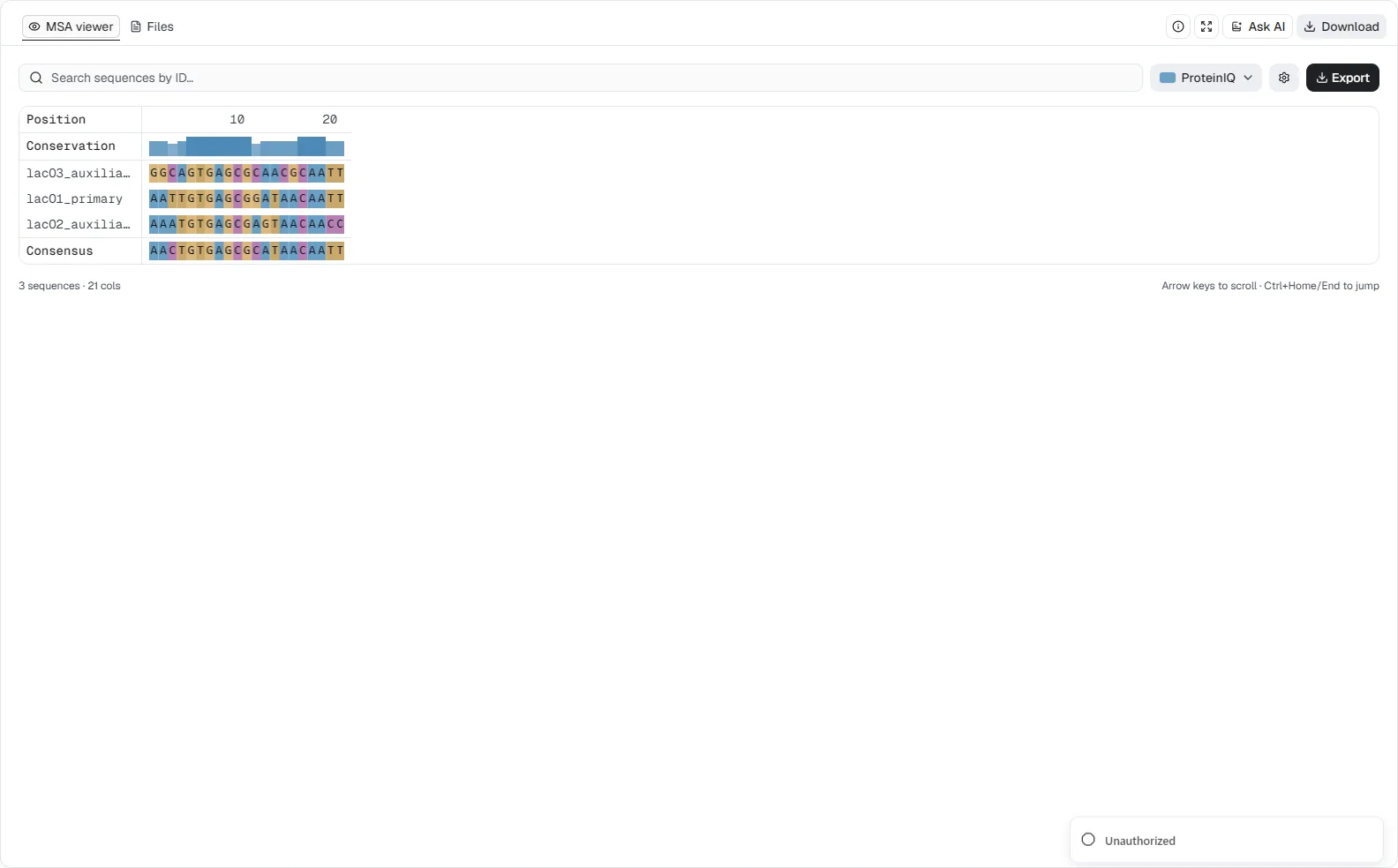
In the lac operator example, the matrix reports 0.238 for lacO1 and lacO2 and 0.524 for lacO2 and lacO3, both equal to their mismatch fractions in the final alignment. For lacO1 and lacO3 it reports 0.429, while the gapless alignment differs at 8 of 21 positions, a distance of 0.381. Calculate identity from the alignment itself when you need it for a table or figure.
Read the matrix for structure rather than exact values. Pairs near 0 are near-duplicates, and a row whose distances to every other sequence are close to 1 belongs to a sequence that is probably unrelated or badly truncated.
The guide tree is an operational UPGMA tree that sets the order in which sequences and profiles are aligned. It is not a phylogenetic inference: UPGMA assumes a constant rate of change, and the branch lengths come from the distances above. For a phylogeny, build a tree from the finished alignment with FastTree or IQ-TREE.
Tree order lists sequences in guide-tree order. In the lac operator example, the tree joins lacO1 and lacO2 first, so lacO3 is written at the top.
When reading the tree, pairs that join at short branch lengths are the most similar sequences, and a sequence that joins last on a long branch is the usual outlier. Check that sequence against the input before trusting the columns around it.
Clustal Omega aligns whatever it is given, including unrelated sequences, and it reports no per-column confidence. Long gapless blocks usually mark a conserved core. Scattered single gaps inside conserved blocks often point to misalignment, a sequencing error, or a fragment, and columns that are gaps in most rows are usually insertions in one or two sequences.
Protein sequences below about 20% pairwise identity are hard to align reliably with any progressive method; structure-based alignment helps there. One row with much lower identity than the rest is the usual sign of a sequence that does not belong. Sorting the MSA viewer by similarity to the consensus brings such a row to the top or bottom.
A good alignment has gaps in a few blocks that several related sequences share, which usually mark a real insertion or deletion. A poor one has gaps scattered along the whole length, long stretches of blank or . conservation symbols, and one or two rows that differ from everything else. Ragged ends mostly reflect different start and stop points in the input, and columns that are gaps in nearly every row add little signal, so they are the usual target for trimming before a tree is built.
Because there is no per-column confidence, validate the alignment against something independent. Known catalytic or binding residues should land in the same column across family members, and a structure-based alignment from US-align is a useful reference when sequences are below about 20% identity. Aligning the same input with MAFFT or MUSCLE5 shows where aligners agree, and the regions where they differ deserve the least trust.
Clustal Omega is a progressive aligner. It estimates how similar the sequences are, builds a guide tree from those distances, then aligns sequences and groups in tree order, closest first, until every sequence is included.
Computing all pairwise distances scales as . The mBed algorithm cuts this to by representing each sequence as a vector of distances to a small set of reference sequences, then clustering the vectors with k-means. Full distance matrices are computed only inside clusters of at most 100 sequences by default, which mBed cluster size changes.
When two groups are merged, each is converted to a profile hidden Markov model and the two HMMs are aligned with HHalign. HMM-to-HMM alignment is more sensitive for distantly related sequences than aligning simple position-specific profiles. Refinement iterations rebuild the guide tree from the current alignment and realign.
The reference Clustal Omega web server is the EMBL-EBI Job Dispatcher. ProteinIQ is not affiliated with EMBL-EBI; it runs the published Clustal Omega 1.2.4 program on its own servers.
The EBI service accepts at most 4,000 sequences or a 4 MB file, whichever is smaller, and keeps results for a week from submission, according to its FAQ.
Its documented parameters cover one set of sequences with sequence type, output format, dealignment, mBed, iterations, output order, and guide-tree and distance-matrix output. The EBI default output is Clustal with residue counts, and its distance matrix is only calculated when mBed clustering is off.
On ProteinIQ, paid plans have no sequence cap beyond the 50 MiB file limit, and every job is saved to the workspace's job history with its inputs, settings, and files.
The tool also offers profile-to-profile alignment, adding sequences to a profile, HMM, guide-tree, and distance-matrix inputs, and the advanced native controls above. Results open in the MSA viewer, and FASTA or Phylip alignments can be sent from the Files tab to tools such as FastTree, or the alignment can be used as a step in a workflow. Paid plans can submit the same jobs through the ProteinIQ API.
ProteinIQ charges credits for each job, as listed under pricing. EMBL-EBI also provides programmatic access to its service through the same REST interface.
This example aligns beta-globin sequences from human, mouse, and chicken to show how Clustal Omega presents conserved positions and lineage-specific substitutions across homologous proteins.
Sequence type = Protein, Output format = Clustal, and Refinement iterations = 1All three proteins are 147 residues long and align without gaps across 147 columns. Human and mouse beta-globin are identical at 118 positions (80.3%), human and chicken at 102 (69.4%), and mouse and chicken at 96 (65.3%). These shared columns are useful candidates for functional or structural follow-up, but the alignment alone does not establish residue function or a phylogenetic history.
This short-DNA example compares the submitted 5′→3′ lacO1, lacO2, and lacO3 operator strings. Manual DNA selection avoids ambiguity for 21-nucleotide inputs, while the additional outputs demonstrate the distance and guide-tree workflow.
Sequence type = DNA, Use full distance matrix = enabled, Output order = Tree order, Output distance matrix = enabled, and Output guide tree = enabledThe 21-column alignment puts lacO3 first because the guide tree joins lacO1 and lacO2 before adding it. The conserved core and the substitutions around it are directly inspectable. The order reflects the operational guide tree; it is not evidence of regulatory strength or evolutionary ancestry.
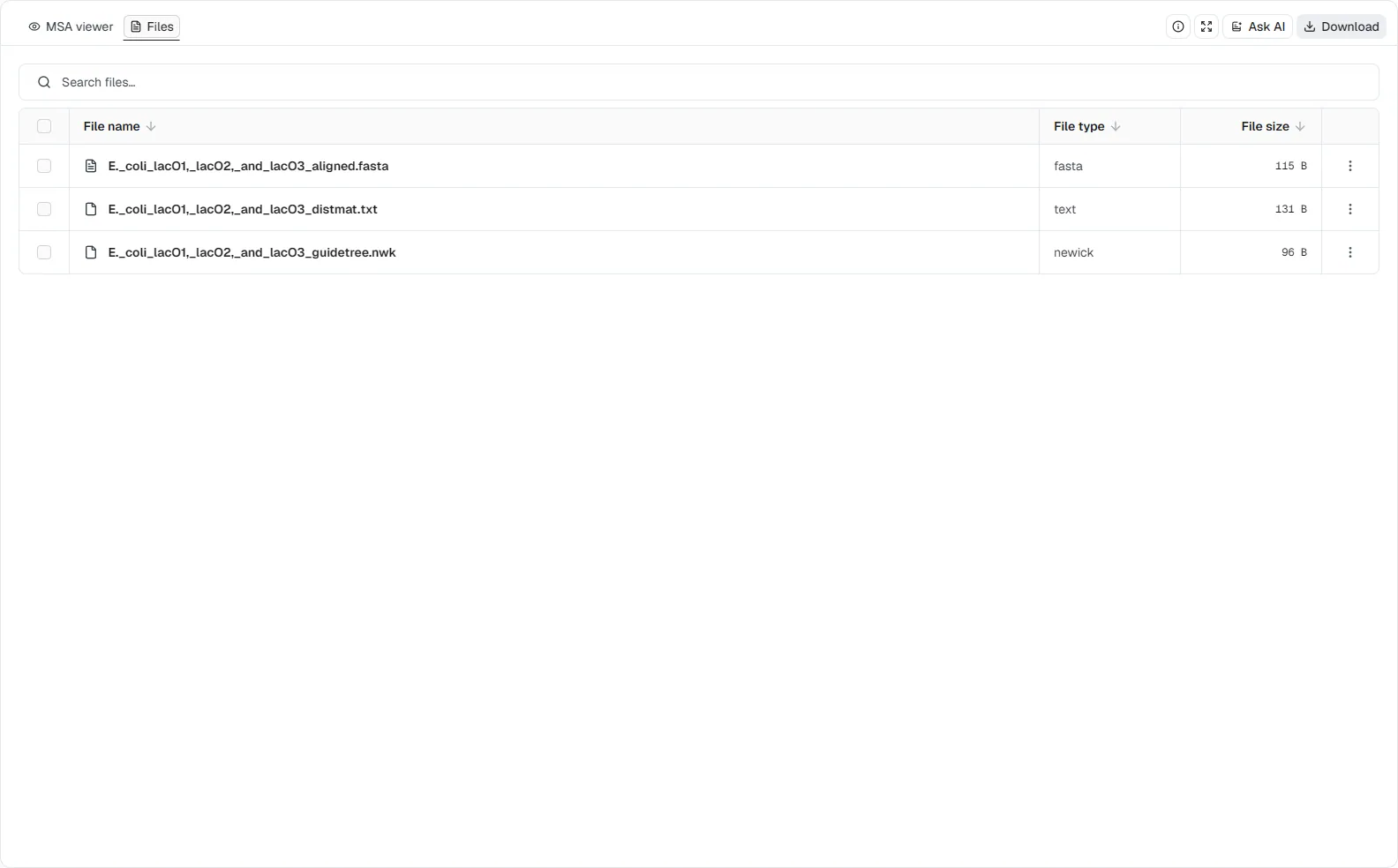
The Files tab holds the aligned FASTA, the uncorrected pair-distance matrix, and the Newick guide tree. The matrix values measure sequence difference, not binding affinity, and the 0.429 reported for lacO1 and lacO3 is the guide-tree distance rather than the 0.381 mismatch fraction of the final alignment.
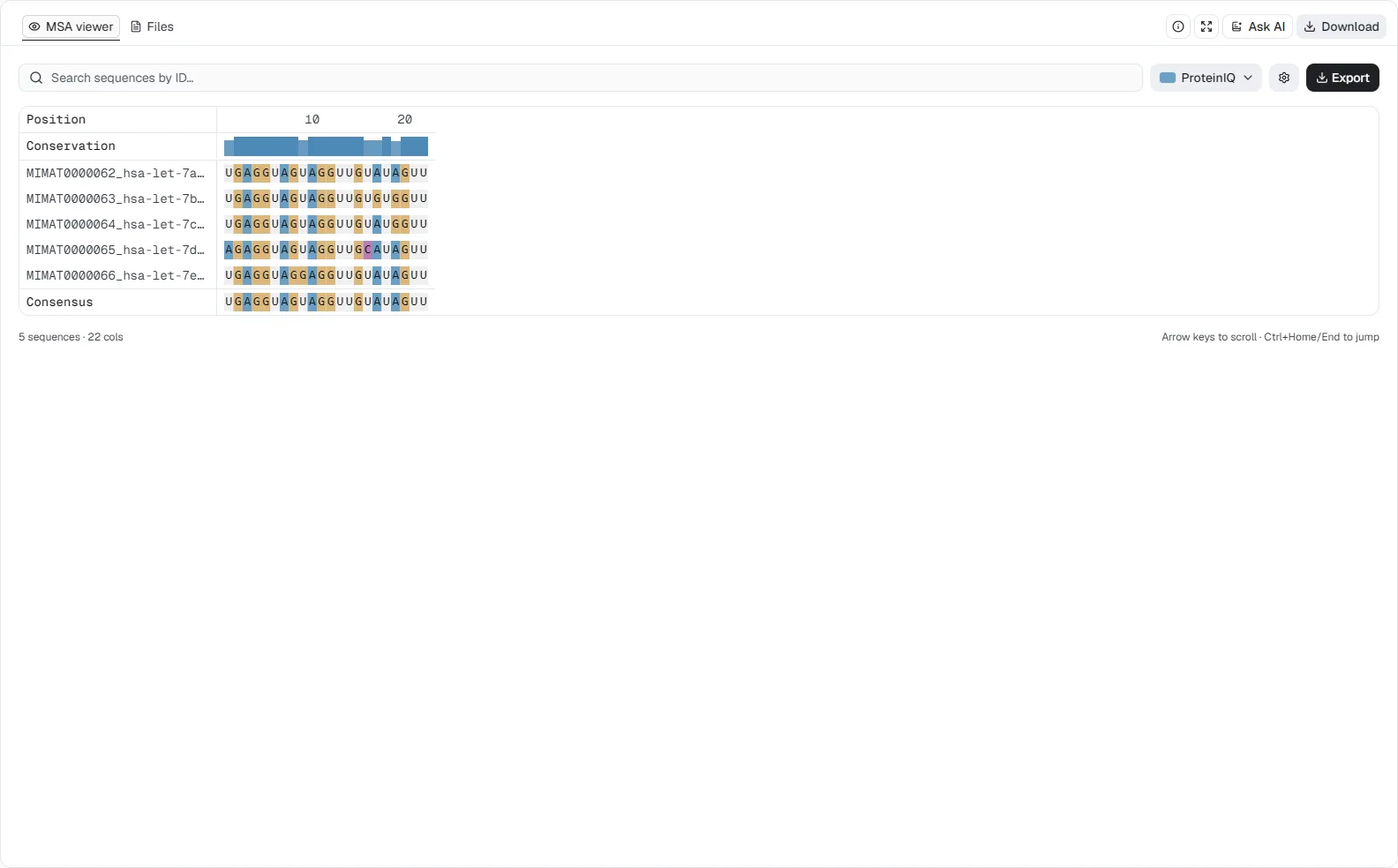
This example aligns five mature human let-7 5p sequences to demonstrate explicit RNA handling, short-sequence conservation, and Stockholm output for RNA-family workflows.
Sequence type = RNA, Output format = Stockholm, and Refinement iterations = 2All five 22-nucleotide miRNAs align without gaps. Seventeen of the 22 columns are identical across the family, including positions 2 to 8 at the 5′ end. The same Stockholm alignment can go into RNAalifold to predict a consensus secondary structure. Conservation within the submitted family does not by itself prove shared targets, expression, or biological function.
Clustal Omega assumes the sequences are homologous and alignable. It will align unrelated sequences without complaint, and the result is then meaningless, so a homology search with HMMER before aligning is a useful check.
For two sequences, EMBL-EBI recommends a pairwise aligner, since multiple aligners are designed for three or more. MAFFT and MUSCLE5 are the usual alternatives for sets where Clustal Omega's alignment looks doubtful. Aligned sequences feed phylogenetic analysis, conservation studies, homology modeling, and the choice of conserved regions for primers designed with Primer3.

Build phylogenetic trees from aligned protein or nucleotide sequences using approximate maximum-likelihood methods.

Build maximum likelihood phylogenetic trees with automatic model selection and ultrafast bootstrap.

Align protein or nucleotide sequences with selectable accuracy and speed trade-offs.

Align multiple protein or nucleotide sequences with high-accuracy PPP refinement.

Hardware-accelerated edit distances and global or local sequence scores

Universal structure alignment for proteins, RNA, and DNA molecules

Search and cluster protein or nucleotide sequences for homology discovery at large scale.

Align and compare whole genomes to detect SNPs, indels, and structural variants.

Predict consensus RNA secondary structures from sequence alignments.

Transcript-level RNA-seq quantification with Salmon selective alignment