How long does a western blot take?
A same-day western blot takes about five hours of timed steps after the lysate is ready. An overnight primary-antibody incubation usually spreads the workflow across two days.
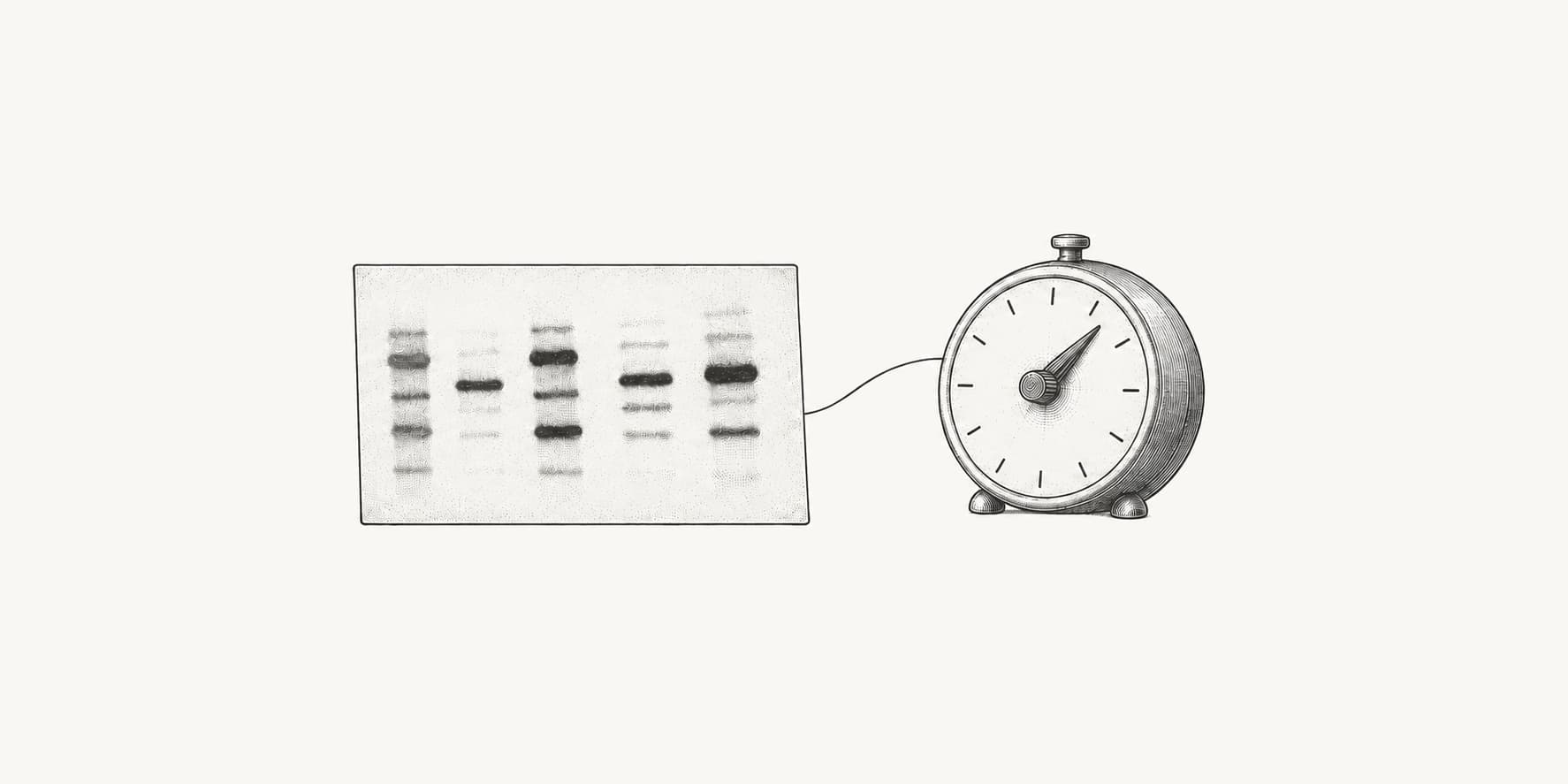
A western blot can be completed in one working day. In a compatible same-day workflow, the explicitly timed steps add up to about five hours after the lysate is ready.
Many laboratories instead incubate the membrane with primary antibody overnight at 4°C. That usually turns the experiment into a two-day workflow, even though most of the overnight period is unattended.
Here, “western blot test” means the research-laboratory workflow from a prepared protein sample to an image, not the turnaround time for a clinical result.
How long does a western blot take?
A same-day western blot takes about five hours of timed steps after lysate preparation, while a protocol with an overnight primary-antibody incubation usually spans two calendar days.
The five-hour estimate combines sample heating and centrifugation, a 20- to 26-minute Criterion TGX gel run, 20 minutes of transfer-stack equilibration, a one-hour tank transfer, five minutes of blocking, one-hour primary and secondary incubations, the specified washes, and five minutes in chemiluminescent substrate.[1][2]
Those timed steps total 295 to 301 minutes. Loading the gel, assembling the transfer stack, preparing solutions, and acquiring the final image are not assigned durations in the protocol, so the real bench schedule will be longer.
The chart uses the upper end of the reported gel-run range and groups consecutive steps from the same Bio-Rad workflow. It is a calculated schedule, not a universal protocol. Different gels, transfer systems, antibodies, targets, and detection methods change the total.[1][2]
Can you do a western blot in one day?
Yes. A western blot fits into one day when the samples and buffers are ready, the antibody works with a one-hour room-temperature incubation, and the transfer does not run overnight.
Bio-Rad's same-day protocol uses a one-hour primary incubation at room temperature. Its more general protocol recommends an overnight primary incubation at 4°C but allows one to three hours at room temperature, depending on antibody performance.[1][3]
A one-hour incubation needs validation for the antibody and sample. Antibody specificity and selectivity depend on the assay context, and published guidance recommends reporting the blocking reagent, antibody concentrations, incubation times, and controls used.[6]
How long does western blot transfer take?
Western blot transfer commonly takes 30 minutes to two hours in a tank, while rapid instrument workflows can transfer a gel in about 10 minutes.
Bio-Rad's general protocol gives a 30-minute to two-hour range at 100 V and also describes low-current overnight transfer.[3] In a direct comparison, the same company tested a 10-minute rapid transfer, a 60-minute tank transfer, and a 15-hour-40-minute overnight tank transfer.[4]
Transfer time depends on protein size and the transfer system. The molecular weight of the target helps determine the gel and transfer conditions, but the protocol still needs an empirical transfer check.
How long should blocking and primary antibody incubation take?
Blocking usually takes about one hour with conventional milk or BSA buffers, and primary-antibody incubation is commonly one hour at room temperature or overnight at 4°C.
The five-minute blocking step in the chart uses Bio-Rad's proprietary rapid blocking buffer. Bio-Rad's general protocol instead uses one hour of blocking with 3% BSA, while Abcam's general workflow uses one hour at room temperature for fluorescent blots and offers one hour or overnight for chemiluminescent blots.[1][3][5]
Primary incubation needs more optimization than the clock alone suggests. Abcam gives one hour at room temperature or overnight at 4°C and states that incubation time may need optimization.[5] A low-abundance target or a weak antibody may need the overnight condition; a validated antibody against an abundant target may work within the same-day schedule.