Three predictors, three crystal fragments: modeling a heat-stable anti-Salmonella enzyme
Gdansk researchers compared Boltz-2, Chai-1 and AlphaFold3 models of a four-module enzyme built to kill Salmonella in milk.

Matic Broz, PhD2 min
- Authors
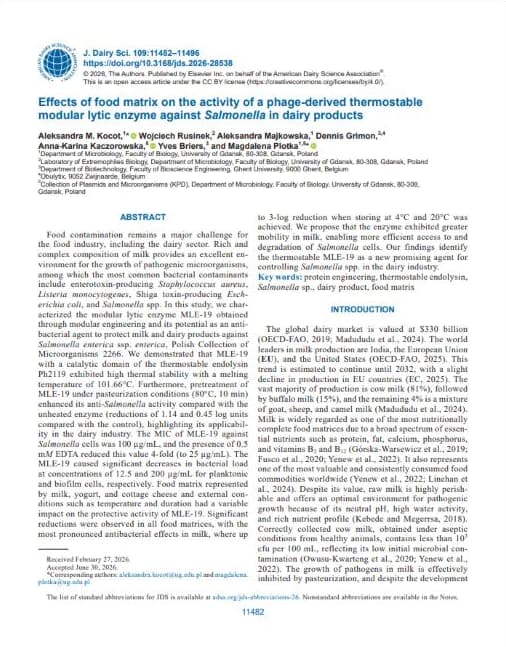
- Aleksandra M. Kocot, Wojciech Rusinek, Aleksandra Majkowska, Dennis Grimon, et al.
- Published in
- Journal of Dairy Science · 2026-11 · University of Gdansk
- ProteinIQ in this study
- The paper links ProteinIQ's Boltz-2 page as the source of one of three structure predictors, and Chai-1 produced the final model.
- Tools used
- Boltz 2
Nobody has solved a structure for a four-module chimera, so the Gdansk team could not check their prediction against the real thing. They ran three predictors instead and let known fragments decide which model to trust.
The enzyme, MLE-19, is built from four parts. A cecropin A peptide sits at the front, followed by a flexible linker, a cell wall binding domain from a Pseudomonas phage endolysin and the catalytic domain of Ph2119, a heat-stable endolysin from a Thermus phage. A His tag allows purification. Milk is a good growth medium for Salmonella, and an enzyme that survives pasteurization could add a second line of defense.
Three predictors, three reference fragments
Aleksandra Kocot, Magdalena Plotka and colleagues at the University of Gdansk and Ghent University predicted a model from the fragment sequences, using a simplified version of the protocol from their earlier work on a related enzyme, MLE-15. They compared the AlphaFold3 server, the Chai-1 server and Boltz-2.
The Methods section gives the ProteinIQ Boltz-2 page as the address for Boltz-2 and says it ran with default parameters through a command-line interface. The paper does not describe a ProteinIQ job, so ProteinIQ appears here as the cited source and not as the place where the prediction was run.
Each model was superimposed in ChimeraX 1.10 on three crystal structures: cecropin A from Aedes aegypti (PDB 2MMM), the binding domain of the phiKZ endolysin (3BKV) and the Ph2119 catalytic module (6SU5). The team scored how well each prediction reproduced the secondary structure of residues 2 to 37, 56 to 137 and 143 to 296.
Chai-1, run with its MSA and template options, matched best and supplied the model shown in the paper. Boltz-2 and AlphaFold3 served as cross-checks, a sensible way to choose among structure prediction models when the whole chimera has no reference.
Heat, EDTA and milk
The wet-lab results carry the paper. Differential scanning fluorimetry gave a melting temperature of 57.78 °C for the binding domain alone and 103.56 °C for Ph2119. The fused MLE-19 melted at 101.66 °C, so attaching a mesophilic domain cost almost no heat stability.
Heating at 80 °C for 10 minutes, a pasteurization condition, improved the enzyme: the heated protein cut Salmonella counts by 1.14 log units against 0.45 unheated. The minimum inhibitory concentration was 100 µg/mL, and 0.5 mM EDTA lowered it fourfold to 25 µg/mL.
The food mattered. Milk gave the largest reductions, up to 3 log units at 4 °C and 20 °C, and cottage cheese the smallest. The authors suggest the enzyme moves more freely through liquid milk than through solid curd.