Coa6-CoQ10 binding site modeled with Protenix
Researchers used Protenix to model how CoQ10 binds Coa6 in a mouse study of mitochondrial memory impairment.
- Authors
- Jingjing Tie, Shujiao Li, Xin Huang, Keke Ren, et al.
- Published in
- Translational Neurodegeneration · 2026-04 · The Fourth Military Medical University
- ProteinIQ in this study
- Protenix was run via ProteinIQ to model the Coa6-CoQ10 binding site.
- Tools used
- Protenix
The research
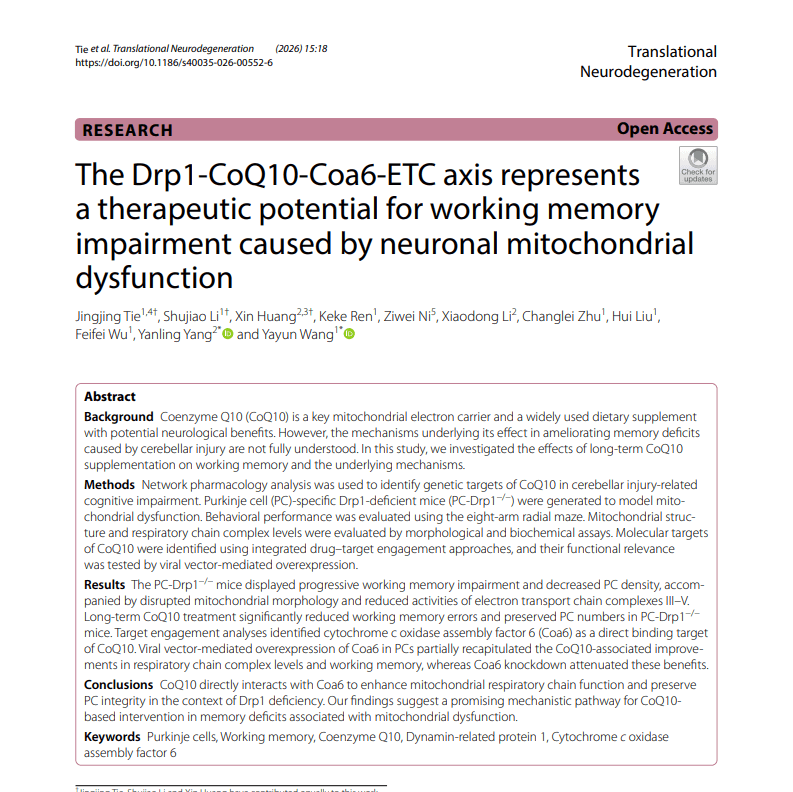
Coenzyme Q10 is a mitochondrial electron carrier sold widely as a dietary supplement, but its mechanistic role in cerebellar injury-related memory deficits has remained unclear. Jingjing Tie, Shujiao Li, Xin Huang, Keke Ren, and colleagues studied whether long-term CoQ10 supplementation could protect working memory when neuronal mitochondrial function is damaged.
The team generated Purkinje cell-specific Drp1-deficient mice to model mitochondrial dysfunction in the cerebellum. Drp1 controls mitochondrial fission, and its loss in Purkinje cells gave the researchers a way to connect mitochondrial structure, respiratory chain activity, cerebellar cell health, and behavior in the same system.
Their study asked a mechanistic question rather than a supplement-screening question. If CoQ10 improved memory behavior, the authors wanted to know which mitochondrial protein it engaged and how that interaction might affect the electron transport chain.
ProteinIQ in action
The computational problem came after the authors used network pharmacology, thermal proteome profiling, and biochemical assays to narrow the search for CoQ10-associated mitochondrial proteins. Target fishing pointed to cytochrome c oxidase assembly factor 6, Coa6, a mitochondrial protein involved in respiratory chain function. The next question was structural: could CoQ10 plausibly fit into a Coa6 binding pocket, and which residues might explain the interaction seen in binding assays?
They used Protenix through the ProteinIQ web server to predict the Coa6-CoQ10 complex under default parameters. Protenix is an open AlphaFold 3-style structure prediction model for biomolecular complexes, including protein-ligand systems. In this case, the output was a predicted three-dimensional complex that the team inspected in Maestro and ChimeraX.
The paper states the method directly:
The structure of the Coa6-CoQ10 complex was predicted utilizing the ProtENIX web (https://proteiniq.io/app/protenix) server under default parameters and subsequently visualized through the academic edition of Maestro.
The predicted model placed CoQ10 inside a protein-binding pocket of Coa6 with strong hydrophobic complementarity. The authors reported a hydrogen bond between a methoxy group of CoQ10 and lysine 18 of Coa6, along with hydrophobic contacts involving W59, V45, P35, V36, W94, Y97, F98, Y104, and F107.
Those predicted contacts did not stand alone. The team paired the model with CETSA, DARTS, and surface plasmon resonance experiments. CETSA showed increased Coa6 retention as CoQ10 concentration rose, DARTS showed dose-dependent protection from proteolysis, and SPR measured direct binding with a dissociation constant of 2.40 x 10^-5 M.
Key findings
Drp1 loss produced a progressive mitochondrial and behavioral phenotype in Purkinje cells. The authors reported a 78% decrease in Drp1 protein level, a 50% reduction in Purkinje cell density at 1 and 2 months, and an approximately 80% reduction at 3 months. Dendritic complexity fell by 70% at 1 and 2 months and by 90% at 3 months, while reactive oxygen species increased 1.5-fold at 1 and 2 months and 3-fold at 3 months.
The working memory phenotype appeared at 3 months, when PC-Drp1-deficient mice showed increased errors in the eight-arm radial maze. Long-term CoQ10 treatment, given as 500 uM in drinking water from postnatal day 15 to day 90, reduced working memory errors and preserved Purkinje cell numbers. It also improved sequential search behavior and reduced activated microglia by 60%.
Mechanistically, the study connects CoQ10, Coa6, and the electron transport chain. Drp1-deficient mice showed reduced complex III-UQCRC2 and complex V-ATP5A, while CoQ10 restored mitochondrial membrane stability and OXPHOS function across complexes III, IV, and V. Coa6 overexpression produced fewer working memory errors, higher mitochondrial membrane potential and ATP, increased levels of complexes I-V, and lower oxidative stress. Coa6 knockdown weakened the benefits of CoQ10, supporting the model that CoQ10 acts through a Coa6-linked pathway in cerebellar mitochondrial dysfunction.