Anticancer plant peptides profiled with ProteinIQ
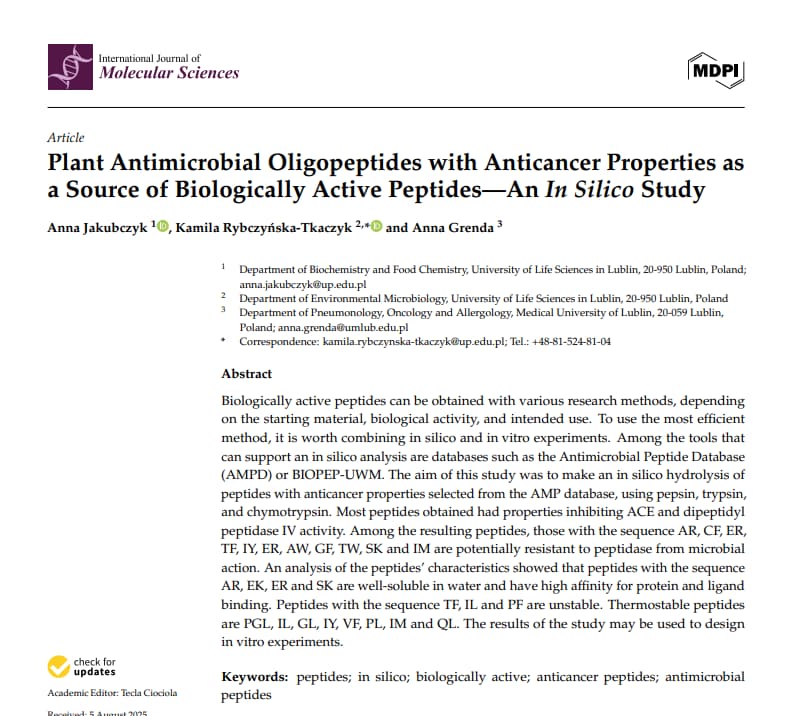
Researchers in Poland used ProteinIQ to compute physicochemical properties of bioactive peptides derived from in silico hydrolysis of anticancer plant antimicrobial peptides.
- Authors
- Jakubczyk A., Rybczyńska-Tkaczyk K., Grenda A.
- Published in
- International Journal of Molecular Sciences · 2025-09 · University of Life Sciences in Lublin
- ProteinIQ in this study
- Physicochemical properties of the bioactive peptides were calculated with ProteinIQ.
- Tools used
- Protein Parameters
The research
Plant antimicrobial peptides (AMPs) are a growing area of interest in cancer research. A class of these peptides found in plant defense systems has shown the ability to bind to cancer cell membranes and cause lysis, making them candidates for new anticancer compounds with lower toxicity than conventional chemotherapy.
Researchers at the University of Life Sciences and the Medical University of Lublin set out to identify biologically active fragments that could be released when these peptides are digested. Their starting material was 57 plant AMPs with confirmed anticancer properties drawn from the Antimicrobial Peptide Database. The team simulated gastrointestinal hydrolysis in silico using pepsin, trypsin, and chymotrypsin via the BIOPEP-UWM database, then asked which of the resulting di- and tripeptides were likely to survive digestion, enter the bloodstream, and reach their targets.
Answering that question required characterizing the physicochemical properties of each resulting peptide fragment. Stability, solubility, charge, and hydrophobicity all determine whether a small peptide can be absorbed intact and interact meaningfully with cells.
ProteinIQ in action
After in silico hydrolysis, the team had a set of short peptide sequences and needed to describe their physical behavior. Four properties were central to the analysis: theoretical isoelectric point (pI), instability index, aliphatic index, and the grand average of hydropathicity (GRAVY). Together, these metrics predict whether a peptide is stable in solution, how it interacts with water, and whether it is likely to associate with lipid membranes - the primary mode of action for anticancer AMPs.
The researchers used ProteinIQ's Protein parameters tool to compute all four values. As they describe in their methods section:
"The Protein IQ tool (https://proteiniq.io/tools#protein-tools) was used to estimate theoretical isoelectric point (TpI), instability index, aliphatic index and grand average of hydropathicity index (GRAVY)."
With protein analysis results in hand, the team could sort each peptide by its behavior profile. Peptides with a positive GRAVY index were classified as hydrophobic and likely components of membrane proteins. Those with a negative GRAVY were hydrophilic and soluble, making them better candidates for systemic delivery. Instability index values above 40 flagged peptides that would likely degrade quickly in vitro, narrowing the shortlist for further study. The aliphatic index informed thermostability.
Key findings
The hydrolysis yielded a shortlist of peptides with distinct property profiles. Peptides with the sequences AR, EK, ER, PK, SK, and QH had a Boman index above 2.48 kcal/mol, indicating high potential for binding to protein receptors or cell membranes. The same peptides were water-soluble and hydrophilic (negative GRAVY), making them the most promising for drug or supplement formulation.
Eight peptides - PGL, IL, GL, IY, VF, PL, IM, and QL - showed thermostability based on high aliphatic index values. These peptides contain hydrophobic amino acids and could find applications in food preservation, pharmaceutical manufacturing, and other contexts where stability under varying temperature or pH is needed. Only TF, IL, and PF were flagged as unstable by the instability index.
On the functional side, most hydrolysis products showed potential for inhibiting angiotensin-converting enzyme (ACE) and dipeptidyl peptidase IV (DPP-IV), pointing to applications in blood pressure and metabolic disorder management beyond the original anticancer focus. The researchers note these results as a starting point for targeted in vitro experiments - a validation of the in silico approach before committing laboratory resources to synthesis and enzymatic testing.