Tuberculosis multi-epitope vaccine modeled with AlphaFold 2
A Xinjiang team modeled a designed tuberculosis vaccine protein with AlphaFold2 before testing it in mice as recombinant BCG.

Matic Broz, PhD2 min
- Authors
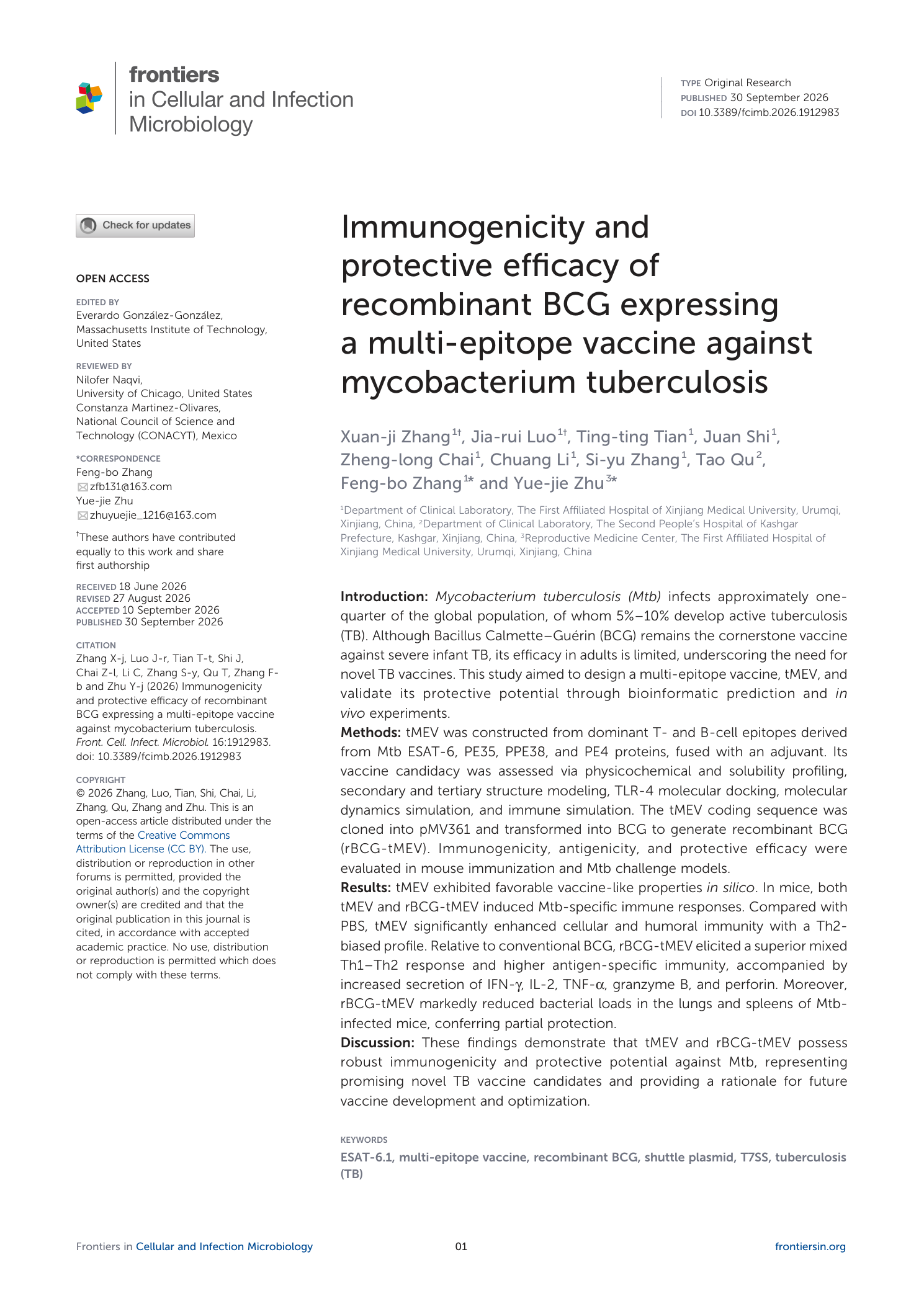
- Xuan-ji Zhang, Jia-rui Luo, Ting-ting Tian, Juan Shi, et al.
- Published in
- Frontiers in Cellular and Infection Microbiology · 2026-09 · The First Affiliated Hospital of Xinjiang Medical University
- ProteinIQ in this study
- The tertiary structure of the tMEV multi-epitope vaccine construct was predicted with AlphaFold2 through ProteinIQ's AlphaFold 2 tool.
- Tools used
- Alphafold 2
The research
About a quarter of the world's population carries Mycobacterium tuberculosis, and 5 to 10% of carriers go on to develop active disease. The only licensed vaccine, BCG, protects infants well but gives limited protection to adults. Xuan-ji Zhang, Jia-rui Luo, Feng-bo Zhang, Yue-jie Zhu and colleagues set out to build a better candidate.
Their construct, tMEV, stitches together T-cell and B-cell epitopes from four secreted proteins: ESAT-6, PE35, PPE38 and PE4. A human beta-defensin-3 adjuvant and a PADRE helper sequence sit at the N-terminus, and a His-tag at the C-terminus allows purification. The team then cloned the gene into the pMV361 shuttle plasmid and expressed it in BCG to make rBCG-tMEV.
ProteinIQ in action
A chain of epitopes joined by short linkers has no crystal structure to check. Before committing to synthesis and animal work, the authors needed a three-dimensional model to judge whether the epitopes would sit on the surface, whether the linkers left the fold intact, and whether the construct could be docked to its innate immune target, TLR-4.
They predicted the tertiary structure with AlphaFold 2 on ProteinIQ. The methods section says so directly:
This study employs AlphaFold21 to predict and model the tertiary structure of tMEV.
The raw prediction then went through GalaxyWEB refinement and validation with SAVES v6.0 (ERRAT, Verify3D and PROCHECK). After four refinement rounds and two local site reconstructions, the model reached a MolProbity score of 1.134, a clashscore of 3.4 and no poor rotamers. The Ramachandran plot put 98.4% of residues in the most favored region and 1.6% in the allowed region, and ProSA-web gave a Z-score of -7.42.
The same structure fed the rest of the in silico pipeline. The authors docked tMEV to TLR-4 with HDOCK, ran three 100 ns GROMACS replicates of the complex, and used C-ImmSim to simulate the immune response to three doses. The refined model kept 48.91% helical content against 50.86% from the sequence-based secondary structure prediction, a useful consistency check between two independent methods.
Key findings
In mice, both tMEV and rBCG-tMEV raised antigen-specific cellular and humoral responses. Protein tMEV with adjuvant pushed a Th2-biased profile, while rBCG-tMEV produced a mixed Th1/Th2 response that was stronger than conventional BCG, with more IFN-γ, IL-2, TNF-α, granzyme B and perforin.
After aerosol challenge with virulent H37Rv at 100 CFU, BCG and rBCG-tMEV both cut bacterial counts in lungs and spleens relative to PBS (P < 0.05). rBCG-tMEV gave the lowest load of the groups, though the authors describe the protection as partial. Unadjuvanted standalone tMEV protected poorly, which is why the team moved to delivery inside BCG.
The study is a pre-clinical, mouse-only result, and the structure work is predictive rather than experimental. What it shows is a practical route for a small clinical laboratory: design the antigen from public epitope tools, model and validate its fold computationally, then spend bench time only on the construct that passes.
Footnotes
-
AlphaFold 2: https://proteiniq.io/app/alphafold-2 ↩