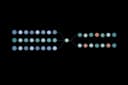
Family-conditioned protein sequence generation from FASTA, A2M, or A3M input
Family-conditioned protein sequence generation from FASTA, A2M, or A3M input
ProFam-1 is a protein family language model for designing new amino acid sequences from a set of related proteins. It uses family context instead of a single sequence or a backbone structure, so it is best suited to tasks where homologs already exist and the design goal is to stay close to an evolutionary neighborhood while sampling new candidates.
The model was introduced for family-conditioned sequence generation and family-aware fitness prediction. In ProteinIQ, ProFam is available for sequence generation: a FASTA, A2M, or A3M family prompt produces generated candidates with model likelihood scores and downloadable FASTA files.
| Pros | Cons |
|---|---|
| Uses family context, which helps preserve conserved motifs and family-specific residue patterns. | Depends heavily on prompt quality. Mixed families, fragments, or noisy alignments reduce generation quality. |
| Does not require a protein structure, making it useful when homologous sequences exist but no reliable backbone is available. | Does not enforce a fixed backbone, active site geometry, oligomeric state, or binding interface. |
| Produces batches of candidates with likelihood scores that can help rank sequences from the same run. | log_likelihood is a model score, not an experimental fitness, stability, expression, or activity measurement. |
| Returns generated FASTA files and the prompt FASTA used by ProFam, which makes downstream screening and record keeping easier. | A2M/A3M family alignments can guide the context, but generated outputs are ungapped sequences and do not preserve alignment columns. |
Run ProFam online by pasting or uploading a protein family FASTA, A2M, or A3M file. ProteinIQ submits the family prompt to ProFam-1 and returns generated protein sequences in a spreadsheet, with per-sequence likelihood scores, sequence lengths, the generated FASTA file, and the prompt FASTA used by the model.
| Input | Description |
|---|---|
Protein family sequences (FASTA/A2M/A3M) | One family prompt containing one or more related protein sequences. FASTA, A2M, A3M, and plain sequence text are accepted. CLUSTAL and other block-alignment formats should be converted to FASTA first. Headers are preserved when present. |
Job name | Optional label for organizing runs in ProteinIQ job history. |
Good prompts contain homologs from the same protein family. Mixed families, unrelated paralogs, or alignments with many fragmentary sequences can push generation toward inconsistent motifs.
| Setting | Description |
|---|---|
Number of sequences | Number of candidates to generate (1-200, standard setting 10). Larger batches explore more sequence space and take longer to run. |
Sampling temperature | Optional diversity control (0.1-2.0). Blank uses the standard ProFam-1 sampling behavior. Lower values are more conservative; higher values increase novelty and the chance of unusual sequences. |
Nucleus sampling (top-p) | Cumulative probability mass used for nucleus sampling (0.5-1.0, standard setting 0.95). Lower values restrict sampling to fewer high-probability residues. |
Maximum sequence length | Optional hard cap on generated length in residues (32-2048). Blank lets ProFam derive the cap from the prompt sequence lengths. |
For routine family expansion, the standard settings are a good starting point. Lowering top_p or Sampling temperature makes candidates more family-like. Raising them is useful when the priority is sequence diversity, but generated sequences should then be filtered more carefully.
ProteinIQ returns one row per generated sequence.
| Column | Description |
|---|---|
sequence_id | FASTA-style identifier emitted by the generation run. It includes the sample index and model score when available. |
generated_sequence | Generated amino acid sequence, without alignment gaps. |
length | Sequence length in residues. |
log_likelihood | Mean per-token log-probability parsed from the generated FASTA header. Higher values, meaning less negative values, indicate sequences that were more typical under the model during sampling. |
The output also includes downloadable FASTA files:
| File | Description |
|---|---|
| Generated FASTA | All generated sequences with ProFam FASTA headers. |
| Prompt FASTA | The family context that ProFam actually used after preprocessing and prompt-length handling. |
log_likelihood is a model score, not an experimental fitness measurement. It is useful for ranking candidates from the same run because all rows share the same family prompt and sampling settings. Scores are less reliable when comparing sequences generated from different families, different prompts, or very different length distributions.
High-scoring candidates are usually more typical of the supplied family. Low-scoring candidates can still be interesting if the goal is diversity, but they should be screened for conserved motif loss, unusual composition, truncation, or downstream structure and function constraints.
ProFam treats a protein family as the conditioning context for an autoregressive protein language model. The prompt is built from related sequences, then the model samples residues one at a time until it reaches an end token or a length cap.
A family prompt carries signals that a single sequence cannot show: conserved active-site residues, variable loops, tolerated substitutions, and family-specific composition patterns. ProFam learns from that context and generates sequences that fit the same distribution.
FASTA-formatted aligned inputs are accepted because many families are stored as A2M or A3M. Before inference, gaps and alignment-specific characters are converted into the sequence representation expected by the model. Generated outputs are ordinary ungapped amino acid sequences.
Two settings change the diversity of generated candidates:
Sampling temperature: Scales the next-residue distribution before sampling. Lower values concentrate probability on the most likely residues.Nucleus sampling (top-p): Limits sampling to the smallest residue set whose cumulative probability reaches the selected value.These controls should be changed together with the design goal in mind. Conservative library design usually benefits from lower diversity. Exploratory campaigns can tolerate higher diversity, especially when followed by structure prediction, motif checks, or functional screening.
ProFam is most useful when a protein family is already available and the goal is to expand or explore that family. It is not the right first choice for every protein design problem.
| Design goal | Better fit |
|---|---|
| Generate family-consistent variants from homologs | ProFam |
| Design sequences for a known backbone structure | ProteinMPNN |
| Generate proteins from a short sequence prompt without family context | ProGen2 |
| Explore diffusion-based protein sequence generation | EvoDiff |
| Design binders or structure-constrained proteins | RFdiffusion or BindCraft |
ProFam pairs well with downstream structure prediction. Generated sequences can be sent to ESMFold for fast structure checks or AlphaFold 2 when higher-accuracy MSA-assisted prediction is needed.

All-atom SE(3)-equivariant diffusion for unconditional generation, motif scaffolding, and binder design.

Generate de novo protein sequences from plain-text prompts with sampling controls.

Design all-atom protein binders with controlled target sites, lengths, and interaction parameters.

Target sequence-conditioned peptide binder design using masked language modeling

Generate protein binder candidates with Proteina-Complexa binder design settings.

Design antibody CDRs with Proteo-R1 reasoning, diffusion, and optional framework inpainting.

Generate protein sequences de novo, scaffold fixed motifs, or inpaint selected regions.

Design protein, peptide, and nanobody binders against protein or small-molecule targets.

Peptide binder design through binding interface mimicry with a latent diffusion model

Generate novel drug-like molecules in protein binding pockets using AI-powered structure-based design.