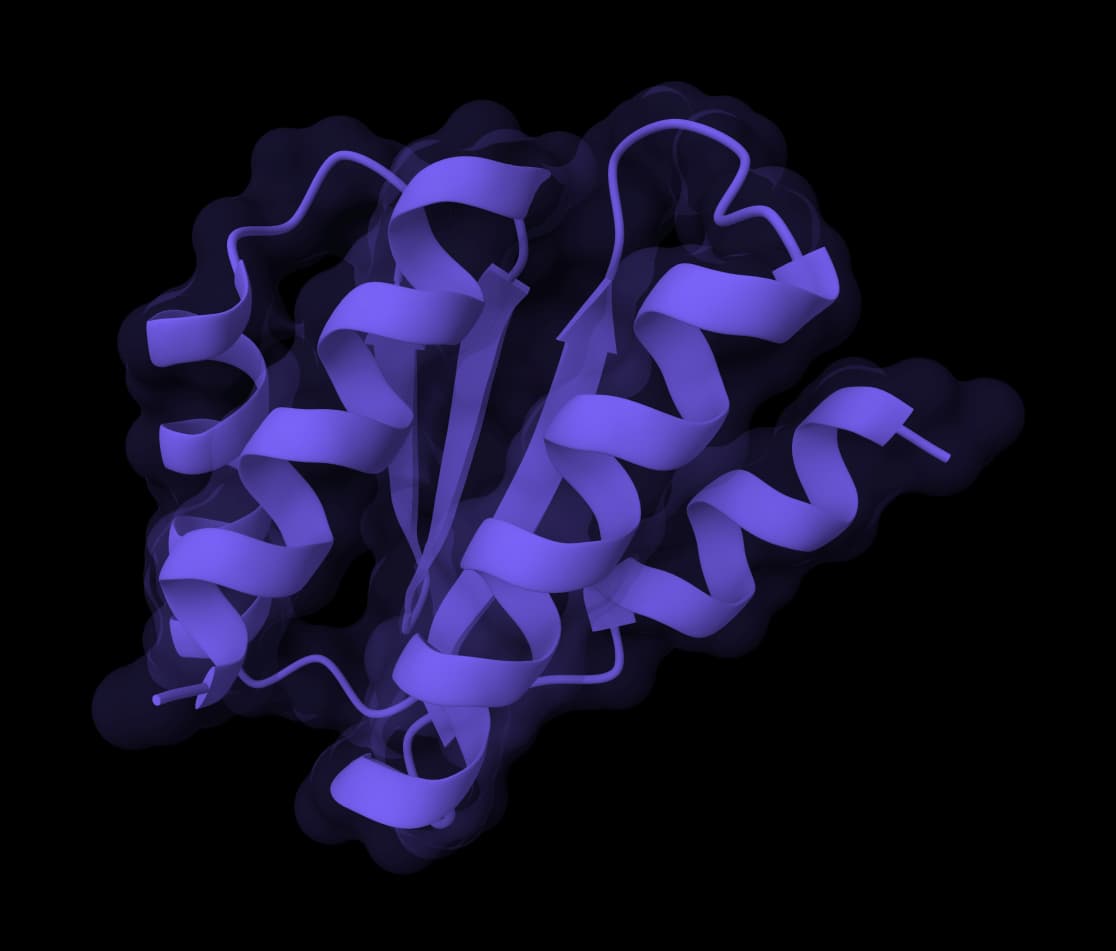
Generate protein sequences de novo, scaffold fixed motifs, or inpaint selected regions.
Input
What is EvoDiff?
EvoDiff is a diffusion-based protein sequence generation framework from Microsoft Research that generates novel protein sequences directly in sequence space. Unlike structure-based methods like RFdiffusion that design 3D backbone coordinates first, EvoDiff works entirely with amino acid sequences—no structural intermediate required.
ProteinIQ currently runs the EvoDiff-Seq OA_DM_38M model. In this tool you can:
- generate protein sequences unconditionally,
- scaffold a fixed motif extracted from a PDB chain, and
- inpaint user-specified regions of an input sequence.
This tool does not currently support EvoDiff-MSA generation, family-conditioned MSA modes, or the OmegaFold/TMscore post-processing pipeline used in the native scaffold benchmark scripts.
Published as a preprint in September 2023 and open-sourced by Microsoft, EvoDiff represents a fundamentally different approach to protein design. While AlphaFold and RFdiffusion revolutionized structure prediction and structure-based design, EvoDiff demonstrates that "sequence is all you need" for generating novel, structurally plausible proteins.
How does EvoDiff work?
Diffusion in sequence space
Traditional diffusion models like DALL-E work by adding noise to images, then learning to reverse the process. EvoDiff adapts this concept for discrete amino acid sequences through two distinct corruption schemes:
Order-Agnostic Autoregressive Diffusion (OADM): At each forward step, one amino acid is replaced with a special mask token. After steps (where is sequence length), the entire sequence is masked. The reverse process learns to unmask residues in any order—not left-to-right like traditional language models—allowing the model to consider global sequence context when generating each position.
Discrete Denoising Diffusion (D3PM): The forward process corrupts sequences by sampling mutations according to a transition matrix. Two variants exist:
- D3PM-Uniform: Random mutations with equal probability across amino acids
- D3PM-BLOSUM: Biologically-informed mutations based on the BLOSUM substitution matrix, respecting evolutionary substitution patterns
After steps, the corrupted sequence becomes indistinguishable from random amino acids. The model learns to reverse this corruption, recovering structured sequences from noise.
Architecture and training
EvoDiff uses a dilated convolutional neural network architecture adapted from the CARP protein masked language model. This architecture efficiently captures long-range dependencies in protein sequences while maintaining computational tractability. The model processes sequences as discrete tokens (20 standard amino acids plus special tokens).
Training used 42 million sequences from UniRef50, a clustered subset of UniProt representing diverse protein families across all domains of life. Two model sizes are available:
- 38M parameters: Faster inference, suitable for rapid prototyping
- 640M parameters: Higher quality generations, recommended for production use
The ProteinIQ implementation uses the 38M-parameter OADM model (EvoDiff-Seq), which benchmarks showed outperforms D3PM variants for unconditional generation.
Current tool scope
The original repository also ships EvoDiff-MSA models, D3PM sequence models, CARP baselines, and LRAR baselines. Those modes are useful, but they are not yet available in the ProteinIQ tool. The current app is intentionally narrower: one EvoDiff-Seq model, one unconditional mode, one scaffold mode, and one custom user-sequence inpainting mode.
Key advantage: Structure-agnostic design
Structure-based design methods require high-quality structural templates—they cannot design intrinsically disordered proteins, linker regions, or proteins lacking structural homologs. EvoDiff's sequence-first approach:
- Generates proteins without any structural input
- Handles intrinsically disordered regions (IDRs) that comprise ~30% of eukaryotic proteins
- Designs linkers and flexible regions connecting structured domains
- Explores sequence space unconstrained by structural templates
Design modes
Unconditional generation
Generates novel protein sequences from scratch without any template. You specify the desired length (1-512 residues) and number of samples. The model samples from learned sequence distributions, producing diverse sequences with natural amino acid composition and secondary structure propensities. The 512-residue maximum is a ProteinIQ compute cap, not a limit imposed by the EvoDiff source function.
When to use: Exploring novel sequence space, generating diverse protein libraries, discovering new folds, or creating synthetic proteins for experimental screening.
Example: Generate 10 sequences of 100 residues each to create a diverse starting library for directed evolution experiments.
Motif scaffolding
Builds a complete protein sequence around a structural motif from an input PDB file. You specify which residues comprise the functional motif and how many additional scaffold residues EvoDiff should generate outside that fixed motif. The tool follows the native EvoDiff scaffold semantics:
motif_start_idxandmotif_end_idxare 0-indexed and inclusive,- the indices are interpreted against the sequential amino-acid sequence extracted from the selected PDB chain, and
scaffold_min/scaffold_maxcount only the generated residues outside the motif, and must request at least one generated residue.
ProteinIQ stages the submitted PDB in the directory layout expected by EvoDiff and calls the package's native evodiff.conditional_generation.generate_scaffold function. Motif extraction, placement, and sampling therefore follow EvoDiff 1.1.2 rather than a separate local implementation.
When to use: Transplanting binding sites, epitopes, or catalytic residues into new sequence contexts. Useful when you have a functional motif and want to explore alternative scaffolds that might improve stability, expression, or other properties.
Input requirements: PDB file containing the motif structure. Specify the motif range using EvoDiff-compatible 0-indexed inclusive positions and a scaffold length range measured in added residues, not total sequence length.
Sequence inpainting
Fills in one contiguous region of an existing protein sequence while preserving the rest. You provide exactly one plain protein sequence or FASTA record and indicate one residue or inclusive range to regenerate, such as "10-25". ProteinIQ removes the FASTA header and line wrapping, validates the residue alphabet, and calls EvoDiff 1.1.2's native evodiff.conditional_generation.inpaint_simple function.
This is a ProteinIQ adaptation of the native inpainting routine. The --cond-task idr CLI is benchmark-oriented and operates on a built-in IDR dataset rather than arbitrary user-supplied sequences.
When to use: Redesigning disordered regions, optimizing problematic loop sequences, replacing aggregation-prone segments, or introducing variation while maintaining framework regions.
Example: For antibody engineering, mask CDR regions while preserving framework residues to generate diverse binding variants.
Input parameters
Core settings
Design mode: Selects the generation task. Unconditional Generation creates sequences from scratch. Motif Scaffolding requires a PDB structure. Sequence Inpainting requires an input sequence.
Number of sequences: How many independent sequences to generate (1-50). More sequences provide better coverage of sequence space. Start with 10 for initial exploration, increase to 30-50 for comprehensive sampling.
Sequence length: Target length in residues for unconditional generation (1-512). Longer sequences increase computational time but enable designing larger proteins. The 512-residue maximum is a ProteinIQ compute cap.
Scaffolding settings
Motif start/end index: Defines the functional motif region in the extracted chain sequence using native EvoDiff semantics: 0-indexed and inclusive. The motif sequence is preserved exactly; surrounding residues are generated.
Minimum/maximum additional scaffold residues: Number of generated residues outside the fixed motif, from 1 to the configured maximum. Final sequence length equals motif length plus the sampled scaffold length.
Inpainting settings
Positions to regenerate: Exactly one residue or contiguous range to mask and regenerate. Format: "10-25" regenerates positions 10 through 25 while preserving all other positions. Use 1-indexed positions matching the normalized input sequence.
Understanding the results
EvoDiff outputs FASTA-formatted protein sequences. The Details tab shows one metadata row per generated sequence, including lengths and mode-specific motif or inpainting fields. The Files tab includes the FASTA plus downloadable JSON and CSV metadata. Unlike structure prediction tools, no confidence scores are directly provided—the model generates plausible sequences but cannot guarantee they will fold or function.
Current limitations and backlog
The current tool intentionally leaves several native capabilities for a later pass:
- EvoDiff-MSA generation and conditioning modes
- optional EvoDiff-Seq model selection beyond
OA_DM_38M - multi-motif scaffold specification in the UI
- OmegaFold/TMscore scaffold evaluation from the native benchmark scripts
Those omissions do not change the scientific behavior of the modes already available; they are simply not surfaced yet.
Evaluating generated sequences
Sequence properties: Check amino acid composition, isoelectric point, and instability index using ProteinIQ analysis tools. Generated sequences should show natural-like properties unless specifically designed otherwise.
Structure prediction: Validate designs with ESMFold, AlphaFold 2, or Chai-1. High pLDDT scores (>70) suggest the sequence encodes a well-defined structure. Low pLDDT may indicate disordered regions or problematic sequences.
Sequence identity: Compare generated sequences to natural proteins using BLAST or MMseqs2. Novel sequences typically show less than 30% identity to known proteins—higher identity suggests the model recovered existing sequences rather than generating novel ones.
Quality indicators
Generated sequences should exhibit:
- Natural amino acid frequencies (no extreme biases)
- Appropriate hydrophobic/hydrophilic balance
- Secondary structure elements when folded (validate with structure prediction)
- Low sequence identity to training data (demonstrating novelty)
Use cases
De novo protein design
Generate entirely novel proteins without evolutionary or structural templates. EvoDiff samples from learned sequence distributions to create proteins with natural-like properties. Combine with structure prediction (ESMFold, AlphaFold 2) to identify well-folded candidates, then use ProteinMPNN for sequence optimization if needed.
Workflow: EvoDiff (sequence generation) → ESMFold (structure prediction) → Filter by pLDDT → ProteinMPNN (sequence refinement) → Experimental validation
Designing around disordered regions
Structure-based methods like RFdiffusion cannot design intrinsically disordered proteins or linker regions. EvoDiff's sequence-first approach handles these naturally. Use inpainting mode to redesign disordered loops while preserving structured domains.
Functional motif transplantation
Scaffold mode enables transplanting binding sites, catalytic residues, or epitopes into new sequence contexts. This can improve protein properties (stability, expression, solubility) while maintaining function, or explore how different scaffolds affect motif conformation.
Sequence library generation
Generate diverse protein libraries for experimental screening. Unlike random mutagenesis, EvoDiff produces sequences that respect evolutionary constraints—mutations are more likely to produce folded, functional proteins.
EvoDiff vs other design methods
| Method | Input | Output | Best for |
|---|---|---|---|
| EvoDiff | None/sequence/PDB | Sequences | Novel sequences, IDRs, linkers |
| RFdiffusion | None/PDB | Structures | Binders, scaffolds, oligomers |
| ProteinMPNN | PDB structure | Sequences | Inverse folding, redesign |
| ESM-IF1 | PDB structure | Sequences | Fast inverse folding |
| ProGen2 | Context token | Sequences | Broad protein language-model generation |
| ProFam | Family context | Sequences | Protein-family-conditioned generation |
Use EvoDiff when: You need novel sequences without structural constraints, want to design disordered regions, or lack a suitable structural template.
Use RFdiffusion when: You need precise structural control, are designing binders, or require symmetric oligomers.
Use ProteinMPNN when: You have a target structure and need optimized sequences to fold into it.
Limitations
Computational constraints
ProteinIQ caps unconditional generation at 512 residues for hosted compute. Longer proteins require splitting into domains or using alternative methods. Generation time scales with sequence length and number of samples.
No structure guarantees
EvoDiff generates sequences without explicit structural constraints. Generated sequences are statistically plausible but not guaranteed to fold or adopt specific conformations. Always validate with structure prediction before experimental work.
Training data bias
The model reflects biases in UniRef50—underrepresented protein families may generate lower-quality sequences. Designed sequences may show composition biases toward well-represented families.
No ligand or cofactor awareness
Unlike structure-based methods, EvoDiff cannot explicitly design around ligands, metals, or cofactors. For binding site design, use RFdiffusion scaffolding or LigandMPNN.
FAQ
How is EvoDiff different from RFdiffusion?
RFdiffusion operates in structure space, generating 3D backbone coordinates that are then sequenced with ProteinMPNN. EvoDiff works directly in sequence space—it generates amino acid sequences without any structural intermediate. This makes EvoDiff uniquely capable of designing intrinsically disordered proteins, linkers, and other sequences without defined structures.
Can EvoDiff design protein binders?
Not directly. EvoDiff generates sequences without considering binding interfaces. For binder design, use RFdiffusion in binder mode or BindCraft. You could use EvoDiff to generate diverse scaffolds, then optimize for binding with structure-aware methods.
What validation should I do before experiments?
- Predict structure with ESMFold or AlphaFold 2
- Check pLDDT scores (>70 suggests well-folded)
- Analyze sequence properties (molecular weight, pI, instability index)
- Search for similar sequences to assess novelty
- Consider molecular dynamics for stability assessment
How many sequences should I generate?
Start with 10 for initial exploration. For comprehensive sampling or experimental screening, generate 30-50 sequences. More sequences increase diversity but require more computational time and downstream filtering.
Is EvoDiff free to use?
Yes, EvoDiff is open-source from Microsoft Research. On ProteinIQ, each job costs a flat 150 credits.
Can I use EvoDiff for commercial applications?
EvoDiff is released under the MIT license, permitting commercial use. Check the GitHub repository for current licensing terms.
References
Alamdari, S., Thakur, N., van den Berg, R., Lu, A.X., Fusi, N., Amini, A.P., & Yang, K.K. (2023). Protein generation with evolutionary diffusion: sequence is all you need. bioRxiv. 10.1101/2023.09.11.556673
Related tools
Genie 3
All-atom SE(3)-equivariant diffusion for unconditional generation, motif scaffolding, and binder design.
ODesign
Design all-atom protein binders with controlled target sites, lengths, and interaction parameters.
PocketFlow
Generate novel drug-like molecules in protein binding pockets using AI-powered structure-based design.
PocketXMol
Generate docking poses, drug-like molecules, and peptides inside protein binding pockets with PocketXMol.
ProGen2
Generate de novo protein sequences from plain-text prompts with sampling controls.
Proteo-R1
Design antibody CDRs with Proteo-R1 reasoning, diffusion, and optional framework inpainting.
RFdiffusion
Design protein structures for de novo scaffolds, binders, motifs, and symmetric oligomers.
RFdiffusion 2
Scaffold enzyme active sites with atom-level control and ligand-aware protein design.
BoltzGen
Design protein, peptide, and nanobody binders against protein or small-molecule targets.
PepMimic
Peptide binder design through binding interface mimicry with a latent diffusion model