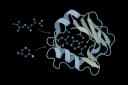
PocketXMol
Generate docking poses, drug-like molecules, and peptides inside protein binding pockets with PocketXMol.
Generate docking poses, drug-like molecules, and peptides inside protein binding pockets with PocketXMol.
PocketXMol is a generative foundation model for molecular tasks governed by atomic interactions inside protein pockets. A single learned model supports small-molecule docking, small-molecule design, peptide docking, and linear or cyclic peptide design. ProteinIQ includes dedicated workflows for all four tasks.
Unlike a conventional docking score, PocketXMol's cfd_traj value is model self-confidence. Generated structures remain computational hypotheses. Chemistry, steric plausibility, affinity, selectivity, and synthetic accessibility require separate evaluation.
Run PocketXMol online by supplying a protein PDB structure, selecting docking or a design mode, and defining the binding pocket from a positioned reference structure or manual coordinates. ProteinIQ samples up to 250 structures and returns generated SDF or PDB files, generation metadata, self-confidence scores, optional denoising trajectories, logs, and an interactive structure viewer.
| Mode | Required molecular input | Result |
|---|---|---|
Dock | Protein plus one small molecule or peptide | Alternative poses using the original docking defaults. Use the dedicated peptide mode for PocketXMol's peptide-specific defaults. |
Peptide docking | Protein plus a peptide sequence or PDB; a positioned reference is required for automatic pocket definition from a sequence | Alternative poses of the submitted peptide using PocketXMol's peptide radius and trajectory defaults. |
Small molecule design | Protein plus a positioned pocket reference when using automatic pocket definition | Newly generated small molecules sampled inside the pocket. |
Peptide design | Protein plus a positioned pocket reference when using automatic pocket definition | Newly generated linear or cyclic peptides of the selected length. |
Small-molecule docking accepts SMILES, SDF, or MOL. Peptide docking accepts a peptide PDB or text beginning with pepseq_. A positioned peptide PDB can define its own automatic pocket; a pepseq_ input needs a positioned SDF, MOL, or PDB pocket reference, or manual pocket coordinates. One ligand entity should be submitted, without salts or counterions.
Pocket definition is the most important setup choice.
| Setting | Description |
|---|---|
Denoising center: Auto | Uses the center of a positioned docking ligand or reference structure. The ligand coordinates must already be in the same coordinate frame as the protein. |
Denoising center: Manual coordinates | Uses explicit X, Y, and Z coordinates for pocket extraction and generation. This is required for docking from SMILES because SMILES has no positioned 3D coordinates. |
Pocket radius | Selects nearby protein residues. Small-molecule docking and design default to 15 Å; peptide docking and design default to 20 Å. |
Pocket distance criterion | Center of mass includes residues according to their centers of mass. Closest atom includes a residue when any atom meets the radius cutoff. |
An automatically centered SDF, MOL, or PDB reference must occupy the intended binding site. A reference structure in unrelated coordinates will define an empty or incorrect pocket. Manual coordinates are preferable when the binding-site center is known independently.
| Setting | Mode | Description |
|---|---|---|
Docking noise | Both docking modes | Gaussian noise uses the standard free docking setup. Flexible noise perturbs translation, rotation, and torsions. |
SBDD sampling strategy | Small molecule design | Refine preserves the existing autoregressive workflow. Simple uses PocketXMol's direct SBDD task and noise configuration. |
Generated atom mean | Small molecule design | Mean atom count for the sampled size distribution, default 28. |
Generated atom std | Small molecule design | Standard deviation of the atom-count distribution, default 2. |
Minimum generated atoms | Small molecule design | Lower bound on sampled molecule size, default 5. |
Peptide length | Peptide design | Number of residues, from 3 to 30, default 10. |
Cyclic peptide | Peptide design | Generates cyclic rather than linear peptides. |
The small-molecule atom count is sampled approximately from a normal distribution using the selected mean and standard deviation, then clamped to the configured minimum. These controls shape size, not drug-likeness or affinity.
| Setting | Description |
|---|---|
Number of molecules | Total structures to sample, from 1 to 250. The standard PocketXMol examples use 100. |
Batch size override | 0 keeps the model configuration. Lower values reduce peak GPU memory use without changing the requested total. |
Trajectory save probability | Fraction of denoising trajectories retained. Defaults to 0.05 for small-molecule docking and 0.02 for peptide docking and design. |
Random seed | Seed for stochastic sampling, default 2024. Matching inputs, settings, and seed reach the same effective PocketXMol random seed. Hardware-level variation can still occur. |
PocketXMol shows a fixed credit quote before submission. The quote accounts for the selected mode, number of structures, batch size, molecular and receptor size, pocket radius, and saved trajectories. Refine molecule design costs more than simple design because it can repeat the denoising process. Smaller batches can take longer to generate the same total number of structures.
The Data tab is parsed from PocketXMol's gen_info.csv; column availability can differ by task. The Viewer overlays generated structures with the submitted protein. The Files tab keeps the model's complete result directory, including primary structures and any saved trajectory snapshots.
| Output | Meaning |
|---|---|
Generated .sdf or .pdb | Final structure for a sampled small molecule or peptide. |
gen_info.csv fields | Generation metadata, status tags, filenames, and confidence values returned by PocketXMol. |
cfd_traj | PocketXMol self-confidence score. Higher values are used for ranking within a run. |
| Trajectory files | Intermediate denoising snapshots retained according to the save probability. |
| Input and configuration files | Protein, ligand or reference, and task configuration retained for provenance. |
PocketXMol represents proteins, small molecules, and peptides at the atomic level and learns their interactions within a pocket. Generation proceeds as a denoising process conditioned on the pocket and task definition. The same interaction-centered model can therefore move an existing ligand into a pose, construct a new molecular graph and coordinates, or generate peptide backbone and side-chain structure.
This shared representation is the key distinction from pipelines that use separate models for each molecular type. It also means the task and conditioning data must be explicit: the model cannot infer the intended pocket from a protein alone when several cavities are plausible.
cfd_traj is useful for ordering PocketXMol samples from the same setup, but it is not an affinity in kcal/mol and does not establish biological activity. Comparisons across different proteins, modes, pocket definitions, or sampling configurations should not assume that the score has identical calibration.
A practical triage sequence is:
PocketXMol does not model full receptor flexibility, assay conditions, synthetic feasibility, or binding free energy. A generated peptide may also require special review for cyclization chemistry and nonstandard residue handling. For docking a known small molecule with an interpretable energy-like score, AutoDock Vina is the more conventional choice; PocketXMol is most useful when one model must sample diverse poses or create new small molecules and peptides inside the same pocket framework.

Generate novel drug-like molecules in protein binding pockets using AI-powered structure-based design.

Design protein, peptide, and nanobody binders against protein or small-molecule targets.

Peptide binder design through binding interface mimicry with a latent diffusion model

Generate novel drug-like molecules using NVIDIA's discrete diffusion AI model.

Target sequence-conditioned peptide binder design using masked language modeling

Generate protein sequences de novo, scaffold fixed motifs, or inpaint selected regions.

All-atom SE(3)-equivariant diffusion for unconditional generation, motif scaffolding, and binder design.

Design all-atom protein binders with controlled target sites, lengths, and interaction parameters.

Design antibody CDRs with Proteo-R1 reasoning, diffusion, and optional framework inpainting.

Design protein structures for de novo scaffolds, binders, motifs, and symmetric oligomers.