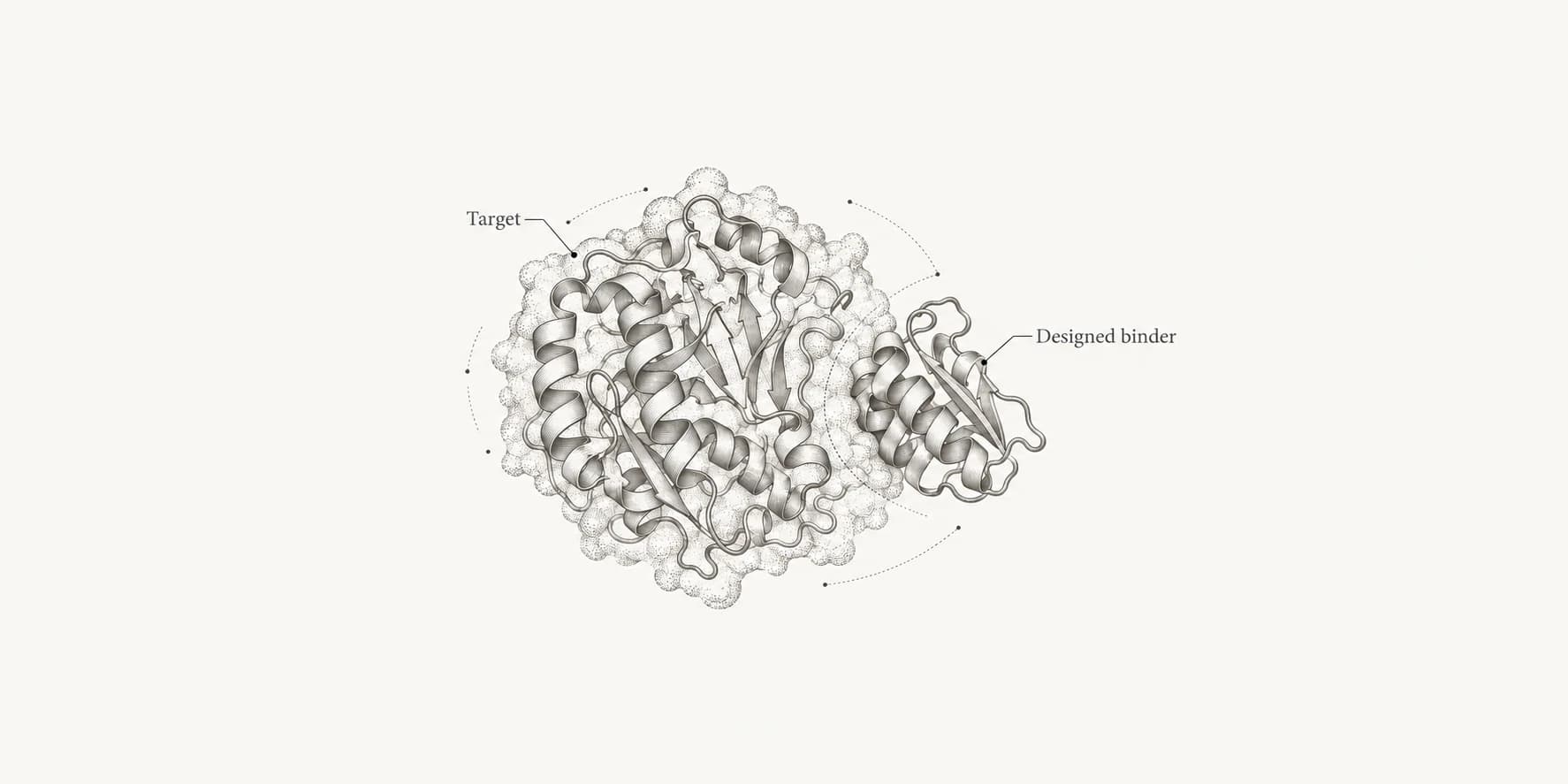
BindCraft is a structure-guided protein binder design pipeline: it proposes new sequences and structures intended to bind a selected protein target. The published method combines AlphaFold2-guided design, ProteinMPNN, and Rosetta-based assessment. ProteinIQ runs an experimental Rosetta-free variant, so published experimental performance should not be assumed for this hosted protocol.[1]
To use BindCraft online, upload a target structure, choose its chains and optional binding-site residues, set a binder length range, and submit a design search. FreeBindCraft is a separate alternative covered throughout this guide. Both run on hosted GPUs, with downloadable structures, sequences in design tables, scores, and diagnostic files.
Open BindCraft online
Open the ProteinIQ BindCraft webserver. For the alternative relaxation and repacking method, use FreeBindCraft.
Add the target and select the binding site
Upload a PDB or ENT structure, or fetch one from RCSB. Select the target chains and optionally specify hotspot residues to focus the search.
Configure the design search
For an initial miniprotein run, keep the Default protocol, a binder length range of 40 to 80 residues, and one requested accepted design.
Review the quote and submit
Check the target, settings, and credit quote. Both tools reserve 5,400 compute credits by default and meter runtime at 45 credits per minute. A search can finish with no accepted designs.
Inspect and download the results
Examine the binder-target structures, confidence scores, and filter decisions, then download the structures and data files. Accepted designs still need experimental binding and specificity tests.
Rosetta licensing and the ProteinIQ protocol
ProteinIQ BindCraft does not include Rosetta/PyRosetta due to licensing. If a project requires Rosetta relaxation, energies, or filtering, contact sales to discuss licensing and requirements. PyRosetta has separate academic and commercial licensing terms.[2]
The hosted BindCraft protocol substitutes restrained OpenMM minimization for Rosetta relaxation. It reports geometry from FreeSASA and sc-rs, but does not calculate Rosetta binding energies, PackStat, or Rosetta hydrogen-bond metrics. The acceptance policy therefore differs from the published pipeline.
FreeBindCraft also runs without PyRosetta on ProteinIQ. Its alternative relaxation includes staged OpenMM calculations and FASPR side-chain repacking, and it supports ranking by interface predicted structural alignment error, or ipSAE.[3] It is an alternative scientific protocol, not a way to enable Rosetta in the standard webserver.
| Choice | Relaxation and packing | Ranking | What acceptance means |
|---|---|---|---|
| BindCraft on ProteinIQ | Restrained OpenMM minimization; no side-chain repacking | Interface predicted TM score, i_pTM | Passes the experimental Rosetta-free confidence and geometry filters |
| FreeBindCraft on ProteinIQ | Staged OpenMM relaxation with FASPR repacking | i_pTM, or optional ipSAE | Passes the selected FreeBindCraft filters; Rosetta-only placeholder fields are not measurements |
| Published Rosetta-inclusive BindCraft | Includes PyRosetta relaxation and assessment | See the published protocol | Uses a different set of scientific checks; discuss Rosetta requirements with sales |
How does BindCraft work?
Design a binder against the target
AlphaFold2 is used as part of an optimization loop. Candidate sequence choices change to improve predicted confidence and target-binder contacts. A trajectory is one such search, not one guaranteed accepted design. The four-stage schedule moves from continuous sequence preferences to discrete amino acids and mutation-based refinement.[4]
ProteinIQ starts with the default design protocol, a length range of 40 to 80 residues, and one requested accepted design. The peptide and beta-sheet protocols change the design settings. Their names do not override the explicit length controls: check both length fields when switching modes.
Redesign sequences and predict them again
ProteinMPNN samples sequences conditioned on a protein backbone. Its sampling temperature controls sequence diversity, and fixed positions can preserve selected residues.[5] In ProteinIQ BindCraft, the default is 20 sequence samples per passing trajectory and at most two passing redesigns saved from each trajectory.
The redesigned complexes and isolated binders are predicted again. This asks whether the new sequence supports the intended complex and binder fold. It is a computational consistency check; the same model family participates in design and evaluation, so this is not independent experimental confirmation.[1]
Minimize, measure, and filter
ProteinIQ BindCraft prepares predicted structures with PDBFixer and minimizes them in OpenMM while restraining the original heavy atoms. This procedure adds missing atoms and hydrogens but performs neither molecular dynamics nor side-chain repacking. When interface residues are fixed during sequence redesign, the minimized trajectory helps determine which residues remain fixed. Relaxation choices can consequently affect sequence generation as well as final measurements.
FreeBindCraft uses a different relaxation and repacking procedure. A shared metric name does not guarantee a shared definition: for example, ProteinIQ BindCraft reports matched heavy-atom binder root-mean-square deviation (RMSD), while FreeBindCraft uses C-alpha atoms. Compare the recorded methods before pooling scores across tools.
How to use BindCraft online
1. Choose a target structure and relevant chains
Open the BindCraft webserver. Upload one .pdb or .ent file, up to 50 MB, or fetch a PDB-format structure from RCSB. A sequence alone is not the target input for this workflow. FreeBindCraft accepts the same input formats.
Set Target chains to the chains that define the intended binding context. For a multi-chain target, use comma-separated IDs such as A,B. Inspect the structure and residue numbering before selecting a site. As a practical preparation check, consider whether omitted domains, partner chains, glycans, or a membrane would obstruct the proposed binder in the biological system.
The BindCraft authors recommend reducing unnecessarily large targets to lower memory use and speed sampling.[4] Keep enough structural context to evaluate whether the intended site is accessible; an artificial cut surface is a poor basis for a biological binding claim.
2. Set hotspots when the binding site matters
Hotspot residues (optional) can identify a residue, a range, or a whole chain. Examples include A56, A50-60, and A. Unchained numbers refer to the first selected target chain. Leave the field empty when the search should select a site.
For a specified epitope, start with a small accessible patch rather than interpreting a hotspot as a guarantee of one exact interaction. After the run, check that the binder actually occupies the intended site. The same hotspot syntax applies to FreeBindCraft.
3. Start with a small, interpretable search
For an initial miniprotein setup check, keep Design protocol at Default, the 40 to 80 residue range, and Number of designs at 1. These are ProteinIQ defaults, not a validated optimum for every target.
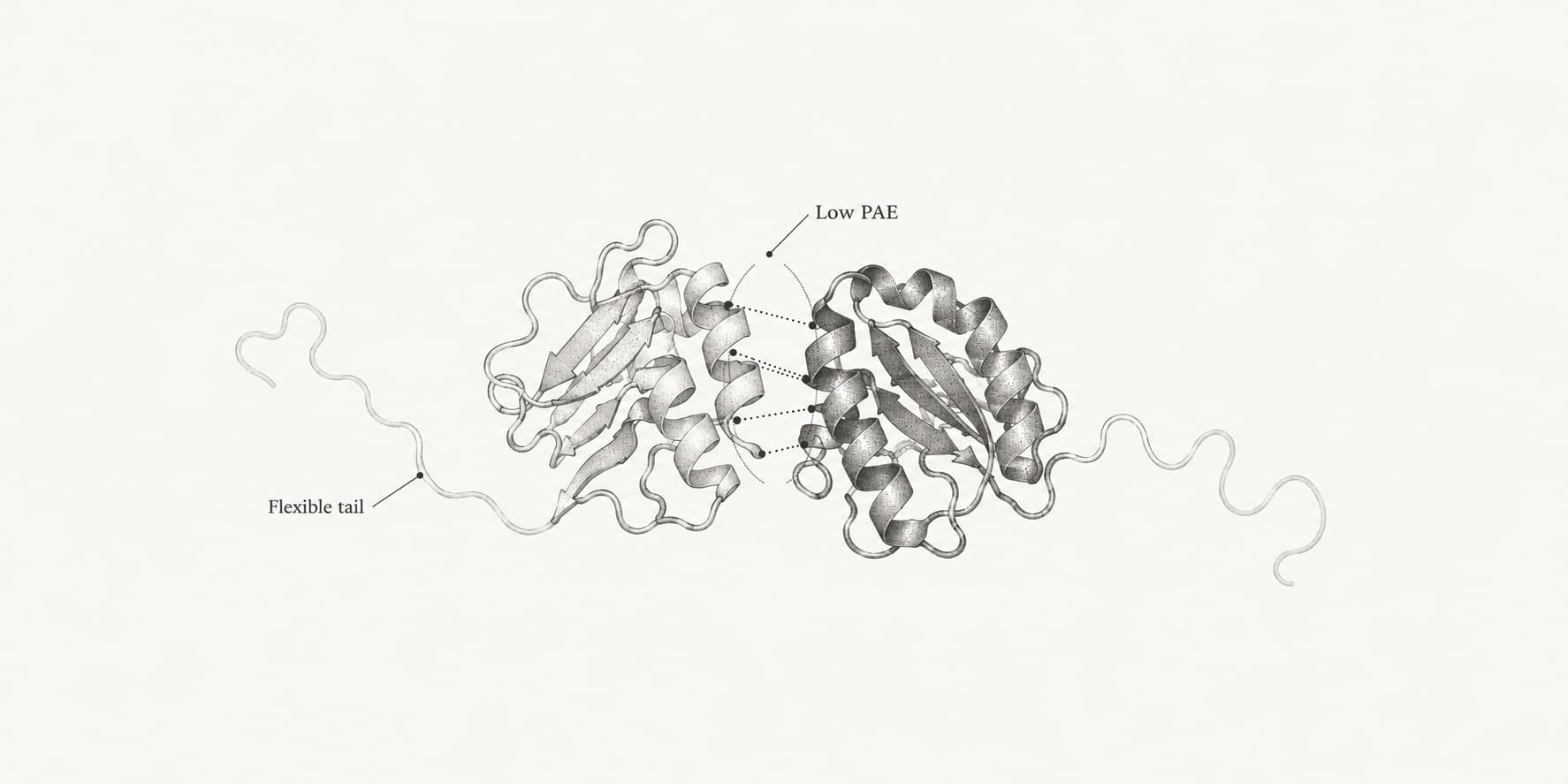
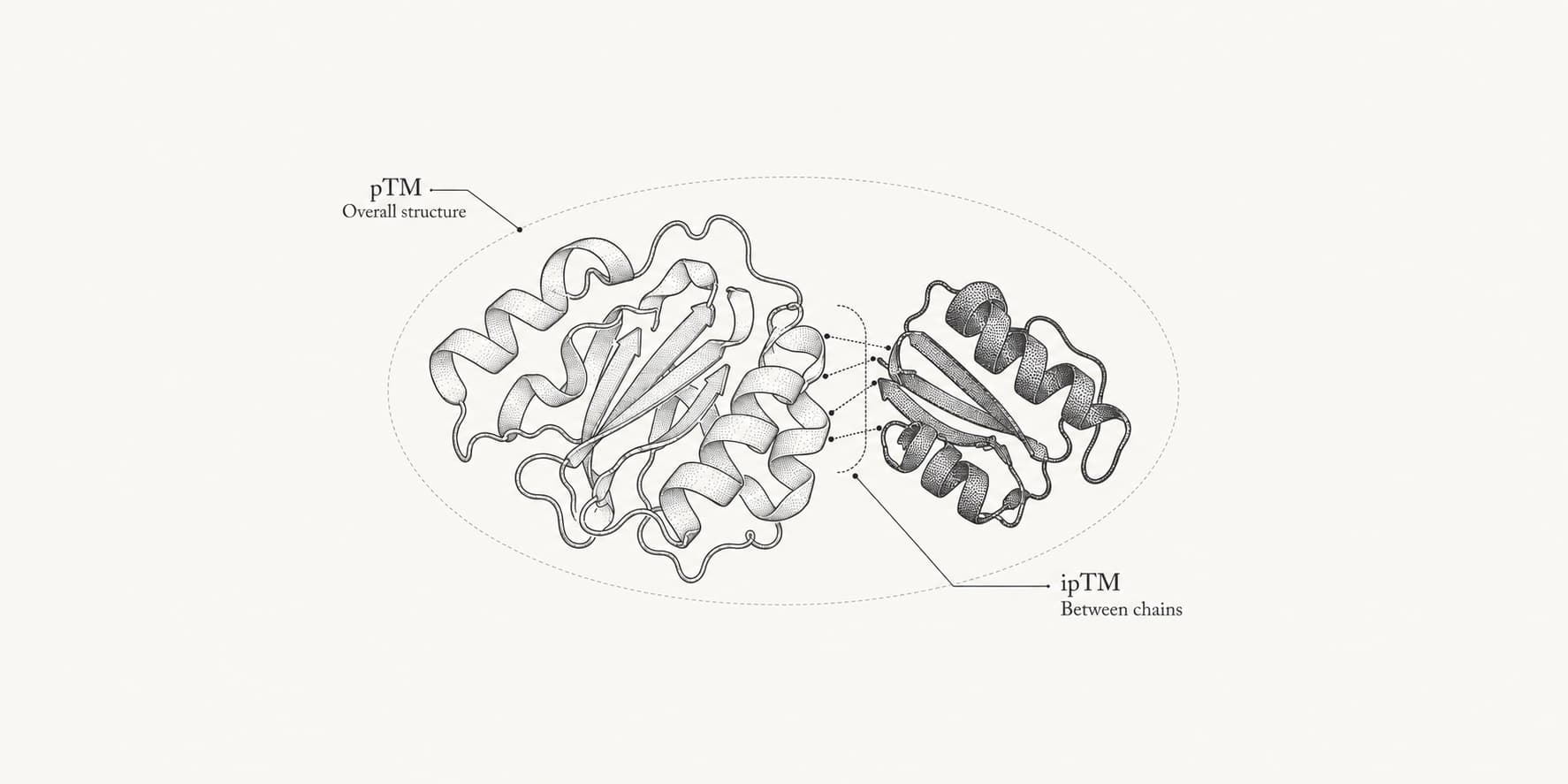
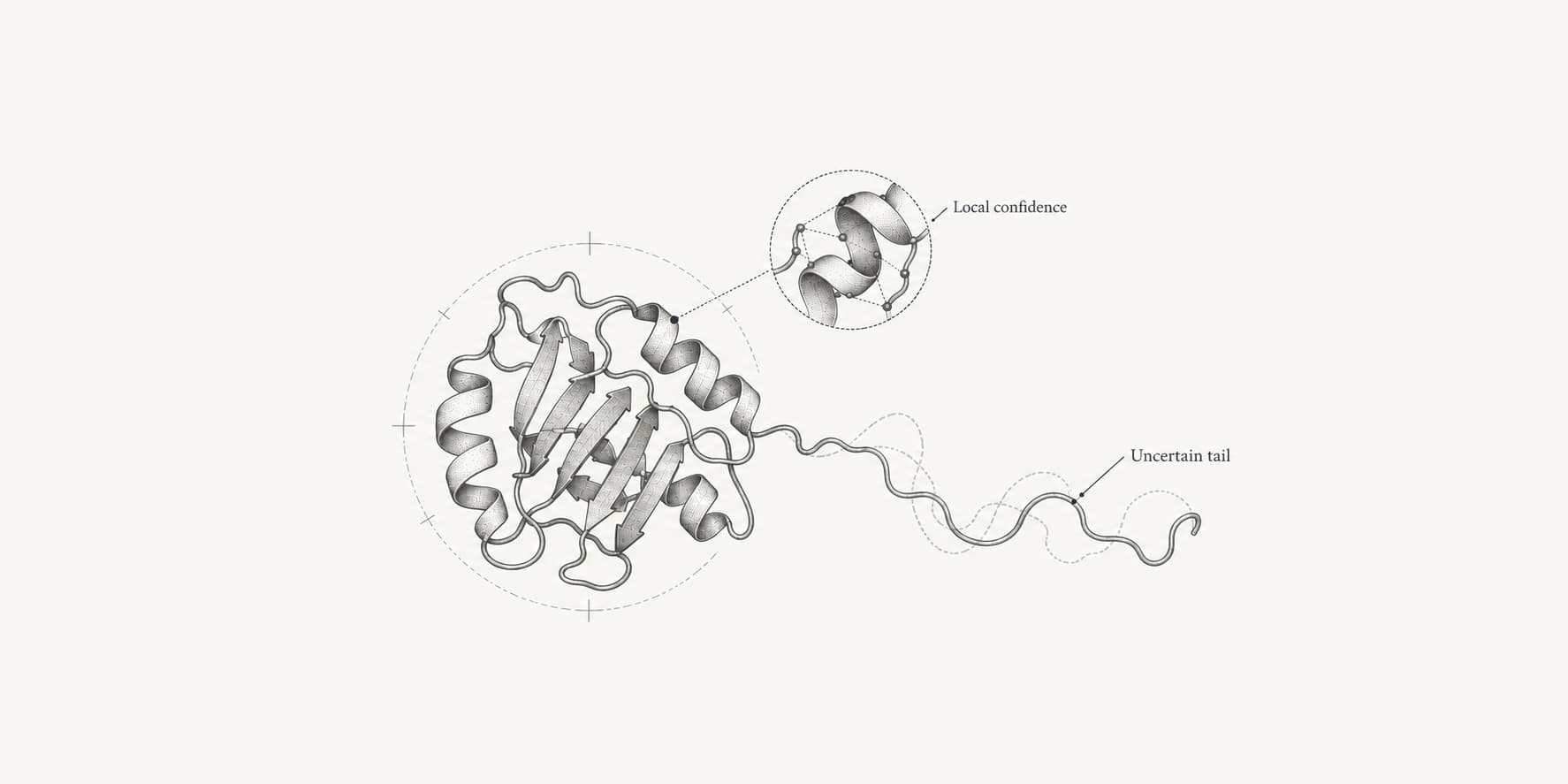
Keep preset overrides off initially. The initial quality controls are pLDDT 80, pTM 0.55, i_pTM 0.5, normalized interface predicted aligned error (i_pAE) 0.35, and binder RMSD 3.5 angstroms. Predicted local distance difference test (pLDDT) describes local confidence; predicted TM score (pTM) describes global confidence. These thresholds define computational selection, not binding affinity.
Filter precedence differs between the tools. BindCraft applies its quality controls to matching filters even after custom filter JSON. In FreeBindCraft, unchanged quality controls preserve the chosen preset; changed controls override matching thresholds, and custom filter JSON is applied last. Inspect the resolved filter files before comparing runs.
4. Review the credit quote and diagnostic settings
Both tools reserve 5,400 compute credits by default for two hours on an A100 80 GB GPU, metered at 45 credits per minute. Unused reserved credits are returned after runtime settlement. The quote appears before submission. Full diagnostic artifacts do not change the standard compute reservation.
More requested designs or more demanding settings can consume more runtime without changing the standard compute reservation. A request for ten accepted designs does not guarantee ten results within the available time.
Enable Full diagnostic artifacts when intermediate structures, plots, animations, or optional sequence files matter to the investigation. Compact BindCraft results still retain the candidate-check and residue-confidence tables. Below-threshold candidates remain exploratory results and do not become accepted workflow inputs.
5. Inspect structures before choosing candidates
Use Viewer for the complex structures, Data for tables, and Files for downloads. BindCraft also provides Checks, which records pass/fail measurements, and Residue confidence, which shows per-residue pLDDT from saved predictions.
Check the binding site, fold, and rejection reasons before selecting a candidate by rank. For FreeBindCraft, choose i_pTM or ipSAE ranking deliberately and retain that setting with the results. Changing the ranking criterion changes selection order; it does not supply experimental evidence.
A reproducible PD-L1 setup exercise
The official BindCraft example uses PD-L1, chain A, and hotspot residue 56.[6] Download the official PD-L1 example structure and use the following setup to practice the online workflow.
| Control | Value for this exercise |
|---|---|
| Target protein | Official PDL1.pdb sample |
| Target chains | A |
| Hotspot residues (optional) | A56 |
| Design protocol | Default |
| Minimum / maximum binder length | 40 / 80 |
| Number of designs | 1 |
| Preset overrides | Off |
This is an input exercise, not a reported ProteinIQ result or a reproduction of the paper. The length range and design count deliberately use the smaller ProteinIQ defaults instead of the official example configuration. No acceptance rate or output score is implied.
To explore FreeBindCraft as an alternative, submit the same target bytes, chain, hotspot, lengths, and design count there, initially retaining i_pTM ranking. Save the resolved settings for both runs. Different relaxation, filters, and stochastic trajectories prevent a single paired run from establishing which method is better.
How to interpret the results
| Readout | Practical interpretation |
|---|---|
Average_i_pTM | Interface confidence and the default ranking criterion; not a measured dissociation constant |
Average_pLDDT | Local confidence stored on the normalized 0 to 1 scale in design CSVs; the residue report uses 0 to 100 |
Average_i_pAE | Normalized interface error; lower is better, but this field is not in angstroms |
| Binder RMSD | Agreement between the isolated-binder prediction and designed fold; check each tool's atom selection |
| Buried surface area | Geometric evidence of an interface; a large interface alone does not establish specificity |
| Accepted status | Passed the effective filters used in that run; compare filter policies before comparing yields |
For BindCraft, Average_Buried_Total_SASA_A2 uses solvent-accessible surface area (SASA): isolated target plus isolated binder minus complex, in square angstroms. Average_TotalBuried_to_BoundBinder_SASA_Percent uses the binder's SASA within the complex as its denominator and can exceed 100%. Do not interpret it as the fraction of the isolated binder surface buried.
BindCraft leaves unavailable Rosetta fields empty. FreeBindCraft's original CSVs can contain fixed compatibility values for Rosetta energy, packing, and hydrogen-bond fields. ProteinIQ excludes those placeholders from displayed measurements. A favorable-looking dG in such a CSV is not a calculated binding energy.
Check candidates before experimental work
Treat selection as a combination of structural inspection, computational checks, and experimental planning:
- Inspect whether the proposed interface is accessible in the full biological target and whether the binder clashes with surrounding structure.
- Review confidence at the interface, isolated-binder agreement, and the individual failed checks. A strong average can hide a weak region.
- Consider several distinct sequences and poses rather than choosing only closely related designs with similar scores.
- Plan expression and solubility assessment, direct binding measurements, and relevant off-target controls. If the goal is inhibition or activation, test that function separately from binding.
These are evaluation steps, not a validated acceptance rule for either Rosetta-free protocol. The original BindCraft study includes experimental binding and functional tests; those results do not establish the performance of the modified hosted methods.[1]
Common problems and what to check
| Problem | What to inspect next |
|---|---|
| No accepted designs | Inspect failure_csv.csv, trajectory/design statistics, and BindCraft's Checks tab. Separate early trajectory failure from redesign or final-filter failure. |
| Missing hotspot or chain | Match the selectors to the actual PDB chain IDs and residue numbers, especially after cropping or renumbering. |
| Run ends before the requested count | Review runtime limits, trajectory caps, and acceptance-rate stopping settings. The requested count is a goal. |
| Relaxed filters still reject candidates | Inspect effective thresholds. BindCraft's quality controls still override matching preset values. |
| No Rosetta energy or hydrogen-bond score | This is expected in the hosted protocols. Contact sales if those measurements are required. |
| No animation, FASTA, or intermediate PDB | Check full diagnostic artifacts and the individual save/remove settings. Some files are deliberately omitted or removed. |
| FreeBindCraft reports a scoring or relaxation failure | Inspect its log. ProteinIQ fails runs that substitute unsupported fallback measurements or structures rather than treating them as valid results. |
Do not weaken all filters just to obtain an accepted design. First identify the stage that failed, then change one relevant choice, such as the target patch or binder length. Keep the original run and effective settings for comparison.
When to use FreeBindCraft or another tool
Use FreeBindCraft as an alternative when the staged OpenMM/FASPR procedure or optional ipSAE ranking is relevant to the design question. Compare its own scores and filter decisions, rather than importing Rosetta thresholds or assuming it is equivalent to ProteinIQ BindCraft.
For a backbone that already exists, ProteinMPNN addresses sequence redesign. For a candidate sequence that already exists, AlphaFold 2 addresses structure prediction. The protein binder design use case covers the broader workflow.
Before submitting
- Confirm the target file, selected chains, residue numbering, and biological accessibility of the intended site.
- Record binder lengths, design count, effective filters, and the chosen tool.
- Review the credit reservation and whether full diagnostic artifacts are needed.
- Decide what computational and experimental evidence will justify advancing a candidate.
- Contact sales before planning work that depends on Rosetta-specific calculations.
BindCraft tools on ProteinIQ
Open BindCraft for the restrained-minimization protocol or FreeBindCraft for the alternative relaxation and repacking method. Each tool's documentation contains the complete input, setting, pricing, and output reference. For Rosetta requirements, contact sales.
Frequently asked questions
Is BindCraft free to use online?
Hosted GPU runs use credits. Both tools currently reserve 5,400 compute credits by default. The Free plan includes 100 monthly credits, which alone does not cover that reservation. FreeBindCraft's name does not mean its ProteinIQ compute is free.
Do I need a GPU, an MSA, or an initial binder sequence?
No local GPU is required. The hosted workflow takes a target structure, selected chains, and design settings; it does not require a user-supplied multiple sequence alignment (MSA) or starting binder sequence.
Does ProteinIQ BindCraft include Rosetta?
No. Rosetta/PyRosetta is omitted due to licensing. The standard protocol uses restrained OpenMM minimization. Contact sales if Rosetta relaxation, energies, or filtering are required.
Is FreeBindCraft the same as ProteinIQ BindCraft without Rosetta?
No. Both already omit Rosetta, but FreeBindCraft is an independently maintained fork with a different relaxation, repacking, and scoring procedure. Neither should be described as experimentally equivalent to the published Rosetta-inclusive pipeline.
Can a successful search return zero accepted designs?
Yes. A run can exhaust its available sampling or runtime without finding a candidate that passes the selected filters. Diagnostic files help distinguish a valid zero-hit search from an execution failure.