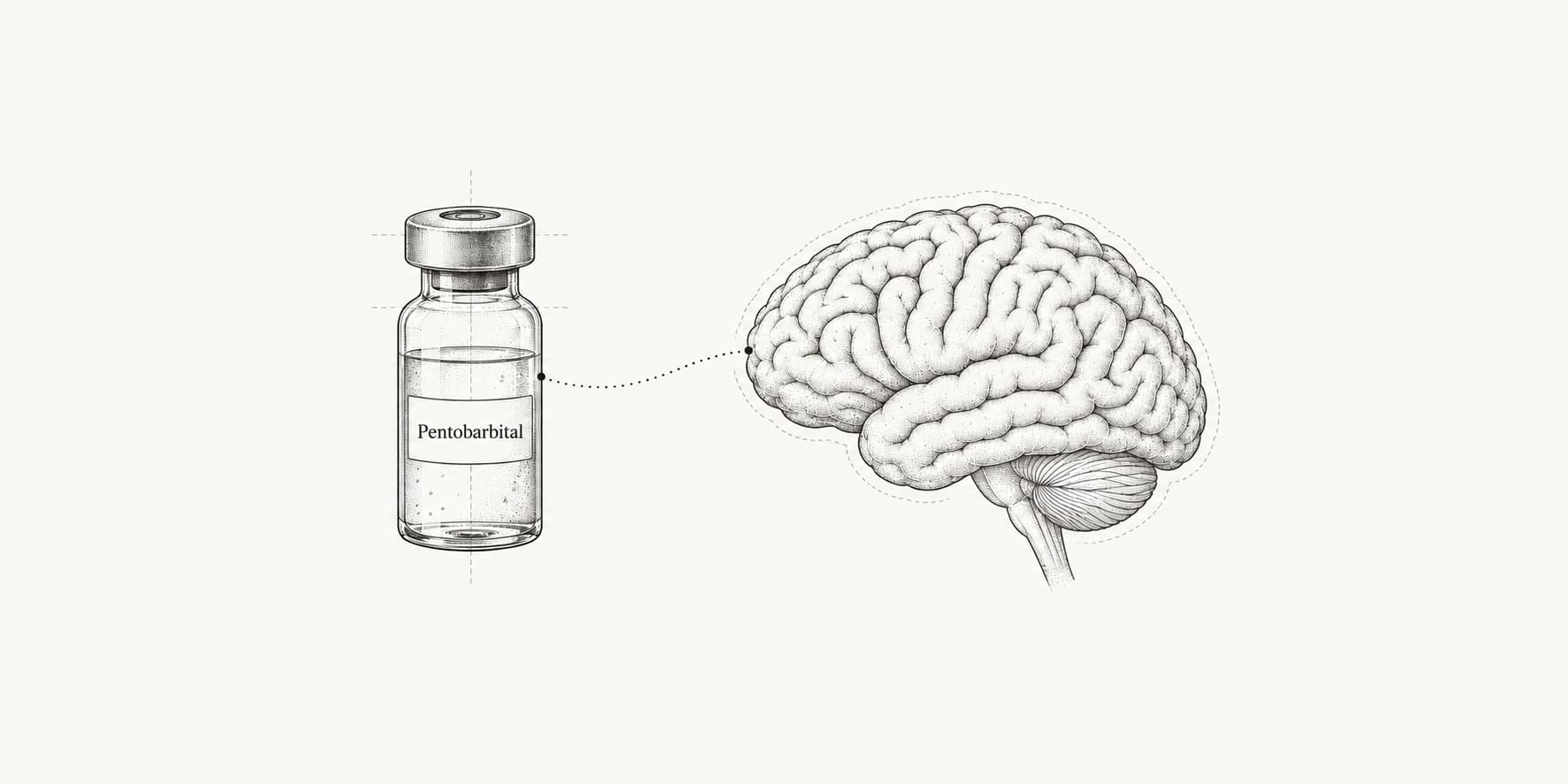
Pentobarbital is a short-acting barbiturate, a sedative drug that slows the brain by strengthening its main inhibitory chemical signal. Doctors use small doses to sedate patients, stop prolonged seizures and induce medical comas; veterinarians use concentrated solutions to euthanize animals; and several US states and the federal government use it as the only drug in a lethal injection. Tennessee's protocol, as described in federal court records, calls for 5 grams of pentobarbital: 100 milliliters of a solution containing 50 milligrams per milliliter, given as two 50-milliliter syringes, with a backup set if the prisoner is still alive. That is 50 times the usual starting intravenous dose for an adult. By our count, pentobarbital has been used in about three of every five US executions since 2010.
On September 30, 2026, Tennessee gave both syringes to Christa Pike, who remained alive, was heard snoring for more than 40 minutes after the last dose and was taken to a hospital. Governor Bill Lee then halted executions for the rest of 2026 and ordered a third-party review. The cause has not been established. This article explains what is known about the drug itself: what it is chemically, how it acts and is measured, how the execution dose compares with medical use, why states adopted it, and which properties of the solution and its delivery decide whether it works as intended.
What is pentobarbital chemically?
Pentobarbital is a small organic molecule with the formula C₁₁H₁₈N₂O₃ and a molecular weight of 226.27 grams per mole.[1] Like every barbiturate, it is built on barbituric acid, a six-membered ring of four carbon and two nitrogen atoms carrying three oxygen atoms. What makes it pentobarbital is the pair of side chains attached to one carbon of the ring: an ethyl group and a branched five-carbon group, 1-methylbutyl. Its systematic name, 5-ethyl-5-(pentan-2-yl)-1,3-diazinane-2,4,6-trione, simply lists those parts.[1] Injections contain the sodium salt, C₁₁H₁₇N₂NaO₃, which weighs 248.25 grams per mole because one hydrogen is replaced by sodium.[2] Both molecular weights follow directly from the formulas.
Ernest Volwiler and Donalee Tabern synthesized pentobarbital at Abbott Laboratories in 1930, and Abbott sold it as Nembutal.[3] The same chemists then made thiopental (Pentothal), which is pentobarbital with a sulfur atom in place of one ring oxygen.[3] Thiopental later became the first drug of the three-drug lethal injection used by the federal government and many states, so the switch to pentobarbital in the 2010s replaced one closely related barbiturate with another.[4] Pentobarbital should not be confused with phenobarbital, a longer-acting barbiturate with a phenyl ring in place of the 1-methylbutyl group; StatPearls notes that the two names are often mixed up, although their doses differ.[3][5]
The carbon where the 1-methylbutyl group branches is a stereocenter, so pentobarbital can exist as two mirror-image forms, called enantiomers. PubChem, whose record can be downloaded as a structure file, and the drug label both describe the compound without specifying either form.[1][6] The distinction matters biologically. In mouse spinal neurons grown in culture, Huang and Barker found that the (+) form was mainly excitatory, whereas the (−) form was mainly inhibitory and much more effective at amplifying the brain's inhibitory signal.[7]
| Property | Value |
|---|---|
| Drug class | Short-acting barbiturate; US DEA Schedule II controlled substance |
| Formula (free acid / sodium salt) | C₁₁H₁₈N₂O₃ / C₁₁H₁₇N₂NaO₃ |
| Molecular weight (free acid / sodium salt) | 226.27 / 248.25 g/mol |
| CAS registry number (free acid / sodium salt) | 76-74-4 / 57-33-0 |
| Acid dissociation constant (pKa) | 8.11 at 25 °C |
| Water solubility of the free acid | 679 mg/L at 25 °C; the sodium salt is very soluble |
| Calculated lipophilicity (XLogP) | 2.1 |
| Commercial injection | 50 mg/mL pentobarbital sodium in 40% propylene glycol and 10% alcohol, pH about 9.5 |
| Plasma half-life in adults | 15 to 50 hours, dose dependent |
Two of these numbers explain much of the drug's behavior. Pentobarbital is a weak acid, and its uncharged form dissolves poorly in water, only 679 milligrams per liter.[1] A 50-milligram-per-milliliter injection is about 74 times more concentrated than that, which is possible only because the drug is supplied as the charged sodium salt in a strongly alkaline solution. The commercial product is adjusted to a pH of about 9.5 and dissolved in propylene glycol and alcohol as well as water.[6] The fraction of molecules carrying a charge follows from the pKa and the pH:
In the vial, about 96% of the molecules are charged and stay dissolved. Once the solution mixes with blood at pH 7.4, about 84% become uncharged, the fat-soluble form that crosses cell membranes and reaches the brain quickly. The same chemistry is a weakness in the syringe: if the solution is made less alkaline, for example by mixing it with an acidic fluid, the uncharged drug can come out of solution as a solid precipitate.[1]
How does pentobarbital work in the body?
Pentobarbital depresses the brain mainly by acting on GABA-A receptors, channels in the membranes of nerve cells that let chloride ions flow in when they are opened by the inhibitory transmitter GABA. Barbiturates prolong and strengthen the effect of GABA on these channels and, at higher concentrations, open them directly. They also block AMPA and kainate receptors, which carry the brain's main excitatory signal, and reduce the release of glutamate.[8] StatPearls summarizes the result as chloride channels that stay open longer, which intensifies depression of the central nervous system. As the dose rises, the effect deepens from sedation to anesthesia and coma, and at high doses neurological function is lost entirely.[5]
An intravenous dose acts almost immediately. Pentobarbital crosses into the brain rapidly, distributes through a volume of about 1 liter per kilogram of body weight, is broken down by enzymes in the liver and has an elimination half-life of 15 to 50 hours in adults.[5] The prescribing information advises waiting at least a minute after an intravenous dose to judge its full effect.[6]
Clinicians measure pentobarbital in blood as micrograms per milliliter, which is the same as milligrams per liter. The ranges in Table 2 show how far the drug can be pushed in a hospital, where the consequences of a high level are managed rather than allowed to run their course.
| Clinical context | Blood concentration |
|---|---|
| Sedation | 1 to 5 µg/mL |
| Considered toxic when the goal is sedation | Above 10 µg/mL |
| Therapeutic coma | 20 to 50 µg/mL |
| Treatment of raised pressure inside the skull | 30 to 40 µg/mL |
Patients with seizures that resist other drugs, or with dangerous brain swelling, can be held in a pentobarbital coma at many times the sedative concentration. They survive because a ventilator breathes for them and drugs support their blood pressure. There is no antidote for pentobarbital, and treatment of an overdose consists of the same support: securing the airway, assisted breathing, vasopressors and warming in an intensive care unit.[5][6] The label of a veterinary euthanasia product describes how death occurs without that support: at a lethal dose, pentobarbital depresses the centers in the brainstem that control breathing and blood vessel tone.[9] Pentobarbital's lethal effect therefore runs through the brain's control of breathing and circulation, and how quickly it acts depends on how much drug reaches the brain and how fast.
This also explains the sound witnesses described in the Pike case. Media witnesses reported that more than 40 minutes passed after the last dose while she remained alive and snoring loudly.[10] Her attorneys told the court that she had not lost consciousness, still had a heartbeat and was audibly snoring.[11] Anesthesia, like sleep, reduces the activity of the muscles that hold the throat open, which makes the upper airway prone to narrowing and obstruction.[12] Snoring is the sound of air moving through such a narrowed airway. It shows that a deeply sedated person is still breathing, but on its own it cannot show how much drug reached the brain, or whether the person was aware.
How much pentobarbital is used in a lethal injection?
Tennessee's single-drug protocol uses 5 grams of pentobarbital, as 100 milliliters of a 50-milligram-per-milliliter solution, according to the claims summarized by the federal court in Harold Nichols's challenge to the protocol.[13] The Nashville Banner reported that the dose is divided between two 50-milliliter syringes and that the protocol provides a second, backup set of syringes if the prisoner is not dead, but no further step if the backup also fails.[14] The federal government's single-drug protocol is built around the same 5-gram dose.[4] For scale, 5 grams in 100 milliliters is the contents of two 50-milliliter vials of the commercial injection, each labeled 2,500 milligrams.[6]
| Use | Dose | 5 g as a multiple of the dose |
|---|---|---|
| Usual initial intravenous dose for a 70 kg adult | 100 mg | 50 times |
| Usual intramuscular dose | 150 to 200 mg | 25 to 33 times |
| Upper total of small intravenous increments for sedation | 200 to 500 mg | 10 to 25 times |
| Tennessee execution protocol, first set of syringes | 5,000 mg (100 mL at 50 mg/mL) | 1 |
The rate of injection differs as much as the amount. In medicine, intravenous pentobarbital should be given slowly, at no more than 50 milligrams per minute, because rapid injection can cause respiratory depression, low blood pressure and spasm of the airways.[5] At that clinical ceiling, 5 grams would take 100 minutes to give. Execution protocols instead deliver the full amount from syringes, so the two settings differ in speed as well as in dose.
Veterinary euthanasia solutions take a different approach. Euthasol, for example, contains 390 milligrams of pentobarbital sodium per milliliter, 7.8 times the concentration of the human injection, together with phenytoin, which is included to produce cardiovascular collapse.[9] Single-drug human protocols rely on pentobarbital alone to stop both breathing and circulation.
How often is pentobarbital used in US executions?
Since 2010, pentobarbital has been used in more US executions than any other drug. In this analysis of the Death Penalty Information Center's yearly execution lists, we count 301 of 495 US executions from January 2010 through September 29, 2026 that used pentobarbital, or 61%. Of these, 233 used pentobarbital as the only drug and 68 used it as the first drug of a three-drug protocol.[15]
Pentobarbital entered US executions as a replacement for thiopental. In January 2011, the only American manufacturer of sodium thiopental stopped producing it after being pressed to guarantee that it would not be used in executions.[4] Oklahoma had already substituted pentobarbital as the first drug of its three-drug protocol in December 2010.[16] Ohio became the first state to execute someone with pentobarbital alone in March 2011.[17] Lundbeck, the Danish company behind the main FDA-approved injectable product, has also restricted the drug's use in capital punishment.[4]
Since then, states and the federal government have generally bought powdered pentobarbital in bulk from chemical suppliers and had compounding pharmacies turn it into an injectable solution. The Justice Department's January 2025 review noted that compounded drugs are not FDA approved, so the agency does not verify their safety, effectiveness or quality before use. Of the 88 pharmacies registered as large-scale compounding outsourcing facilities at the time, 31 had never been inspected, and 55 of the 57 inspected had received FDA notices of objectionable conditions.[4] The same review counted 194 people executed with pentobarbital as the only lethal drug in eight states between 2011 and 2024, 109 of them in Texas, and 13 federal executions with the drug between July 2020 and January 2021.[4]
Our count of the same period agrees with the review once three executions are added that its state list omits: Missouri's in December 2024, Utah's in August 2024 and Indiana's in December 2024. Like the review's Texas and South Dakota totals, ours includes two 2018 executions that the Death Penalty Information Center lists as using an undisclosed drug, likely pentobarbital.[15][4]
The chart shows two transitions. In 2011 and 2012, states replaced thiopental with pentobarbital, first inside the three-drug protocol and then as a single drug; in 2012, every one of the 43 US executions used it. Its share has fallen since the mid-2010s, and in 2025 it was used in 15 of 47 executions, or 32%. Most of the remainder were in Florida, which carried out 35 of the 53 executions without pentobarbital in 2025 and 2026 using a three-drug protocol that begins with etomidate.[15]
Single-drug use is concentrated in a few places. Texas accounts for 120 of the 233 executions with pentobarbital alone, more than half, followed by Missouri with 34 and Georgia with 25. In all, 11 states and the federal government have executed someone with pentobarbital as the only drug, and 17 states have used it in some protocol.[15] The execution-level records, annual counts, counts by jurisdiction, analysis script and source checksums document every classification. The counts depend on the protocol labels the Death Penalty Information Center assigns, which come from news reports and state records, and they include only completed executions, not attempts such as Pike's.
| Date | Event |
|---|---|
| December 2010 | Oklahoma uses pentobarbital in place of thiopental in a three-drug execution, the first US execution with the drug. |
| January 2011 | The sole US maker of sodium thiopental stops production. |
| March 2011 | Ohio carries out the first execution with pentobarbital as the only drug. |
| 2011 to September 2026 | 233 executions with pentobarbital as the only drug in 11 states and the federal system, 120 of them in Texas. |
| July 2020 to January 2021 | 13 federal executions with pentobarbital. |
| December 2024 | Tennessee adopts a single-drug pentobarbital protocol. |
| January 2025 | The Justice Department's Office of Legal Policy recommends halting federal use of pentobarbital. |
| May, August and December 2025 | Tennessee executes Oscar Smith, Byron Black and Harold Nichols with pentobarbital. |
| April 2026 | The Justice Department reinstates the federal pentobarbital protocol. |
| May 2026 | Tennessee halts the execution of Tony Carruthers after the team cannot establish the required second intravenous line. |
| August 2026 | Tennessee executes Anthony Hines with pentobarbital, its fourth execution under the protocol. |
| September 30, 2026 | Christa Pike survives both syringes of pentobarbital; Tennessee suspends executions for the rest of 2026. |
Federal policy has reversed twice in this period. The 2025 review concluded that there remained significant uncertainty about whether single-drug pentobarbital causes unnecessary pain and recommended stopping its use until that was resolved.[4] On April 24, 2026, the Justice Department reinstated the pentobarbital protocol and stated that its use is consistent with the Eighth Amendment.[18] Tennessee resumed executions with the drug in May 2025. In May 2026 it called off Tony Carruthers's execution after the team could not establish a second intravenous line, and in August 2026 it executed Anthony Hines, its fourth execution with pentobarbital.[19][15]
What can stop a pentobarbital injection from working?
Tennessee has not explained why Christa Pike survived. The Department of Correction said it followed every step of the state's protocol, and it has described the drug in the protocol as consistently effective.[14][10] Pike's attorneys pointed to difficult vein access, blown veins and degraded pentobarbital, and one witness recalled Pike saying that the vein in her arm felt as if it was about to burst.[11] The chemistry of the drug identifies three places where an injection can fall short, and each leaves evidence that can be checked.
The first is the drug in the syringe. Aqueous solutions of pentobarbital sodium are unstable, alkaline solutions decompose during storage and heating, and the drug is more stable in propylene glycol, which is why commercial injections use that solvent.[1] The commercial label calls for storage at 20 to 25 °C, protection from heat and freezing, and not using the solution if it has precipitated.[6] A compounded solution may differ from the commercial product in concentration, solvent, pH and age, and its quality depends on how it was made and tested. The state's earlier record shows why this is a live question. In the Nichols case, the federal court summarized allegations about Tennessee's previous three-drug process, supported by an independent review ordered after a 2022 reprieve, that included failures to test drugs for potency and bacterial toxins, improper storage and the preparation of expired drugs.[13]
The second is whether the drug stays dissolved. Because the injection depends on high pH to hold the drug in its soluble salt form, anything that lowers the pH, including mixing with acidic solutions in a line, can make pentobarbital precipitate.[1] A precipitated or partly precipitated solution delivers less dissolved drug than its label states.
The third is delivery into a vein. Barbiturate injections are highly alkaline, and the prescribing information warns that injection outside a vein can damage and kill surrounding tissue, while injection into an artery can cause anything from transient pain to gangrene.[6] A dose that leaks into tissue does not reach the bloodstream, and therefore the brain, at the intended speed or amount. Intravenous access was the documented problem in Tennessee's halted May 2026 execution.[19]
These explanations make different predictions. Testing any unused drug from the same batch for concentration, pH and breakdown products would show whether the solution was what the protocol assumed. A pentobarbital level measured in Pike's blood at the hospital, compared with the ranges in Table 2, would indicate how much drug reached her circulation. Records of where the lines were placed, and whether swelling or leakage was seen, would address delivery. Until such evidence is released, the cause remains undetermined.
Does pentobarbital cause pulmonary edema in executions?
Autopsies show that fluid in the lungs, called pulmonary edema, is common after lethal injection, including single-drug pentobarbital executions. An NPR investigation reviewed more than 200 autopsies and found signs of pulmonary edema in 84% of the 216 that included an internal examination of the lungs.[20] The Justice Department's review, drawing on those records, reported signs of edema in 47 of 58 autopsies from state executions that used pentobarbital as the only drug, and pulmonary edema in both federal autopsies it examined.[4] In a smaller set of autopsy reports from eight states, posted as a preprint that had not been peer reviewed, Zivot and colleagues found lung edema in 10 of 15 executions involving pentobarbital and 23 of 28 involving midazolam.[21] Byron Black's 2025 autopsy in Tennessee found pulmonary congestion and edema.[19]
The mechanism links back to the chemistry. The Justice Department review lists three routes by which a barbiturate overdose can cause sudden pulmonary edema: direct chemical injury to the lungs from a highly alkaline solution, which it gives as pH 9.8 to 11; the strong suction created by breathing against an obstructed airway; and weakened contraction of the heart.[4] Whether a person feels any of this is the central dispute. The review found it unclear whether 5 grams of pentobarbital makes a person unconscious or only unresponsive, whereas an expert retained by the Bureau of Prisons had argued, in a report the review noted cited no literature, that consciousness is lost within 10 to 30 seconds.[4] The Justice Department reached opposite conclusions in January 2025 and April 2026.[4][18]
Taken together, the evidence describes a drug whose effects are predictable from its chemistry but whose results in an execution depend on things outside the molecule. Pentobarbital's acidity and fat solubility explain why it is sold as an alkaline salt solution and why it reaches the brain quickly. Its action on GABA-A receptors explains why higher doses keep deepening sedation until breathing stops, and why hospitals can keep patients alive at coma levels with ventilators. Whether a 5-gram injection kills within minutes therefore depends on whether the solution contains what its label says, whether it stays dissolved, and whether all of it enters a vein. Those are measurable questions, and in the Pike case they are the ones a review would need to answer.