Surface-informed diffusion generative model for reliable and accurate protein-ligand complex prediction Learn more
Input
What is SurfDock?
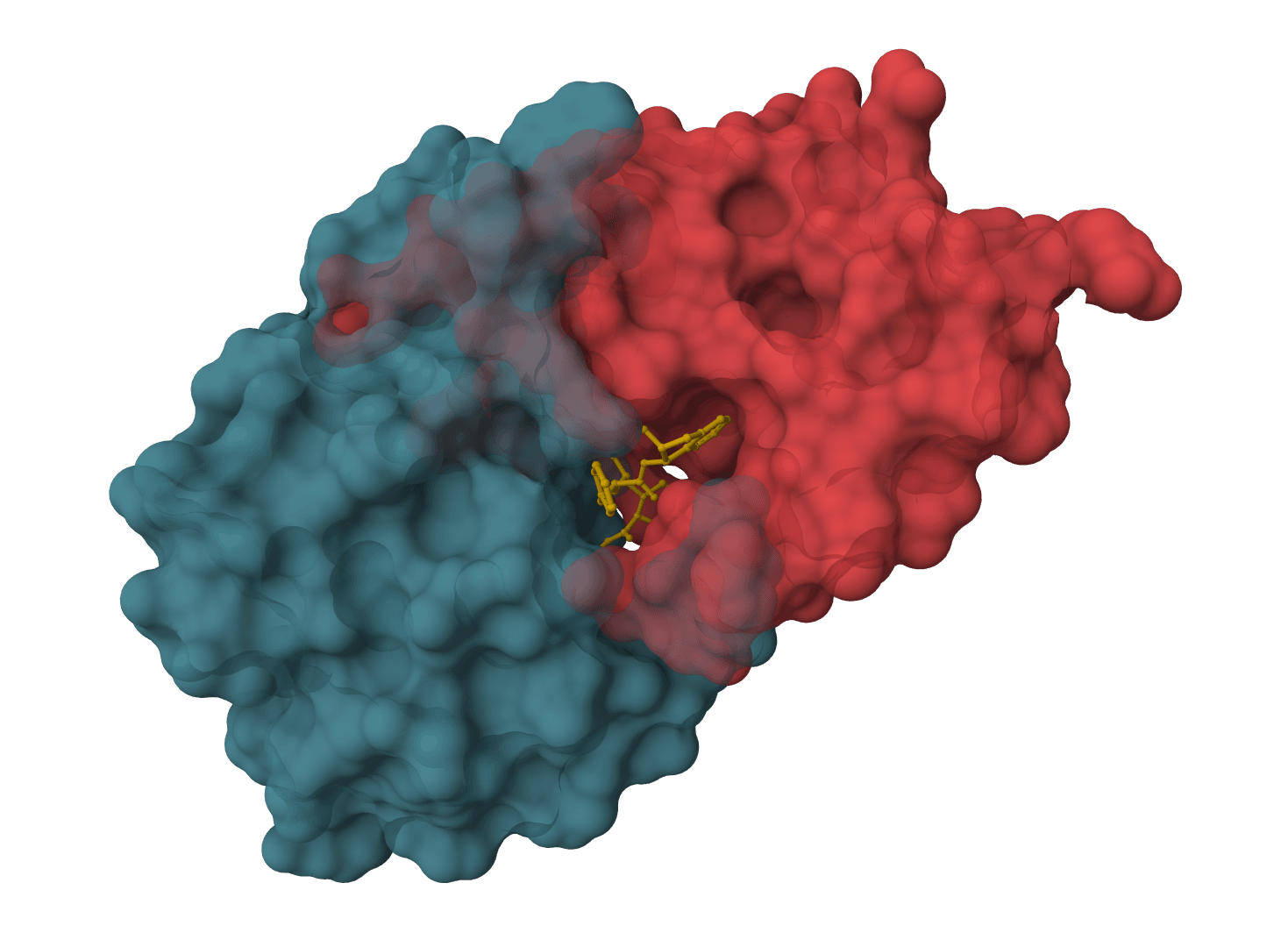
SurfDock is a protein-ligand docking method that guides pose generation using the geometric features of the protein binding surface. Published in Nature Methods in 2024, it combines a multimodal protein representation — sequence, 3D structural graphs, and molecular surface geometry — with a generative diffusion model that optimizes translational, rotational, and torsional degrees of freedom. The surface geometry component is what distinguishes SurfDock from earlier diffusion-based docking methods: encoding the shape and electrostatic properties of the binding pocket reduces intermolecular clashes and improves physical plausibility of the predicted poses.
Pose confidence is estimated by SurfScore, a mixture density network trained on the same multimodal protein-ligand representation. This means the same surface-aware features used to generate poses are also used to rank them.
On the PDBbind 2020 benchmark, SurfDock achieved Top-1 / Top-5 success rates of 68% / 81% at a 2.0 Å RMSD threshold, substantially outperforming DiffDock (45% / 51%) while also improving adherence to physical constraints.
How to use SurfDock online
ProteinIQ hosts SurfDock on GPU infrastructure, so no local installation, CUDA setup, or dependency management is required.
Inputs
| Input | Description |
|---|---|
Protein | Uploaded PDB file. Must contain protein atom records. |
Ligand | Uploaded SDF file. Organic small molecules only (no metals or metalloids). Maximum 150 heavy atoms. The ligand SDF must already be in the same coordinate frame as the receptor. |
Settings
| Setting | Range | Default | Description |
|---|---|---|---|
Number of poses | 1–40 | 10 | How many binding pose conformers to sample. More poses increases prediction diversity but adds compute time. |
Number of rescored poses | 1–40 | 10 | How many generated poses to pass into the native SurfDock screen-model rescoring stage. This is automatically clamped to the total sampled pose count. |
Sampling steps | 5–50 | 20 | Number of diffusion denoising steps. Increasing this can improve pose quality at the cost of runtime. |
Outputs
SurfDock returns ranked SDF files, one per pose, alongside a summary table, the prepared receptor and pocket artifacts used during docking, and the native rescoring CSV:
| Column | Description |
|---|---|
Rank | Pose rank by confidence score (1 = best). |
Confidence Score | SurfScore confidence estimate. Higher values indicate a more plausible binding geometry. |
File | Downloadable SDF file for the pose. |
All poses are also available in the 3D viewer, and the downloadable file set includes the prepared receptor PDB and the SurfDock execution log. The download bundle also includes the 8A pocket PDB, surface PLY, docking confidence CSV, and rescoring CSV produced by the SurfDock screen model.
How SurfDock works
Structure preparation runs through PDB2PQR and APBS to compute molecular surface electrostatics, and MSMS to generate the surface mesh. These surface features — encoding shape complementarity and charge distribution in the binding pocket — are combined with sequence-level information and a graph-based 3D structural representation into a unified equivariant network.
Pose generation starts from randomized ligand conformations that are iteratively refined through reverse diffusion. At each denoising step the model predicts how to adjust the ligand's translation, rotation, and internal torsion angles to better fit the pocket geometry. After generation, SurfScore ranks poses using the same protein surface representation, giving a confidence estimate grounded in the same geometric information that drove sampling.
In ProteinIQ's current tool, uploaded ligand files stay in an evaluate-style workflow and are treated as reference-pose inputs. That means the ligand SDF must already be aligned to the receptor structure before submission. The tool now follows the native single-complex preprocessing chain more closely by generating the 8A pocket/surface artifacts, building the same CSV schema SurfDock expects, and running the screen-model rescoring pass after docking.
Interpreting confidence scores
SurfScore assigns a scalar confidence to each pose. Higher scores indicate better predicted complementarity between ligand and binding surface. Unlike docking energies from physics-based methods, SurfScore does not correspond to binding affinity in kcal/mol; it is a relative ranking signal rather than an absolute thermodynamic prediction.
For downstream analysis, poses with the highest confidence scores are the most appropriate starting points for visual inspection or further refinement. Significant drops in score between the top-ranked and lower-ranked poses often indicate a well-defined binding mode.
Limitations
- Rigid receptor: the protein backbone is held fixed during docking. Targets requiring large induced-fit conformational changes may not be handled well.
- Small-molecule only: peptides, macrocycles, and ligands with metal coordination are not supported. Heavy atom count is capped at 150.
- Aligned SDF ligand files only: the uploaded ligand SDF must already be in the target protein coordinate frame. Generic 2D ligands or unaligned 3D conformers are not supported in the current tool.
- No binding affinity prediction: confidence scores rank poses relative to each other; they are not absolute affinity estimates. For predicted binding free energies, use a post-docking MM/PBSA calculation.
- Apo structures: SurfDock was benchmarked on both holo (ligand-bound) and apo (unbound) crystal structures and generalised well, but predictions for highly disordered or flexible binding pockets carry more uncertainty.
Related tools
FlowDock
FlowDock predicts protein-ligand complex structures and binding-affinity scores using geometric flow matching.
SigmaDock
SigmaDock is a fragment-based molecular docking tool using SE(3) equivariant diffusion models to predict how small molecule ligands bind to protein targets. Presented at ICLR 2026, it generates multiple binding poses with Vinardo scoring.
DiffDock-L
DiffDock-L is a state-of-the-art molecular docking tool that uses diffusion models to predict how small molecule ligands bind to protein targets. It generates multiple binding poses with confidence scores.
DynamicBind
DynamicBind is an AI-powered protein-ligand binding prediction tool that recovers ligand-induced conformational changes from unbound protein structures. It predicts both ligand binding poses and protein conformational changes.
GNINA
GNINA is a molecular docking tool that combines traditional physics-based docking with deep learning CNN scoring for protein-small-molecule complexes. It provides accurate binding predictions with confidence scores, optimized for high-throughput virtual screening.
AutoDock-GPU
GPU-accelerated molecular docking using the AutoDock4 force field. Up to 56x faster than serial AutoDock via CUDA parallelization of the Lamarckian Genetic Algorithm.
AutoDock Vina
AutoDock Vina predicts protein-ligand binding modes with Vina, Vinardo, or AutoDock4 scoring and returns ranked poses with energy estimates.
PandaDock
Open-source molecular docking platform using physics-based scoring functions. CPU-optimized algorithms achieve sub-angstrom accuracy (0.014A RMSD) without GPU requirements.
SMINA
SMINA is a fork of AutoDock Vina with enhanced scoring functions, custom scoring support, and 10-20x faster minimization. Ideal for scoring function development, pose refinement, and high-performance docking workflows.
TEMPL Pipeline
TEMPL Pipeline predicts protein-ligand poses by finding similar protein templates, aligning template ligands, generating constrained conformers, and ranking poses with shape and pharmacophore scores.