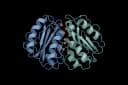
DFMDock
(PINDER e2fd499+checkpoint-compatibility)Code (opens in a new tab)Paper (opens in a new tab)DocsRun as batch
Dock protein-protein complexes with diffusion-based sampling and learned energy ranking.
Dock protein-protein complexes with diffusion-based sampling and learned energy ranking.
Protein-protein interfaces are hard to dock when no restraints, cross-links, or known interface residues are available. DFMDock addresses that case with a rigid docking model that generates candidate complexes and ranks them with the same learned energy landscape.
The method was developed in the Gray Lab as Denoising Force Matching Dock. It starts from two unbound protein structures, receptor and ligand, and searches rigid-body translations and rotations with a reverse diffusion process. No multiple sequence alignment is required, which makes it useful for fast structure-only screening. The tradeoff is the same one shared by other rigid docking methods: if binding depends on major backbone rearrangement, loop opening, or induced fit, the top pose can still look reasonable while missing the true interface.
Run DFMDock online by uploading two protein structures, or by entering two RCSB PDB IDs, then choosing how many poses to sample and how many reverse diffusion steps to use. ProteinIQ returns complex PDB files, the submitted receptor and ligand inputs, learned energy values, clash counts, native metrics CSV, and execution logs.
| Input | Accepted format | Description |
|---|---|---|
Receptor (larger protein) | .pdb, .ent, or PDB ID | First docking partner. The tool requires protein ATOM records and limits each partner to 1000 residues and 50 MB. |
Ligand (smaller protein) | .pdb, .ent, or PDB ID | Second docking partner moved during docking. The same protein-only, 1000-residue, and 50 MB limits apply. |
| Setting | Default | Description |
|---|---|---|
Number of poses | 1 | Number of sampled complexes returned. Range 1 to 20. Higher values broaden the search over alternative interfaces. |
SDE steps | 40 | Number of reverse diffusion denoising steps. Range 10 to 200. More steps give the sampler more refinement iterations but increase runtime. |
Use clash force | false | Adds repulsive guidance during sampling to discourage severe steric overlap between receptor and ligand. |
Random seed | 42 | Sets the native random seed. GPU runs can still produce different results with the same seed and inputs. |
Noise annealing | false | Uses the native timestep-dependent noise schedule, overriding the two noise scales below. |
Translation noise scale | 0.5 | Finite translation noise multiplier accepted by the native sampler. |
Rotation noise | Native default (0.5) | Omits the native rotation-noise argument. The native CLI accepts only integers for explicit custom values. |
Custom rotation noise scale | 0 | Integer used when Rotation noise is set to Custom integer. |
ProteinIQ returns two reference files, receptor_input.pdb and ligand_input.pdb, plus native complexes named complex_0.pdb, complex_1.pdb, and so on. Files and spreadsheet rows retain generation order. Rank adds an energy ranking without changing native filenames or row order. Download metrics.csv, stdout.log, and stderr.log from Files.
| Column | Description |
|---|---|
Rank | Pose rank after sorting by DFMDock energy. |
ID and Index | Native complex identifier and zero-based sample index, retained as text. |
File | Downloadable PDB file for the predicted complex. |
Energy | DFMDock learned energy. Lower values rank ahead of higher values within the same run. |
DockQ | Dimensionless diagnostic comparing the sampled pose with the submitted partner arrangement. It is not confidence against an experimental reference complex. |
iRMSD | Native interface RMSD diagnostic in Å, relative to the submitted arrangement. |
LRMSD | Native ligand RMSD diagnostic in Å, relative to the submitted arrangement. |
cRMSD | Native complex RMSD diagnostic in Å, relative to the submitted arrangement. |
Fnat | Dimensionless native contact-overlap diagnostic relative to the submitted arrangement. |
Clashes | Native count based on Cα distances, rather than a full all-atom clash assessment. |
DFMDock treats docking as denoising in rigid-body pose space. The ligand is randomized in orientation and translation, then a reverse stochastic differential equation updates that pose over a series of steps. At each step, the model predicts how the ligand should move relative to the receptor.
The network is SE(3)-equivariant, so rotation and translation of the input coordinates do not change the learned physical relationship. Residues are encoded with amino acid identity, backbone geometry, and ESM-2 embeddings. From those features, DFMDock learns two coupled signals:
That single-model setup is what makes DFMDock distinctive. Classical docking often separates search from rescoring. DFMDock uses one learned representation for both.
The ProteinIQ tool:
SDE steps.The tool does not model backbone flexibility, cofactors, glycans, membrane context, or non-protein partners. Native parsing determines how structure records are interpreted. Historical jobs retain their original cleanup, sampling behavior and ranked filenames.
Energy is the main ranking signal. DFMDock was trained to make that value useful for selecting among poses sampled in the same run, so it should be read as a within-job score rather than an absolute affinity estimate. A large gap between the top pose and the rest is usually more meaningful than the raw value itself.
Clashes is a coarse Cα-distance check. Inspect the atomic interface and consider a dedicated clash assessment before follow-up refinement.
The remaining columns, DockQ, iRMSD, LRMSD, cRMSD, and Fnat, deserve careful reading. In the current ProteinIQ tool, these are emitted directly by the inference script as pose diagnostics even though a true native reference complex is not supplied at submission time. They are best used for relative comparison among poses from the same job, not as standalone claims that a complex is CAPRI-high-quality or experimentally near-native.
For practical triage, the most useful pattern is usually:
EnergyClashesDFMDock is a good fit when both unbound structures are already available and the goal is to screen plausible rigid interfaces without building restraints first.
| Tool | Best fit | Why choose it |
|---|---|---|
DFMDock | Fast structure-only protein-protein docking | Learned sampling and ranking in one model, no MSA required |
| AF2Dock | AlphaFold2-style protein-protein docking from two structures | Useful when AF2-style confidence and refinement are part of the workflow |
| GeoDock | Geometry-aware protein complex prediction | Useful for learned rigid-body complex generation with geometric constraints |
| LightDock | Broader exploratory sampling is needed | Swarm-based search can be useful when interface hypotheses are still wide open |
| EquiDock | One fast deep-learning pose is enough | Deterministic and lightweight when pose diversity is less important |
| ColabDock | AlphaFold-style docking with external restraints is preferred | Better aligned with workflows built around AlphaFold2-derived complex prediction |
DFMDock is especially attractive for MSA-poor systems and early exploratory docking runs. It is less attractive when binding requires major conformational change or when strong experimental restraints are already available, because those cases favor flexible or data-driven docking workflows.
Based on the Gray Lab DFMDock repository and preprint, plus the current ProteinIQ DFMDock hosted implementation.

Structure-based protein-protein docking with AF2Dock flow-matching refinement

Rigid protein-protein docking with a diffusion model and confidence ranking.

Dock rigid protein-protein complexes using SE(3)-equivariant geometric modeling.

Flexible protein-protein docking with a multi-track iterative transformer.

Protein-protein docking guided by experimental restraints using AlphaFold2

Protein-protein, protein-peptide, and protein-DNA docking using Glowworm Swarm Optimization

Surface-based deep learning for paratope-antigen interaction prediction

All-atom protein-peptide docking with unranked samples.

Surface-informed diffusion generative model for reliable and accurate protein-ligand complex prediction

Predict protein-ligand binding poses and confidence scores without a predefined binding site.