AutoDock Vina
v1.2.7Dock ligands into protein structures and estimate binding modes, poses, and affinity scores.
Dock ligands into protein structures and estimate binding modes, poses, and affinity scores.
AutoDock Vina online on ProteinIQ is a hosted web server for AutoDock Vina 1.2.7, the open-source molecular docking engine from Scripps Research: upload a receptor and a ligand, and it prepares both, builds the search box, docks the ligand and ranks each pose by a score in kcal/mol. The run uses the official 1.2.7 release (Eberhardt et al., 2021) with Vina, Vinardo or AutoDock4 scoring and returns ranked poses, affinity scores, RMSD bounds, energy terms, preparation records and PDBQT and SDF files.
Trott and Olson (2010) reported that Vina predicted binding modes more accurately than AutoDock 4 on the AutoDock 4 training set while running about two orders of magnitude faster. Its scores rank poses within one setup; they are not measured binding affinities.
The webserver supports single-ligand docking, independent batch docking, simultaneous ligand docking, selected flexible receptor residues, hydrated ligand workflows, zinc metalloprotein workflows, and score, local, or randomize operations.
Scripps Research does not host an AutoDock Vina web server. The developers distribute Vina as source code on GitHub, as precompiled vina and vina_split executables, and as Python bindings installed with pip install vina on Linux and macOS. A local run follows the official basic docking tutorial: prepare the receptor PDBQT with Meeko's mk_prepare_receptor.py, prepare the ligand PDBQT with mk_prepare_ligand.py, write the box center and size, generate AutoGrid maps with autogrid4 when scoring with AutoDock4, and then call vina with those files.
The hosted run covers each of those steps. The receptor can be fetched by RCSB PDB ID and is prepared with Meeko 0.7.1, after a PDB2PQR repair when atoms are missing. A SMILES string or PubChem compound becomes a 3D ligand with RDKit before Meeko prepares it. The box is built from a bound ligand, selected residues, manual coordinates or the whole protein, and drawn over the receptor before submission.
AutoDock4 scoring gets its maps from AutoGrid 4.2.9, and the hydrated ligand and zinc workflows use the mapwater.py, dry.py and zinc_pseudo.py scripts from the Vina 1.2.7 repository. Poses return as PDBQT and, when Meeko can restore the bonds, as SDF. One job docks up to 10 ligands in a batch or 5 in co-docking; larger screens run through the API or batches.
"AutoDock" names a family of docking programs from Scripps Research, and the bare name usually means AutoDock4, last released as 4.2.6 in 2014. AutoDock4 precomputes interaction grids with AutoGrid, searches with a Lamarckian genetic algorithm, and scores poses with a force field of van der Waals, hydrogen bond, electrostatic and desolvation terms (Morris et al., 2009).
AutoDock Vina is a separate program from 2010 with its own empirical scoring function and a Monte Carlo search with BFGS local optimization, and with Vina scoring it needs no grid maps or partial charges. This page runs AutoDock Vina 1.2.7. Its AutoDock4 scoring option evaluates poses with the AutoDock4 force field through AutoGrid maps, a mode added in Vina 1.2, but the search remains Vina's. To dock with AutoDock4's genetic algorithm, AutoDock-GPU runs AutoDock-GPU 1.6, the GPU implementation of AutoDock4 from the same developers.
AutoDock Vina jobs start at 15 credits. A standard single-ligand docking run starts at 20 credits. ProteinIQ calculates the exact price from the submitted structures and settings before submission.
| Ligand heavy atoms | Exhaustiveness 8 | Exhaustiveness 32 | Exhaustiveness 64 |
|---|---|---|---|
| Up to 30 | 20 credits | 40 credits | 57 credits |
| 60 | 26 credits | 51 credits | 73 credits |
| 100 | 31 credits | 61 credits | 87 credits |
| 150 | 36 credits | 71 credits | 100 credits |
| Ligands | Exhaustiveness 8 | Exhaustiveness 32 | Exhaustiveness 64 |
|---|---|---|---|
| 2 | 28 credits | 56 credits | 80 credits |
| 3 | 36 credits | 72 credits | 102 credits |
| 5 | 52 credits | 104 credits | 148 credits |
| 10 | 92 credits | 184 credits | 261 credits |
| Ligands | Exhaustiveness 8 | Exhaustiveness 32 | Exhaustiveness 64 |
|---|---|---|---|
| 2 | 40 credits | 80 credits | 114 credits |
| 3 | 100 credits | 200 credits | 283 credits |
| 4 | 240 credits | 480 credits | 679 credits |
| 5 | 500 credits | 1,000 credits | 1,415 credits |
These baseline prices assume Dock, a compact search box, a receptor with up to 4,000 protein atoms, and ligands with no more than 7 rotatable bonds. Batch and simultaneous prices assume up to 30 heavy atoms per ligand. Larger search boxes, receptors, or more flexible ligands increase the exact quote.
Score only, Local only, and Randomize only start at 15 credits. The scoring function and number of returned poses do not currently change the estimate.
One receptor and at least one ligand are required. The selected ligand mode determines whether one ligand is docked, several ligands are docked independently, or several ligands are placed in the same pocket.
| Input | Accepted formats | Limits and behavior |
|---|---|---|
Receptor | .pdb, .ent, .cif, .mmcif, prepared .pdbqt, or an RCSB PDB ID | Maximum 50 MB. Prepared PDBQT receptors are used as submitted. Other structures follow the selected receptor preparation method. |
Ligand | SMILES, .pdbqt, .sdf, .mol, .mol2, .smiles, .smi, .txt, or .csv; PubChem identifiers are also accepted | Maximum 50 MB. Hosted docking supports up to 32 rotatable bonds per ligand. |
Job name | Text | Optional label for the run. |
Defaults and ranges follow the ProteinIQ AutoDock Vina tool definition. Dependent controls appear when their parent mode is selected.
The form shows the docking, pocket, and main receptor preparation controls. Advanced settings includes Residues to remove, Residue template assignments, Default alternate location, and Residue alternate locations, alongside Docking operation, Flexible residues, Random seed, Hydrated ligand workflow, and Zinc metalloprotein mode. The remaining Meeko receptor options, the ligand preparation settings, the search and output controls, and custom scoring weights are set through the API, MCP, or workflows.
| Parameter | Type | Default | Description |
|---|---|---|---|
Ligand mode | enum | Single ligand | Single ligand, Simultaneous co-docking with up to 5 ligands, or Batch docking with up to 10 ligands. |
Scoring function | enum | Vina | Vina, Vinardo, or AutoDock4. Zinc and hydrated workflows require AutoDock4. |
Exhaustiveness | integer | 8 | Search thoroughness, 1 to 64. |
Number of poses | integer | 9 | Maximum poses, 1 to 50. |
Pocket definition | enum | Automatic | Automatic uses a detected bound ligand or falls back to the whole receptor. Bound ligand only uses a bound ligand strictly and is available when the receptor contains one. Select residues, Manual coordinates, and Whole protein are also available. |
Bound ligand residues | string | optional | Comma-separated chain:residue IDs. Defines the pocket, then removes those residues. |
Binding-site residues | string | conditional | Comma-separated chain:residue IDs. Required for Select residues; residues remain in the receptor. |
Pocket padding (A) | number | 5 | Padding on each side of a ligand or residue pocket, 0 to 20 in 0.5 steps. |
Center X (A) | number | 0 | Manual box center on the X axis. |
Center Y (A) | number | 0 | Manual box center on the Y axis. |
Center Z (A) | number | 0 | Manual box center on the Z axis. |
Size X (A) | number | 25 | Manual box size on the X axis, minimum 1. |
Size Y (A) | number | 25 | Manual box size on the Y axis, minimum 1. |
Size Z (A) | number | 25 | Manual box size on the Z axis, minimum 1. |
Whole-protein padding (A) | number | 4 | Padding around receptor bounds, 0 to 20 in 0.5 steps. |
Automatic is the best start when the receptor still holds a co-crystallized ligand in the site of interest, because the box is anchored to an observed pose. The form names the pocket the rule resolved to and draws the box over the receptor; check both before submitting, since a receptor with no detected ligand falls back to the whole protein. Select residues suits a site known from mutagenesis or a homolog, and Manual coordinates reproduces a published box.
The box should hold the ligand with room to rotate and no more. The Vina FAQ advises keeping the search space under about 30 × 30 × 30 Å, or raising Exhaustiveness for larger regions. Whole protein spreads the same effort over the entire surface and often settles in a shallow groove. When the site is unknown, fpocket proposes candidate pockets to weigh against biological evidence first, and blind docking covers methods built for that case.
Exhaustiveness sets search effort, not scoring accuracy. The default 8 suits a focused box and a ligand with a few rotatable bonds. The Thorough preset (Exhaustiveness 32, up to 20 poses) fits larger boxes, flexible ligands, flexible side chains, or runs whose top pose changes between seeds. No amount of search corrects a wrong box, protonation state, or receptor conformation.
Batch docking and Simultaneous co-docking answer different questions. A batch docks each ligand on its own against the same receptor and box and returns a separate ranked set for each. Co-docking, added in AutoDock Vina 1.2 (Eberhardt et al., 2021), moves all ligands in one search, such as an inhibitor with its cofactor, and each Affinity scores the whole arrangement. It cannot rank the ligands against one another.
Automatic runs PDB2PQR when standard protein residues have reconstructable missing atoms, including structures with linked or modified residues. Bond records must reference existing, unambiguous atoms. Preparation checks for lost heavy atoms or changed residue identities before Meeko assigns docking charges and atom types. PDB2PQR may adjust atom positions during its native repair; the preparation report records those changes. Duplicate atom identities, insufficient reconstruction coordinates, or missing atoms above PDB2PQR's 10% repair limit prevent automatic repair. Choose Always PDB2PQR to request preparation even when no missing atoms are detected.
Automatic uses direct Meeko when no supported missing-atom repair is needed. Both automatic paths retain deposited waters unless they are explicitly selected in Residues to remove. Choosing Always PDB2PQR removes waters unless Retain waters during PDB2PQR is on. Prepared receptor PDBQT files bypass these preparation steps and retain their submitted charges and atom types.
Waters, cofactors, bound ligands, and alternate conformers need to match the intended receptor model. Component warnings invite review and do not reject a structure merely because it contains nonstandard residues. Meeko makes the final chemistry check. For example, an unexpected inter-residue bond involving HOH A:791 requires inspection of that water and its nearby atoms. Adding A:791 to Residues to remove is appropriate only when that water should be excluded. Preparation does not retry by deleting a failing component or changing chemistry automatically. When Meeko's own options would resolve a failure, such as removing a component it cannot type, the failed job offers that change as a button, and the updated settings are applied to the form for review before you run again.
When residues have alternate conformers and no choice is set, ProteinIQ keeps the conformer with the highest mean occupancy (ties keep A) and lists every choice in the run log. Default alternate location and Residue alternate locations override it. Selenomethionine (MSE) residues in crystal structures are docked as methionine, with selenium typed as sulfur as Vina does, because Meeko cannot prepare selenium; the run log lists the converted residues.
Missing binding-site selections and inputs beyond PDB2PQR's supported reconstruction limits are rejected before submission when those conditions can be determined from the selected inputs. A receptor that needs explicit component removal or conformer selection is checked by the native preparer after those choices are applied. Large search boxes produce a warning rather than an arbitrary size restriction.
Vina keeps the backbone and every side chain outside Flexible residues fixed, so the receptor structure decides much of the result. A structure solved with a ligand in the target site usually has a pocket closer to the bound state than an apo structure or a predicted model. A metal, cofactor, or conserved water that lines the pocket is part of the binding environment, so remove it only when the model should exclude it. Flexible residues suits one or two known mobile side chains, not loop or backbone motion.
| Parameter | Type | Default | Description |
|---|---|---|---|
Docking operation | enum | Dock | Dock, Score only, Local only, or Randomize only. |
Receptor preparation method | enum | Automatic | Automatic, Direct Meeko, or Always PDB2PQR. Prepared PDBQT is unchanged. |
Use PROPKA protonation | boolean | false | Runs PROPKA during Always PDB2PQR preparation. |
Receptor pH | number | 7 | PROPKA pH, 0 to 14 in 0.1 steps. |
Retain waters during PDB2PQR | boolean | false | Keeps compatible deposited waters during PDB2PQR preparation only. |
Remove detected ligand-like chains | boolean | true | Removes detected ligand-like chains and stale linked records. |
Residues to remove | string | optional | Meeko deletion specification for waters, ligands, ions, or other components. |
Residue template assignments | string | optional | Meeko assignments in chain:residue=template form. |
Default alternate location | string | optional | Alternate-location ID for residues with multiple conformers; blank keeps the highest-occupancy conformer. |
Residue alternate locations | string | optional | Residue-specific choices, for example A:42=B,B:17=A. |
Blunt polymer ends | string | optional | Meeko polymer-end termination specification. |
Delete residues Meeko cannot parameterize | boolean | false | Deletes incomplete or unsupported residues and records their IDs. |
Rotatable terminal groups | string | optional | Residues in chain:residue form whose terminal functional group rotates. |
Receptor charge model | enum | Gasteiger | Gasteiger or Zero partial charges from Meeko. |
Flexible residues | string | optional | Side chains in chain:residue form. |
Random seed | integer | 0 | Nonzero values make identical runs reproducible. |
Hydrated ligand workflow | boolean | false | Includes ligand-associated waters. Requires one ligand, Dock, and AutoDock4. |
Zinc metalloprotein mode | boolean | false | Enables zinc-specific parameters. Requires AutoDock4. |
SDF, MOL, and MOL2 ligands are read the way Meeko's mk_prepare_ligand reads them, so submitted hydrogens and their coordinates are kept. If a file leaves hydrogens implicit, ProteinIQ adds them with RDKit and reports how many it added. SMILES ligands get hydrogens and a 3D conformer from RDKit. These settings pass Meeko's ligand options and do not apply to prepared PDBQT ligands, which are used as submitted.
The ligand is docked in the chemical form submitted. ProteinIQ does not enumerate protonation states, tautomers, or stereoisomers, so a wrong formal charge, an unspecified stereocenter, or an unsuitable tautomer changes the donors and acceptors Vina sees and can move the whole pose. Submit a fully hydrogenated SDF or MOL2 when protonation matters, and dock alternative forms as separate ligands in Batch docking when the chemistry is uncertain.
| Parameter | Type | Default | Description |
|---|---|---|---|
Ligand charge model | enum | Gasteiger | Gasteiger, Zero, or Read from file for charges stored in an SDF or MOL2 ligand. |
Keep macrocycles rigid | boolean | false | Keeps macrocycles in their input conformation instead of opening them. |
Minimum macrocycle size to open | integer | 7 | Smallest ring, in atoms, that Meeko may open for flexible macrocycle docking. |
Double bond penalty | integer | 50 | Values above 100 prevent opening macrocycles at double bonds. |
Allow macrocycle breaks at aromatic carbons | boolean | false | Lets Meeko break bonds to aromatic carbon, retyping those atoms as C. |
Keep chorded rings | boolean | false | Returns every ring from exhaustive ring perception. |
Keep equivalent rings | boolean | false | Keeps rings with the same size and neighbors. |
Flexible amide bonds | boolean | false | Lets amide bonds rotate and become non-planar. Meeko advises against it. |
Rigidified bonds | string | optional | One bond per line: a SMARTS pattern and two 1-based atom indices, such as [CX4][OX2] 1 2. |
Merged atom types | string | H | Atom types merged into their heavy atoms. Leave empty to keep every hydrogen. |
| Parameter | Type | Default | Description |
|---|---|---|---|
Energy range (kcal/mol) | number | 3.0 | Retains poses within 0.1 to 20 kcal/mol of the best pose. |
Min RMSD between poses (A) | number | 1.0 | Minimum pose separation, 0.1 to 5. |
Max evaluations | integer | 0 | Scoring-evaluation limit, up to 2147483647. 0 uses Vina's heuristic. |
Grid spacing (A) | number | 0.375 | Affinity-map spacing, 0.1 to 1 in 0.025 steps. |
Force even voxels | boolean | false | Requests even affinity-map voxel counts for Vina or Vinardo. |
Set unbound ligand energy | boolean | false | Enables a supplied unbound energy in Score only mode. |
Unbound ligand energy (kcal/mol) | number | 0 | Unbound ligand energy used when enabled. |
Local optimization max steps | integer | 0 | Step limit in Local only, up to 2147483647. 0 uses Vina's heuristic. |
Randomization max steps | integer | 10000 | Clash-avoidance step limit in Randomize only, 0 to 100000. Randomize only requires Vina or Vinardo scoring. |
Disable post-docking refinement | boolean | false | Skips final local optimization for Vina or Vinardo. |
Use custom scoring weights (advanced) | boolean | false | Enables weights for the selected scoring function. |
These fields are available when Use custom scoring weights (advanced) is enabled. The defaults are the tool's current Vina, Vinardo, and AutoDock4 values.
| Parameter | Type | Default | Description |
|---|---|---|---|
Vina gauss1 | number | -0.035579 | Vina weight. |
Vina gauss2 | number | -0.005156 | Vina weight. |
Vina repulsion | number | 0.840245 | Vina weight. |
Vina hydrophobic | number | -0.035069 | Vina weight. |
Vina hydrogen | number | -0.587439 | Vina weight. |
Vina glue | number | 50 | Vina weight. |
Vina rotation | number | 0.05846 | Vina weight. |
Vinardo gauss1 | number | -0.045 | Vinardo weight. |
Vinardo repulsion | number | 0.8 | Vinardo weight. |
Vinardo hydrophobic | number | -0.035 | Vinardo weight. |
Vinardo hydrogen | number | -0.6 | Vinardo weight. |
Vinardo glue | number | 50 | Vinardo weight. |
Vinardo rotation | number | 0.05846 | Vinardo weight. |
AD4 van der Waals | number | 0.1662 | AutoDock4 weight. |
AD4 hydrogen bond | number | 0.1209 | AutoDock4 weight. |
AD4 electrostatic | number | 0.1406 | AutoDock4 weight. |
AD4 desolvation | number | 0.1322 | AutoDock4 weight. |
AutoDock4 glue | number | 50 | AutoDock4 weight. |
AutoDock4 rotation | number | 0.2983 | AutoDock4 weight. |
| Output | What it contains |
|---|---|
Structure | Interactive receptor and ligand poses for inspecting binding geometry. |
Data | Docking affinity, RMSD lower and upper bounds, and native energy terms. Score only and Local only also return the named energy-term vector. |
Files | Individual pose PDBQT files, a combined native PDBQT, prepared receptor and ligand files, the prepared flexible residues when side chains or terminal groups are flexible, optional PDB2PQR output, and preparation metadata. Each pose_modeNN.pdbqt also gets a bonded pose_modeNN.sdf when Meeko can restore the ligand chemistry. Hydrated workflows include their additional water-containing files. |
Logs | The curated run.log with preparation, resolved automatic-pocket decisions, box, docking, and output details. |
Vina ranks poses by a score in kcal/mol, and every value in the result is relative to the setup that produced it. Within one run that keeps the receptor preparation, ligand representation, box, scoring function, and settings fixed, a more negative Affinity ranks as more favorable. The Vina score explains how the score is built, how it scales with ligand size, and how to set a threshold for one target.
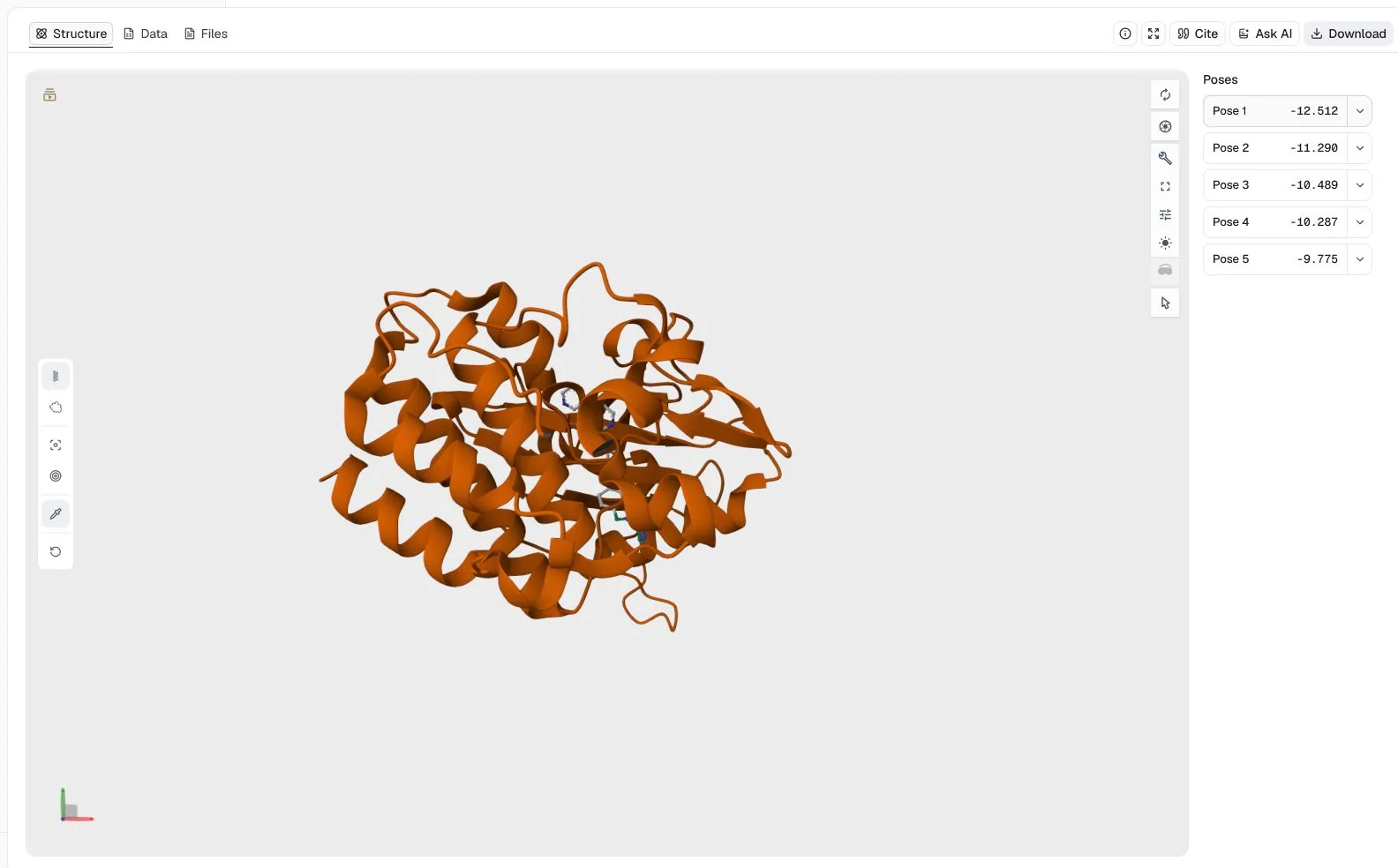
The Data view has one row per pose. The structure viewer shows the same values for the selected pose as Affinity, RMSD l.b., RMSD u.b., Inter energy, and Intra energy.
| Column | Meaning |
|---|---|
Rank | Vina's mode number. Poses are sorted by Affinity, and 1 is the best score. |
Affinity (kcal/mol) | The score used to rank poses under the selected scoring function. |
RMSD lower bound (Å) | Distance from rank 1, matching each atom to the nearest atom of the same element in the other pose. Always 0 for rank 1. |
RMSD upper bound (Å) | Distance from rank 1, matching each atom to itself. Never smaller than the lower bound. |
Intermolecular energy (kcal/mol) | Interaction energy between the ligand and the receptor. |
Intramolecular energy (kcal/mol) | Internal energy of the ligand and any flexible side chains. |
Torsional energy (kcal/mol) | The flexibility penalty, which grows with the ligand's rotatable bonds and is positive. |
Fifth native energy term (kcal/mol) | The value named in Fifth energy term: intra_best_pose_energy for Vina and Vinardo, unbound_system_energy for AutoDock4. |
For Vina and Vinardo, the columns add up. Affinity equals the intermolecular, intramolecular, and torsional energies minus the fifth term, which is the intramolecular energy of rank 1. For rank 1 the two intramolecular values cancel, so its score is the intermolecular energy plus the torsional penalty. Score only and Local only return a single row of Vina's eight named terms instead, from Total energy (kcal/mol) to Unbound system energy (kcal/mol).
No Affinity value is good on every target. The most useful reference is the co-crystallized ligand redocked into the same prepared receptor: imatinib scores −12.512 kcal/mol in its own c-Abl pocket in the examples below, and a new compound scoring well above its target's reference probably fits less well under this model. Scores become more negative as ligands grow, so a large molecule can outscore a small one without binding better.
A positive Affinity means Vina found no pose free of clashes or strain. That usually points to a box too small for the ligand, a retained component occupying the pocket, or a preparation problem. Trott and Olson fitted the Vina weights to experimental binding data, yet the remaining error is a few kcal/mol (Trott and Olson, 2010). At 25 °C every 1.36 kcal/mol is a factor of 10 in Kd, so a score converted to a dissociation constant is not a predicted Kd or IC50.
Both RMSD bounds compare a pose with rank 1 of the same run, never with an experimental structure; RMSD against a crystal pose has to be calculated separately. Both bounds under about 2 Å mean a near-copy of rank 1. A small lower bound with a much larger upper bound means the ligand fills the same space but is flipped or rotated, and an upper bound of several ångströms or more marks a different binding mode.
A run can return fewer poses than Number of poses. Poses closer than Min RMSD between poses (A) to a better pose are merged, and poses more than Energy range (kcal/mol) above the best are dropped. With the defaults of 1.0 Å and 3.0 kcal/mol, the c-Abl imatinib example returned five of nine.
Comparing scores across receptors is the most frequent error. A −9 kcal/mol pose on one target and a −7 kcal/mol pose on another say nothing about which compound binds more tightly, because the pocket, its preparation, and the box all set the scale. Scores from Vina, Vinardo, and AutoDock4 sit on different scales too, and a co-docking Affinity describes the combined ligands rather than either one.
Reading rank 1 alone is the other. When the top poses lie within about 1 kcal/mol of each other but their upper bounds differ by several ångströms, the score cannot choose between those binding modes, and the run is better read as two or three hypotheses. Contacts with known recognition residues, clashes, and agreement across repeated seeds decide which one to follow.
A protocol earns trust on the target it will be used for. When a co-crystal structure exists, redock its ligand with Automatic or Bound ligand only, which boxes the site and removes the ligand, and check that the top poses recover the deposited pose and its defining contacts. Repeat with two or three values of Random seed, and raise Exhaustiveness if the answer changes.
Before screening new compounds, dock known actives and size-matched decoys with the same settings and check that the scores separate them, as the Vina FAQ recommends. PoseBusters checks the chemistry and geometry of a shortlisted SDF pose and compares it with a reference ligand when one is supplied. GNINA docks the same site with CNN rescoring, which gives a second scoring model to compare against.
Most disappointing Vina runs trace back to setup rather than to the search. The table maps what the result shows to the usual cause.
| What the result shows | Likely cause | What to change |
|---|---|---|
| Top pose sits on the surface away from the intended site | The box is too large, or Automatic fell back to the whole protein | Check the resolved pocket and box preview, then use Select residues or Manual coordinates |
| Top pose changes between seeds | The search has not converged for this box and ligand | Raise Exhaustiveness or apply Thorough, and shrink the box if it is larger than the site |
Positive or near-zero Affinity | The box is too small, or a retained ligand, ion, or water blocks the pocket | Increase Pocket padding (A) or the box size, and review Residues to remove |
| A redocked ligand misses its crystal pose | Wrong protonation or tautomer, a removed cofactor or water, or an unsuitable receptor conformation | Fix the ligand chemistry, retain the component, or try another structure of the same target |
| Known actives score no better than decoys | The scoring function does not separate actives on this target | Try Vinardo, compare with GNINA, or use docking for pose generation only |
Vina docks small molecules into a mostly rigid receptor. It is not a method for protein-protein docking, and a binding site that needs a large backbone change is better served by a different receptor structure than by more flexible residues.
Each example is a public run that opens with its inputs, settings, and results. The scores hold only for the stated receptor preparation, box, scoring function, and seed.
This single-ligand run docks imatinib (PubChem CID 5291) into the ATP site of the c-Abl kinase domain from PDB 1IEP (2.1 Å). Automatic builds the box from the co-crystallized ligand, and Random seed is 42. Vina returned five poses within the energy window: the top pose scores −12.512 kcal/mol and the others range from −11.290 to −9.775 kcal/mol.
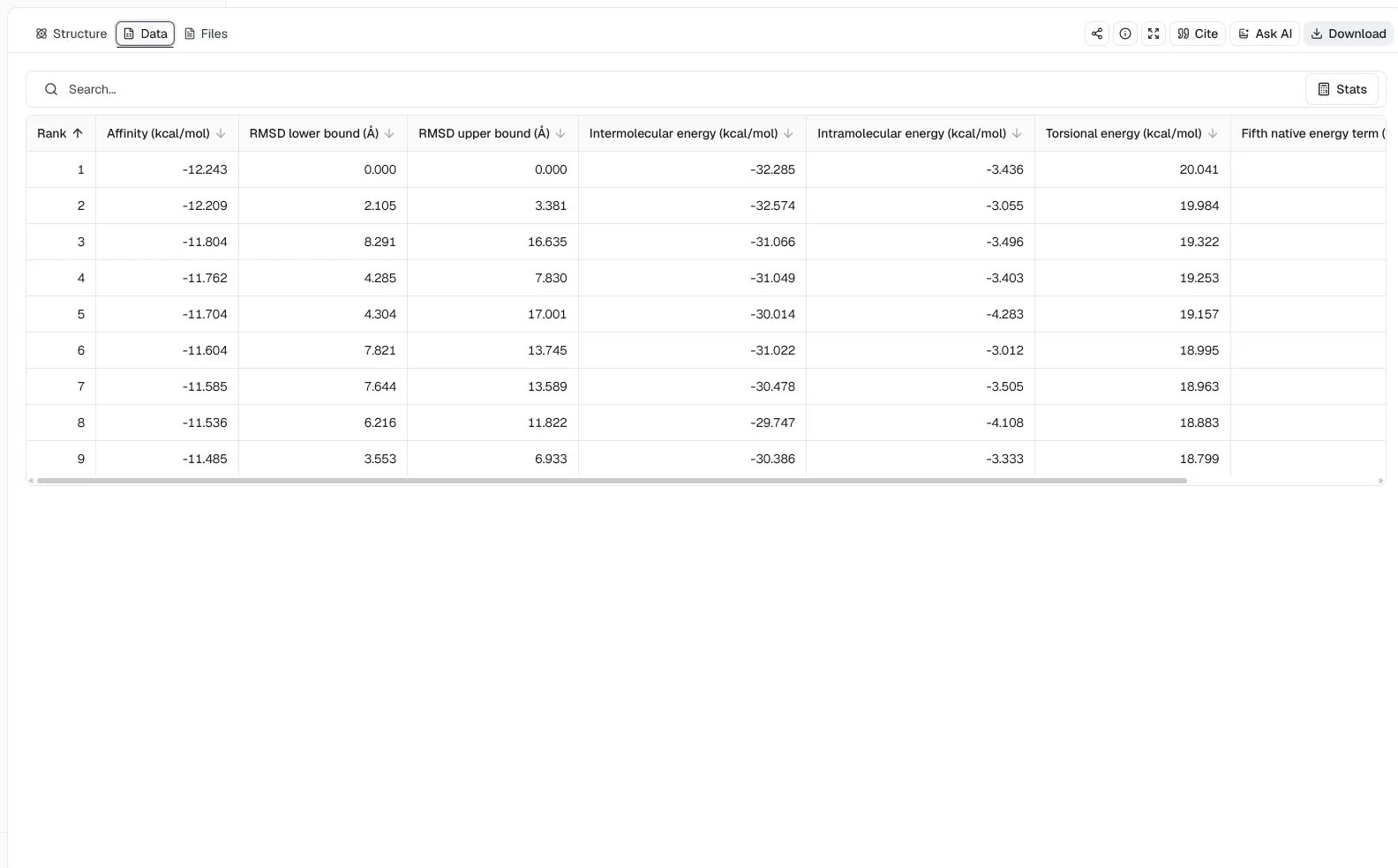
This co-docking run places methotrexate (CID 126941) and NADPH (CID 5884) together in human dihydrofolate reductase from PDB 1U72 (1.9 Å). It uses Simultaneous co-docking, Manual coordinates with center (26.624, 14.574, 5.689) Å and size (26.204, 28.087, 32.768) Å, and Random seed 42.
The top two of nine joint poses score −12.243 and −12.209 kcal/mol, yet the second has an RMSD lower bound of 2.105 Å and an RMSD upper bound of 3.381 Å. A 0.034 kcal/mol gap cannot separate two arrangements that far apart, so both deserve inspection. The joint pose also does not show that both molecules bind at once in an experimental system.
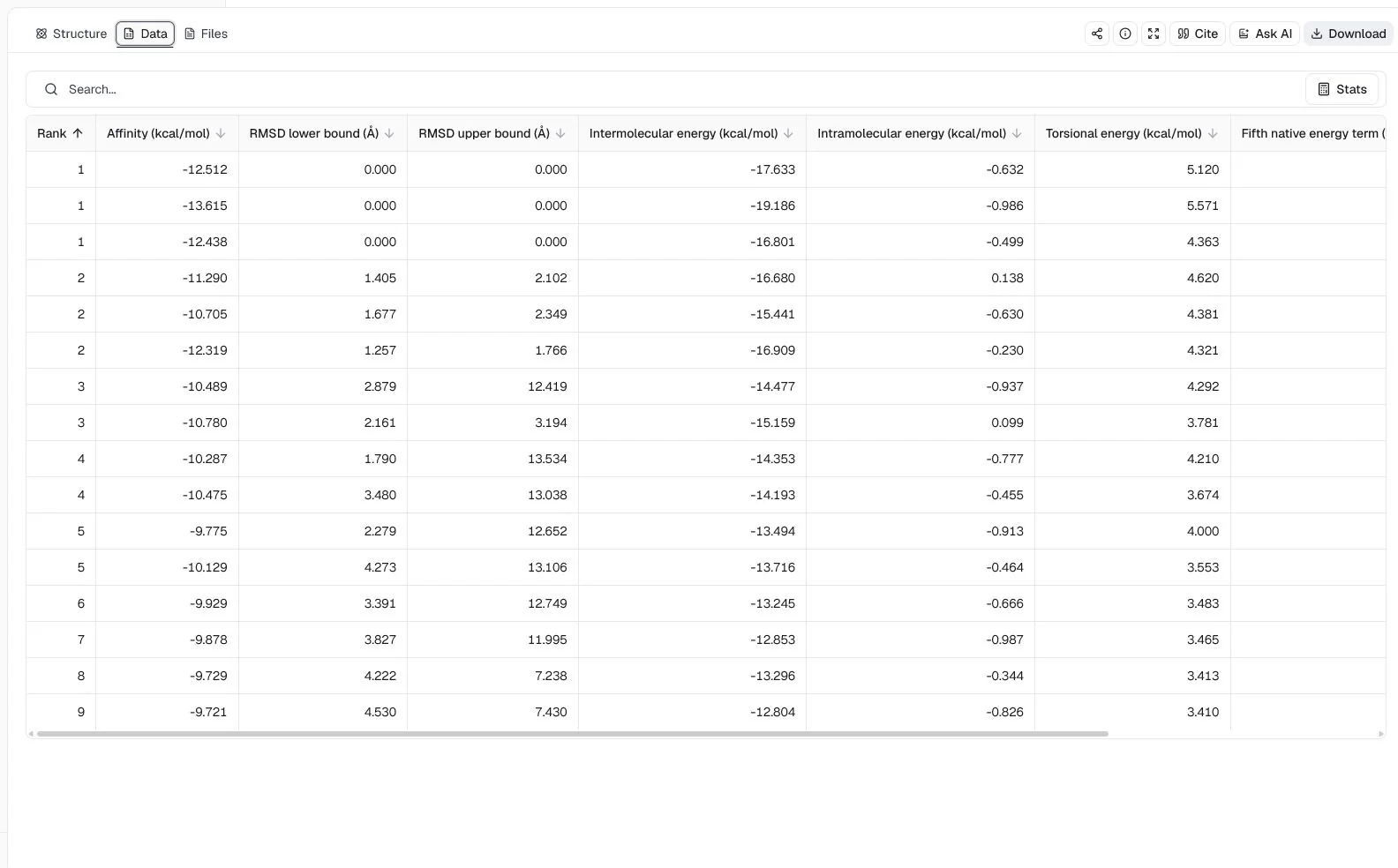
This batch run docks imatinib, nilotinib, and ponatinib independently against the same 1IEP receptor, with Manual coordinates center (15.190, 53.902, 16.917) Å, size (18.664, 26.739, 23.526) Å, and Random seed 42. It returned 16 poses across the three ligands.
The leading Affinity values are −13.615 kcal/mol for nilotinib, −12.512 kcal/mol for imatinib, and −12.438 kcal/mol for ponatinib. Holding the receptor and box constant makes that ordering a fair within-run prioritization, but it is not a measured affinity series and needs pose inspection and repeated seeds before it informs a decision.
The Affinity is Vina's estimate of binding free energy in kcal/mol, computed by an empirical scoring function whose weights Trott and Olson (2010) fitted to experimental binding data. More negative is more favorable, but only between poses and ligands docked with the same receptor, box and scoring function. The Vina score covers how it scales with ligand size and how to set a threshold for one target.
Score only scores the ligand exactly where it sits, without searching. Vina 1.2.7 prints the estimated free energy of binding as the final intermolecular energy plus the final internal energy plus the torsional free energy, minus the unbound system's energy. ProteinIQ returns those terms as the eight named rows from Total energy (kcal/mol) to Unbound system energy (kcal/mol), which is how a crystal pose or a pose from another program is rescored.
Trott and Olson (2010) reported that Vina predicted binding modes more accurately than AutoDock 4 on the AutoDock 4 training set, and that its score still carries an error of a few kcal/mol against measured affinities. Pose accuracy depends on the target and the setup, so the reliable check is to redock a co-crystallized ligand and confirm that the top poses recover it, as described in Validating a protocol.
Vina treats the receptor as rigid apart from the side chains you mark flexible, treats water implicitly unless you use the hydrated ligand workflow, and scores poses with a fast empirical function. It cannot compare scores across receptors or scoring functions, does not predict Kd or IC50, and is not a method for protein-protein docking.
AutoDock Vina itself is free software under the Apache 2.0 licence and can be installed locally; Scripps Research distributes it for the command line and Python rather than as a hosted server. ProteinIQ runs it as a hosted web server with automatic receptor and ligand preparation, starting at 15 credits per job. A free account starts with 200 credits and is topped back up to 100 credits each month, and paid plans add API access.

Dock ligands with AutoDock4 scoring, CUDA acceleration, and flexible receptor sidechains.

Geometric flow matching for generative protein-ligand docking and affinity prediction.

Dock small molecules into proteins using CNN scoring and physics-based pose optimization.
Physics-based molecular docking with CPU-optimized hierarchical algorithms

Enhanced molecular docking with custom scoring functions and fast minimization

Predict protein-ligand binding poses and confidence scores without a predefined binding site.

Predict protein-ligand binding poses while modeling ligand-induced conformational changes.

Fragment-based SE(3) equivariant diffusion docking for protein-ligand binding pose prediction

Surface-informed diffusion generative model for reliable and accurate protein-ligand complex prediction
Template-based protein-ligand pose prediction with MCS-guided conformer generation.