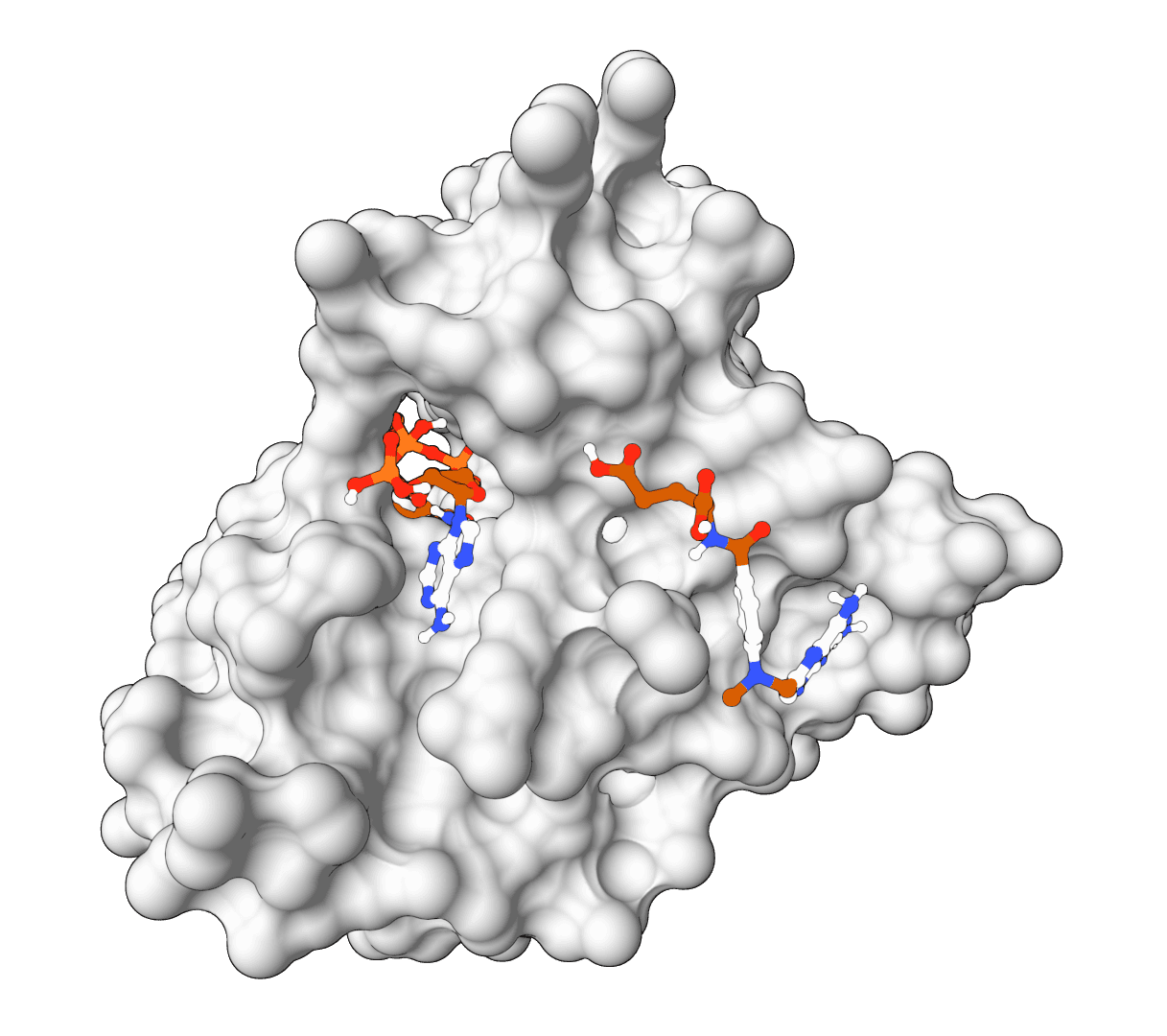
Template-based protein-ligand pose prediction with MCS-guided conformer generation. Learn more
Input
Protein target structure. TEMPL can use the PDB ID when available and can generate an embedding for uploaded PDB files.
Small-molecule ligand as SMILES or an SDF file. Large peptides, polysaccharides, and rhenium complexes are outside the source method.
What is TEMPL Pipeline?
TEMPL Pipeline predicts protein-ligand binding poses by borrowing geometry from related protein-ligand complexes instead of starting from an unconstrained docking search. It is a template-based method from Jozef Fulop, Martin Sicho, and Wim Dehaen for rapid pose prediction when similar ligands and binding sites are already represented in structural data.
The method is strongest in interpolative settings: close analogs, conserved pockets, lead-optimization series, and targets with useful protein-ligand templates. It is less suitable for novel scaffolds, allosteric pockets with little template coverage, and cases where binding depends on large receptor rearrangements.
How to use TEMPL Pipeline online
A TEMPL Pipeline online run accepts a protein structure as PDB, ENT, or RCSB PDB ID and one organic small-molecule ligand as SMILES, PubChem, drawing, or SDF. ProteinIQ searches for related protein-ligand templates, generates constrained ligand poses, and returns ranked SDF files with shape, color, and combo Tanimoto scores.
Inputs
| Input | Accepted values | Notes |
|---|---|---|
Protein | .pdb or .ent file, Files library structure, or RCSB PDB ID | Protein atoms are required. Structures with nucleic acid atoms may need review before interpretation. |
Ligand | SMILES text, PubChem lookup, structure drawing, or .sdf file | One covalent organic small molecule is expected. Disconnected salts, query atoms, metals, large peptides, and very complex carbohydrates are rejected or fail validation. |
Job name | Optional text label | Stored with the run for later job history lookup. |
For structures with missing atoms, alternate locations, or unusual residues, PDB Fixer can be used before running pose prediction.
Settings
| Setting | Default | Description |
|---|---|---|
Number of templates | 100 | Number of candidate protein-ligand templates to consider. Larger values broaden the search but can introduce less relevant templates. |
Similarity threshold | Blank | Optional cutoff from 0.0 to 1.0. Leaving it blank keeps top-template selection by rank. |
Number of conformers | 200 | Number of ligand conformers generated before alignment and scoring. More conformers can help flexible ligands but increases runtime. |
Ranking metric | Combo Tanimoto | Metric used to select the ranked conformer. Combo Tanimoto averages shape and pharmacophore agreement; Shape Tanimoto and Color Tanimoto can be used when one signal should dominate. |
Skip shape realignment | Off | Uses the generated conformer without the final shape realignment step. This is mainly useful for diagnostic comparisons. |
Enable force-field optimization | Off | Applies force-field optimization after pose generation. It may improve local geometry but can also move a pose away from its template constraint. |
Unconstrained conformer generation | Off | Disables MCS-constrained conformer generation. Use only when the shared scaffold constraint is undesirable. |
Random seed | Blank | Optional non-negative integer for reproducible conformer generation and scoring behavior. |
Results
| Output | Description |
|---|---|
Viewer | 3D view of the submitted protein with ligand poses overlaid for inspection. |
Data | Pose summary table with rank, metric, shape score, color score, combo score, template PDB ID, and file name. |
Files | Downloadable SDF, JSON, and reference structure files. |
The main result files are:
| File | Contents |
|---|---|
*_top3_poses.sdf | One top ligand pose for each scoring metric: shape, color, and combo. |
*_all_poses.sdf | All ranked ligand poses generated during the run. |
*_template.sdf | The selected template ligand used for MCS-guided pose generation. |
*_pipeline_results.json | Template, MCS, target, and run metadata. |
*_reference.pdb | Submitted protein structure included so the viewer can place ligand-only SDF poses in the target context. |
File names may use the selected template PDB ID rather than the submitted target ID. That is expected for TEMPL outputs because the winning template determines the pose file prefix.
How TEMPL Pipeline works
TEMPL is a data-driven baseline for protein-ligand pose prediction. It searches a library of known protein-ligand complexes, identifies suitable templates, transfers ligand geometry into the target frame, and ranks generated poses by 3D similarity.
Template search
The pipeline uses protein embeddings to find structurally related protein-ligand templates. The released TEMPL dataset includes precomputed ESM-2 protein embeddings and processed ligand structures from PDBbind-scale complexes, which makes the search fast enough for interactive use.
Template quality matters more than template count. A close template from the same protein family with a related ligand can be more useful than many weakly related hits.
MCS-guided pose generation
After a template ligand is selected, TEMPL finds the maximal common substructure (MCS) between the submitted ligand and the template ligand. The shared atoms act as geometric anchors, and RDKit ETKDG conformer generation builds candidate 3D ligand conformations around that constraint.
This is why TEMPL is most useful for analog series. If the submitted ligand and template ligand share a clear scaffold, the MCS constraint gives the generated pose a strong geometric prior. If the ligand is a new chemotype with little shared substructure, the constraint becomes weaker or may fall back to less informative alignment.
Shape and pharmacophore scoring
Generated conformers are aligned to the template ligand and scored with RDKit shape alignment:
- Shape score: Agreement between the 3D molecular volumes.
- Color score: Pharmacophore-like feature agreement, such as donor, acceptor, aromatic, and hydrophobic feature overlap.
- Combo score: Average of the shape and color scores.
The top poses are not binding free-energy estimates. They are similarity-ranked hypotheses for where the ligand could sit if the selected template captures the relevant binding mode.
Interpreting results
Higher Tanimoto scores indicate closer agreement with the selected template. Scores near 1.0 suggest strong shape or feature overlap, while values closer to 0 indicate weak agreement. The useful threshold depends on ligand size, scaffold similarity, and whether the template ligand binds the same pocket.
| Result field | Interpretation |
|---|---|
Rank | Order in the result table for the reported top poses. |
Metric | Scoring criterion used for that top pose: shape, color, or combo. |
Shape score | 3D volume overlap with the selected template ligand. Higher is better. |
Color score | Pharmacophore feature overlap with the selected template ligand. Higher is better. |
Combo score | Mean of shape and color scores. Useful as the default balanced ranking. |
Template PDB | PDB ID of the protein-ligand complex that supplied the template geometry. |
File | SDF file containing the corresponding ligand pose. |
Visual inspection is essential. A high-scoring TEMPL pose should still be checked for steric clashes, impossible protonation assumptions, and whether key interactions are plausible in the submitted protein structure. The *_pipeline_results.json file is useful when documenting which template and MCS mapping drove a result.
When to use TEMPL Pipeline vs docking tools
TEMPL is a good first choice when the ligand resembles known binders and the protein has nearby structural templates. It can be faster and more stable than unconstrained docking for analog pose transfer because it starts from experimental geometry.
| Method | Best fit | Main output |
|---|---|---|
| TEMPL Pipeline | Template-rich analog series and fast pose transfer | Similarity-ranked ligand pose SDFs |
| AutoDock Vina | General small-molecule docking with an interpretable empirical score | Binding poses with kcal/mol docking scores |
| GNINA | Docking plus CNN pose confidence and affinity-style rescoring | CNN-ranked poses and Vina-style scores |
| DiffDock-L | Blind docking or cases without a reliable known pocket template | Diffusion-generated poses with confidence scores |
| PandaDock | Physics-based protein-ligand docking with affinity-style ranking | Docked poses and binding-energy-oriented scores |
For a lead series around a known chemotype, TEMPL can quickly test whether new analogs preserve a crystallographic binding mode. For chemically distant ligands or targets without useful templates, AutoDock Vina, GNINA, or DiffDock-L usually provide a better starting point.
Related tools
AutoDock-GPU
GPU-accelerated molecular docking using the AutoDock4 force field. Up to 56x faster than serial AutoDock via CUDA parallelization of the Lamarckian Genetic Algorithm.
AutoDock Vina
AutoDock Vina predicts protein-ligand binding modes with Vina, Vinardo, or AutoDock4 scoring and returns ranked poses with energy estimates.
DiffDock-L
DiffDock-L is a state-of-the-art molecular docking tool that uses diffusion models to predict how small molecule ligands bind to protein targets. It generates multiple binding poses with confidence scores.
DynamicBind
DynamicBind is an AI-powered protein-ligand binding prediction tool that recovers ligand-induced conformational changes from unbound protein structures. It predicts both ligand binding poses and protein conformational changes.
FlowDock
FlowDock predicts protein-ligand complex structures and binding-affinity scores using geometric flow matching.
GNINA
GNINA is a molecular docking tool that combines traditional physics-based docking with deep learning CNN scoring for protein-small-molecule complexes. It provides accurate binding predictions with confidence scores, optimized for high-throughput virtual screening.
PandaDock
Open-source molecular docking platform using physics-based scoring functions. CPU-optimized algorithms achieve sub-angstrom accuracy (0.014A RMSD) without GPU requirements.
SigmaDock
SigmaDock is a fragment-based molecular docking tool using SE(3) equivariant diffusion models to predict how small molecule ligands bind to protein targets. Presented at ICLR 2026, it generates multiple binding poses with Vinardo scoring.
SMINA
SMINA is a fork of AutoDock Vina with enhanced scoring functions, custom scoring support, and 10-20x faster minimization. Ideal for scoring function development, pose refinement, and high-performance docking workflows.
SurfDock
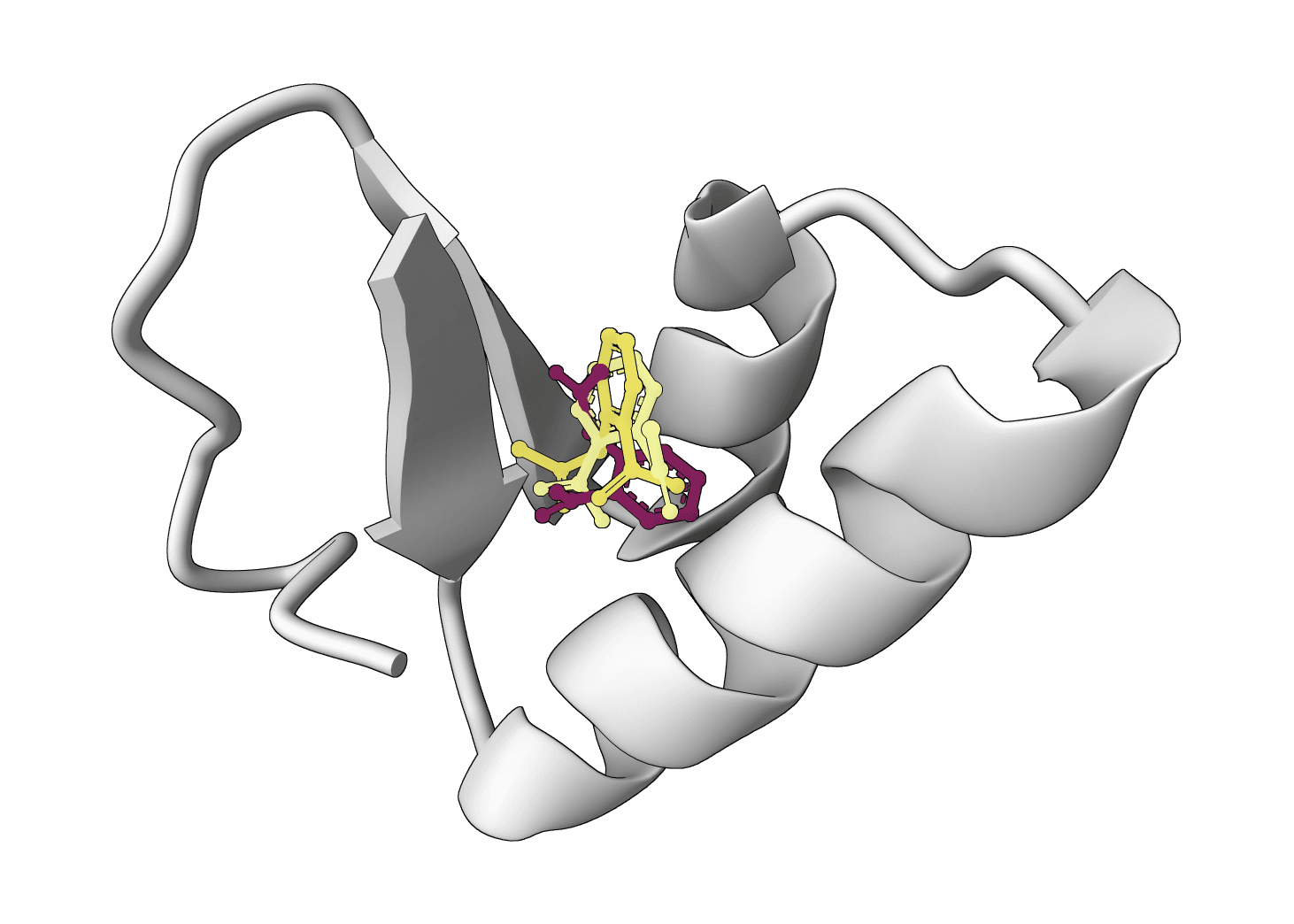
SurfDock is a surface-informed diffusion generative model for protein-ligand docking, published in Nature Methods 2024. It leverages protein surface geometry to guide a diffusion process for reliable and accurate protein-ligand complex prediction.