New docking tool: AutoDock Vina
 Dr. Matic Broz3 min readNovember 7, 2025
We've integrated AutoDock Vina, the gold standard for physics-based molecular docking that has defined the field for over a decade. With 17,000+ citations since its 2010 publication, Vina remains the most widely used docking tool in computational drug discovery.
Molecular docking predicts how small molecules bind to protein targets, which is critical for drug discovery, lead optimization, and structure-based design. AutoDock Vina utilizes classical force fields and efficient search algorithms to predict binding modes and estimate binding affinity in kcal/mol, providing thermodynamically meaningful scores that are validated across thousands of protein-ligand systems.
Running Vina traditionally requires installing dependencies, configuring environments, and managing compute resources. ProteinIQ makes it accessible to everyone. You upload a protein structure and ligand, configure parameters, and get ranked binding poses with affinity predictions in under a minute.
Fast, interpretable, physics-based docking
Our implementation runs on optimized CPU infrastructure that delivers results in less than a minute. AutoDock Vina's multithreaded architecture parallelizes independent docking runs efficiently, providing fast screening without GPU requirements.
The tool accepts:
-
Protein structures as PDB files or RCSB PDB IDs
-
Ligands as SMILES strings or SDF files
-
Configurable exhaustiveness (thoroughness of search)
-
Auto or manual search space definition
-
Up to 20 binding poses per job Each prediction includes:
-
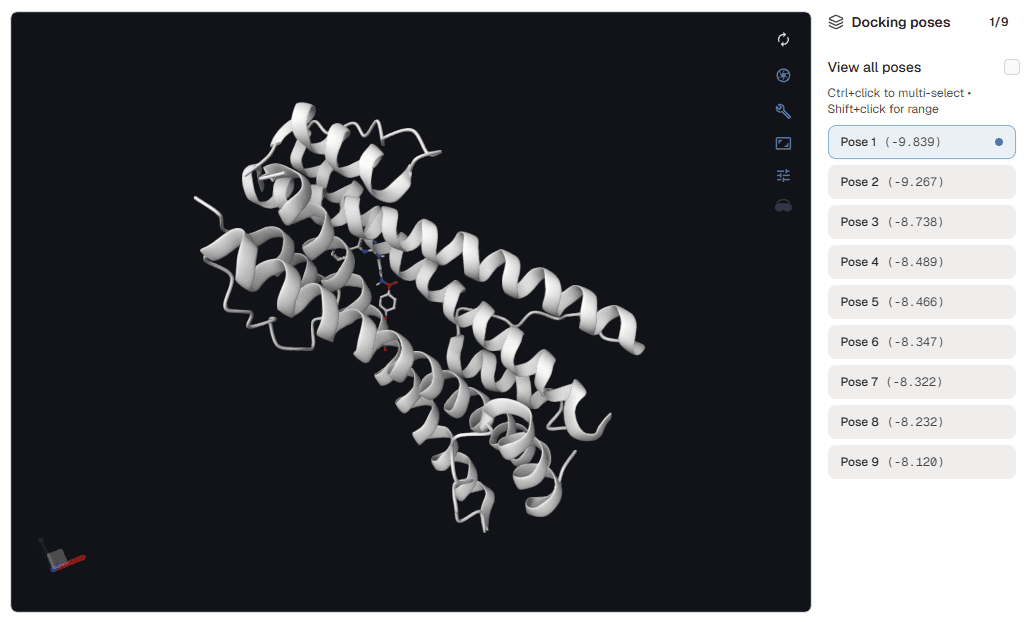
Ranked binding modes with affinity scores (kcal/mol)
-
RMSD metrics showing pose similarity
-
Interactive 3D visualization in the browser
-
Downloadable PDBQT files for further analysis
Why AutoDock Vina
Vina's physics-based approach provides interpretable results grounded in established force fields. The binding affinity output (kcal/mol) directly correlates with experimental binding constants, making results comparable across studies and enabling quantitative screening workflows.
Unlike AI-based methods that provide confidence scores, Vina's thermodynamic estimates have clear physical meaning:
-
-6 to -8 kcal/mol: Moderate binding (low μM range)
-
-8 to -10 kcal/mol: Strong binding (nM range)
-
< -10 kcal/mol: Very strong binding (sub-nM range) The algorithm excels at:
-
High-throughput virtual screening
-
Lead optimization campaigns
-
Known binding site analysis
-
Educational workflows requiring interpretable results
Getting started
AutoDock Vina is available now on ProteinIQ. Navigate to Tools → AutoDock Vina to start docking. Free-tier users can run two jobs to explore the tool.
For typical usage:
- Upload or fetch your protein (PDB file or PDB ID)
- Provide your ligand (SMILES or SDF)
- Configure exhaustiveness and search space (defaults work well)
- Submit and review results in ~1-2 minutes Best practices:
- Use exhaustiveness 8 for preliminary screening
- Increase to 16-32 for publication-quality results
- Use auto search mode when the binding site is unknown
- Use manual coordinates for focused search at known sites
- Keep search boxes under 30×30×30 Å for optimal performance The scoring function is validated across diverse protein families. For best results, prepare your protein structure (fix missing residues, proper protonation) using tools like PDB Fixer.
What this enables
Fast, physics-based docking means:
- Rapid virtual screening: Test compound libraries without cluster access
- Lead optimization: Iterate binding hypotheses quickly with interpretable scores
- Educational workflows: Students learn docking without installation barriers
- Complementary validation: Cross-validate AI-based predictions with established methods
Cost and availability
Using AutoDock Vina through ProteinIQ costs 25 credits per docking job—5× faster and more accessible than traditional HPC workflows.
Further information
AutoDock Vina was developed by the Olson Lab at Scripps Research and is based on research published in the Journal of Computational Chemistry (2010). The algorithm uses an empirical scoring function and iterated local search optimizer with BFGS local minimization. We've integrated version 1.2.5 with optimized infrastructure for accessible, fast execution.
For technical details, see the AutoDock Vina tool page. For questions about infrastructure, pricing, or custom deployments, contact our team.